
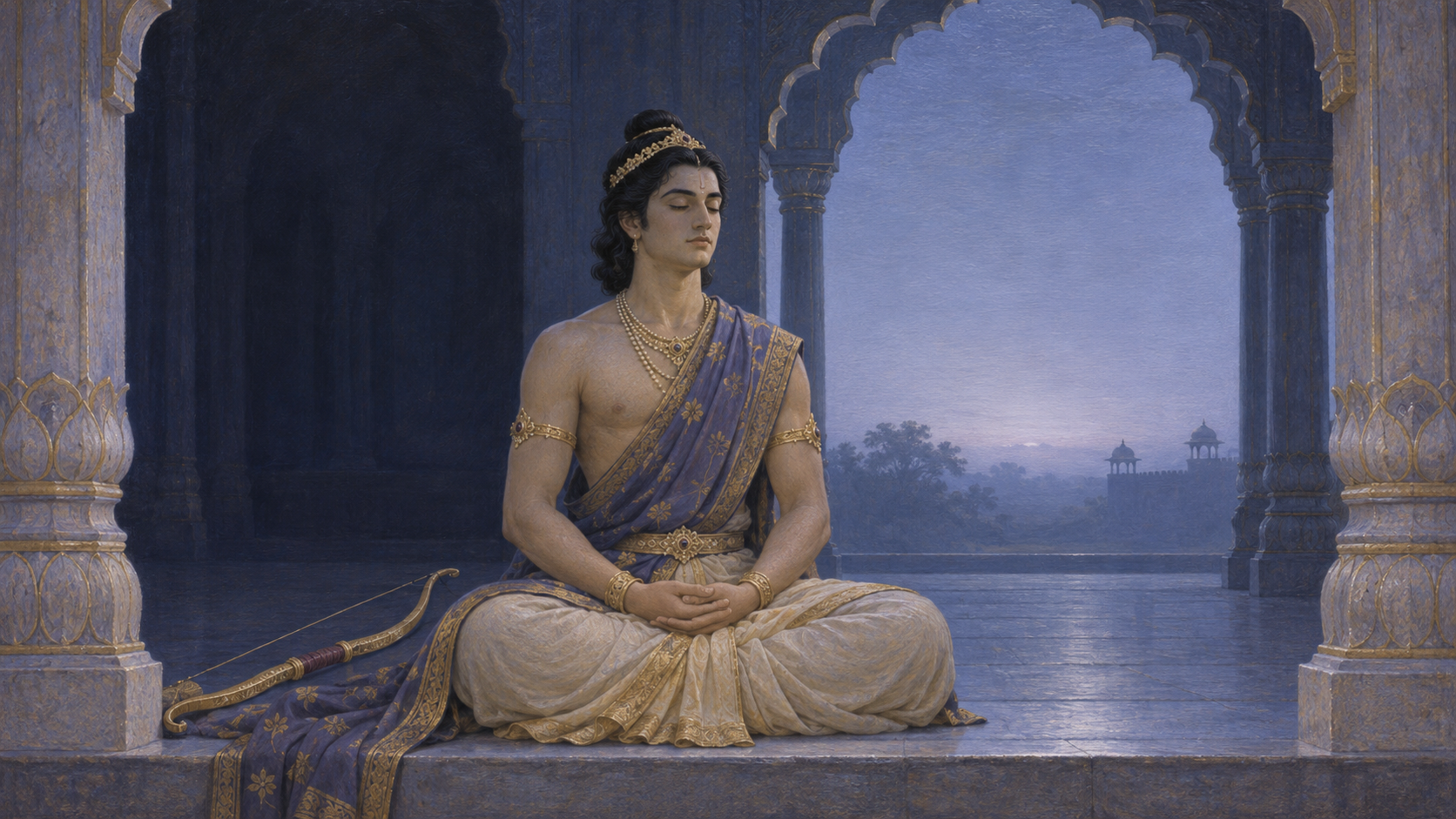
You may have encountered the claim that Shatrughna represents Sushupti, the state of deep sleep. If that sounds intriguing but obscure, the useful question is not whether every Ramayana character can be fitted into a philosophical chart. It is what this association helps you notice in your own experience: when your roles, plans and inner images disappear in sleep, what has actually disappeared?
The answer requires care. Deep sleep can loosen your assumption that the waking personality is the whole Self, but sleep is not automatically liberation. Shatrughna becomes a valuable contemplative figure precisely because silence is easy to mistake for emptiness, and inward depth is easy to overlook when it does not advertise itself.
Read Shatrughna as a contemplative key, not a literal code
Vedantic philosophy describes four modes of consciousness: Jagrat, Swapna, Sushupti and Turiya. The first three are familiar conditions through which experience changes. Turiya is the underlying witness and therefore is not merely another passing interval beside the other three.
| Mode | What is available | Question for contemplation |
|---|---|---|
| Jagrat | The waking world, body, relationships, duties and public identity | Am I identical to the roles that command my attention? |
| Swapna | A dream world presented through mental forms | How does an experienced world acquire its temporary authority? |
| Sushupti | Differentiated objects, roles and narratives are unavailable | What can be said about the Self when familiar contents are absent? |
| Turiya | The witness underlying waking, dream and deep sleep | What does not arrive and depart with a changing state? |
Within this contemplative use of the Ramayana, Shatrughna is aligned with Sushupti. The alignment does not turn him into a sleep stage or reduce a sacred narrative to a diagram. Character and state illuminate each other: Shatrughna’s quiet presence gives form to the unadvertised depth associated with deep sleep, while Sushupti helps you see that a lack of outward display need not mean a lack of significance.
Use the association as a mirror. Ask what Shatrughna’s restraint reveals about consciousness when its usual performances fall silent. Do not force every episode into a rigid one-to-one correspondence. A sound symbol clarifies experience; it does not abolish the richness of the person or narrative carrying it.
Sushupti removes familiar content, but it is not Turiya

The philosophical value of deep sleep lies in subtraction. During waking, you ordinarily introduce yourself through a name, history, body, occupation, family position, preferences and unfinished concerns. Dreams replace that arrangement with another field of experience. In deep sleep, neither the waking arrangement nor the dream arrangement is available in the same way.
This gives you a precise point of inquiry. Much of what you call yourself is present only under certain conditions. Your professional identity does not conduct meetings in deep sleep. A social disagreement does not continue as a consciously managed argument. Even the inner narrator that keeps explaining you to yourself is not available as it is in waking life. Those identities may be valid within Jagrat, but their temporary absence challenges the claim that any one of them is the whole of you.
After waking, you might say that you slept deeply or that you remember no dream. Treat that report carefully. It is not a recording made by a waking observer stationed inside deep sleep. It marks a transition and opens a question: is the absence of remembered objects the same as the absence of the Self?
This is where Sushupti must be distinguished from Turiya. Deep sleep begins and ends. You enter it and return to waking, where old habits, duties and confusions can reappear. Turiya, by contrast, names the witness underlying waking, dreaming and deep sleep. If it were merely another period of blankness, it too would be a temporary condition rather than the ground of the changing conditions.
For that reason, the phrase deep sleep consciousness should not be interpreted as ordinary object-awareness continuing in darkness. If you are watching a black field, following a sensation or thinking about silence, some content is still being presented. Sushupti points to the unavailability of differentiated experience; Turiya points beyond the changing availability or unavailability of such content.
This distinction also prevents a category error. The Vedantic map is a contemplative account of experience and the Self, not a neurological classification of sleep. It should not be presented as laboratory evidence about the brain. Its practical purpose is to help you examine identification, continuity and awareness with greater precision.
Shatrughna changes how you judge silence in daily life

Waking culture often treats visibility as evidence of importance. The person who speaks most appears to lead. The thought that repeats most loudly appears urgent. The identity that receives the most public recognition begins to feel like the real self. The Shatrughna-Sushupti association interrupts that habit.
Its lesson is not that speaking, thinking or acting is inferior. It is that depth does not always announce itself through performance. A pause can contain an unexpressed reaction until you are able to answer responsibly. Listening can reveal what self-display would have concealed. Quiet preparation can support an action whose value does not depend on applause.
You can test whether such quietness is Dharmic by looking at what follows it. Fruitful silence returns as clearer perception, more exact speech or responsible action. Avoidant silence postpones necessary words, hides from a duty or leaves another person to carry what you should address. Shatrughna’s symbolism is therefore not permission to disappear from life. It asks whether you can act without making the performance of identity your hidden objective.
Before entering a difficult conversation, ask what the situation actually requires: a contribution, a correction, a boundary, a question or simply attentive listening. Then ask a second question: are you about to serve that need, or are you trying to secure a particular image of yourself? That small distinction carries the teaching of Sushupti into Jagrat, where Dharma must be practised.
Use the transition through sleep as a daily inquiry

You do not need to manufacture a special experience or interfere with natural sleep. The ordinary movement from waking to sleep and back to waking already gives you material for contemplation.
- Name the waking identities currently demanding attention. At bedtime, notice the roles, conflicts and plans that feel most like me. Do not solve them. Simply identify them as contents of the waking condition.
- Separate validity from ultimacy. A responsibility can be real and important without being the whole Self. Tell yourself plainly that the duty belongs to waking life and can be resumed when waking returns.
- Notice the reconstruction of the waking person. When you wake naturally, pause before reaching for a screen if circumstances permit. Observe what returns: bodily sensation, location, name, relationships, plans or unfinished concerns.
- Question the transition. Ask what was absent, what has returned and whether the absence of remembered content proves the absence of being. Leave the question open rather than forcing a verbal answer.
- Apply the insight to one reaction. When a role is challenged later in the day, recognise the reaction as content appearing in waking awareness. Give yourself enough space to choose a response consistent with Dharma instead of defending the role automatically.
Keep several guardrails around the practice:
- Do not chase mental blankness. Inattention is not the same as knowledge of the Self.
- Do not claim that a failure to remember dreams proves a metaphysical conclusion. Let it generate inquiry, not certainty.
- Do not turn a Vedantic symbol into a claim about sleep physiology.
- Do not glorify passivity. The worth of inward quiet is tested by the quality of your waking conduct.
If the contemplation makes you more alert at bedtime, move it to a quiet period during the day rather than sacrificing sleep. Persistent difficulty sleeping is a health matter, not evidence of spiritual failure, and this inquiry is not a substitute for appropriate professional care.
Key takeaways
- The link between Shatrughna and Sushupti is best used as a contemplative symbol, not a literal equation that exhausts either the character or the Ramayana.
- Sushupti reveals the temporary absence of waking and dream contents, including the roles through which you usually define yourself.
- Deep sleep is not Turiya. Sushupti comes and goes; Turiya is the witness underlying waking, dreaming and deep sleep.
- The absence of remembered experience invites inquiry, but it is not by itself proof of liberation or a complete metaphysical argument.
- Shatrughna’s quietness becomes practical when it produces attentive listening, responsible action and less need to perform an identity.
The next time you wake, do not search for an exotic memory of deep sleep. Watch the ordinary sense of me return with its name, place and obligations. That return is enough to begin. Let Shatrughna remind you that quietness need not be insignificance, and then test the insight in the next waking response you choose with care.
References

Leave a Reply
You must be logged in to post a comment.