
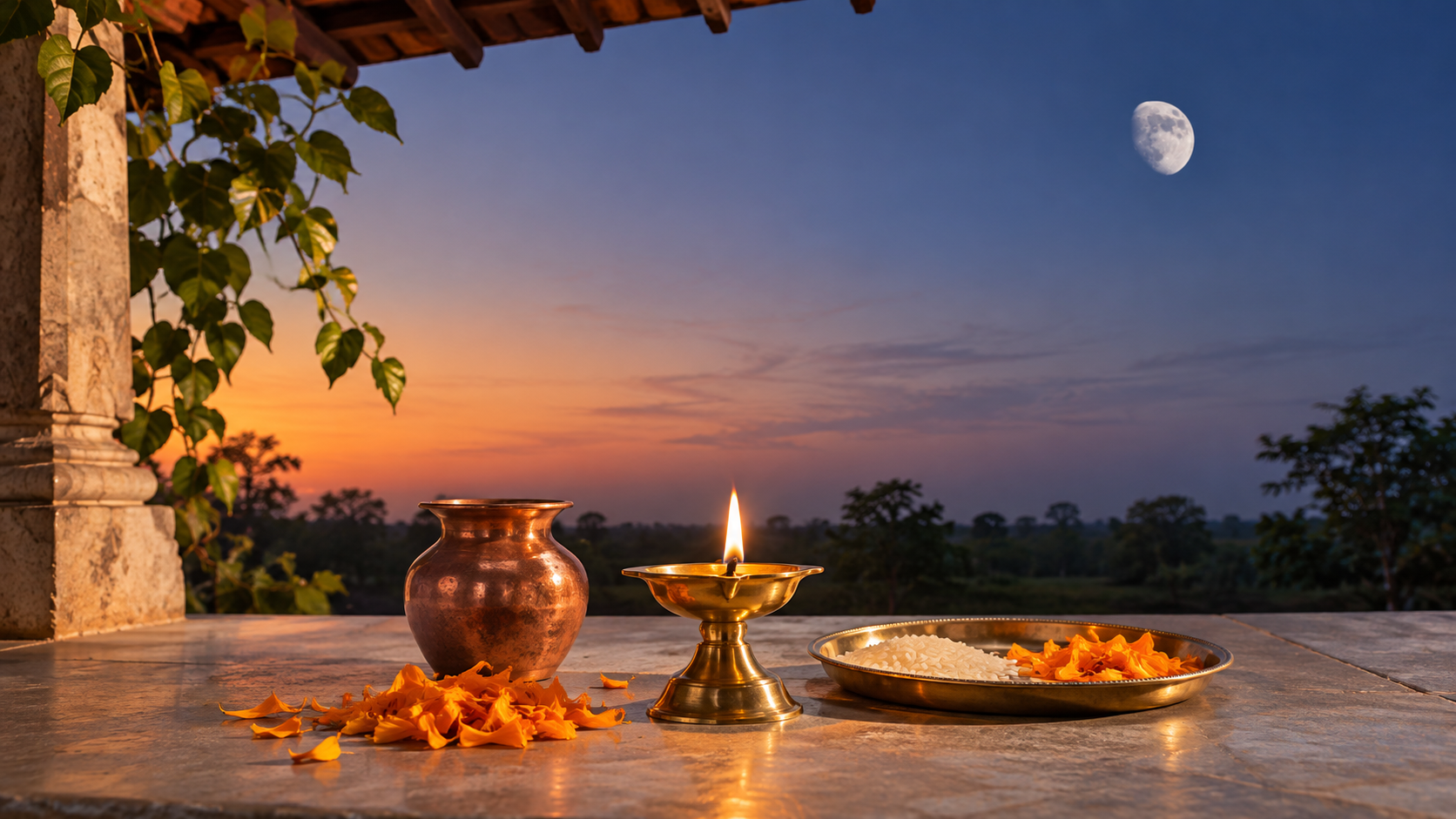
If you are deciding whether a puja, vrata, or family observance on Wednesday, November 25, 2026 falls under Pratipada or Dwitiya, the answer changes that evening. For most regions covered by the calendar, Krishna Paksha Pratipada lasts until 7:02 PM; Krishna Paksha Dwitiya follows.
Use that boundary for a quick daily check, but do not mistake a tithi change for a complete muhurta. If the timing affects a tithi-bound observance, confirm the local clock convention and the rule followed by your family, temple, or sampradaya before committing to a time.
November 25 Panchang at a glance
| Day | Period | Tithi |
|---|---|---|
| Wednesday, November 25, 2026 | Until 7:02 PM | Krishna Paksha Pratipada |
| Wednesday, November 25, 2026 | After 7:02 PM | Krishna Paksha Dwitiya |
The civil date remains November 25 across both rows. What changes is the lunar-day identity. Krishna Paksha is the waning, or dark, half of the lunar month. Pratipada is its first tithi, and Dwitiya is its second.
This distinction prevents a common calendar mistake. A weekday follows the civil date, but a tithi does not have to wait for midnight before changing. November 25 is Wednesday throughout, while its prevailing tithi changes at 7:02 PM.
What the 7:02 PM tithi change means
The 7:02 PM transition is a lunar-calendar boundary, not an all-purpose ritual deadline. If your activity is meant to follow the tithi prevailing at the time it is performed, the practical distinction is straightforward: use Pratipada before the boundary and Dwitiya after it.
A vrata or festival may follow a more specific rule. Its observance can depend on the tithi at sunrise or on the tithi prevailing during a prescribed worship period. The evening transition alone therefore cannot tell you which civil date should carry a named festival or whether a ritual must end before 7:02 PM. For that decision, follow the vrata procedure or temple tradition concerned.
If a ceremony begins before 7:02 PM and continues after it, do not invent a cutoff rule from the calendar entry. Confirm whether the practice uses the starting tithi, the tithi during its principal rite, or another established convention. This is precisely where guidance from your family purohit or temple is more useful than a date-only calendar.
You also should not infer Nakshatra, Rashi, or an auspicious time from the tithi alone. Those are separate Panchang considerations. Knowing that Pratipada changes to Dwitiya answers the lunar-date question; it does not, by itself, certify a time for marriage, griha pravesh, a major purchase, or another muhurta-sensitive undertaking.
How to plan your puja or vrata correctly
- Identify the decision you are making. A flexible daily prayer needs less calendrical precision than a vrata, temple service, or ceremony prescribed for a particular tithi.
- Note your intended start time. Under the stated timing, an observance before 7:02 PM falls within Krishna Paksha Pratipada; one after the transition falls within Krishna Paksha Dwitiya.
- Check the observance rule. Determine whether it uses the tithi prevailing at sunrise, at the time of worship, or during another prescribed period. Do not assume every Hindu observance uses the same rule.
- Verify the local clock time. A displayed time belongs to the time convention used by that Panchang. If you live in another time zone, or if exact timing matters, consult a Panchang calculated or displayed for your location.
- Check muhurta separately. If you need a good time rather than only the day’s tithi, use a complete local Panchang that supplies the additional factors required for that decision.
For an ordinary home prayer that is not bound to a formal vrata rule, there is no need to manufacture anxiety around the transition. Choose a practical time and keep the tithi change in view only if your sankalpa or family practice requires it. For a formal observance, confirm the convention before preparing offerings or announcing a schedule to others.
Key takeaways
- November 25, 2026 is a Wednesday.
- Krishna Paksha Pratipada continues until 7:02 PM for most regions covered by the stated calendar.
- Krishna Paksha Dwitiya begins after 7:02 PM.
- The tithi changes during the civil day; the weekday does not.
- The 7:02 PM boundary is not automatically a muhurta or a universal ritual deadline.
- For a location-sensitive or rule-bound observance, verify the local Panchang and the method followed by your tradition.
If all you need is the day’s lunar date, mark the transition at 7:02 PM. If your decision affects a vrata, sankalpa, temple rite, or major ceremony, pause before fixing the hour and confirm both the local timing and the observance rule.

References

Leave a Reply
You must be logged in to post a comment.