
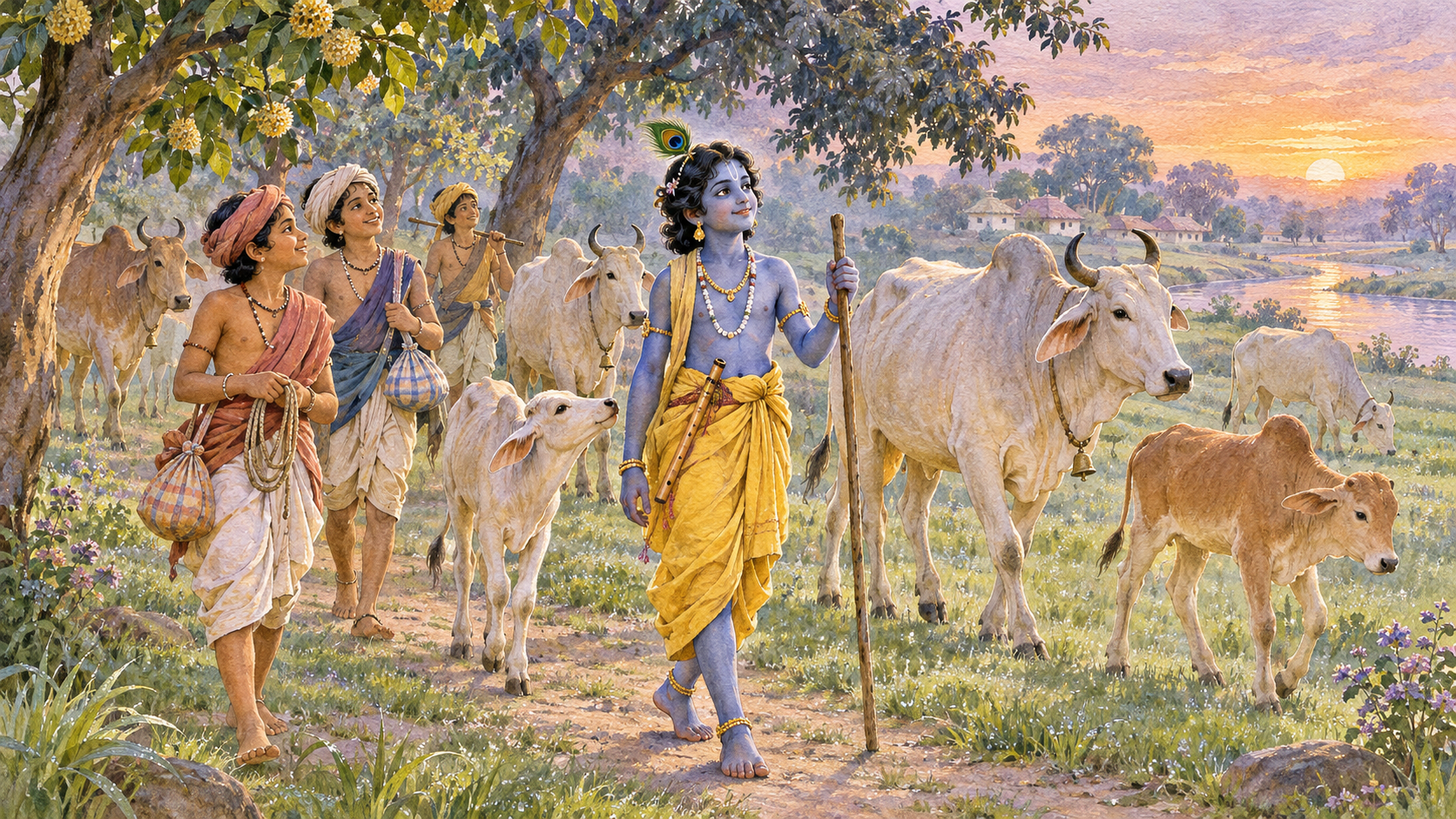
If Gopastami has appeared on your calendar and you are unsure what to do beyond visiting a temple, begin with the moment the festival remembers: Krishna is entrusted with the care of cows. That change turns a beloved image of Vrindavana into a practical lesson about affection, responsibility and protection.
You do not need an elaborate ceremony to enter that lesson. You need to understand the lila, honour the cow without causing distress, and choose one act of seva that survives after the festival day.
Gopastami begins with a change in responsibility
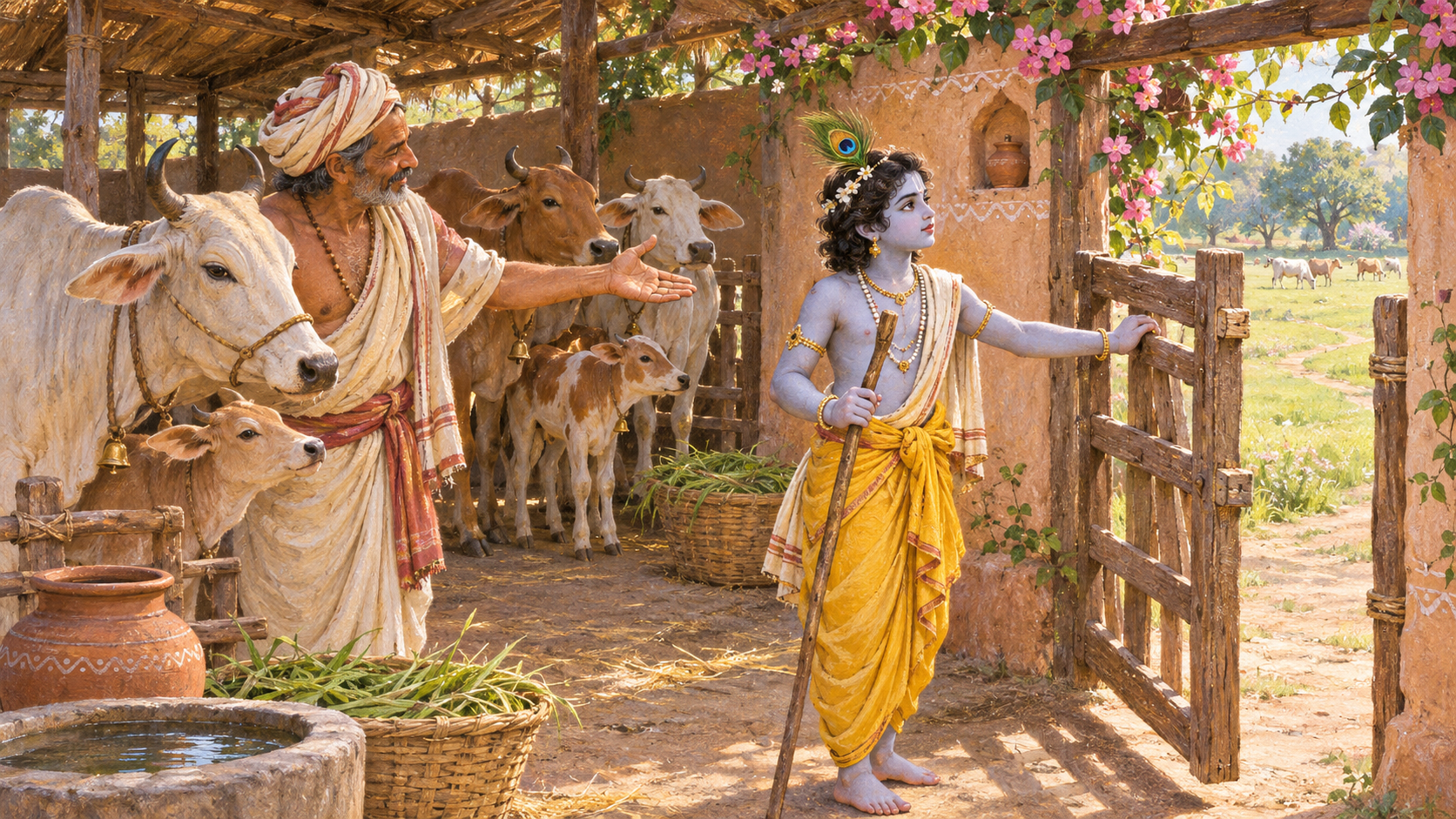
Krishna’s early cowherd life includes a meaningful progression. As a younger child, he tends calves. Later, he and Balarama become old enough to take the cows to pasture. Gopastami commonly commemorates this transition from the smaller duty to the fuller one.
Srimad Bhagavatam 10.15.1 places Krishna and Balarama at this threshold. They enter the boyhood stage known as pauganda, are accepted as cowherds, graze the cows with their friends and sanctify Vrindavana with their footsteps. The verse does not separate divine play from ordinary care. Walking, friendship, pasture and responsibility all belong within the sacred scene.
This is the first thing to notice when you observe Gopastami: Krishna’s growing freedom comes with growing responsibility. He does not merely wander into the forest for amusement. He goes with living beings under his care, alongside companions who share the work.
Gopastami is commonly kept on the eighth lunar day of the bright fortnight of Kartika. Its civil-calendar date can therefore change from year to year, and the details of the observance can vary among regions, temples and sampradayas. Confirm the date with the panchang or temple calendar you actually follow rather than transferring last year’s date to a new calendar.
The name itself directs attention to both the cow and the cowherd. A gopa is not simply someone photographed beside a cow. The role implies sustained guardianship. That distinction matters because Gopastami can otherwise become a day of decoration without protection, sentiment without service, or reverence without any examination of how cows are treated during the rest of the year.
Three ways to read Krishna’s cowherd pastimes
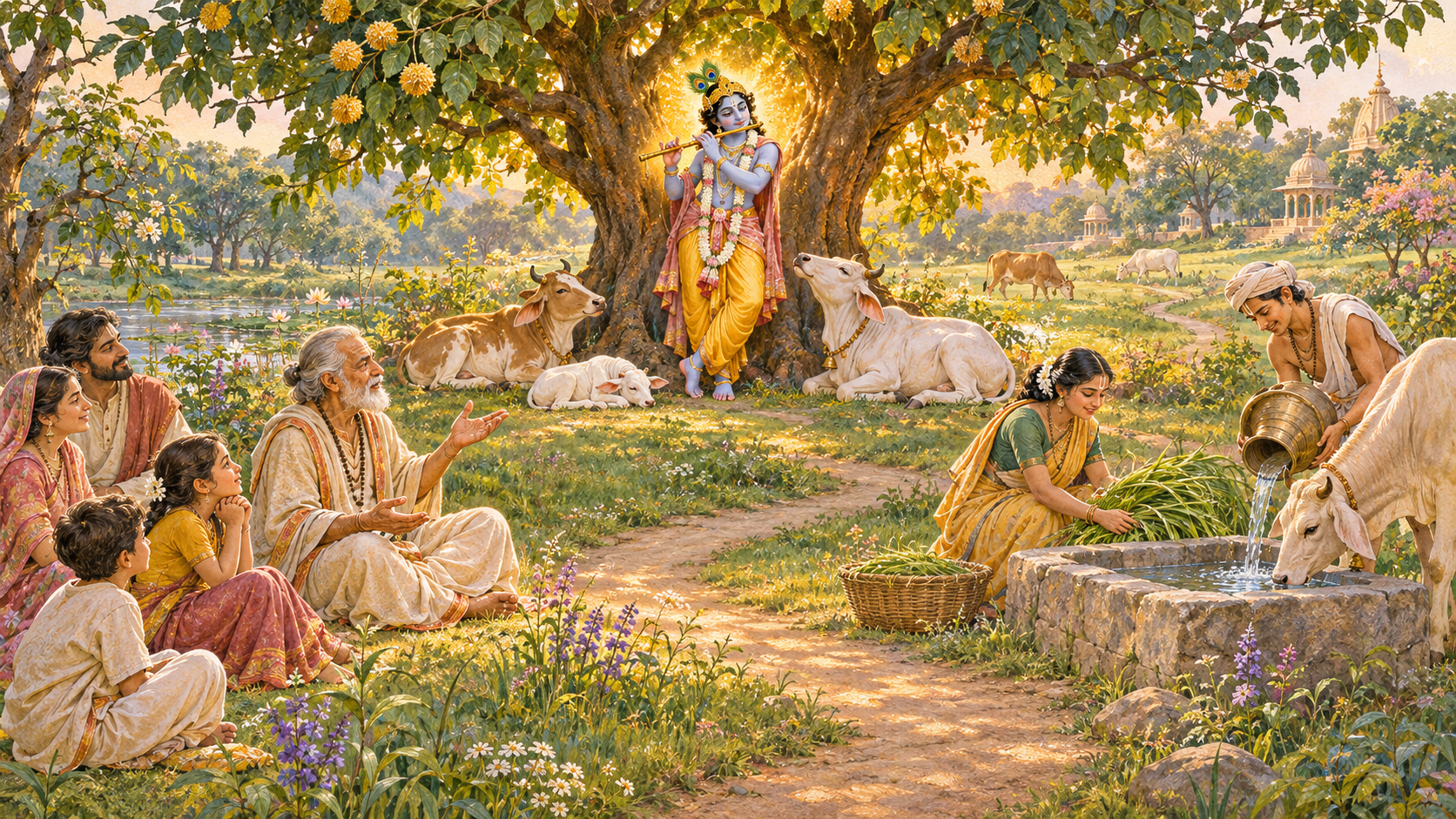
The cowherd pastimes are sometimes treated as charming background to Krishna’s supposedly more important deeds. That reading misses their theological force. Vrindavana reveals divine greatness through nearness rather than distance. Krishna accepts the routines of village life, moves among cows and trees, and allows his friends to approach him as a companion.
- Read for relationship. Krishna does not appear alone. Balarama, the cowherd boys, the cows and the land form a web of belonging. When reading the lila, notice who walks together, who depends on whom and how companionship shapes the activity.
- Read for responsibility. Taking cows to pasture means attending to beings with needs, not using them as scenery. Gopastami therefore asks you to connect devotion with the patient, repetitive work of care.
- Read for place. Vrindavana is not an interchangeable backdrop. The Bhagavatam describes Krishna and Balarama sanctifying it through their presence and footsteps. The land through which the herd moves participates in the lila.
These three lenses prevent a common misreading. Krishna’s play and Krishna’s duty are not opposites. The cows are cared for in an atmosphere of friendship, music, movement and delight. Responsibility is not erased by joy, and joy is not postponed until the work is finished.
This also changes how you understand power. The cowherd Krishna is powerful without making domination the centre of the scene. His presence gives safety, companionship and sanctity to those around him. For a devotee, the practical question is immediate: when something weaker or dependent comes under your care, does your presence bring the same qualities closer?
Use that question when you hear a Gopastami discourse or join a mahotsav. Do not listen only for descriptions of Krishna’s beauty. Listen for the duties created by loving him in this form.
How to observe Gopastami with attention and care
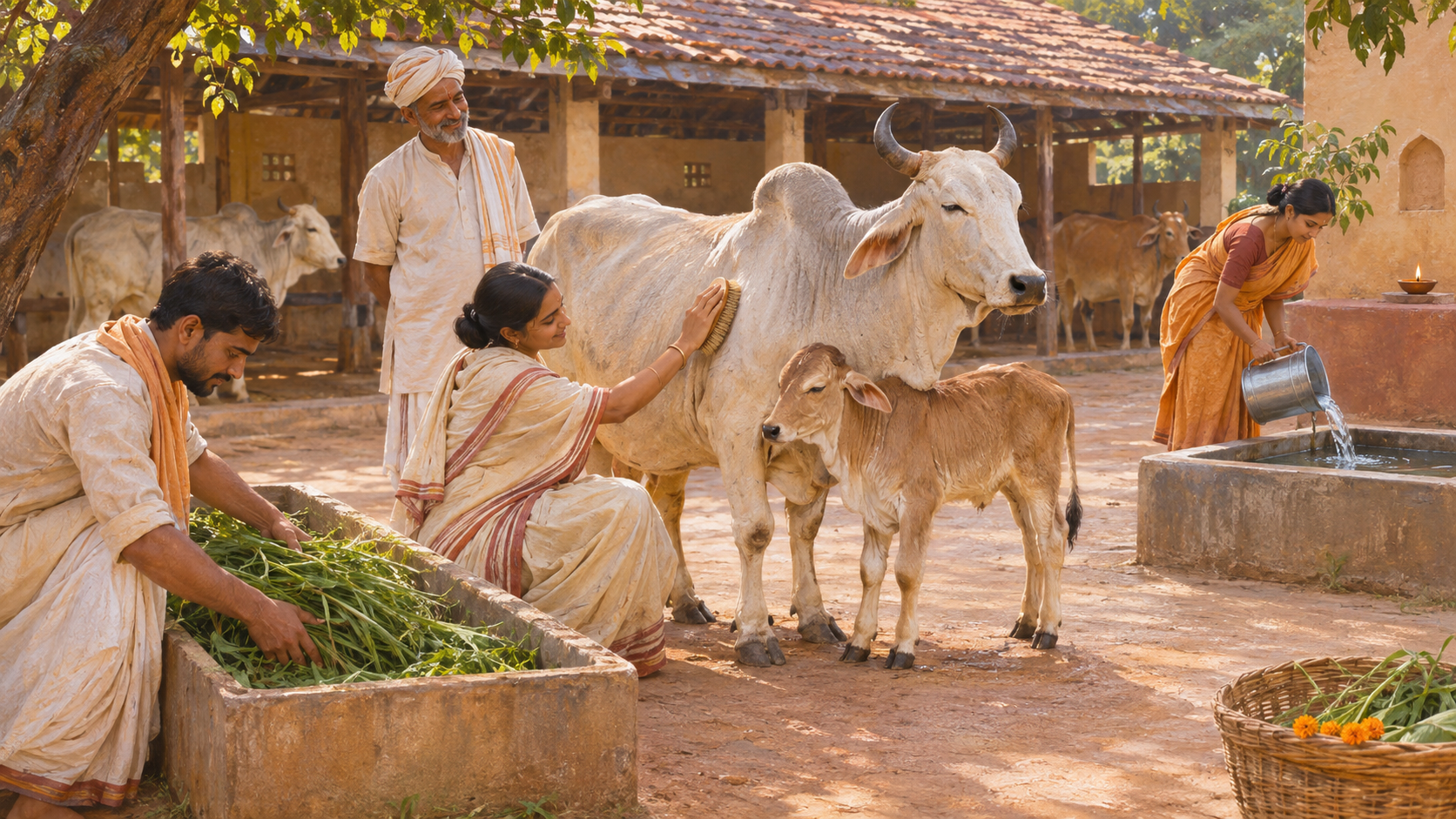
A meaningful observance can be simple, but its parts should agree with one another. Worship of Krishna as a cowherd and careless treatment of an actual cow send opposite messages. Use the following sequence to keep the day centred on both remembrance and seva.
- Confirm your local observance. Check the tithi, temple schedule and customs of your sampradaya. If your temple has a special darshan, kirtan, discourse or go-puja, learn when it begins and whether registration or a particular offering is expected.
- Read the scriptural centre before adding activities. Read Srimad Bhagavatam 10.15.1 slowly. If time permits, continue into the surrounding chapter. Ask three questions: What new responsibility has Krishna accepted? Who shares the journey with him? What happens to the place through which he walks?
- Join worship without turning the animal into a prop. If a temple or goshala conducts go-puja, follow the caretaker’s directions. Keep your movements calm. Do not crowd, restrain or startle a cow for a photograph. Decorative materials should never be toxic, painful or difficult to remove.
- Feed only what the caretaker approves. Do not assume that every festive food is suitable for every animal. At a managed goshala, ask what may be offered and in what quantity. If direct feeding is not permitted, sponsor approved fodder instead.
- Support whole-life care. Before donating, ask how the goshala provides water, shelter and continuing care for animals that are old, ill or no longer producing milk. A serious institution should be able to explain what your contribution supports.
- Choose one continuing practice. Make a recurring contribution, volunteer for an appropriate task, study the Bhagavatam’s Vrindavana chapters, or examine the dairy you purchase. The point is not to perform every possible act on one day. It is to let the day’s worship correct one durable habit.
If no cows or goshala are accessible to you, do not manufacture an encounter with an unfamiliar animal. You can still read the lila, offer worship at home, join a temple programme online or in person, and support a responsible institution from a distance. Physical proximity is not a licence to ignore an animal’s welfare, and distance does not prevent sincere seva.
For a home observance, place the emphasis on remembrance rather than imitation. Offer the lamp, flowers, food or prayers customary in your family or lineage. Recite the verse, chant Krishna’s names, and speak with children about why tending cows represents trust. Then let each person name one responsibility that has grown with age. That question translates the movement from calves to cows into a lesson a family can practise.
Key takeaways
- Gopastami commonly remembers Krishna and Balarama advancing from tending calves to caring for cows.
- Srimad Bhagavatam 10.15.1 joins divine play, friendship, responsibility and the sanctity of Vrindavana in a single scene.
- The festival is more than rural nostalgia. It asks what loving protection looks like when another being depends on you.
- Temple customs may vary, so follow your sampradaya and local panchang instead of treating one regional practice as universal.
- Go-puja should never frighten, crowd or harm the cow. Follow the caretaker’s instructions and offer only approved food.
- The strongest observance includes year-round action: accountable go-seva, thoughtful consumption, regular study or another sustainable commitment.
Let the next morning test the celebration
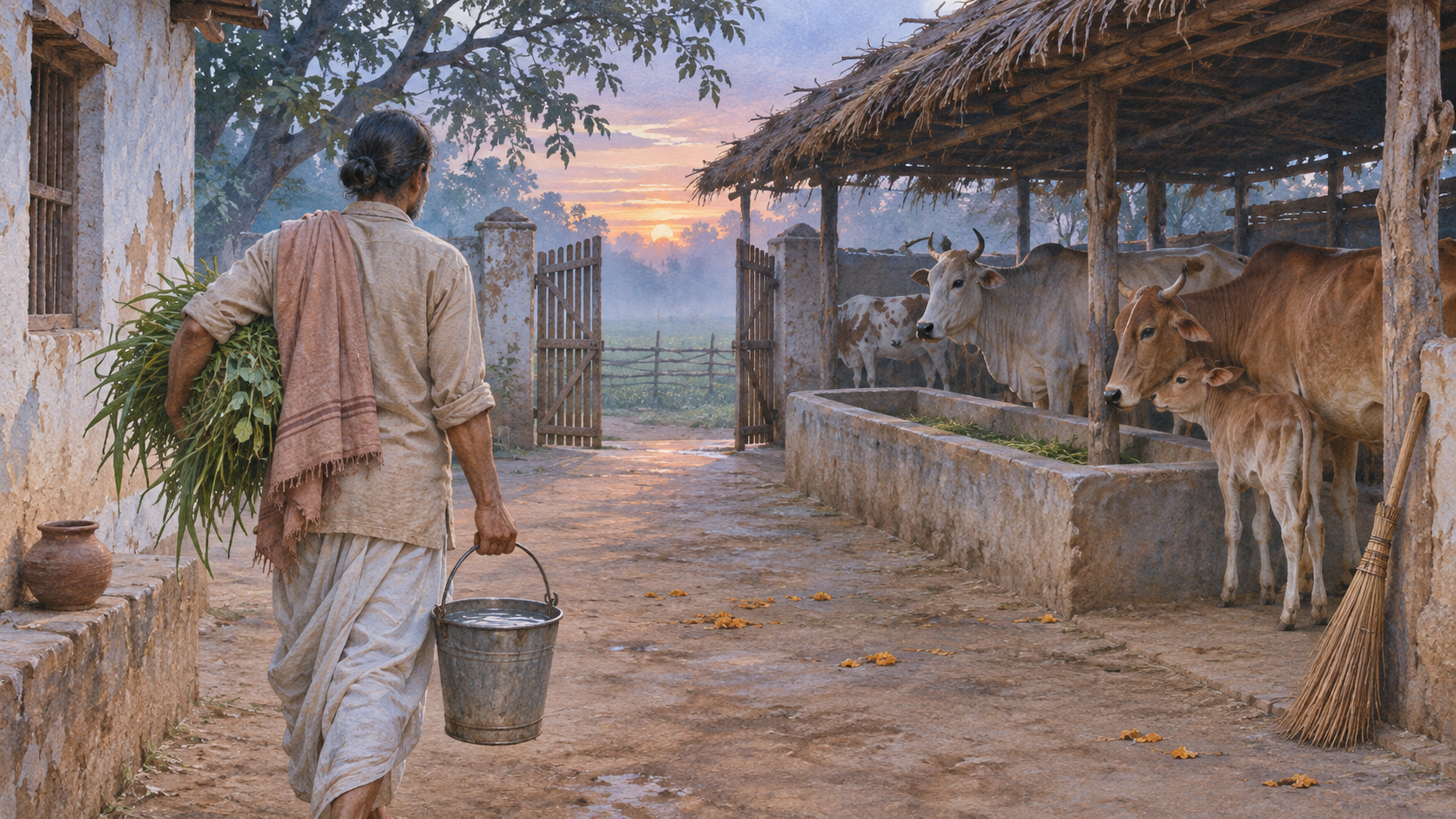
Before Gopastami ends, put one continuing action on your calendar. It might be a regular goshala contribution, a scheduled inquiry into the conditions behind the dairy you buy, or time set aside to study Krishna’s Vrindavana-lila. Make it small enough to keep and specific enough to verify.
Then let the next morning reveal whether the festival changed anything. Krishna’s cowherd form is not only an image to admire. It gives you a standard for care: affection that accepts responsibility, strength that protects rather than exploits, and devotion that leaves the beings and places within its reach better tended.
References
- Dandavats — Srimad Bhagavatam Text 10.15.1 – HH Bhakti Vighna Vinasak Narsimha Maharaja
- Dandavats — Gopastami Mahotsav || HH Bhakti Sundar Goswami Maharaj || 17.11.2026

Leave a Reply
You must be logged in to post a comment.