
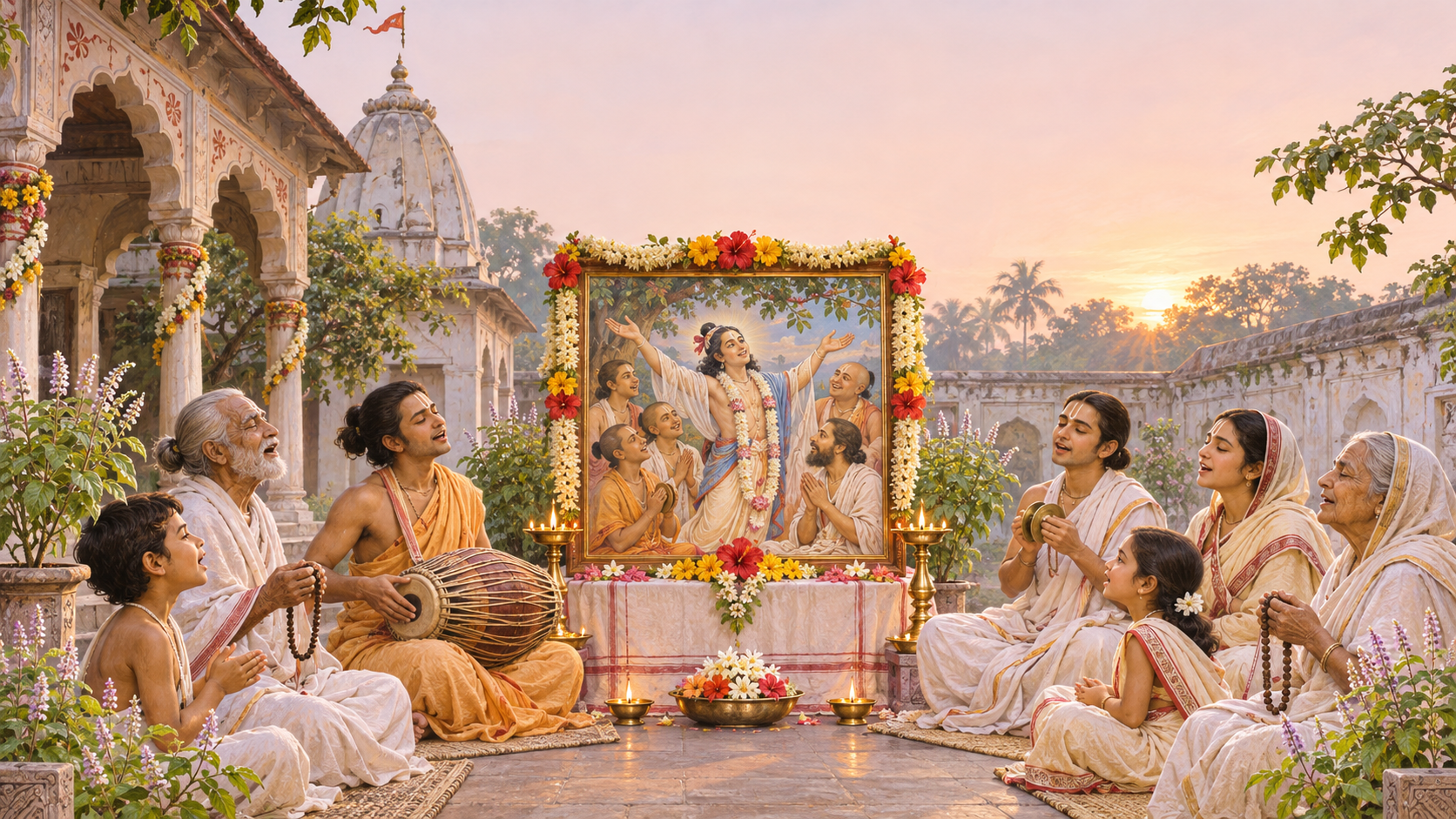
You open a Vaishnava calendar and find the disappearance day of one of Nityananda Prabhu’s associates. The name may be only partly familiar, and the calendar may not explain what you should do. Should you fast, hold a kirtan, read a biography, or simply acknowledge the day?
You do not need to manufacture an elaborate ceremony. A sound observance has a clear movement: verify the tithi, hear what is genuinely known about the devotee, chant while remembering that service, and carry one lesson into your own conduct.
Begin with remembrance, not ritual anxiety

A disappearance day is not merely a biographical anniversary. In Vaishnava practice, it is an occasion to remember a devotee’s relationship with Bhagavan, guru, the holy name, and other Vaishnavas. The calendar tells you when to remember; the devotee’s life tells you what to remember.
This distinction keeps the observance from becoming generic. If every disappearance day receives the same reading, the same speech, and the same vague praise, the person being honored almost disappears from the program. Begin instead with one question: what form of service did this Vaishnava embody, and what does that service expose in your own spiritual life?
The word disappearance also shapes the mood. It does not ask you to treat the devotee as erased from the spiritual community or to recreate a secular funeral. It directs attention toward gratitude, separation, instruction, and continued service. Sorrow may be present, but it is joined to the conviction that a saintly life remains spiritually instructive.
Remember Dhananjaya Pandit and Gadadhara Dasa distinctly
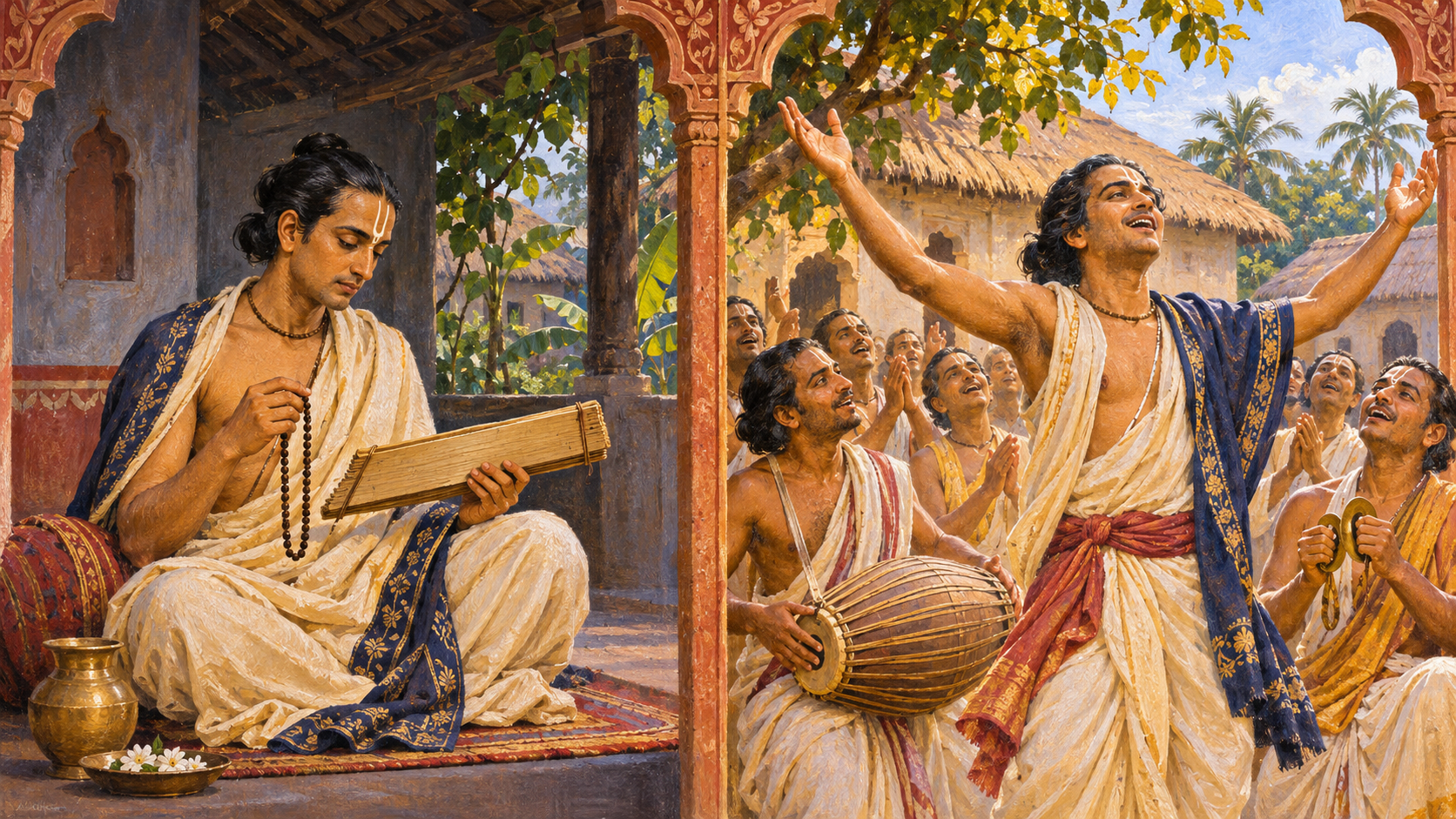
Dhananjaya Pandit is remembered as a great devotee of Nityananda Prabhu. That concise description is enough to establish the center of his observance: devotion expressed through attachment to Nityananda Prabhu and His service.
Do not turn the word great into an excuse for grand but unverifiable storytelling. Let it sharpen your examination instead. Ask where your own service has become dependent on mood, recognition, or convenience. A fitting offering may be to keep an existing chanting commitment more carefully, complete an overlooked service, or support another devotee without seeking attention.
Gadadhara Dasa Goswami is remembered as a fearless preacher of the holy name. His defining words give the observance a different emphasis: courage, communication, and nama. Remembering him should therefore move beyond admiring boldness. It should make you consider whether the holy name has become something you practice privately but hesitate to represent with clarity and respect.
Fearless preaching should not be confused with aggression. Volume, argument, and humiliation do not prove spiritual courage. In an observance centered on Gadadhara Dasa Goswami, translate fearlessness into a constructive act: invite someone receptive to kirtan, explain why chanting matters without pressuring them, make a devotional gathering easier to attend, or stop concealing your practice merely to avoid mild social discomfort.
These two remembrances give you different points of entry. Dhananjaya Pandit directs attention toward the depth and steadiness of devotion. Gadadhara Dasa Goswami directs attention toward the courage to carry the holy name outward. Honor the distinction rather than blending both men into a single, indistinct picture of saintliness.
Build a practical observance around hearing, nama, and seva
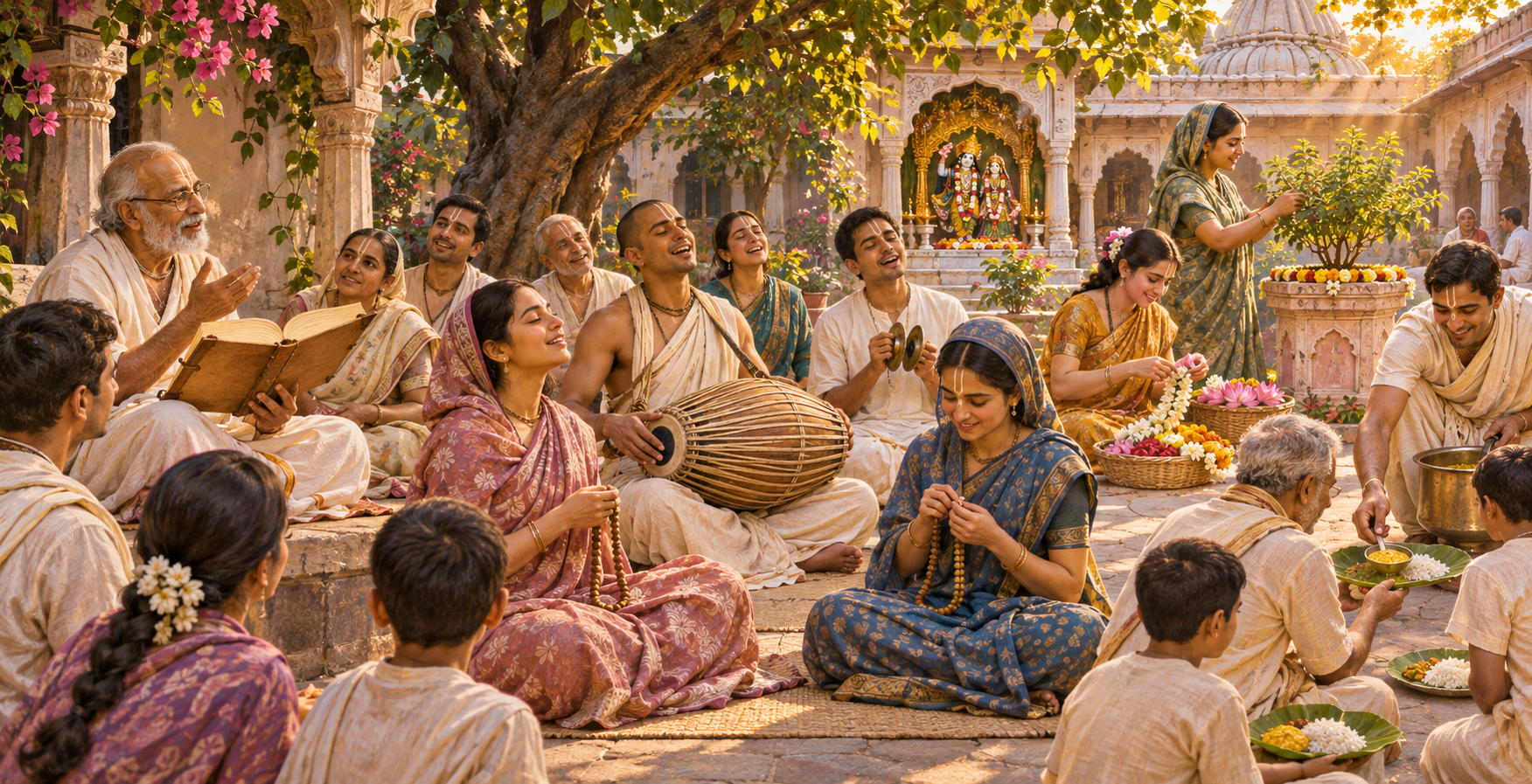
The following sequence works as a simple framework. Adapt its scale to your household or community, but preserve its order: establish accuracy first, then hear, chant, reflect, and act.
- Confirm the correct tithi. Vaishnava observances follow the lunar calendar. Do not assume that a Gregorian date copied from a previous year or another location is correct for you. Use the calendar followed by your temple, guru’s community, or established local Vaishnava association.
- Select a trustworthy reading before the day begins. Choose a concise biographical account that clearly identifies the devotee and the service for which he is remembered. If dependable information is limited, remain within that limit. A short, accurate remembrance is better than an impressive collection of uncertain anecdotes.
- Prepare according to your established practice. You may arrange a clean place for reading and kirtan and, where customary, offer flowers or food. Follow the standards already observed in your home or temple. A calendar entry is not permission to improvise deity worship or procedures for which you have not been trained.
- Read before offering commentary. Let participants first hear the devotee’s name, relationship, and known quality of service. Personal reflections can follow, but listeners should be able to distinguish biographical information from the speaker’s application.
- Center the gathering on the holy name. Use the form of nama-kirtana or chanting your community normally follows. On Gadadhara Dasa Goswami’s day, the connection is direct. On Dhananjaya Pandit’s day, chanting can be offered in the mood of deepening devotion to the path carried by Nityananda Prabhu.
- Name one practical response. Before closing, ask each participant to identify a small act of service that follows from the remembrance. The act should be definite enough to complete: keep an existing chanting commitment, help with a kirtan, welcome a newcomer, distribute prasada, or finish a neglected service.
- Conclude in the customary way. If food has been offered, share prasada according to your community’s practice. If no formal offering is possible, close with prayer and a clear intention to carry the remembrance beyond the gathering.
If you are observing at home
Keep the observance proportionate. Read the verified account aloud, chant, speak briefly about the quality you want to cultivate, and write down the service you will undertake. You do not need to imitate a temple festival. The test is whether the person and his service become more present in your consciousness, not whether the program appears elaborate.
If you do not know whether fasting or another vrata applies, do not invent one from an isolated social-media notice. Follow the instruction of the Vaishnava authority or community whose calendar you use. Different lineages and temples may organize commemorations differently, and disciplined fidelity is more useful than improvised severity.
If you are organizing a community program
Give the event a defined center. Ask the reader or speaker to state what is reliably known, explain the devotee’s characteristic service, and connect it to one present need in the community. For Dhananjaya Pandit, that need may be dependable service without recognition. For Gadadhara Dasa Goswami, it may be a welcoming kirtan, thoughtful outreach, or greater confidence in speaking about the holy name.
End with an invitation that can actually be accepted. Instead of saying, “We should all become better preachers,” name an available service. Participants might assist at the next kirtan, bring prasada for guests, accompany an experienced devotee during outreach, or help someone new learn the community’s chanting practice. The disappearance observance then becomes a doorway into seva rather than a program that ends when the room is cleared.
Keep the commemoration accurate and spiritually focused

Devotional enthusiasm does not remove the duty to be truthful. In fact, respect for a Vaishnava requires care with his life. Watch for these common failures when preparing the observance:
- Using the wrong date: a civil-calendar reminder can drift away from the relevant lunar tithi. Confirm the observance each year instead of automatically repeating last year’s date.
- Replacing the person with generic praise: words such as glorious and merciful communicate little unless you identify the devotee’s characteristic service and explain its practical meaning.
- Filling gaps with confident speculation: if a detail cannot be verified, omit it or label it honestly as a devotional reflection. Repetition does not turn an uncertain anecdote into established biography.
- Turning fearlessness into combativeness: Gadadhara Dasa Goswami’s preaching of the holy name should lead toward nama and service, not provide cover for personal anger or online quarrels.
- Admiring devotion without examining your own: remembrance becomes passive when it never changes a commitment, relationship, or act of service. Decide what you will do before the observance concludes.
- Measuring devotion by program size: a household reading followed by sincere chanting and completed seva can be more coherent than a large event whose speakers barely discuss the devotee being honored.
Accuracy and devotion are not competing aims. Accuracy protects remembrance from becoming fantasy; devotion keeps accuracy from becoming a bare recital of names. You need both if the day is to educate the community and deepen practice.
Key takeaways
- Verify the lunar tithi through the Vaishnava calendar your local or initiating community follows.
- Remember each associate through his distinctive service rather than using a generic memorial program.
- Let Dhananjaya Pandit’s remembrance examine the steadiness of your devotion to service.
- Let Gadadhara Dasa Goswami’s remembrance examine your courage to share the holy name without aggression or display.
- Use only biographical details you can state responsibly; never compensate for limited information by embellishing it.
- Join hearing and kirtan to one definite act of seva that you can carry out after the observance.
When the next disappearance day appears on your calendar, prepare before it arrives. Confirm the tithi, choose a trustworthy passage, arrange the chanting, and decide which service the remembrance will awaken. That is how a name on the calendar becomes a living discipline of gratitude and discipleship.
References
- Dandavats — Sri Dhananjaya Pandit | The Great Devotee of Nityananda Prabhu | Disappearance Day
- Dandavats — Sri Gadadhara Dasa Goswami | The Fearless Preacher of the Holy Name | Disappearance Day

Leave a Reply
You must be logged in to post a comment.