
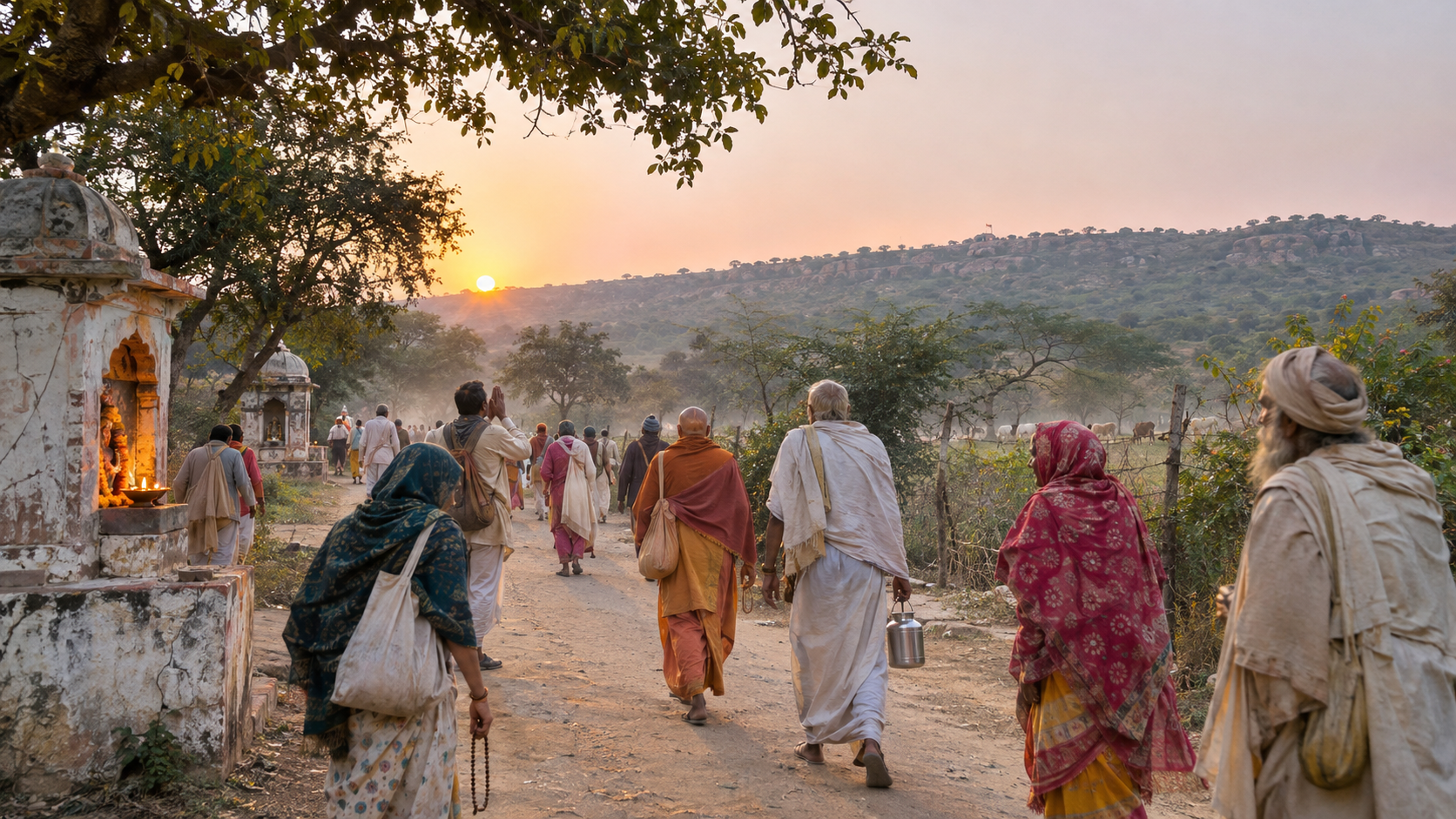
If you are planning Kartik in Vraja, the hardest decision is not how many sacred places you can fit into the journey. It is what will govern your attention when the road is crowded, your body is tired, and your schedule begins to slip.
Govardhan gives the pilgrimage a clear center. You are not merely visiting a hill associated with Krishna. You are approaching a form of sacred geography in which remembrance, shelter, humility, and service meet. Prepare for that encounter before you prepare your route.
Begin with a sankalpa, not a list of destinations
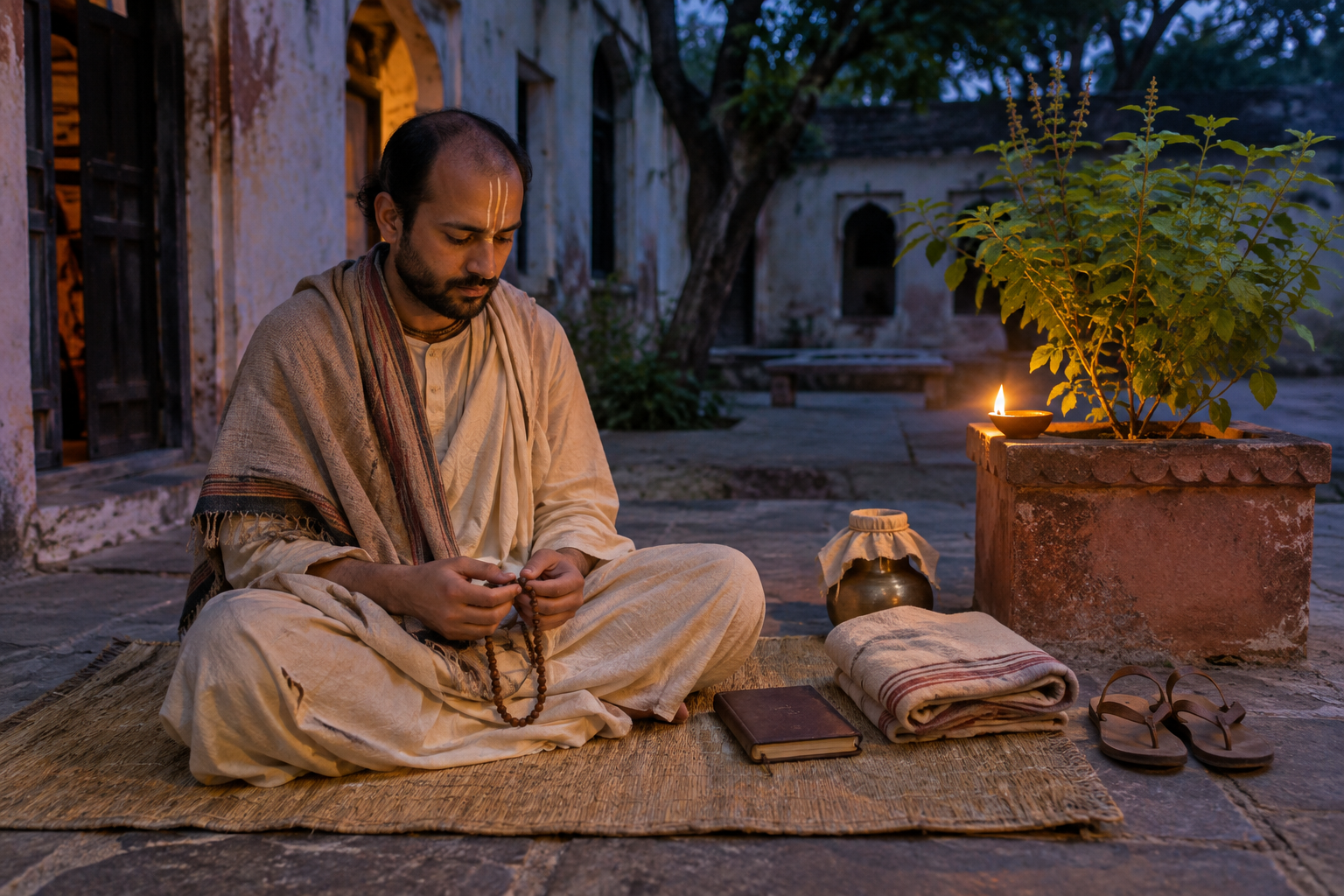
A Kartik journey can easily become devotional tourism: more temples, more photographs, more places checked off, and less time to absorb any of them. A sankalpa prevents that drift. It is a deliberate commitment that tells you what the pilgrimage is for.
Write your sankalpa in one sentence. It should be clear enough to guide an ordinary day, including a day when you are delayed or exhausted. Before finalizing the itinerary, answer three questions:
- What one devotional practice will I protect every day?
- What habit will I reduce because it scatters my attention?
- How will my presence benefit the people, animals, temples, and land of Vraja rather than merely consume an experience?
A workable plan usually has one primary practice, one support, and one restraint. Your primary practice might be nama-japa, katha, prayer, or attentive darshan according to your sampradaya. The support might be an earlier bedtime or a simpler itinerary. The restraint might be keeping the phone away during worship or declining optional excursions that would crowd out the main vow.
Do not confuse severity with sincerity. A modest sankalpa kept with attention is more useful than an impressive promise that collapses as soon as travel becomes inconvenient. If your sentence cannot guide the first difficult day, simplify it before you leave.
Approach Govardhan as shelter, not scenery
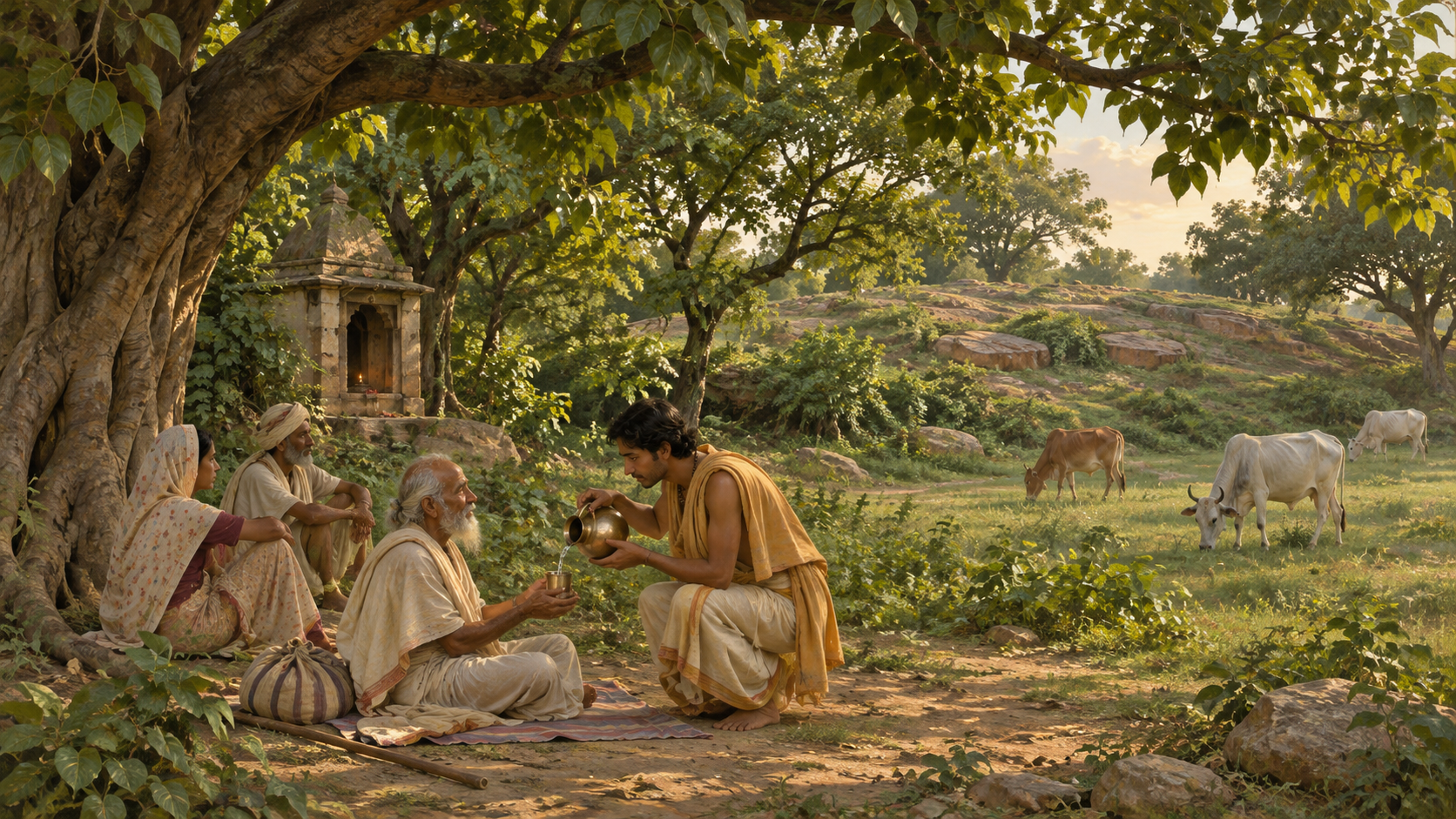
In the Govardhan lila, Krishna turns the people of Vraja toward honoring Govardhan and attending to the duties immediately before them. When Indra’s storm threatens the community, Krishna lifts the hill and makes it their shelter. Vaishnava traditions may emphasize different theological dimensions of this lila, but its practical challenge to the pilgrim is direct: does your worship make you humbler, more dependable, and more willing to protect others?
Govardhan is therefore not a backdrop for proving that you completed a route. Devotees honor the hill as Giriraj and as intimately related to Krishna’s pastimes. During parikrama, keep Govardhan at the center both physically and inwardly. The outer movement is circumambulation; the inner movement is the repeated return of attention to refuge, gratitude, and seva.
Use one question whenever your attention becomes mechanical: Am I seeking shelter, or am I trying to be seen seeking it? That question can correct the urge to rush, display austerity, photograph every moment, or compare your pilgrimage with someone else’s.
Devotion to Govardhan is not confined to those who can reach Vraja. Communities outside Bharat also gather for teaching centered on the appearance of Govardhan. If travel is not possible, begin where you are: hear the lila, make a respectful offering within your tradition, and translate the lesson of shelter into concrete service.
Give every day a devotional spine
The crowded parts of a pilgrimage tend to organize themselves. Buses depart, meals arrive, groups move, and temple schedules impose their own rhythm. Quiet practice does not organize itself. Put it into the day first, then arrange travel around it.
The following pattern is not a universal liturgy. Adjust it to the instructions of your guru, sampradaya, family responsibilities, and yatra organizer.
- Set the day’s intention before leaving. Repeat your sankalpa and decide which practice cannot be displaced by sightseeing.
- Hear before accumulating impressions. Listen to katha or read a relevant passage slowly enough to carry one teaching into the day.
- Keep one part of the journey undistracted. Put the phone away except for necessary communication and give that stretch to nama, prayer, or quiet remembrance.
- Pause instead of collecting stops. At a sacred place, ask what the place reveals about Krishna, the devotees, and your own conduct before moving onward.
- Review the day honestly. Record one moment of grace, one lapse of attention, and one correction for the next day. Do not turn the review into self-display or self-condemnation.
Katha helps keep sacred geography intelligible. Without hearing, one holy place can blur into the next. With hearing, the landscape becomes a field of remembered relationship. A live Kartik katha shared from Vrindavan can also anchor a home observance or help you prepare before departure.
Do not pack every open period with another destination. Leave enough room for rest, unhurried prasada, personal japa, and the unexpected needs of companions. The test of the schedule is not how much it contains. It is whether the schedule still permits devotional attention after fatigue appears.
Walk parikrama with reverence and physical honesty
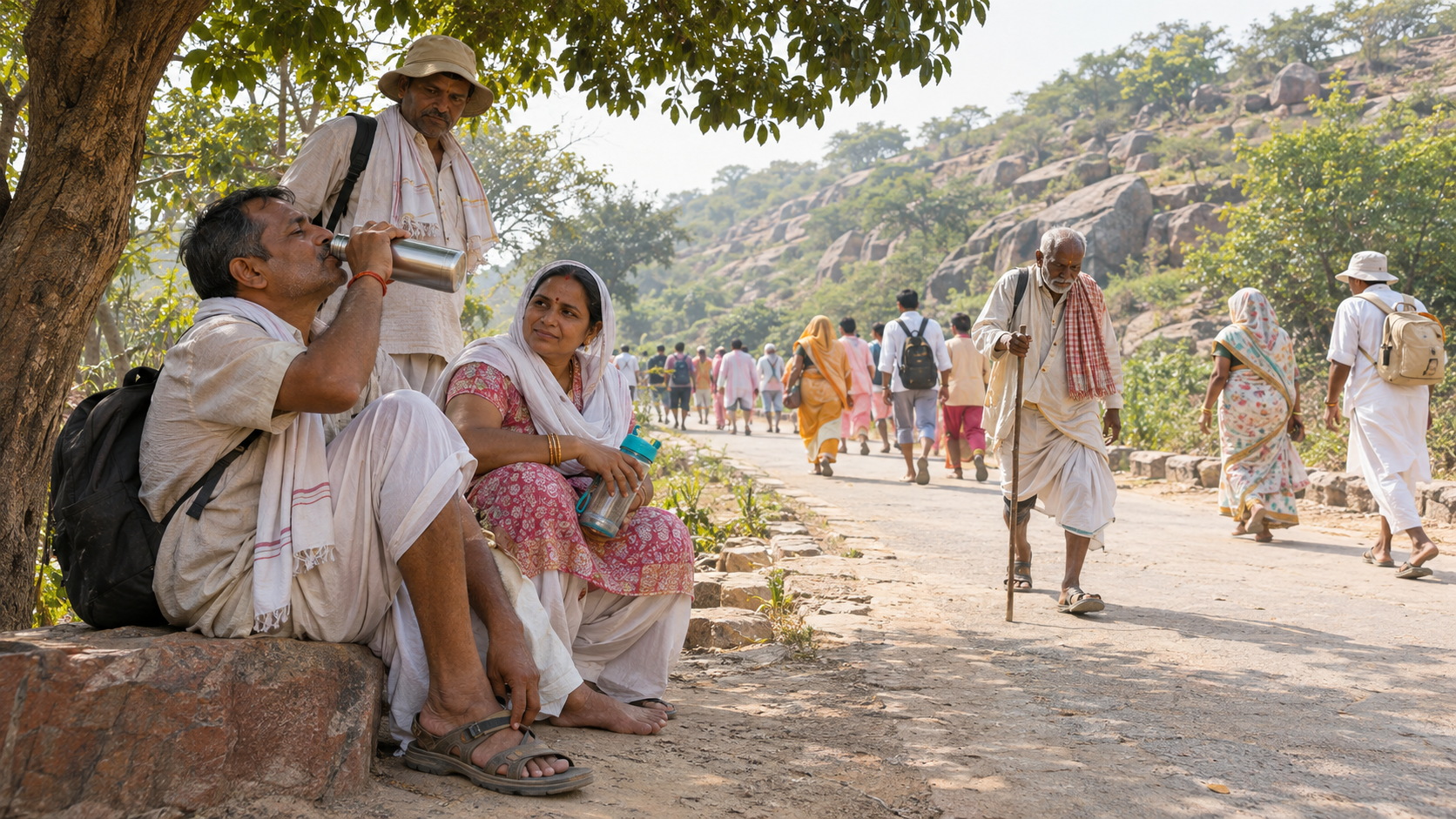
Parikrama is an embodied form of reverence, but the body is not an obstacle to be punished. Barefoot walking, fasting, silence, or a demanding route may have meaning within a particular discipline. They are not moral tests by which you should judge another devotee, and they should not be used to ignore a known medical constraint.
If you are managing an illness, recovering from injury, pregnant, elderly, or responsible for young children, discuss the practical demands with your clinician when appropriate and with an experienced local organizer. Ask about a shorter route, transport, rest points, or another form of participation. An injury caused by concealment or pride does not deepen bhakti.
Carry required medicines, safe drinking water, your lodging details, and a way to contact your group. Agree on a meeting place before starting. A child should be assigned to a named adult, not vaguely assumed to be under the group’s supervision. These small arrangements protect the inward purpose of parikrama because they prevent avoidable confusion from taking over the day.
Reverence also governs how you treat the place. Do not climb on Govardhan, remove stones or soil as souvenirs, or leave plastic, packaging, lamps, or discarded offerings behind. Follow temple instructions and informed local Vaishnava guidance about darshan, offerings, and access. Sacredness is not permission to take from a place; it is a reason to leave the place cared for.
Keep necessary communication available, but do not let filming become the dominant activity. Take the photograph you genuinely need, then return the device to your bag. If every encounter is converted immediately into content, you may come home with a record of the pilgrimage but little memory of being present within it.
Let the group support devotion without replacing it
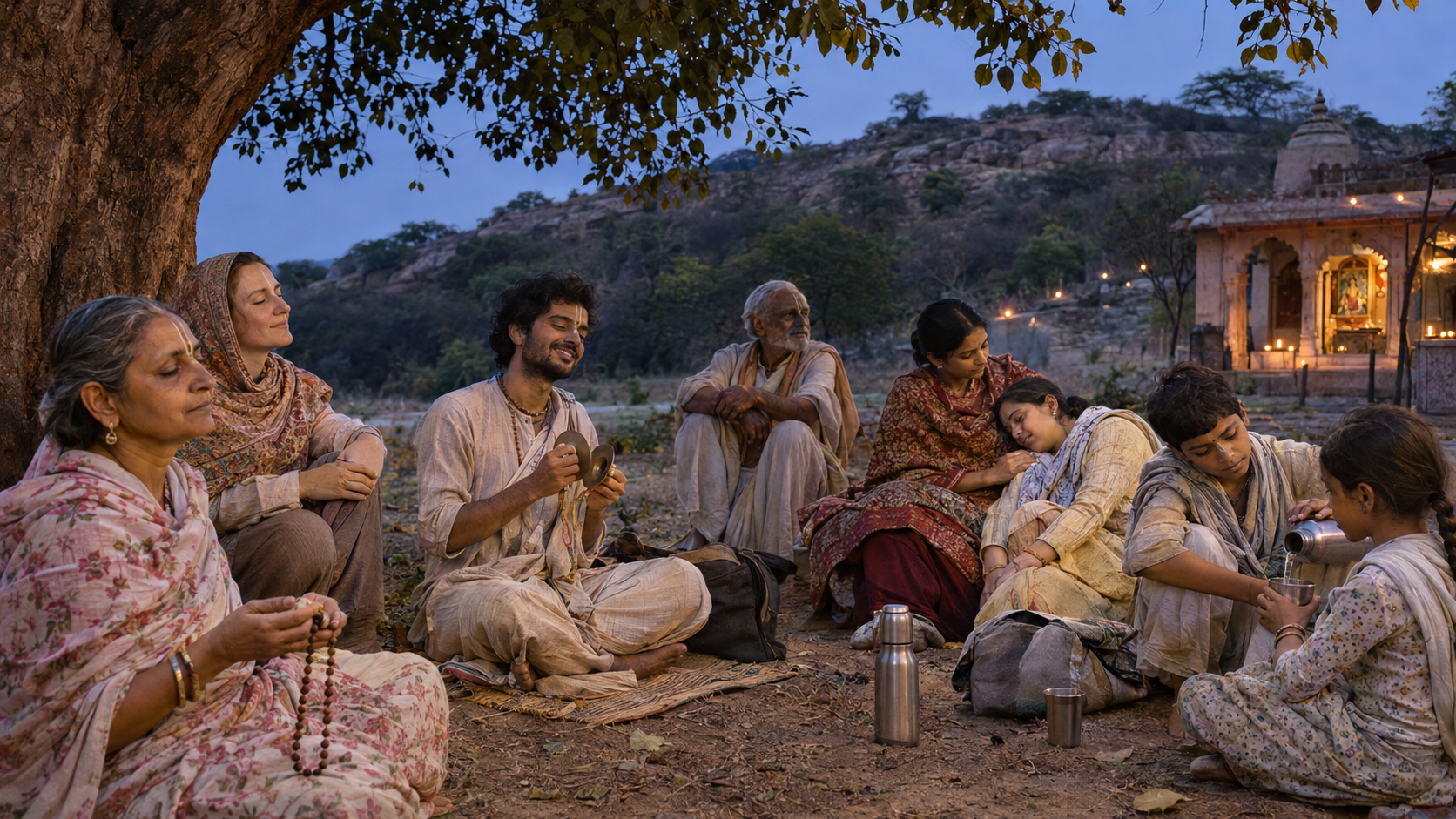
A 2026 Vraja yatra brought together more than 200 devotees, including youth, families, and congregational participants from Srinagar, IIT Delhi, Jia Sarai, Siksharthakam, and Sausar in Madhya Pradesh. Such variety is one of pilgrimage’s strengths. It is also why a group needs more than transportation and a shared timetable.
Before the first outing, the organizer should identify the group leader, emergency contact, meeting point, and procedure for a missing participant. Every pilgrim should have a buddy. Families should know which adult is responsible for each child during movement and rest stops. People who walk at different speeds should be told whether the group will wait, split, or regroup at a named location.
The group should also protect a defined period of quiet. Collective chanting and katha are powerful, but constant conversation can turn a yatra into a social tour. Agree in advance that part of the journey will be free from casual talk and routine photography. This prevents the most talkative members from setting the spiritual temperature for everyone else.
Community can carry you through tiredness, but borrowed enthusiasm rarely survives the return home. Choose one practice from the yatra that you can continue without the bus, crowd, or festival atmosphere. That continuing practice is where pilgrimage begins to alter ordinary life.
Key takeaways
- Write a one-sentence sankalpa before building the itinerary.
- Treat Govardhan parikrama as an act of shelter, remembrance, and seva rather than a distance to complete.
- Schedule katha, nama, and quiet attention before optional travel fills the day.
- Respect your physical limits, local instructions, and the sanctity of the land.
- Use a buddy system and a clear regrouping plan when traveling with a congregation or family.
- Return with one devotional practice that does not depend on the atmosphere of Vraja.
Before adding another stop to your Kartik plan, write the sentence that will govern the journey and share it with your companions. Build the day around that commitment. Then approach Giriraj without the need to perform, collect, or rush. Go ready to receive shelter, and return ready to offer it.
References
- Dandavats – Kartik Katha 14 / LIVE FROM VRINDAVAN, 2026
- Dandavats – ISKCON Scarborough November 15, 2026 Lecture by HG Minakashi Devi Dasi on Appearance of Govardhan
- Dandavats – Vraja Yatra 2026 | Highlights

Leave a Reply
You must be logged in to post a comment.