
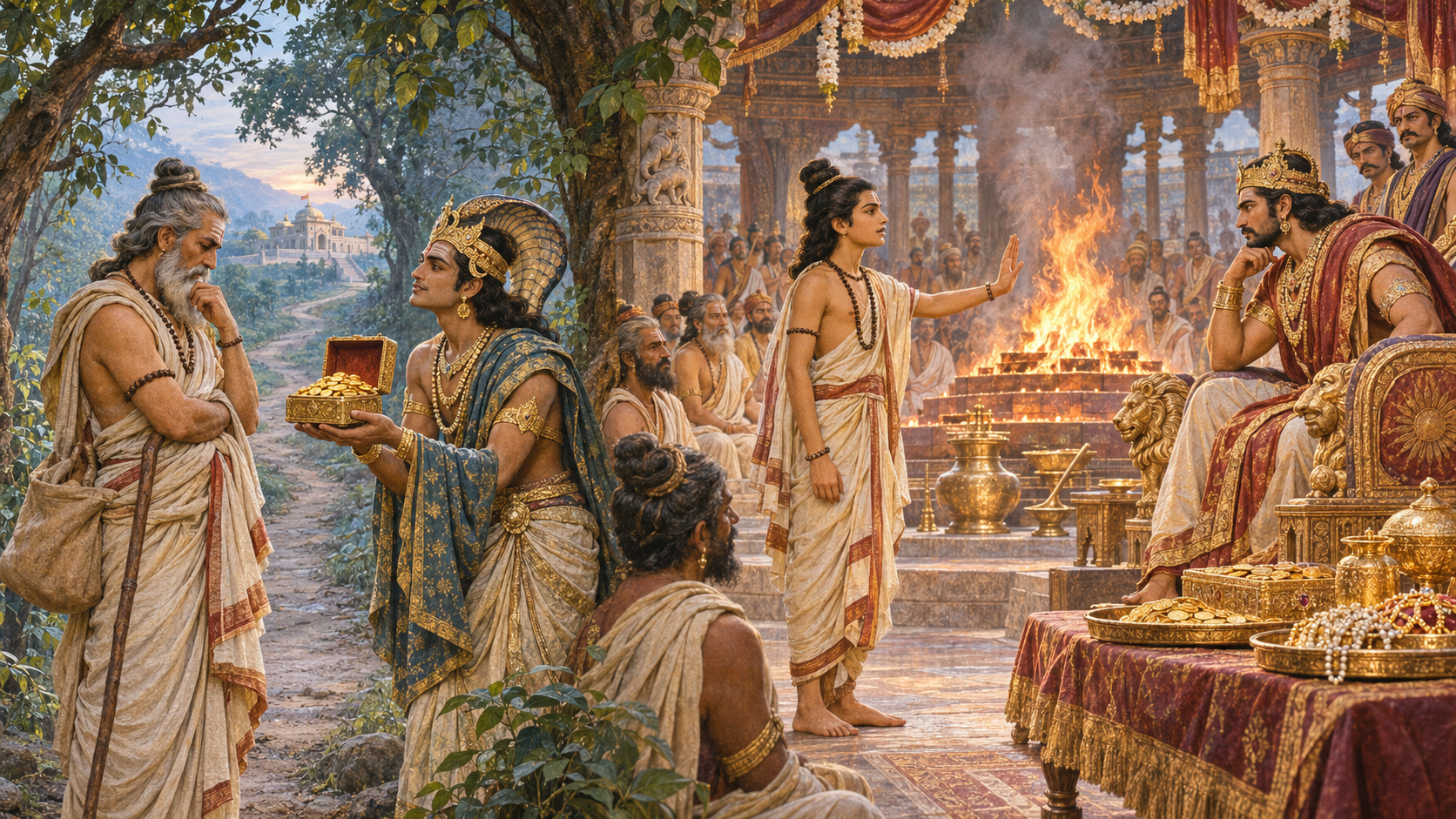
If you have ever wondered whether a Dharmic life requires you to distrust money, Kashyapa and Astika give a more exact answer. The decisive question is not simply whether you accept wealth. It is what accepting that wealth makes you willing to abandon.
The Mahabharata does not treat money as morally self-explanatory. Wealth can support knowledge, family, service, generosity and social order. It can also purchase silence, withdrawal or consent. These two Brahmins help you distinguish between those uses without pretending that poverty is automatically virtuous.
One royal death creates two tests of wealth
King Parikshit, the son of Abhimanyu and grandson of Arjuna, is cursed to die from Takshaka’s bite on the seventh day. He withdraws into a protected palace, but Takshaka reaches him in disguise and the curse is fulfilled.
Kashyapa enters the crisis before the king’s death. He possesses the knowledge needed to confront the effect of serpent venom and sets out to intervene. Takshaka meets him and offers him wealth. Kashyapa accepts the payment and turns back. His knowledge remains his, but it is no longer placed at the endangered king’s service.
Parikshit’s son Janamejaya later begins the Sarpa Satra, a sacrifice directed against the serpents. Astika enters this second crisis with a sharply defined aim: the destruction must stop. When royal favour and material reward become available, he does not allow them to replace that aim. He asks for the sacrifice to end.
The contrast is not merely that one Brahmin takes wealth while another refuses it. Both make their choice at the moment when their agency matters. Kashyapa is offered wealth to cease acting. Astika declines to let wealth become a substitute for the action he considers necessary. The moral pressure lies in what the transaction changes.
Kashyapa’s danger is not payment but purchased withdrawal
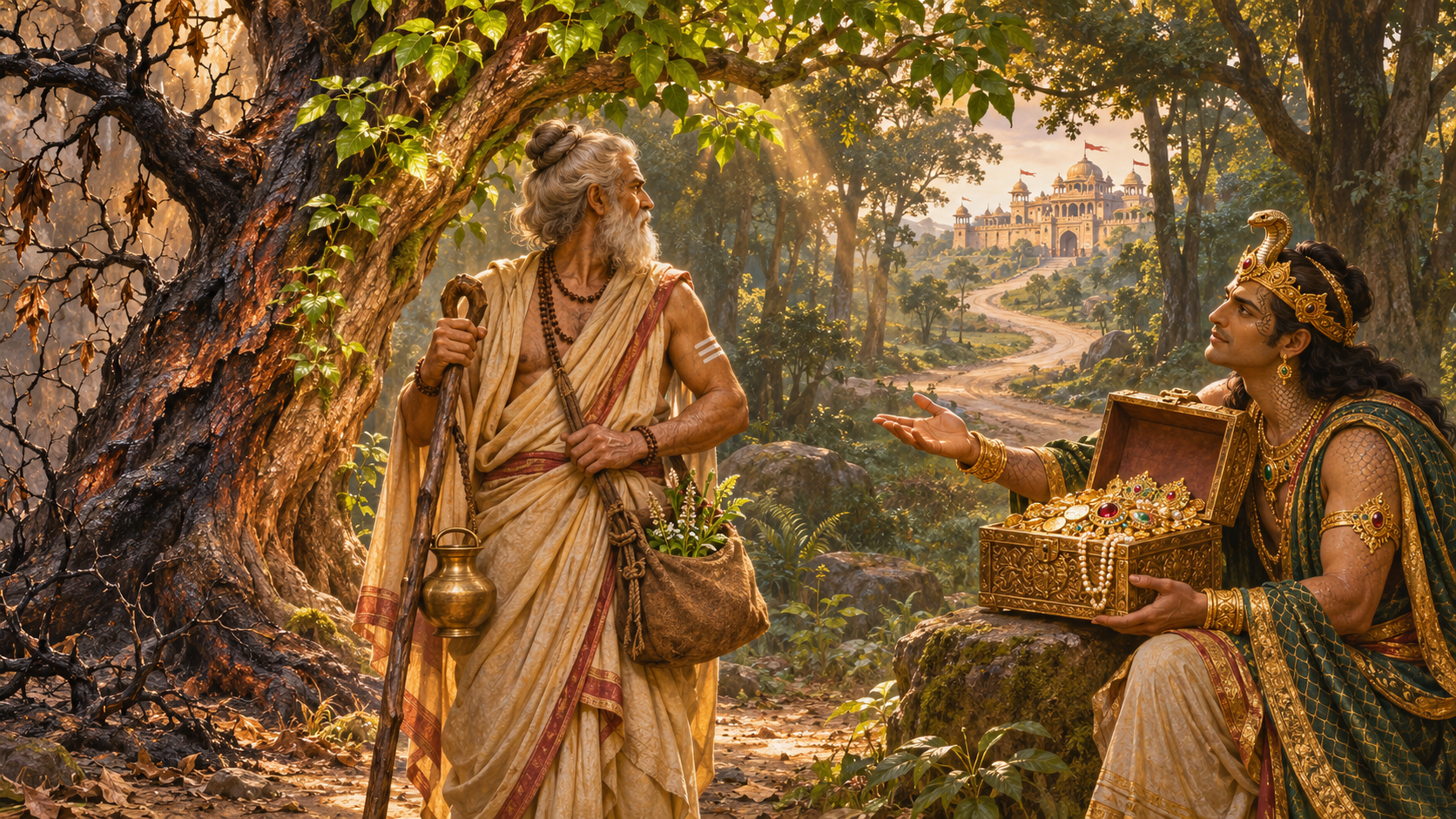
It would be too easy to conclude that Kashyapa failed simply because he accepted money. Payment for knowledge, time or skilled work is not inherently adharmic. Artha, material security and the means of sustaining life, has a legitimate place among the aims of human life. A healer does not become corrupt merely by receiving a fee, and a teacher does not lose integrity merely by accepting support.
Kashyapa’s decision raises a different problem. The payment comes from the party whose purpose is served by his retreat. Wealth does not support his intended work; it reverses it. What began as a journey to use knowledge becomes a compensated decision not to use it.
That distinction still matters whenever you are offered money, status or access. Ask what the payer is actually purchasing. Is it your labour, a legitimate good or the use of your property? Or is it your silence, delay, withdrawal, endorsement or refusal to help someone else?
- A fee pays you to perform a defined service; a compromising payment may pay you to abandon one.
- A genuine gift leaves your judgement free; a disguised bargain becomes costly when you exercise that freedom.
- Compensation recognises work or loss; inducement attempts to change a duty that should not be for sale.
- A legitimate contract can be described openly; a corrupting arrangement usually depends on concealing its real purpose.
Parikshit’s curse adds an important complication. Fate and agency are intertwined in the episode, so Kashyapa’s choice should not be reduced to the claim that one man certainly could have erased the king’s destined end. Yet the presence of destiny does not make human motives irrelevant. You are still responsible for deciding whether your capacity will be offered, withheld or sold. Uncertainty about the eventual result does not automatically excuse the abandonment of right effort.
Astika refuses a substitute for the outcome that matters
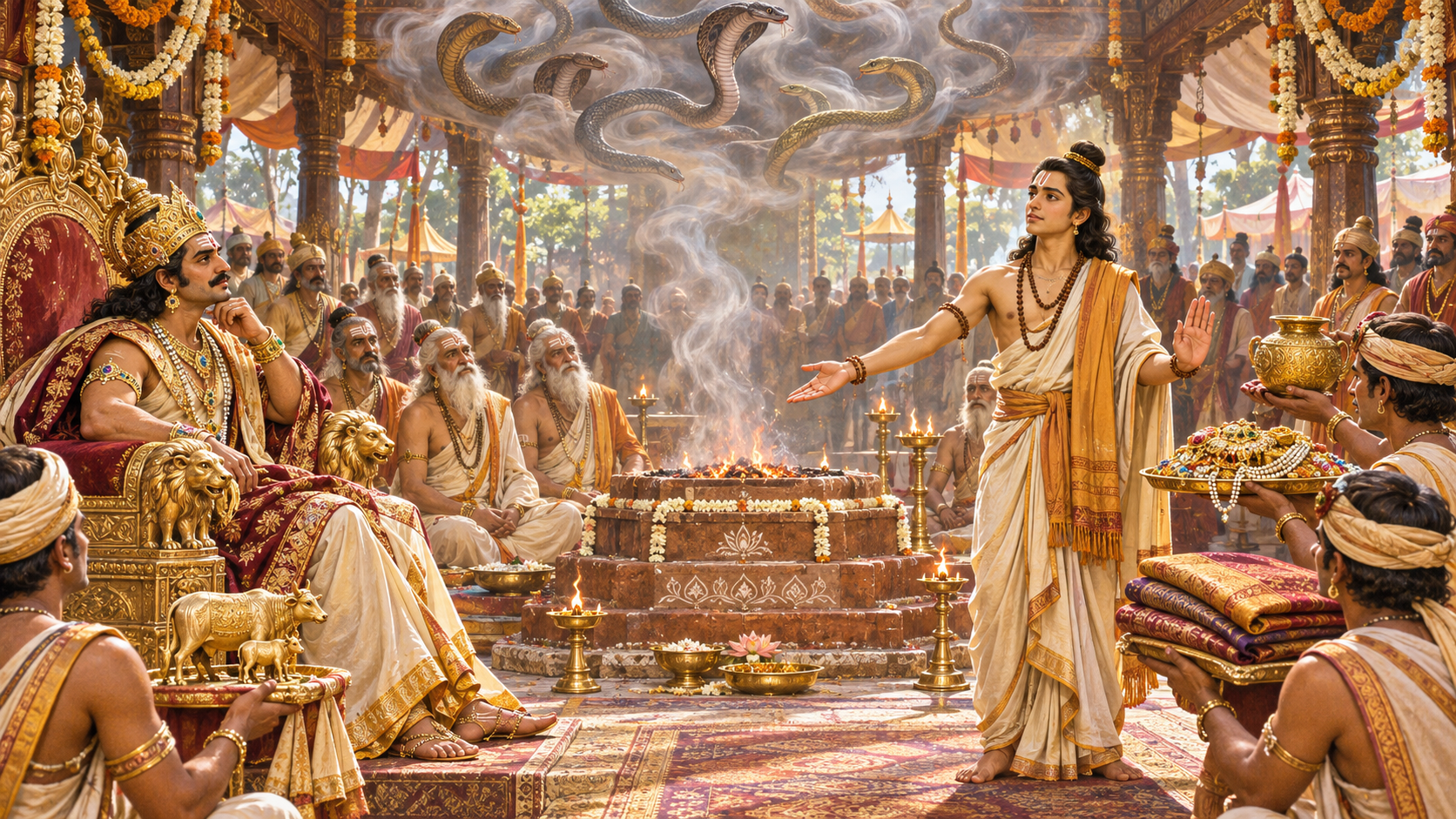
Astika confronts the opposite temptation. Janamejaya’s response to his father’s death has expanded into a destructive campaign against serpents. Astika does not arrive merely to display learning or secure royal patronage. He comes with a concrete purpose: stop the Sarpa Satra.
That clarity protects him. Wealth may be valuable, but it cannot compensate for the continuation of the very harm he has come to end. Astika therefore refuses the substitution. He uses the opportunity before him to seek cessation rather than enrichment.
This is a more demanding form of non-attachment than casually declaring money unimportant. Astika must distinguish a secondary good from the primary good while both are within reach. His refusal has three features you can use in your own decisions:
- A defined purpose: he knows what result he is seeking before the reward is offered.
- No false equivalence: personal wealth cannot be treated as equal to ending the destruction.
- Action at the decisive moment: he does not postpone the moral request until after accepting a more convenient benefit.
Refusal is therefore not automatically noble. Rejecting payment out of pride, fear or a desire to appear pure can be another form of attachment. Astika’s refusal matters because it protects a purpose larger than his own gain. The question is not whether saying no looks spiritual. It is whether saying yes would displace the good you are responsible for pursuing.
Artha remains legitimate when Dharma governs its terms
The two choices become clearer when read through the relationship between Dharma and artha. Artha supplies means: food, shelter, tools, institutions, education and the capacity to help others. Dharma supplies order: which means may be pursued, by whom, for what end and at whose expense.
| Moral question | Kashyapa | Astika |
|---|---|---|
| What is at stake? | Whether his knowledge will be brought to Parikshit’s crisis | Whether the Sarpa Satra will continue |
| What role does wealth play? | It redirects him away from his intended intervention | It appears as a possible substitute for the outcome he seeks |
| What does the decision reveal? | Payment can purchase non-action as effectively as action | A reward need not be accepted when it compromises the purpose of the encounter |
| What should you examine? | Who benefits from your withdrawal | Whether a personal benefit is being offered in place of a necessary result |
This framework prevents four common mistakes. First, it prevents you from treating all acquisition as greed. Second, it prevents you from treating every renunciation as wisdom. Third, it shifts attention from the size of a payment to its function. A modest sum can purchase a serious betrayal, while substantial wealth can be used without violating duty. Fourth, it forces you to notice the people who bear the cost of a transaction even when they are not present at the negotiation.
The identity of the giver does not settle the matter either. A king’s patronage is not automatically righteous, just as commercial payment is not automatically impure. Titles, ceremonies and respectable language can dignify an exchange without changing what it does. Follow the consequence: does the wealth strengthen your capacity to fulfil Dharma, or does it reward you for setting Dharma aside?
Use a six-question Dharmic audit before accepting wealth

You can apply the Kashyapa-Astika distinction to a salary, consulting fee, donation, inheritance, sponsorship, promotion or personal gift. Before deciding, write down brief answers to these six questions. Writing matters because an attractive offer can quietly redefine the decision while you are considering it.
- What was my duty before the offer appeared? Name the person, promise, role or purpose involved. Do not begin with the amount of money.
- What is the payment really buying? Distinguish work, time, property and risk from silence, withdrawal, approval and inaction.
- Who benefits if I accept, and who carries the cost? Include people absent from the room. Kashyapa’s encounter is ethically charged because another person’s peril remains outside the bargain.
- Would I make the same choice if the payer changed? If you would serve the endangered party but withdraw when the opposing party pays, the payment is redirecting your judgement rather than merely supporting your work.
- Is wealth being offered instead of the result I actually sought? Astika’s test is especially useful here. A reward, title or future opportunity may be attractive and still be irrelevant to the harm that needs to stop.
- What term must remain non-negotiable? Decide this before bargaining. It may be truthful disclosure, professional independence, fulfilment of an existing promise or refusal to participate in harm.
A difficult answer does not always require rejecting the entire opportunity. Sometimes the Dharmic response is to change its terms: disclose the conflict, preserve your independence, narrow the scope, refuse a condition, direct the benefit elsewhere or step away. The point is to prevent the amount offered from becoming the only fact you can see.
Key takeaways
- The Mahabharata’s useful distinction is not wealth versus poverty, but wealth governed by duty versus wealth that displaces duty.
- Kashyapa’s choice warns you to identify payments that purchase withdrawal, silence or non-action.
- Astika’s choice shows how a clearly defined purpose prevents personal reward from becoming an inadequate substitute.
- The ethical weight of a payment depends less on its size than on what changes after you accept it.
- A sound decision keeps the real duty, affected parties and non-negotiable terms visible before any amount is discussed.
When the next consequential offer arrives, complete two sentences before you answer: “My duty here is…” and “This wealth asks me to…” If the second sentence cancels the first, do not let a respectable label conceal the conflict. Renegotiate the terms or refuse the bargain.
Kashyapa and Astika do not ask you to become hostile to prosperity. They ask you to become difficult to purchase where Dharma is concerned, and free enough to refuse a benefit that cannot replace the good you are called to protect.
References

Leave a Reply
You must be logged in to post a comment.