
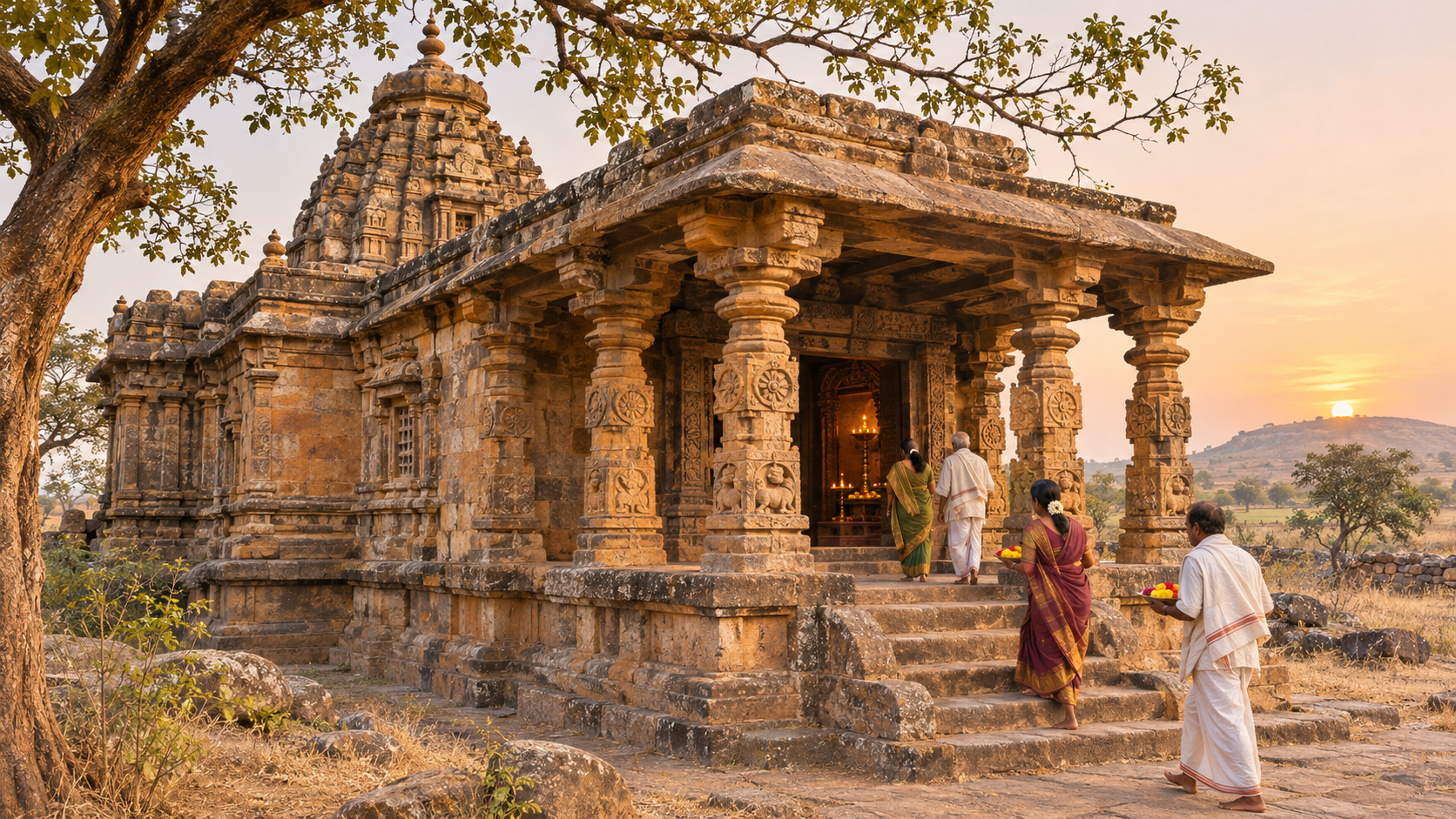
If you know Sri Dattatreya chiefly through three-faced images, Chattarki presents an immediate question: is its rare one-faced murti a different deity, a regional exception, or another way of contemplating Guru Datta? The name used at the shrine gives the firmest starting point: this is Ekamukhi Sri Guru Dattatreya. The iconographic form differs, but the divine identity remains Dattatreya.
You will understand the tradition more clearly if you read it at three levels: the single-faced form of the Guru, the living spaces of the temple, and the older sacred landscape around Vijayapura. That approach keeps you from reducing Chattarki either to an unusual photograph or to a claim that its surviving evidence cannot support.
What the single face changes, and what it does not
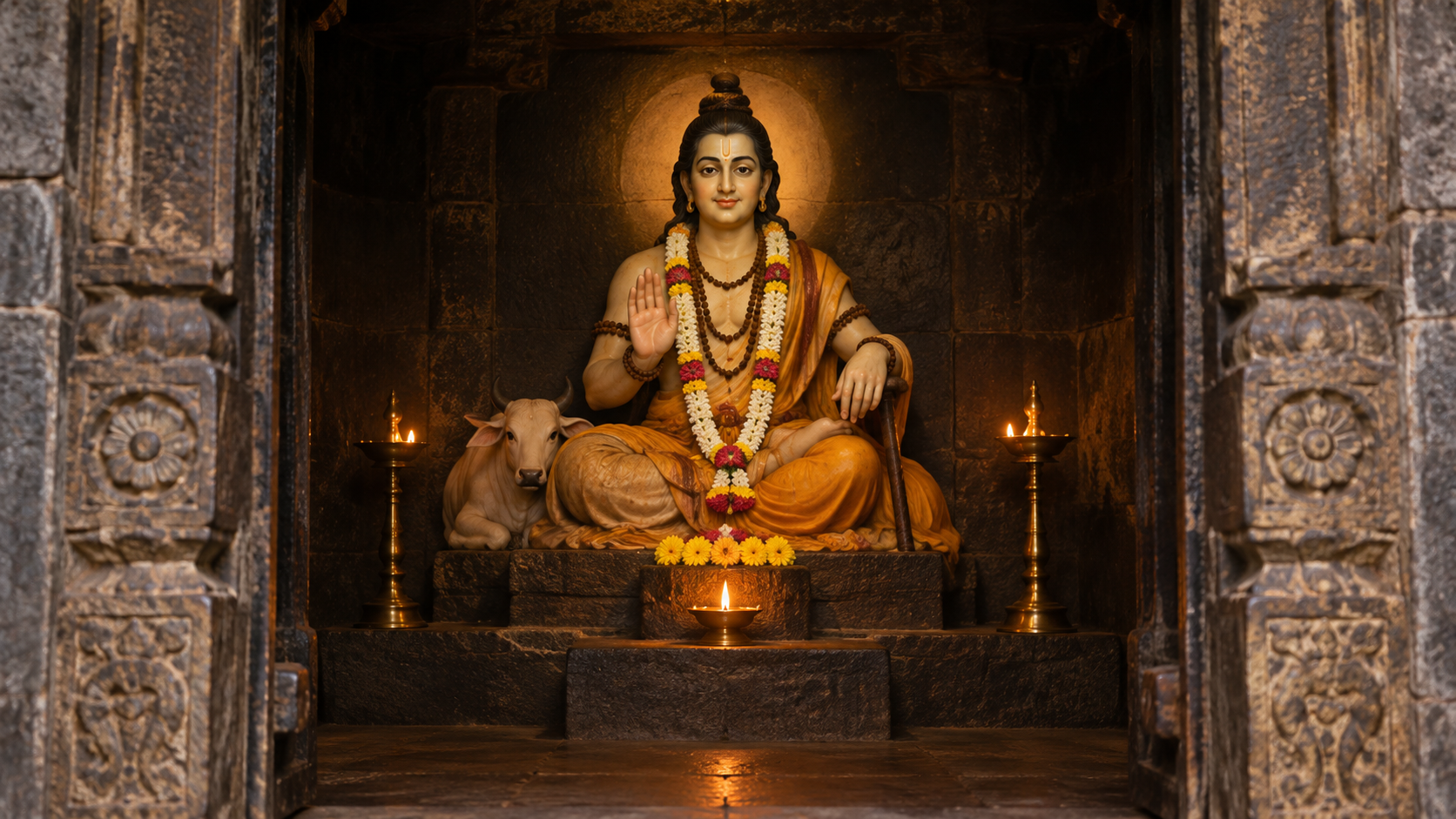
Ekamukhi means single-faced. It describes the visible form of the murti. It does not, by itself, mean that Chattarki worships only one member of the Trimurti, nor does it identify a deity other than Dattatreya. Those conclusions would go beyond the name and setting of the shrine.
Dattatreya is understood as the son of Anasuya, manifested through the grace of Brahma, Vishnu and Maheshwara. More importantly for this shrine, he is revered as Sri Guru: the divine teacher in whom creation, preservation, dissolution and the reality beyond those functions can be contemplated together. The familiar teaching that the Guru is Brahma, Vishnu, Maheshwara and the supreme Brahman provides the devotional frame for approaching Chattarki.
A useful way to read the one face is therefore concentration rather than subtraction. Three faces can make the triune association visually explicit. One face can turn your attention toward the unity of the Guru who contains those functions. This is an interpretive way to enter darshan, not a claim that a surviving inscription has supplied a final doctrinal explanation for the murti.
That distinction matters because rare forms attract tidy origin stories. A precise account of when the Ekamukhi image was installed, who commissioned it, or why one face was chosen would require evidence such as an inscription, a sthala-purana, a firmly transmitted oral lineage or a ritual record. Until such evidence is identified, do not turn an appealing explanation into historical fact. You can honour the form without pretending that every stage of its origin is known.
Devotees also understand Datta as the Guru who responds when called, protects, guides and may appear in an unexpected circumstance. That living devotional conviction explains why the tradition cannot be reduced to iconography. The murti is not merely a rare specimen. It is the focus of a relationship between Guru and devotee.
Chattarki resets the usual timeline of Vijayapura
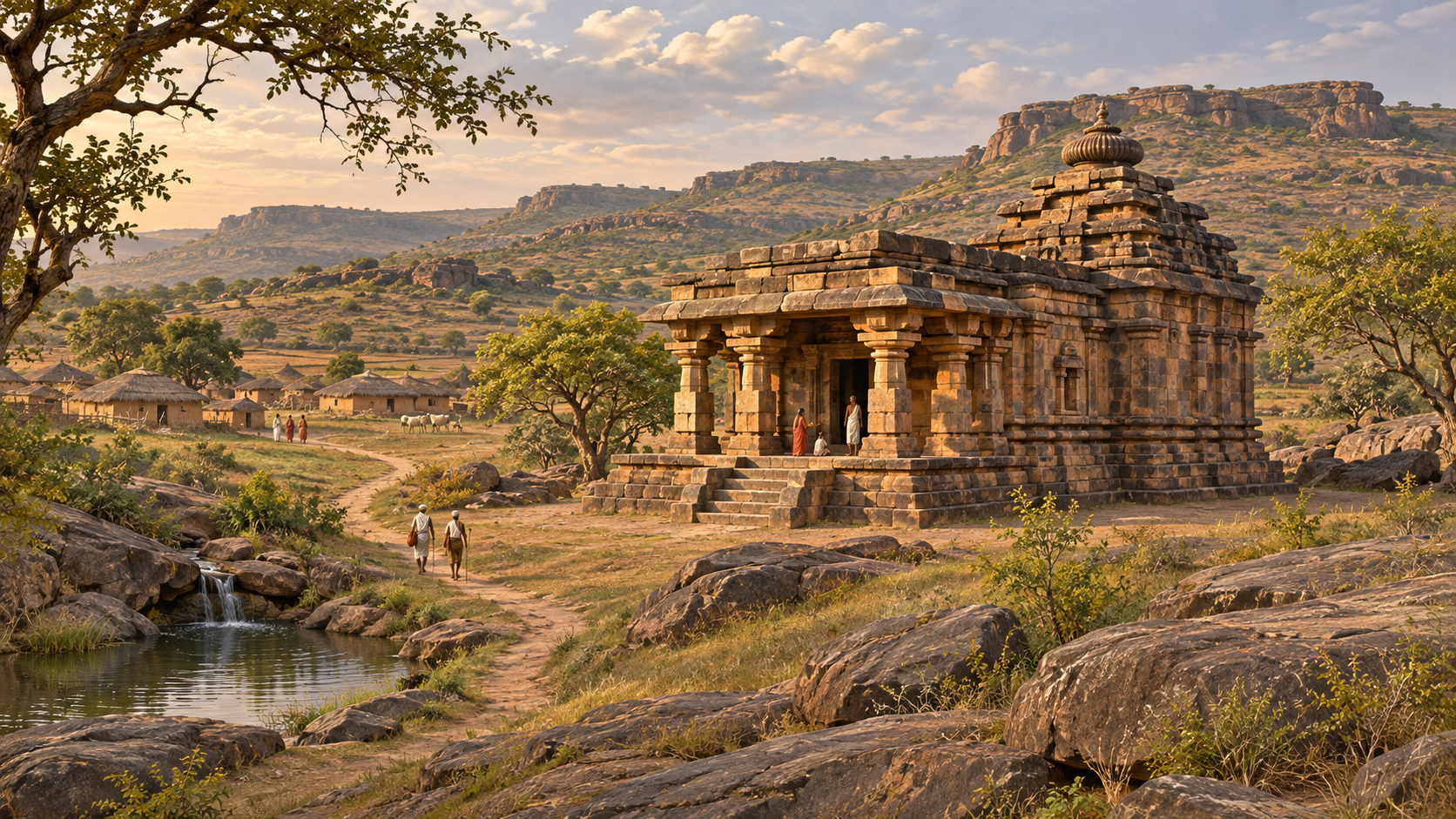
Many journeys through Vijayapura begin and end with the Adil Shahi period, when the city served as the dynasty’s capital from 1489 to 1686. Gol Gumbaz and the other monuments of that era deserve attention, but they are not the beginning of the region’s history. Chattarki places you in an earlier layer associated with the Kalyani Chalukyan tradition of temple building.
The shrine is generally attributed to the twelfth century and is built largely in basalt. Its geometry, ornament and stepped-diamond design connect it with the refined architectural work for which the Kalyani Chalukyan period in Karnataka is known. Chattarki therefore does more than add another monument to a travel itinerary. It corrects a compressed historical memory in which centuries of Dharmic architecture disappear behind the region’s better-publicised later monuments.
Two inscriptional details make that correction tangible. An inscription on the temple’s outer wall, dated approximately to the thirteenth century, refers to Rudra-loka. Another record preserves Chatturage as an earlier name of the settlement. These details show that the present village belongs to a much older cultural landscape; they do not merely decorate the temple with an impressive date.
Local historical memory also associates the area with Mahamandalika Gunadevarasa, who is said to have fought an adversary with help from the local people and rewarded them with grants after his victory. Keep the levels of evidence distinct: stone architecture can be examined stylistically, inscriptions are documentary records, and locally transmitted accounts require their own evaluation. Treating all three as identical proof weakens the history instead of defending it.
Together, the surviving elements point toward a world in which a temple was not an isolated worship chamber. It stood within networks of patronage, political authority, community gathering, artistic work and sacred learning. When you see the congregation spaces inside Chattarki, that larger social role becomes easier to recognise.
The location itself demands preparation. Chattarki is roughly 50 kilometres from Vijayapura, but roadside visibility should not be assumed: the shrine stands toward the far end of the village, and even a driver from Vijayapura needed guidance for the final turn during the recorded journey. Confirm the last part of the route locally, as well as current access and worship timings, rather than depending on the fame of the temple to produce obvious signboards.
Read the Chalukyan temple from the outside inward
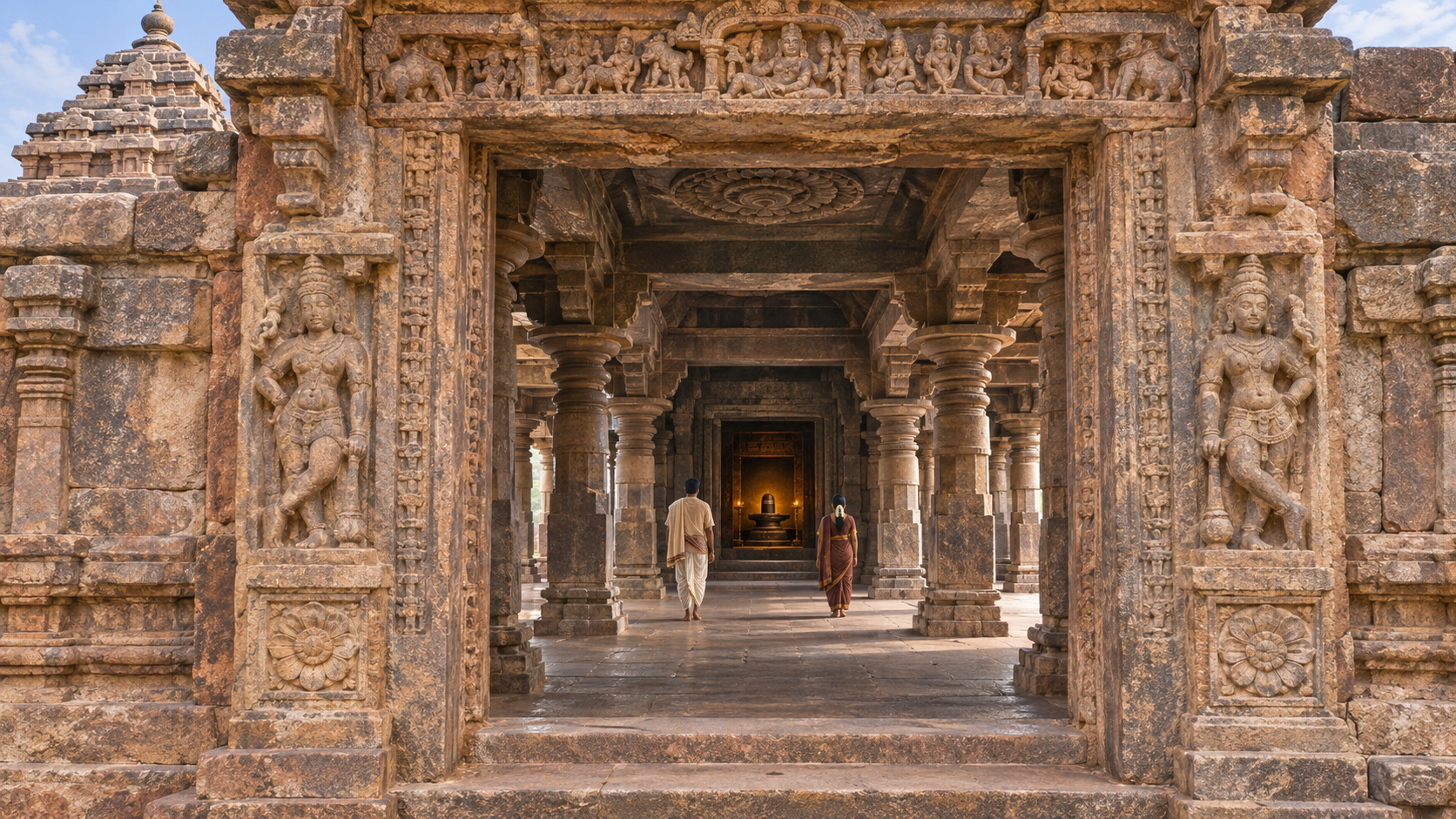
Two similar terms describe different things here. Ekamukhi refers to the one-faced form of Dattatreya. Ekakuta refers to the temple’s single-shrine architectural plan. Keeping them separate prevents a common misunderstanding: one is about sacred representation, while the other is about the organisation of the building.
Do not rush directly to the garbhagriha and leave after darshan. Where access and temple rules permit, move through the complex in sequence. Each space tells you something different about the tradition:
- Begin with the exterior geometry. The shrine is recognised as a notable stepped-diamond temple of the Kalyani Chalukyan tradition. Look at the rhythm of projections and recesses rather than viewing the wall as a flat surface. The changing angles allow light and shadow to animate the stonework.
- Notice the entrances. The complex has approaches on the eastern, western and northern sides. Multiple entrances affect how worshippers move between the outer world, gathering areas and more concentrated sacred space.
- Look for the inscription without touching it. The approximately thirteenth-century record is on an outer wall. Do not rub it, chalk it, wet it for a photograph or trace its letters. Physical contact undertaken in the name of documentation can damage the very evidence a visitor hopes to preserve.
- Pause at the Nandi Mantapa. Its presence within a Dattatreya complex should prompt attention, not a hurried sectarian conclusion. The mandapa participates in the continuing ritual life of the site, including its association with the utsava murti. A Nandi alone cannot settle every question about the temple’s dedication or historical development.
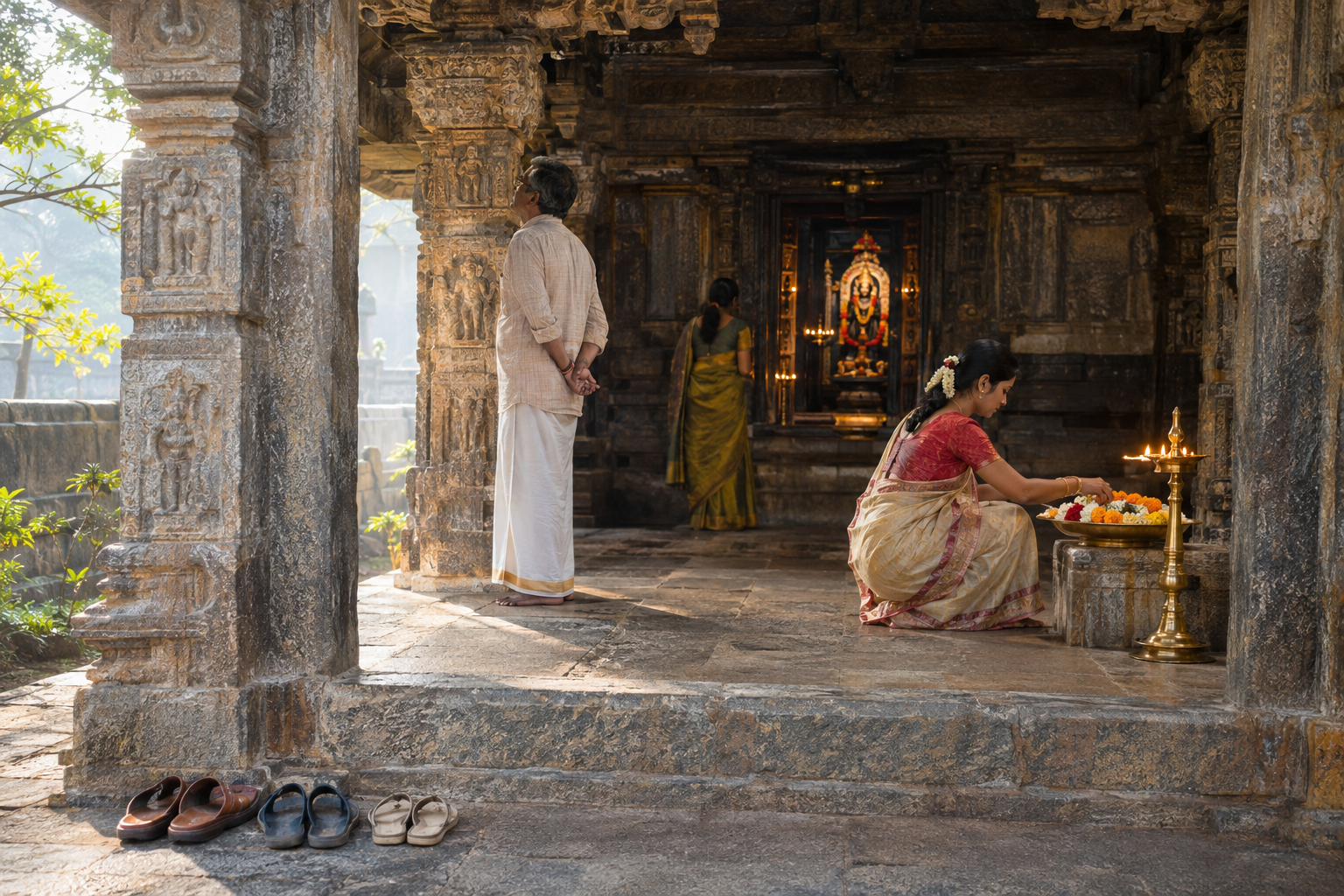
- Use the Mukhamantapa as a clue to community life. Broad, raised stone platforms run along its sides. Known in Kannada as jaguli or katte, they provided places where people could sit and gather. They are architectural evidence that a temple visit was not only a brief individual act before the deity.
- Give time to the Navaranga or Rangamantapa. Its elevated and carefully articulated space is suited to collective ritual and festival activity. You may readily imagine music, worshippers and traditional arts there, but keep imagination distinct from a documented programme for a particular historical period.
- Look upward at the bhuvaneshwari. The ceiling is one of the building’s strongest demonstrations of geometric planning and stone craftsmanship. Then locate the fierce Kirtimukhas. Their placement makes them appear to bear or guard the architectural mass around them.
This sequence helps you see why the temple itself belongs to the Dattatreya tradition. The one-faced murti is its devotional centre, but the mantapas, seats, entrances, ceiling and ritual movement show how that devotion was given a durable social and architectural form. Separating the deity from these spaces would leave half the tradition unread.
Chattarki is also a living sacred place, not an archaeological set. Give worship priority over photography, ask before recording the murti or rituals, and do not obstruct a doorway or circumambulation route while examining carvings. If a caretaker gives you a local explanation, note it respectfully and record who provided it. That lets you preserve oral memory without silently converting it into an inscriptional claim.
Key takeaways for a meaningful visit
- Identify the form accurately: Ekamukhi describes the one-faced Dattatreya murti; Ekakuta describes the single-shrine temple plan.
- Do not divide the theology mechanically: one face does not establish worship of only one member of the Trimurti. Approach the murti through the unified idea of Sri Guru.
- Separate observation from interpretation: write down what you saw, what an inscription records, what a local person told you and what you inferred as four different kinds of information.
- Place the shrine before the Adil Shahi era: its twelfth-century attribution and Kalyani Chalukyan design reveal a much older layer of the Vijayapura region.
- Read the whole complex: the Nandi Mantapa, Mukhamantapa, jaguli or katte, Navaranga, bhuvaneshwari and Kirtimukhas explain how worship, gathering and craftsmanship meet at the site.
- Prepare for the final approach: confirm local directions, access, timings and photography rules before leaving Vijayapura because the village shrine may not announce itself through prominent roadside signage.
- Protect what you came to learn from: never rub, chalk or wet an inscription or carving, and do not touch delicate stonework for a closer photograph.
If you visit Chattarki, make three passes through it. First, take darshan without trying to solve the image. Second, walk through the permitted architectural spaces and notice how they organise community and worship. Third, place the temple back into Vijayapura’s longer civilizational timeline. You will leave with more than a photograph of a rare murti: you will have begun to understand how Guru Datta, Chalukyan craftsmanship and local memory remain joined in one sacred place.
References

Leave a Reply
You must be logged in to post a comment.