
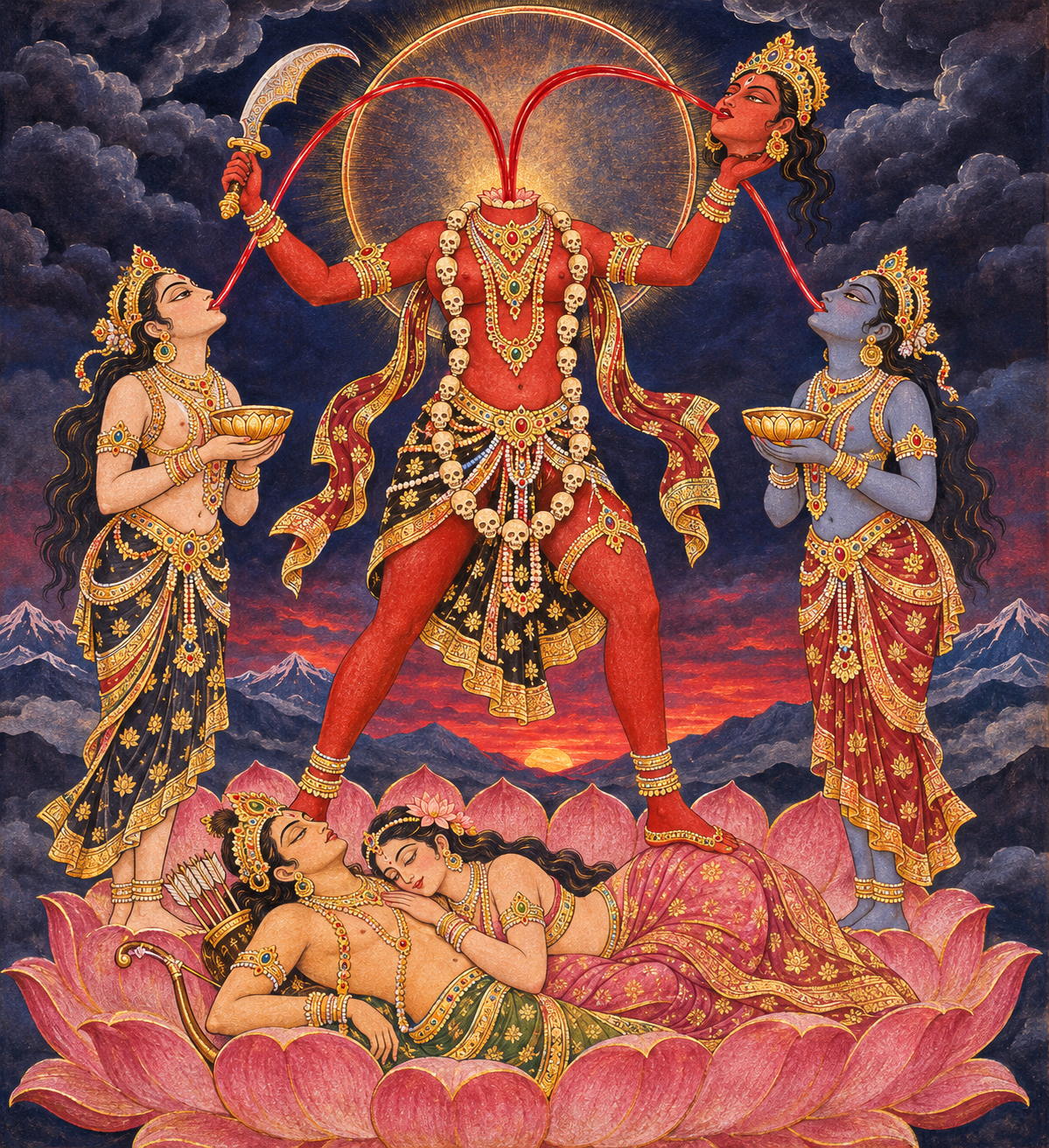
If you have just encountered Chinnamasta for the first time, the severed head and streams of blood may seem to offer an obvious verdict: this is an image of horror. That verdict comes from isolating the most shocking detail. Her iconography asks you to do the opposite.
Read the whole composition before interpreting any one part. The Goddess acts rather than suffers. Blood becomes nourishment as well as loss. Desire remains visibly present beneath transcendence. Once those relationships come into view, Chinnamasta no longer appears as a celebration of destruction. She reveals the difficult unity of life, death, desire, sacrifice, and awakened consciousness.
Start with what the complete image actually shows
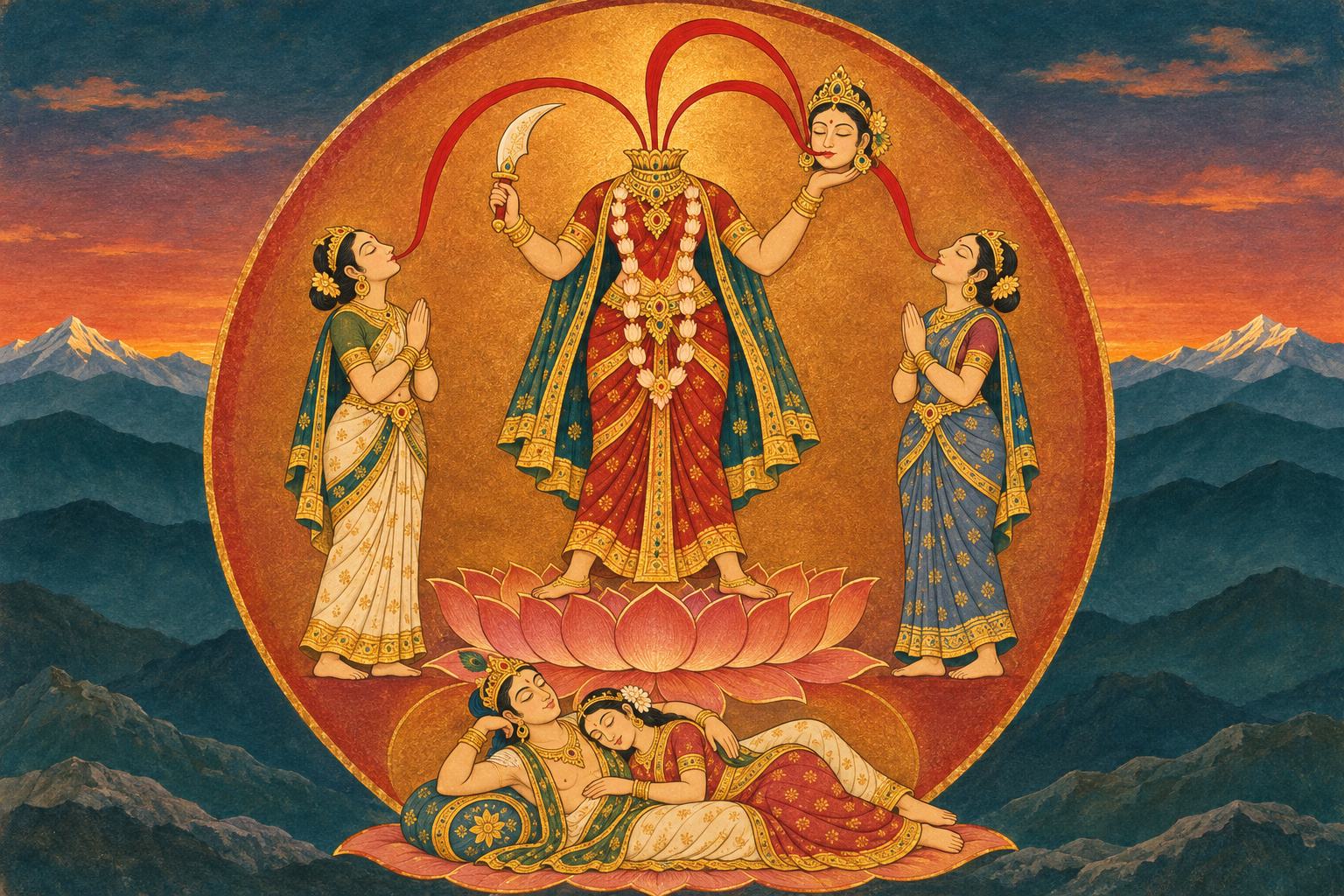
Chinnamasta is one of the ten Mahavidyas, and her form belongs to the symbolic language of Shakta Tantra. That context matters. A Mahavidya is not merely a personality to be judged by ordinary social expectations. Each is a form through which profound knowledge is made visible, including knowledge that polite or comforting images may leave untouched.
Before asking what Chinnamasta means, identify the main relationships in a typical depiction:
- The Goddess has severed her own head. No enemy stands over her as the victor.
- She remains upright, active, and conscious, commonly holding both the severed head and the blade associated with the act.
- Three streams of blood issue from her neck. The central stream enters her own mouth, while the other two feed the attendants beside her.
- Her two companions, often called Dakini and Varnini, receive the blood rather than recoiling from it.
- She is commonly nude and may wear ornaments or a garland associated with mortality and power.
- She stands upon a couple in sexual union, conventionally identified as Kama and Rati, desire and its delight.
Individual paintings, sculptures, and lineage-specific forms can differ in colour, ornament, posture, weapons, and the treatment of the attendant figures. Use the list as a visual map, not as a test that invalidates every variation. First notice what is present in the particular image before importing details from another version.
The practical rule is simple: do not interpret the severed head alone. The head, body, blade, blood, attendants, and couple constitute one symbolic statement.
The severed head signifies agency, not defeat
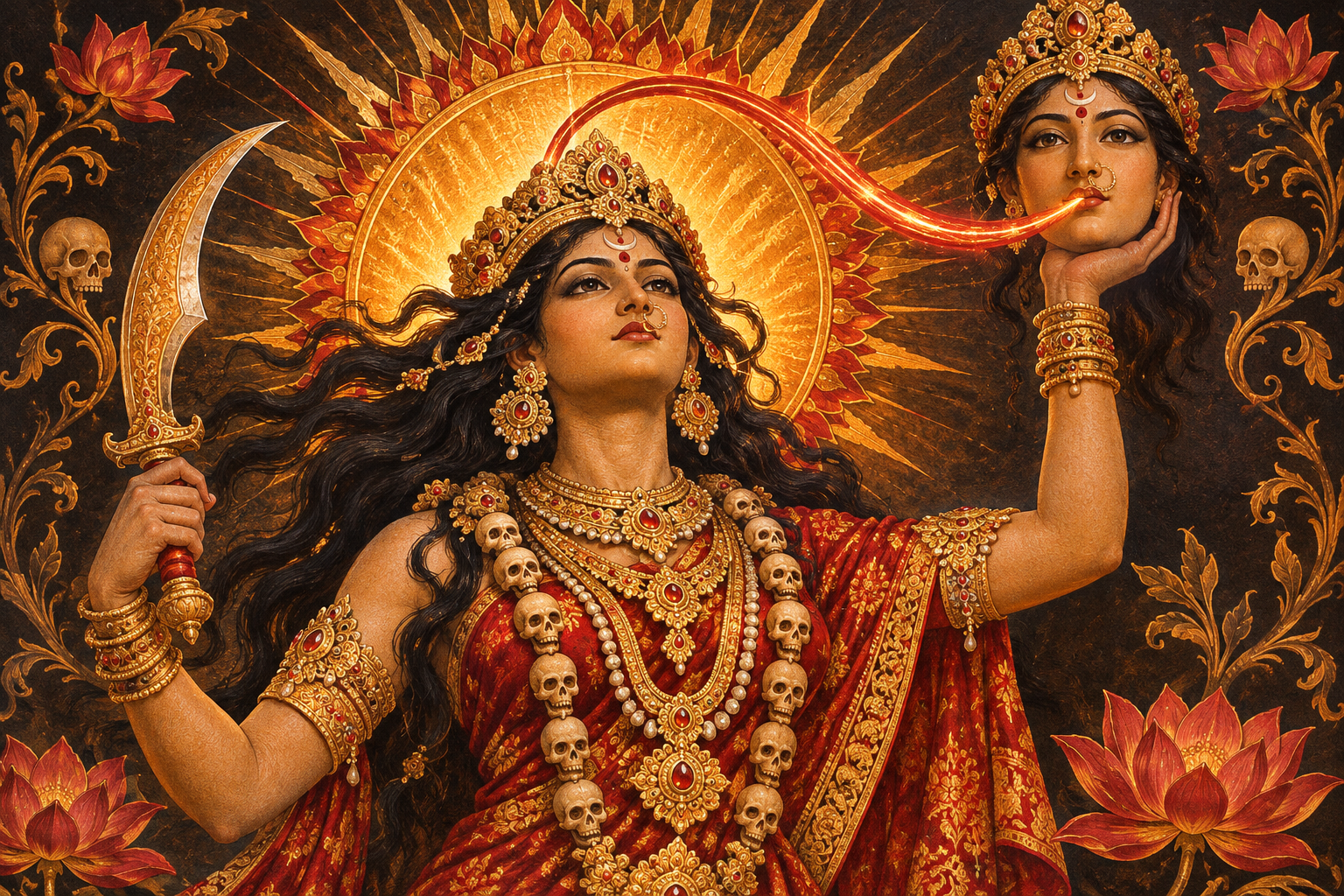
The decisive feature is not decapitation by itself. It is self-decapitation. Chinnamasta is neither conquered nor rendered powerless. She performs the act and remains sovereign afterward. Any reading that turns her into a passive victim has missed what the image visibly establishes.
The head is the seat through which we ordinarily construct identity: name, status, memory, opinion, self-image, and the continuing story of “me.” Chinnamasta’s blade can therefore be read as discriminating awareness that cuts identification with this limited self. This is not the destruction of consciousness. Her severed head remains alert and receives the central stream. Awareness persists when the usual emblem of ego has been separated from the body.
That distinction prevents a common mistake. “Ego death” can become a vague slogan suggesting numbness, self-erasure, or contempt for personal existence. Chinnamasta is anything but numb. Her posture, gaze, and circulating blood present concentrated power. The image points toward freedom from domination by the constructed self, not hatred of embodied life.
The blade sharpens this meaning. A cutting instrument divides one thing from another; symbolically, it evokes the capacity to distinguish the transient from the enduring and attachment from awareness. The act is immediate because some attachments cannot be negotiated away indefinitely. They must be seen clearly and severed at their root.
Her nudity reinforces the same movement. Clothing marks role, rank, convention, and social identity. The unclothed Goddess stands without those coverings. This does not make the image merely erotic, just as the blood does not make it merely violent. Nudity shows a power that cannot be reduced to a socially managed persona.
If you want to test an interpretation, ask three concrete questions: Who performs the action? Does consciousness disappear? Does the Goddess lose or retain power? Chinnamasta acts, remains aware, and retains power. Your interpretation should preserve all three observations.
Blood, attendants, and desire form one cycle of Shakti
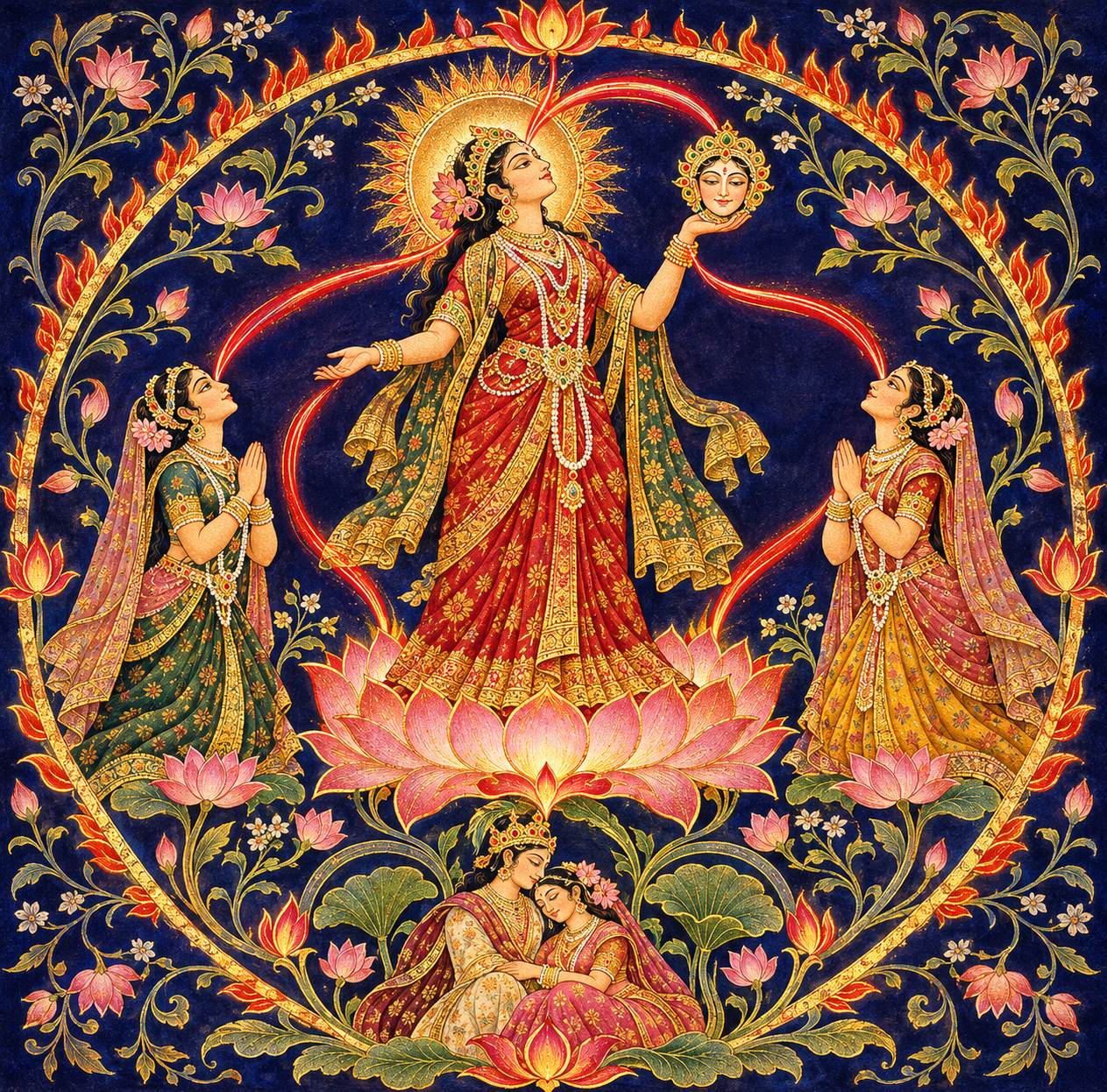
Blood is easy to read only as injury because that is its ordinary physical meaning. Within this composition, however, blood also travels as nourishment. It leaves the Goddess, sustains her, and feeds two beings beside her. Loss and generosity occupy the same visual event.
The three streams are therefore essential. The central stream returns to Chinnamasta’s own mouth, while the two outer streams reach her companions. She is at once giver, recipient, and source. Divine power is not pictured as a possession locked inside an isolated individual. It circulates.
Notice the attendants’ response. They do not flee, mourn, or attempt to reverse what has happened. They receive. Their participation shifts the scene from private injury to an exchange of vital power. A reading concerned only with death cannot explain why the blood feeds three mouths.
The couple beneath Chinnamasta introduces another apparent contradiction. Kama and Rati embody desire, attraction, pleasure, and the generative force of embodied existence. The Goddess stands above their union, but the union has not been erased from the image. Desire remains the base of the composition.
This positioning permits more than one complementary emphasis. Chinnamasta may be seen as mastering desire rather than being ruled by it. She may also be seen as transforming the same life-energy that appears as sexuality into awakened power. Most importantly, she does not teach that life becomes sacred only after fertility and desire have been denied. The sacred form rises in direct relation to them.
That is why “she crushes sexuality” is too small an explanation. It notices vertical position but ignores the flow of the whole image. Sexual union expresses the arising and continuation of life; blood sustains life while also signalling mortality; self-decapitation interrupts identification with the ordinary self. Birth, appetite, nourishment, death, and transcendence appear together because embodied existence contains all of them.
Read the composition from bottom to top and then outward. Begin with the generative couple. Move to the standing Goddess who interrupts ordinary identity. Follow the blood from her neck to her own mouth and to the two attendants. This visual route turns a collection of disturbing details into a coherent meditation on Shakti: the energy that creates, sustains, consumes, and exceeds individual life.
How to approach Chinnamasta without flattening her meaning
Chinnamasta is difficult partly because viewers often decide what the image must mean before examining its internal relationships. You can avoid that error with a disciplined sequence.
- Describe before interpreting. Write one sentence containing only what you can see: who stands, who lies below, what flows, and who receives it. Do not use words such as evil, morbid, liberated, or transcendent yet.
- Identify agency. Ask who acts and who responds. The Goddess initiates the central action; the attendants receive its life-bearing result.
- Read apparent opposites together. Pair death with nourishment, nudity with freedom from social identity, sexuality with spiritual power, and severance with continuing awareness.
- Check your reading against every major element. If an explanation accounts for the head but not the attendants or the couple, it is incomplete.
- Separate study from ritual practice. Anyone may approach the iconography respectfully and learn its visual grammar. Mantra, initiation-based worship, and specialised Tantric disciplines belong within qualified guidance rather than casual experimentation.
Four misreadings to leave behind
- “This is a Hindu image of evil.” Fierceness is not the same as malevolence. Chinnamasta’s actions disclose and nourish; they are not directed toward tormenting a helpless victim.
- “The image glorifies physical self-harm.” Sacred iconography communicates through a divine body and symbolic impossibility. It is not a literal instruction for human conduct.
- “The Goddess rejects the body and sexuality.” Her living body remains powerful, while the erotic couple is retained within the sacred composition rather than banished from it.
- “Everything means only the destruction of ego.” Severing limited identity is central, but it does not explain the nourishing streams, the attendants, or the generative base. Chinnamasta also reveals circulation, interdependence, and the continuity of life through transformation.
There is another distinction worth keeping. Iconographic interpretation can tell you how visual elements work together, but it should not pretend that one English phrase exhausts a deity. “Ego transcendence,” “sacrifice,” “life-force,” and “mastery of desire” are useful doors. None is the entire shrine.
Key takeaways
- Chinnamasta is self-decapitated, so the scene begins with divine agency rather than victimhood.
- Her living head and active body show that awareness and power continue after the symbolic severing of limited identity.
- The three streams of blood make nourishment as important as death: the Goddess sustains herself and her two attendants.
- Kama and Rati place desire and generative life inside the sacred image; Chinnamasta masters and transforms that energy rather than merely denying it.
- The composition must be read as a whole. An explanation that cannot account for the blade, blood, attendants, and erotic base remains incomplete.
- Respectful study is open to the viewer, while specialised Tantric ritual and mantra practice call for competent lineage-based guidance.
The next time you meet this form, give the image a full minute before deciding how it makes you feel. Trace the movement from the couple to the Goddess, and from her neck to the three receiving mouths. Then ask what remains alive after the head has been severed. That question brings you closer to Chinnamasta’s challenge: not to look away from life’s contradictions, but to discover the consciousness capable of holding them together.
References

Leave a Reply
You must be logged in to post a comment.