

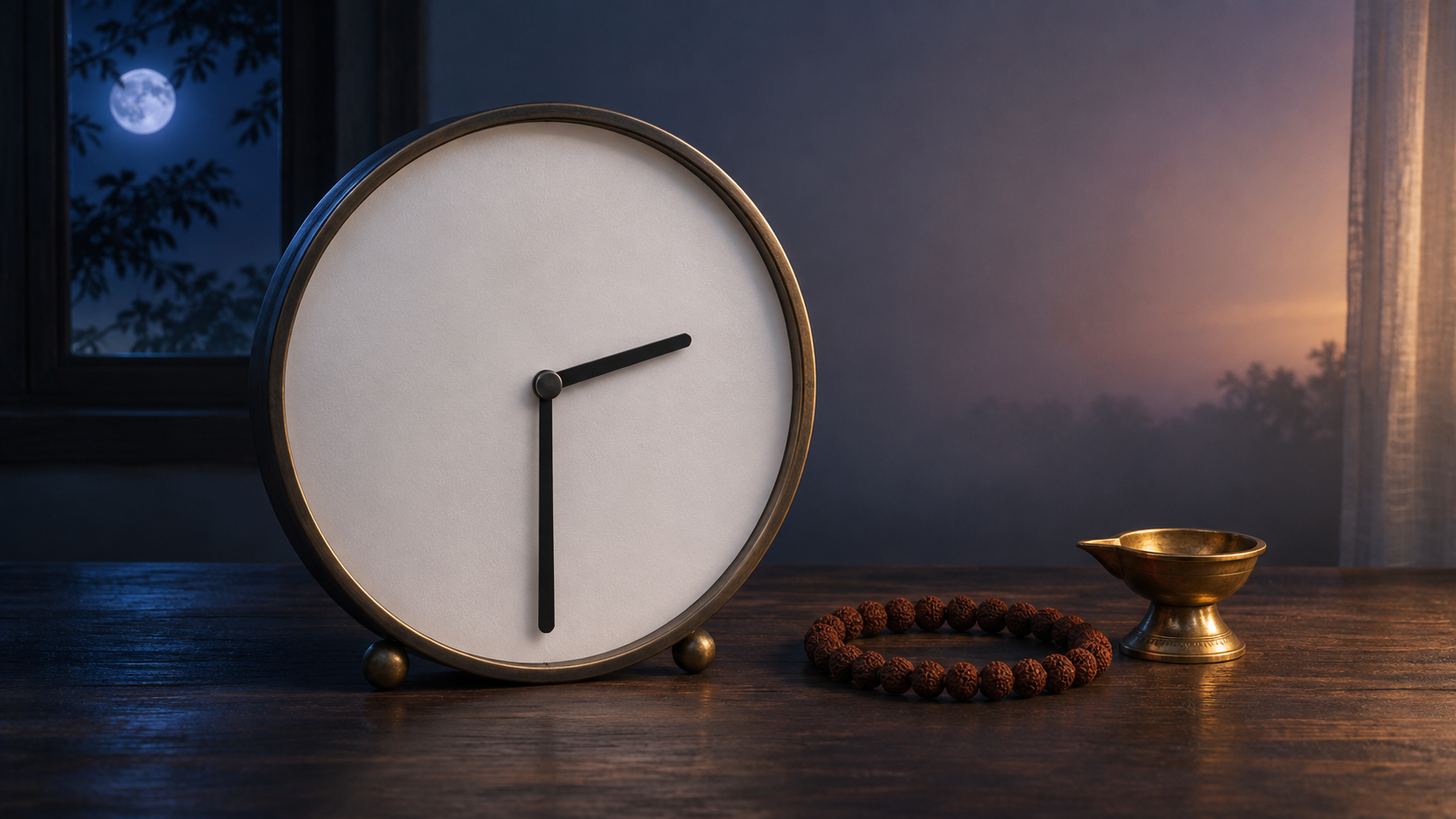
If you are deciding whether to mark November 20, 2026 as Dashami or Ekadashi, the answer depends on the hour. Dashami continues only until 2:30 AM. Shukla Paksha Ekadashi applies after that transition and therefore governs nearly the entire civil date.
This distinction matters when you are recording a sankalpa, arranging a vrata, or scheduling a ritual near the boundary. Do not rely only on the large tithi name printed beside a date. Use the tithi prevailing when the observance actually begins, and verify the published time for your location.
The Panchang reading for November 20, 2026
| Panchang element | Reading |
|---|---|
| Day | Friday, November 20, 2026 |
| Paksha | Shukla Paksha, the waxing phase of the lunar cycle |
| Opening tithi | Dashami, the tenth tithi |
| Tithi transition | Dashami lasts until 2:30 AM; Ekadashi begins afterward |
| Main tithi for the date | Shukla Paksha Ekadashi, the eleventh tithi |
A tithi is a lunar division, so its boundary does not have to coincide with midnight, sunrise, or the end of a civil date. That is why both Dashami and Ekadashi occur on November 20 even though Ekadashi is the useful day label in most regions.
How to apply the 2:30 AM transition
The practical rule is simple: compare the starting time of your activity with the tithi boundary. The name attached to the date is secondary.
- For an activity before 2:30 AM: use Shukla Paksha Dashami in the sankalpa or calendar record.
- For an activity after 2:30 AM: use Shukla Paksha Ekadashi.
- For ordinary daytime worship: Ekadashi is the relevant tithi because the transition has already occurred.
- For an observance close to the boundary: check a Panchang configured for your city before proceeding. Treat 2:30 AM as the published reference time, not as a universal time that can be transferred unchanged across time zones.
This method prevents a common calendar mistake: treating a civil date as though it must contain only one tithi. November 20 contains parts of two, but they are not equally significant for someone acting during normal daytime hours.
What the tithi does and does not settle
You can confidently use this entry to identify the transition from Dashami to Ekadashi. It does not, by itself, settle every question about an Ekadashi vrata or an auspicious muhurta.
- For a personal or family vrata: confirm the observance date under the tradition followed by your household. Rules can depend on how Ekadashi relates to sunrise, not merely on whether it appears somewhere within the civil date.
- For parana: obtain the local breaking window separately. The time when Ekadashi begins does not supply the time for concluding the fast.
- For a temple programme: follow the temple’s announced schedule. Its calendar may be prepared for a particular location, sampradaya, or ritual convention.
- For a major muhurta: do not make the decision from the tithi alone. A complete Panchang assessment also considers vara, nakshatra, yoga and karana, along with the relevant local timings.
No verified nakshatra, yoga, karana, rashi, sunrise, sunset, or auspicious-period timing is included here. Adding any of those from assumption would create false precision. If your decision depends on them, consult a full location-specific Panchang rather than filling the gaps from a calendar for another city.
Key takeaways
- Friday, November 20, 2026 begins in Shukla Paksha Dashami.
- Dashami ends at 2:30 AM in the published calendar timing.
- Shukla Paksha Ekadashi begins after 2:30 AM and is the principal tithi for the rest of the date.
- Use Dashami only for an activity occurring before the transition; use Ekadashi after it.
- Verify the boundary locally when planning a vrata, sankalpa, temple ritual, or other time-sensitive observance.
If you are planning ordinary daytime worship on November 20, mark Ekadashi. If the observance carries a formal fasting rule, a precise sankalpa, or a significant muhurta, take one further step: open a Panchang set to your city and confirm the local boundary before fixing the time.
References

Leave a Reply
You must be logged in to post a comment.