
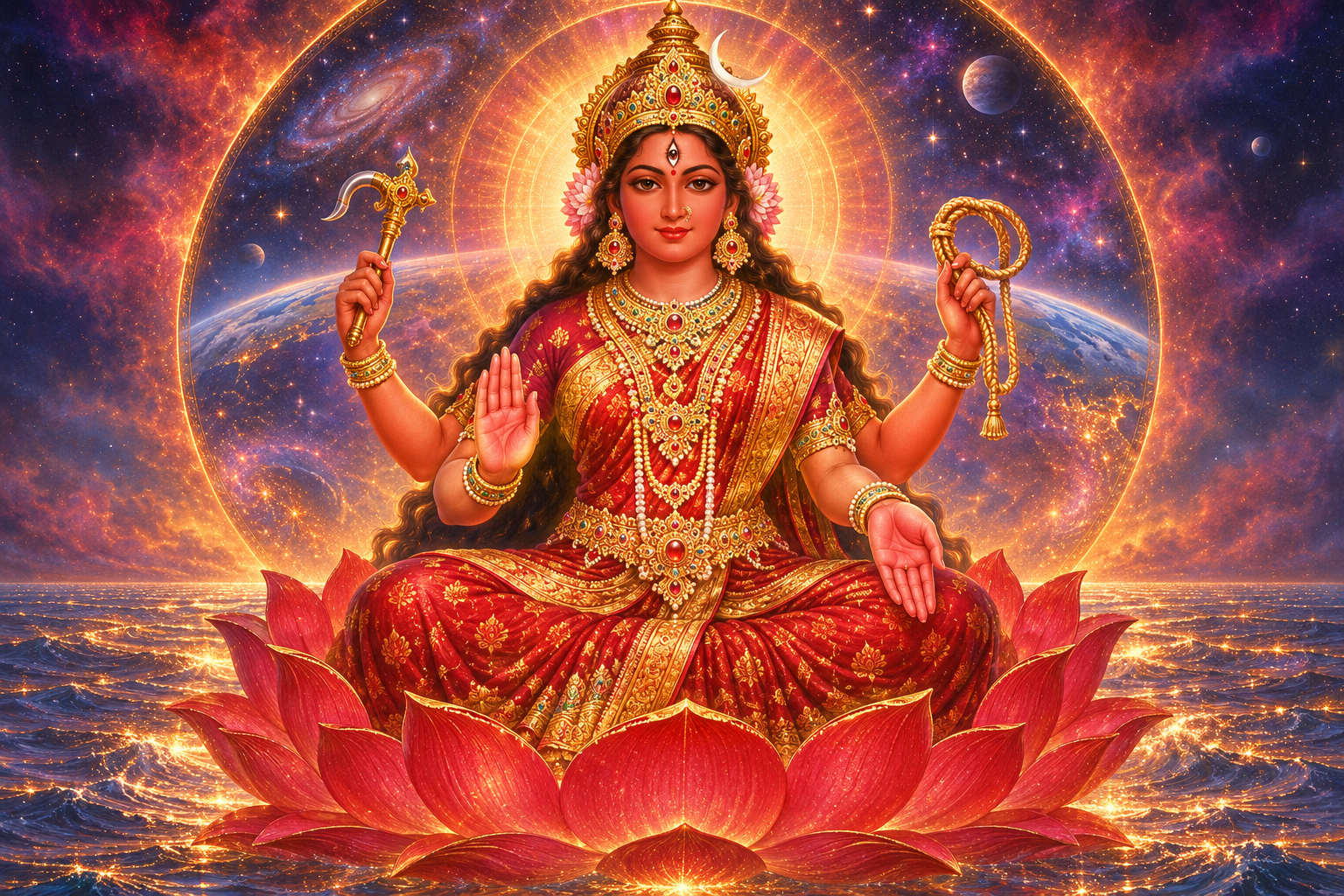
You may recognize an image as Bhuvaneswari yet still wonder what you are meant to see. Is every colour, ornament, gesture, and surrounding figure a fixed theological code, or are some features particular to a temple, lineage, or artist?
Begin with the claim made by the whole sacred form: Bhuvaneswari is not merely a goddess who governs a universe outside herself. She is revered as the Divine Mother embodied as the universe itself. That principle gives you a reliable centre from which to read the image without turning every visual detail into guesswork.
Identify Bhuvaneswari before interpreting her details
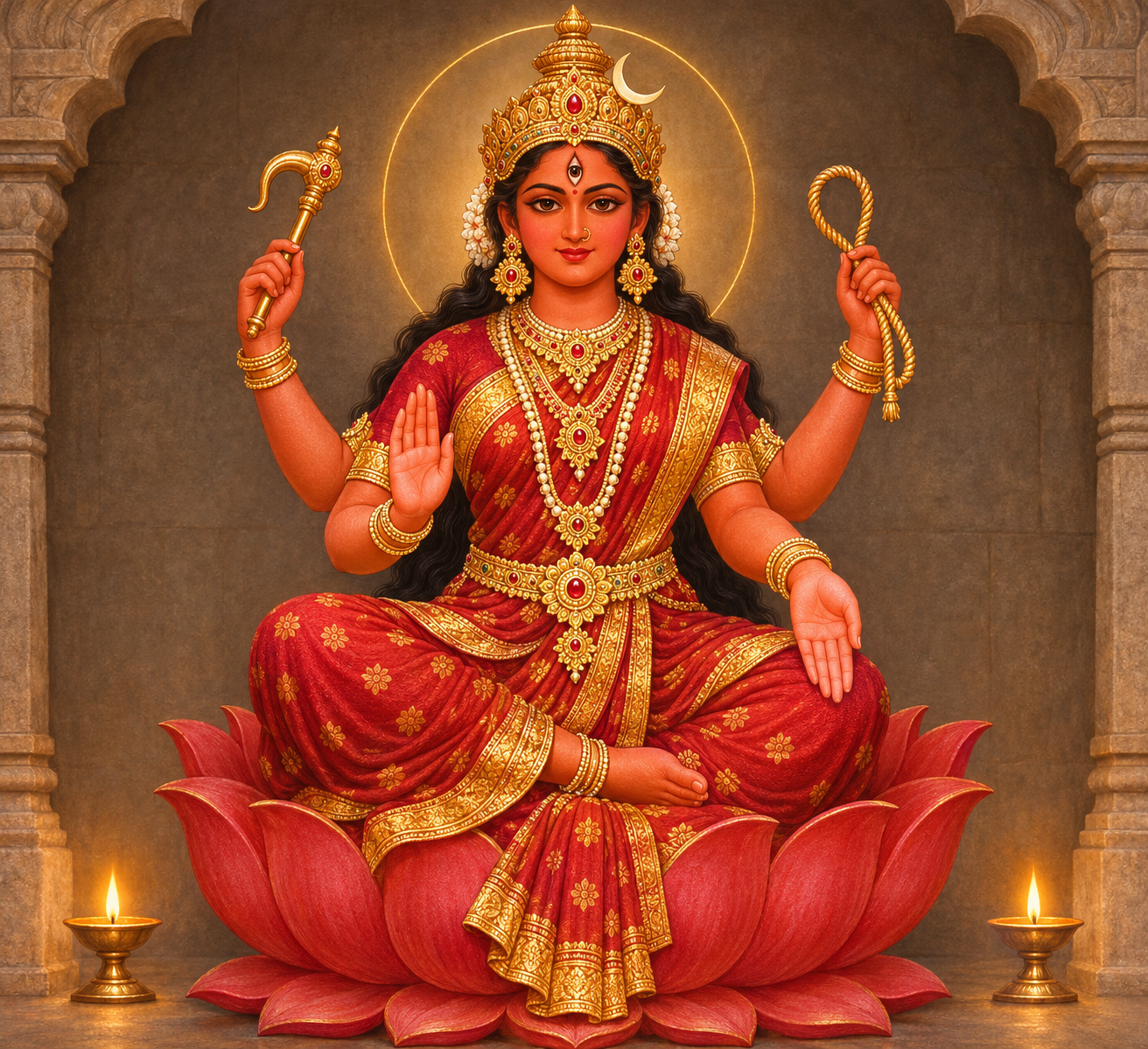
Bhuvaneswari belongs to the ten Mahavidyas, the supreme manifestations of the Divine Mother revered in the Shakta tradition. That setting matters. An image of her should not be reduced to a generic portrait of a benevolent goddess, nor should it be read apart from the larger Mahavidya vision of divine reality.
Iconography is the visual grammar through which a sacred form is identified and understood. Symbolism is the meaning carried by that form. The two belong together, but they are not identical. A visible feature can help identify a deity, express a teaching, reflect a local convention, or perform more than one of those functions at once.
Use three levels of confidence when you examine a particular image:
- Established identity: Record the name given by the shrine, lineage, inscription, or trustworthy description. If the form is identified as Bhuvaneswari, place it first within the Mahavidya tradition.
- Visible observation: Describe only what is actually present. Note posture, gestures, objects, expression, colour, setting, surrounding figures, and relative scale without assigning meanings prematurely.
- Interpretation: Connect a feature to Bhuvaneswari’s cosmic sovereignty only when the connection is supported by the tradition presenting the image. Label a personal or aesthetic reading as such.
This discipline prevents two common errors. The first is treating every artistic choice as a universal doctrine. The second is dismissing the image as decoration and missing the theology communicated by its total composition.
Her name supplies the central symbolic key
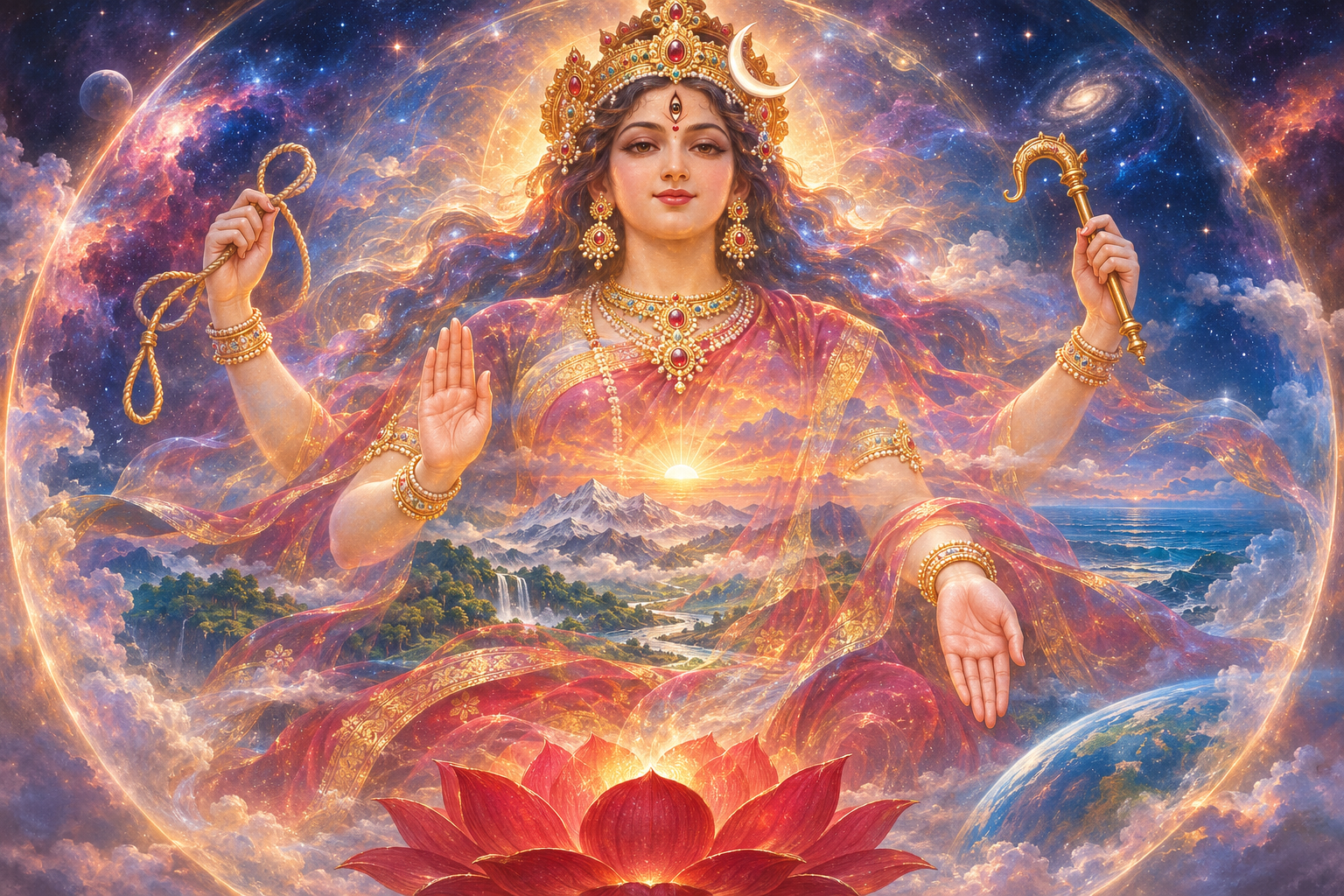
Bhuvaneswari’s name presents her as the ruler of the world and queen of the cosmos. Here, sovereignty should not be reduced to political power projected onto a divine figure. It signifies the primacy of the consciousness that pervades creation.
That distinction changes how you look. If she were only a ruler standing outside the world, the universe would be her possession. As the universe’s embodiment, the world is not separate territory beneath her authority. It exists within the sacred reality she makes present.
Her cosmic queenship therefore carries three connected meanings:
- Sovereignty: No part of manifested existence lies outside the reality she represents.
- Immanence: Divine consciousness is present throughout creation rather than confined to a remote realm.
- Total form: The image points beyond one divine personality to the universe understood as the body or manifestation of the Divine Mother.
This is the test to apply to any proposed interpretation. Ask whether it clarifies her cosmic identity or merely attaches a free-floating meaning to an isolated detail. A sound reading should return you to Bhuvaneswari as sovereign consciousness pervading the whole, not leave you with a collection of unrelated symbols.
Read the whole composition before decoding its parts
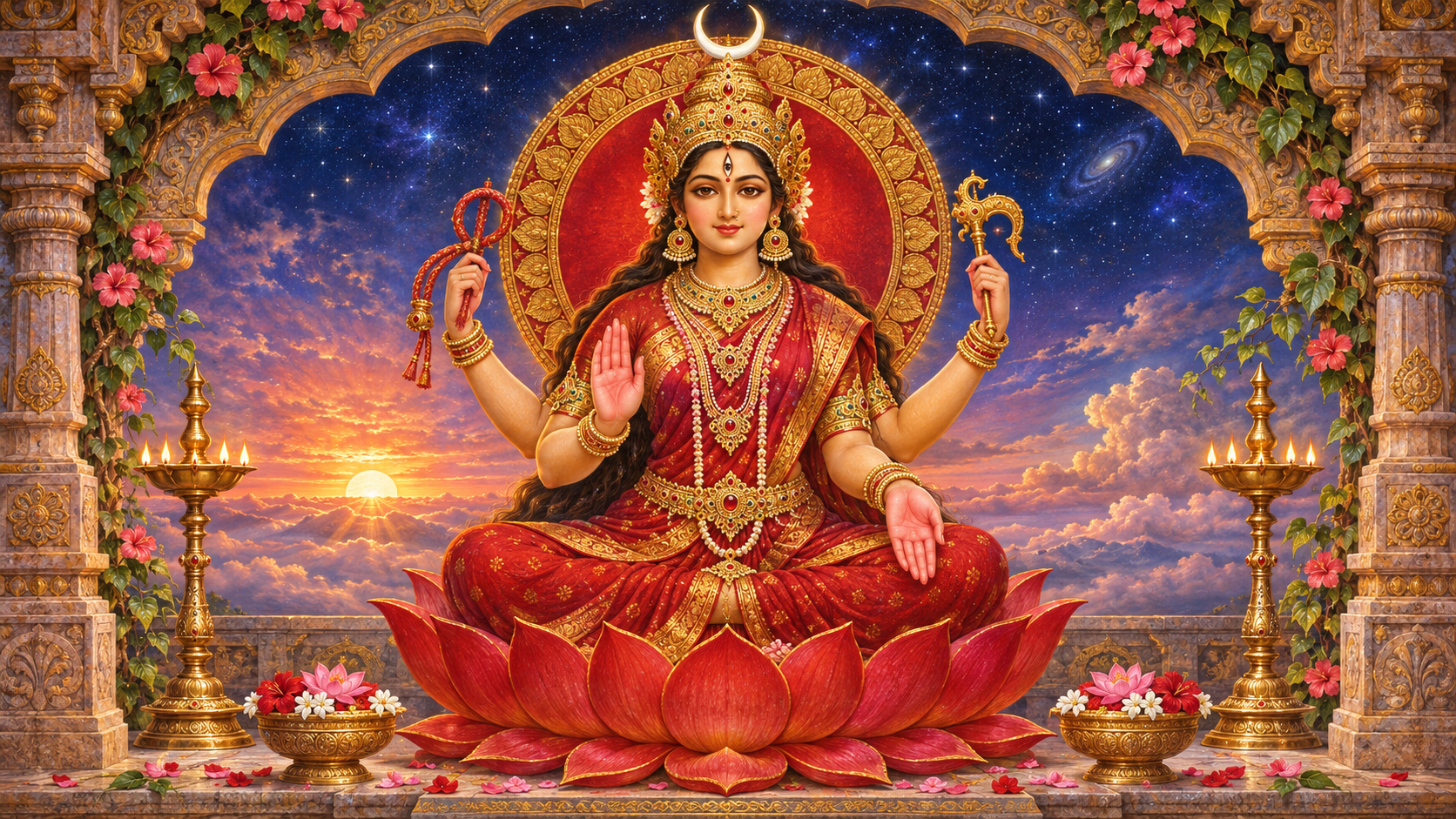
The quickest way to misread sacred art is to begin with an isolated object and search for a universal definition. The same visual element can carry different emphases in different ritual and artistic settings. Start instead with the relationship between the deity and everything around her.
- Confirm the context. Determine whether you are looking at a temple murti, a ritual image, a printed devotional picture, or a modern artistic rendering. Do not assume that conventions from one setting automatically govern another.
- Find the visual centre. Notice how placement, scale, symmetry, surrounding space, and attendant forms direct attention. These compositional choices may express sovereignty even before an individual attribute is interpreted.
- Inventory what you can see. Write a literal description: what is shown, where it appears, and how it relates to the rest of the image. Observation should come before explanation.
- Check the presenting tradition. Use the shrine’s identification, lineage teaching, accompanying text, or established description to determine whether a feature has a stated meaning.
- Return to the theological whole. Ask how the details work together to present the Divine Mother as cosmic sovereign and all-pervading consciousness.
This sequence is especially important when two images of Bhuvaneswari differ. Variation does not automatically mean that one is defective. It may reflect a distinct ritual context or artistic convention. Preserve the difference until you have evidence for explaining it.
Keep doctrine, local convention, and personal response distinct
A devotional image can operate at several levels simultaneously. You can respond to its beauty, learn its theological meaning, and encounter it as a sacred presence. Confusion begins only when one level is presented as if it proves another.
If you are writing a caption, teaching a class, or explaining an image to your family, use a four-part description:
- Identification: “This form is identified as Bhuvaneswari, one of the ten Mahavidyas.”
- Theological core: “She embodies the universe and represents the sovereign consciousness present throughout creation.”
- Visible features: Describe the particular image without claiming that every detail appears in every representation.
- Supported symbolism: Explain only the meanings established for this form or supplied by the tradition to which the image belongs.
Use careful language when certainty changes. “This image shows” is appropriate for a visible fact. “In this tradition, the feature signifies” identifies a received interpretation. “This may evoke” marks an informed possibility. “It makes us feel” names a personal response. Those statements can all be worthwhile, but they should not be treated as interchangeable.
This approach also protects the devotional character of the image. Bhuvaneswari’s icon is not merely a puzzle whose pieces have to be decoded. Its symbolism gathers the mind toward a single recognition: the world you inhabit is not outside the reach of the Divine Mother.
Key takeaways
- Bhuvaneswari is one of the ten Mahavidyas revered within the Shakta tradition.
- Her name and identity express cosmic sovereignty: she is the ruler of the world because she embodies the universe, not because she merely governs it from elsewhere.
- Her deepest symbolism is the presence of sovereign consciousness throughout creation.
- Read a depiction from the whole composition toward individual features, not from an isolated symbol outward.
- Separate what the image visibly shows from what a particular lineage teaches and from what you personally experience.
- When depictions differ, investigate their contexts instead of forcing them into one supposedly universal visual formula.
The next time you encounter Bhuvaneswari, give the whole image your first minute. Confirm who is being shown, observe how the composition organizes your attention, and then ask how its details reveal the universe as permeated by divine consciousness. That order turns looking into contemplation while keeping interpretation honest.
References

Leave a Reply
You must be logged in to post a comment.