

You may know the uncomfortable point where a sincere search stops feeling noble. The goal is still right, but your energy is spent, your bearings are gone, and the first refuge that appears begins to look like the destination. Svayamprabha’s cave speaks precisely to that moment.
Its spiritual value lies in a demanding distinction: relief is not liberation, splendour is not necessarily truth, and entering the inner world is not the same as completing your dharma. The episode gives you a way to examine spiritual experiences without dismissing them and without becoming captive to them.
The search reaches the limit of ordinary effort

In the Kishkindha Kanda episode, the search for Sita brings the monkey party to the edge of what it knows. Exhausted, hungry, and disoriented, the searchers enter a dark cave and discover a dazzling golden realm within. It is the abode of Svayamprabha.
The sequence matters. They do not enter the cave while comfortably sightseeing. They enter after their normal resources have failed. Hunger, fatigue, and lost direction make the inward turn unavoidable. That is often how an inner crisis begins: a method that once worked no longer carries you forward, yet the duty that set you in motion has not disappeared.
The cave can therefore be read as the concealed interior of human experience. From outside, it appears dark and uncertain. Once entered, it contains beauty, nourishment, fascination, and danger. The searchers have crossed from a problem they can see into a realm whose attractions are harder to judge.
This symbolic reading should not flatten the narrative into a code in which each character has only one meaning. Sita remains Sita, the search remains part of the Ramayana’s sacred action, and Svayamprabha remains a person within that action. Allegory adds a contemplative dimension; it does not erase the story.
Why a golden cave can still represent bondage

The dark entrance is the easy symbol. It resembles ignorance, fear, and the loss of familiar direction. The golden interior is more searching. It warns that an enclosure does not stop being an enclosure merely because it is beautiful.
This is especially relevant to spiritual life. A powerful meditation, an elegant philosophy, mastery of ritual, admiration from others, or a compelling vision may be meaningful. Any of them can also become something you possess, repeat, display, or use to postpone a difficult obligation. The problem is not beauty or spiritual experience. The problem is attachment to an experience that interrupts the search it was supposed to serve.
The most reliable test is not how extraordinary an experience felt but what it enables afterward. Ask:
- Has this made my actual duty clearer, or only made ordinary duty seem beneath me?
- Am I less governed by fear and craving, or have I acquired a more refined object of craving?
- Has my attention become steadier and more truthful, or am I chasing a repetition of one impressive state?
- Am I returning to service, relationship, courage, and disciplined action, or using spirituality to remain unavailable?
These questions prevent two opposite mistakes. One is to assume that every pleasant inner state is liberation. The other is to become suspicious of all beauty, rest, or inwardness. The cave gives the searchers what they need at a moment of depletion, but it is not the destination of their mission. Refuge is legitimate; confusing refuge with fulfilment is the danger.
Exhaustion makes that confusion more likely. When you have struggled for a long time, the end of discomfort can feel like the arrival of truth. Treat that feeling as a signal to pause and discriminate. Do not make permanence out of the first place that gives you relief.
Svayamprabha represents light that is not another object
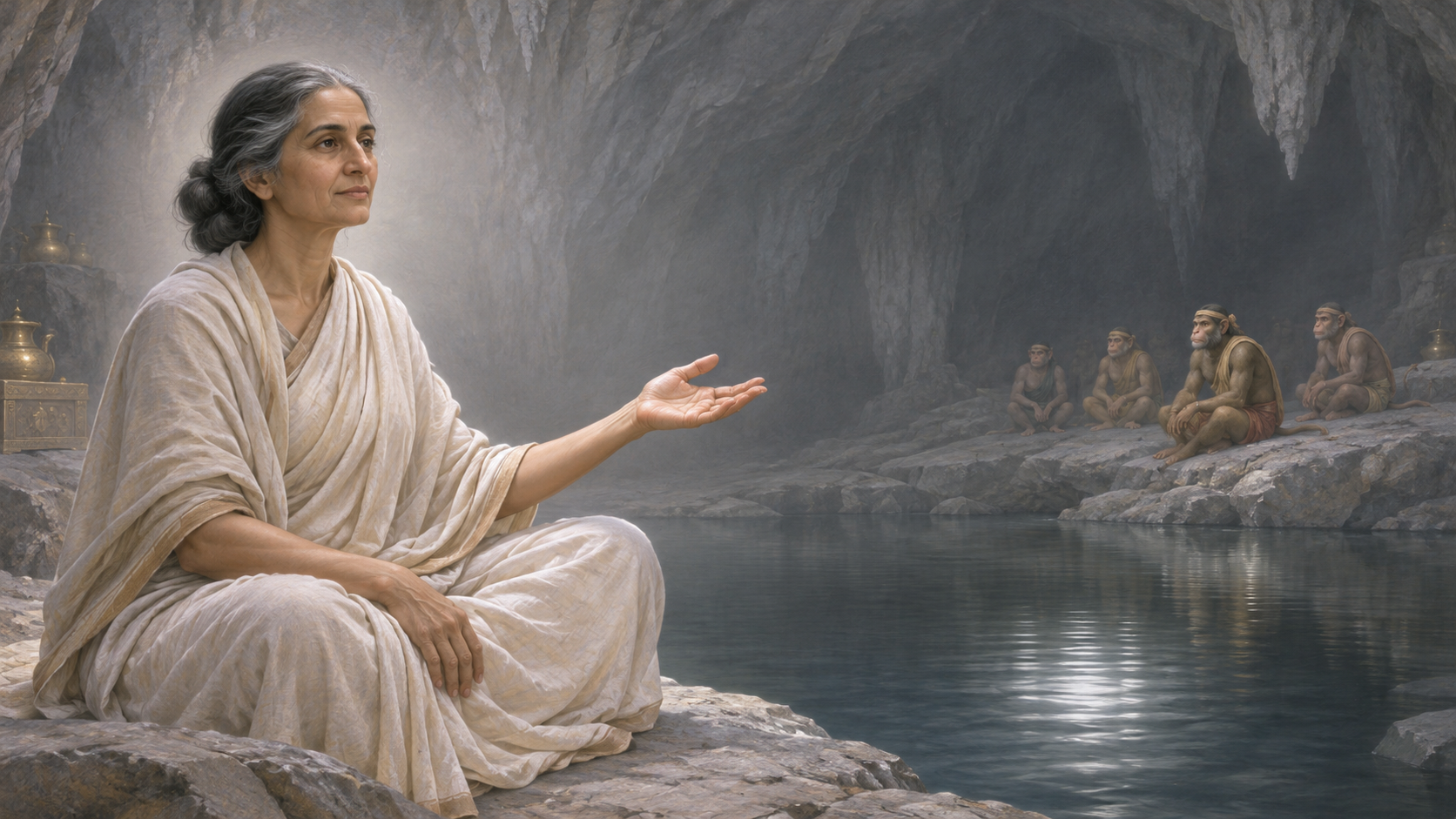
Svayamprabha’s name can be understood through svayam, meaning oneself or by oneself, and prabha, meaning light or radiance. Symbolically, she is therefore not merely one more shining thing inside the golden realm. She points toward the light by which the realm itself can be recognized.
That distinction is central. Gold is visible because it is illuminated. Self-luminous awareness is not another piece of gold to collect. It is the capacity by which you know attraction, fear, hunger, thought, and confusion as experiences. You may be caught in them, but the fact that you can notice them already opens a small space between awareness and what awareness observes.
Different practitioners can approach Svayamprabha on complementary levels:
- As the guru principle: guidance appears when unaided effort has reached its honest limit. A true guide does not make the seeker dependent on spectacle; the guide restores direction.
- As grace: the way out is not always produced by force. Help can arrive when effort has become receptive rather than self-sufficient.
- As viveka, or discernment: the mind learns to distinguish what merely attracts it from what actually frees it to act rightly.
- As witnessing awareness: sensations, thoughts, and spiritual states change, while the capacity to know that change is not identical to any one of them.
These readings need not be forced into a single sectarian formula. Their practical convergence is enough: liberating light reveals your condition and helps you leave confusion. It does not demand that you build a new identity around having encountered it.
You can apply this distinction during prayer or meditation. When a thought, image, emotion, or sensation becomes compelling, do not immediately suppress it or interpret it as a message. First notice, “This is being known.” Then ask what in the experience is observable, what interpretation you are adding, and what duty remains when the experience passes. This turns inwardness into discernment rather than fascination.
Svayamprabha also does not replace the object of the search. The encounter does not make the search for Sita irrelevant. Its value is shown by the searchers’ return to their task. In the same way, sound guidance should return your agency and sharpen your dharma. If a teacher, practice, or interpretation makes you increasingly passive, self-important, or detached from moral responsibility, its brightness deserves examination.
Use the cave as a diagnostic when you feel spiritually stuck
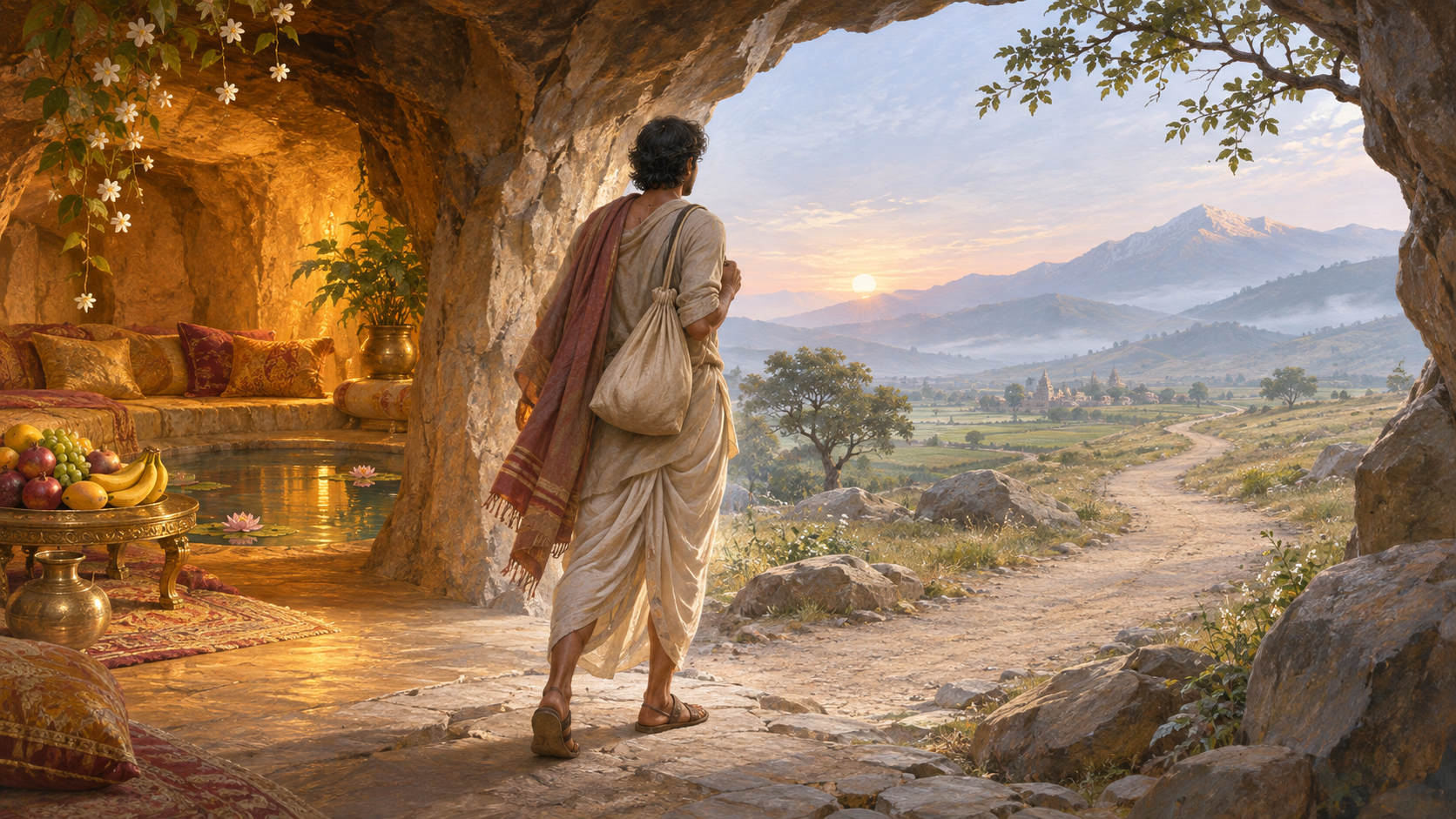
You do not need to manufacture a mystical experience to learn from this episode. Place one real decision, conflict, or neglected responsibility inside its pattern. Work through the following sequence in writing:
- Name the search. Without reducing Sita to an abstract concept, identify the rightful aim in your own situation. It may be keeping a promise, repairing trust, completing necessary work, seeking truth, or serving someone who depends on you.
- Mark the edge of your present capacity. State what you actually know, what you do not know, and where fatigue or fear is distorting your judgement. Honest limitation is different from defeat.
- Identify the cave. What refuge have you entered because the search became painful? It might be withdrawal, endless reading, ritual without reflection, argument, entertainment, or the pursuit of another uplifting experience.
- Separate gold from light. In one column, write what is attractive, soothing, or impressive. In another, write what reveals the truth of the situation. An attractive thing may also be useful, but do not assume the two columns are identical.
- Recognize the Svayamprabha function. Ask what kind of help would restore discernment: counsel from a trustworthy teacher, prayer, a scriptural teaching already received, a candid conversation, or quiet attention free from self-justification.
- Return to open ground. Choose one observable action that resumes the rightful search. Make the apology, ask the necessary question, keep the commitment, stop the evasive habit, or seek the help you genuinely lack.
Suppose your duty is a difficult conversation, but you keep reading spiritual material until you feel perfectly calm. The reading may be nourishing, yet it has become the golden cave if calmness is being used as a condition that must be satisfied before honesty begins. The outward step is not to abandon study. It is to let study prepare a truthful sentence and then speak it with restraint.
The same principle protects you from harsh self-reliance. The searchers need help; the episode does not glorify exhaustion for its own sake. Asking for guidance can be the dharmic action when you cannot distinguish perseverance from stubbornness. The useful guide is the one who helps you see the next truthful step, not the one who makes your ordinary responsibilities disappear behind spiritual theatre.
Key takeaways
- The cave becomes spiritually significant because the searchers enter it when ordinary effort has reached its limit.
- Its golden interior shows that bondage may be attractive, nourishing, and impressive rather than obviously painful.
- Svayamprabha can be contemplated as the guru principle, grace, discernment, or the self-revealing awareness that illuminates experience.
- The test of spiritual light is whether it restores clarity, agency, ethical responsibility, and movement toward dharma.
- Inward retreat serves the path when it prepares your return; it becomes avoidance when you make refuge into a permanent destination.
Before your next period of prayer, study, or meditation, write one unresolved duty at the top of a page. End the practice by choosing the outward step that duty now requires. Let the cave be where your vision clears, not where your mission disappears.
References

Leave a Reply
You must be logged in to post a comment.