
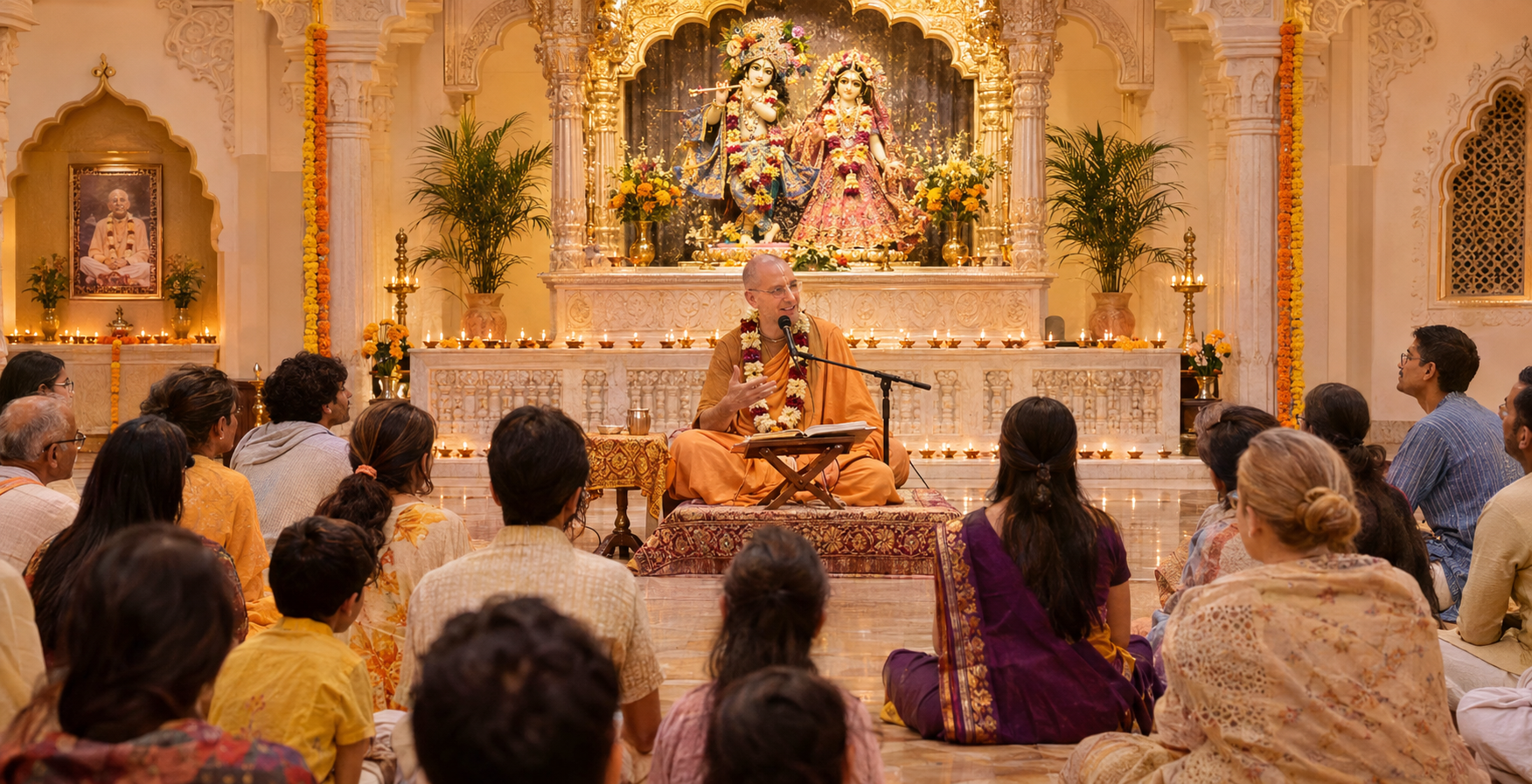
If you found ISKCON Houston’s Diwali observance after the festival and are wondering what you missed, or how to approach the next one, don’t begin with a guessed schedule. Begin with the kind of observance the temple chose: a festival situated within hearing, reflection and communal devotion.
The confirmed occasion was a Dipavali or Divali festival Sunday Feast class at ISKCON Houston on 8 November 2026. That framing gives you a useful key. The celebration was not identified merely as entertainment or a cultural display. A class asks you to listen for meaning and then decide what that meaning should change in your practice.
A Sunday Feast class changes how you should read the festival
It is easy to approach a large temple festival as a spectator. You notice the lamps, clothing, music, food and movement, but leave without being able to state what the observance taught. The words “Sunday Feast class” point in another direction: hearing is part of the celebration, not an interruption before the celebration begins.
When you listen to a festival class, don’t try to retain every name or theological detail. Listen for the structure of the teaching:
- Which relationship with Bhagavan is being placed at the center?
- Which quality is the speaker asking the congregation to cultivate?
- What obstacle in ordinary life is the teaching trying to expose?
- What practice should continue after the festival setting disappears?
Those questions turn religious hearing into discernment. They also help parents. Instead of asking a child whether the program was enjoyable, ask whose sacred story they heard, what virtue it praised and what the family could practice at home. The answers reveal whether the festival became spiritual formation or remained only an outing.
If you are planning for a future year, do not reuse the 2026 date as though it were an annual appointment. Confirm the current date, start time and program directly with the temple before travelling. Dharmic festival dates do not remain fixed to the same Gregorian day, and a Sunday gathering may not reproduce every element of another year’s observance.
Keep the ISKCON lens distinct without narrowing Diwali
Diwali belongs to a broad Dharmic civilizational inheritance, but that does not make every observance interchangeable. Regions, families and sampradayas preserve different sacred memories and devotional emphases. A Krishna-bhakti temple will naturally interpret the festival through its own theology and discipline.
You do not need to flatten those distinctions in order to affirm Dharmic unity. In fact, respectful unity begins by hearing each tradition accurately. Attend an ISKCON program to understand how Krishna-bhakti receives the festival. Practice your inherited family observance faithfully at home. Where the two overlap, let the shared values deepen your appreciation. Where they differ, name the difference without treating it as a conflict that must be erased.
This matters especially in the diaspora. “Diwali celebrates light over darkness” is an accessible introduction, but it becomes thin when it replaces the divine relationships, sacred narratives and disciplines that give the light meaning. A lamp is not merely seasonal decoration in a devotional setting. It directs attention beyond itself.
As you hear the class, distinguish among three layers: the widely shared symbolism of the festival, the temple’s Krishna-centered interpretation and the particular application offered to the congregation. Keeping those layers clear prevents two common errors. You will neither mistake one temple’s emphasis for the only Dharmic understanding of Diwali nor reduce the temple’s theology to a generic message about positivity.
Participate with attention rather than performance
If you are new to ISKCON or to Hindu temple life, you do not need to imitate every action around you. Reverence is more important than confident-looking performance. Wear clean, modest clothing; silence your phone; follow posted instructions about footwear; and ask before photographing worshippers or sacred spaces. Local practice should guide you when it differs from what you have seen elsewhere.
During congregational responses, observe before joining. Stand or sit with the congregation when physically able, but do not treat an unfamiliar gesture as a test. If you want to understand a mantra, ritual action or theological term, remember it and ask a devotee at an appropriate pause. A specific, sincere question usually opens a better conversation than pretending familiarity.
The word “feast” should also be approached devotionally. If prasadam is offered, receive it respectfully rather than treating it as an ordinary buffet. At the same time, sacred food is not automatically safe for every allergy or medical dietary restriction. Ask about ingredients when you need to know, and do not rely on appearance alone.
Bring children into the meaning of the occasion before entering. Give them something concrete to listen for, such as a divine name, a quality worth imitating or a practice they recognize from home. Afterwards, let them explain it in their own words. That small act moves them from passive attendance to cultural memory.
Key takeaways
- ISKCON Houston marked the 2026 occasion through a Dipavali or Divali Sunday Feast class on 8 November.
- The class framing makes attentive hearing part of the observance, not merely background to the festivities.
- Receive the temple’s Krishna-bhakti interpretation on its own terms while preserving the distinct practices of your family and sampradaya.
- Confirm every future date and program directly; the 2026 date is not a reusable annual schedule.
- Leave with a practice you can continue. Otherwise, the festival risks becoming a memory of atmosphere rather than an encounter with dharma.
Carry the observance into family practice
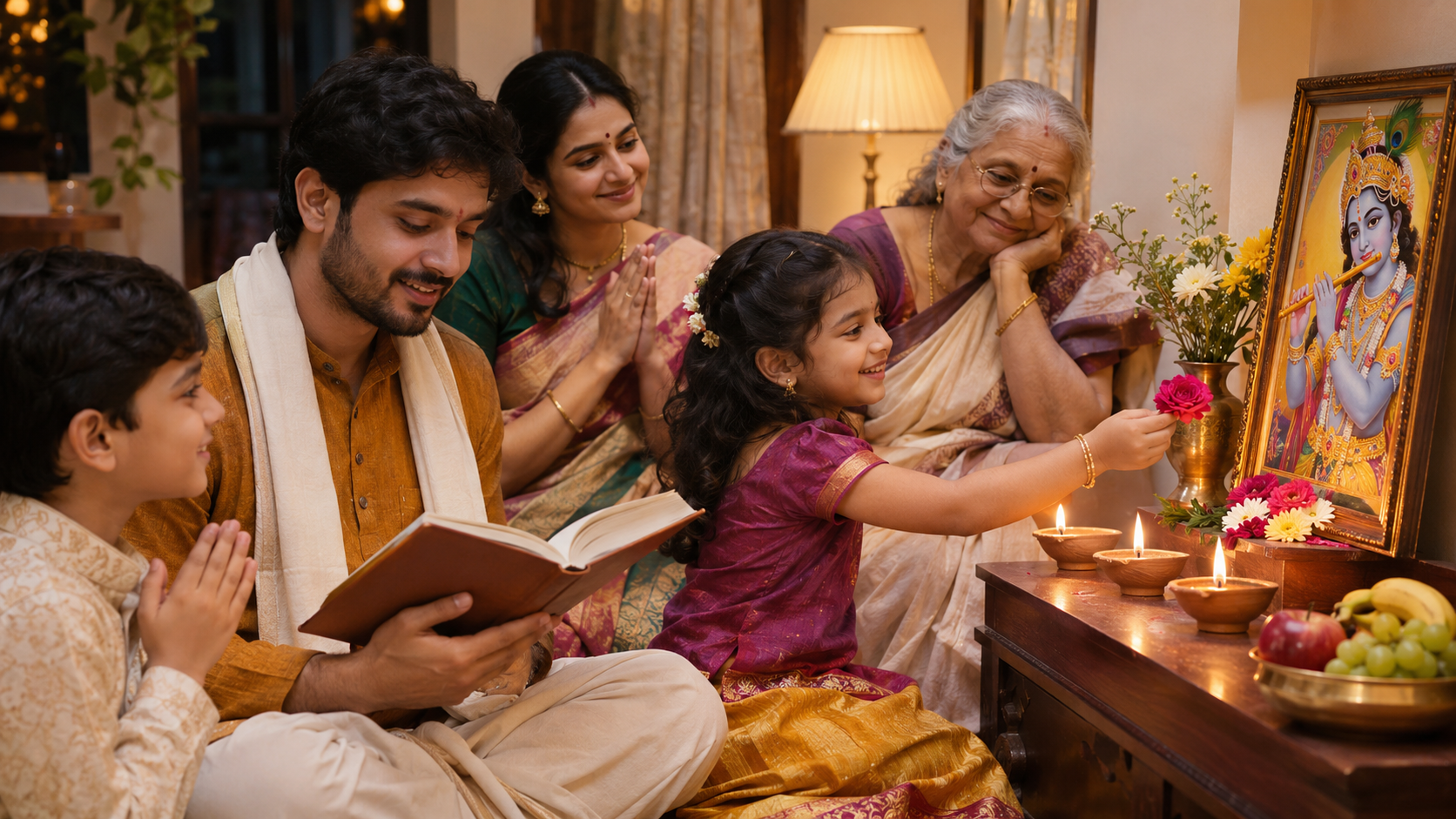
The most useful question comes after the class: what will you do differently when the temple program is over? Choose a practice that is small enough to repeat and clear enough to recognize. You might continue a mantra already received through your tradition, read a passage honored in your lineage, prepare and offer sattvic food according to your household practice, serve someone without seeking recognition, or speak with your family about the teaching you heard.
Avoid assembling an improvised ritual from unrelated fragments simply because they all appear under the label “Diwali” online. Begin with your family’s tradition or the guidance of the sampradaya you follow. If you are still learning, ask what a practice means before adopting it. Dharmic continuity depends not only on repeating actions but on understanding the relationships and obligations those actions express.
If lighting a diya is part of your observance, place it on a stable, nonflammable surface, keep it clear of loose clothing and decorations, supervise children, and never leave it burning unattended. Carelessness does not make a ritual more authentic.
A temple gathering and a household observance do different work. The temple gives you congregation, teaching and a living devotional setting. The home gives the teaching continuity. Let ISKCON Houston’s festival occasion prompt you to connect the two: hear carefully in the temple, name the lesson plainly, and carry an appropriate practice back into daily life.
References

Leave a Reply
You must be logged in to post a comment.