
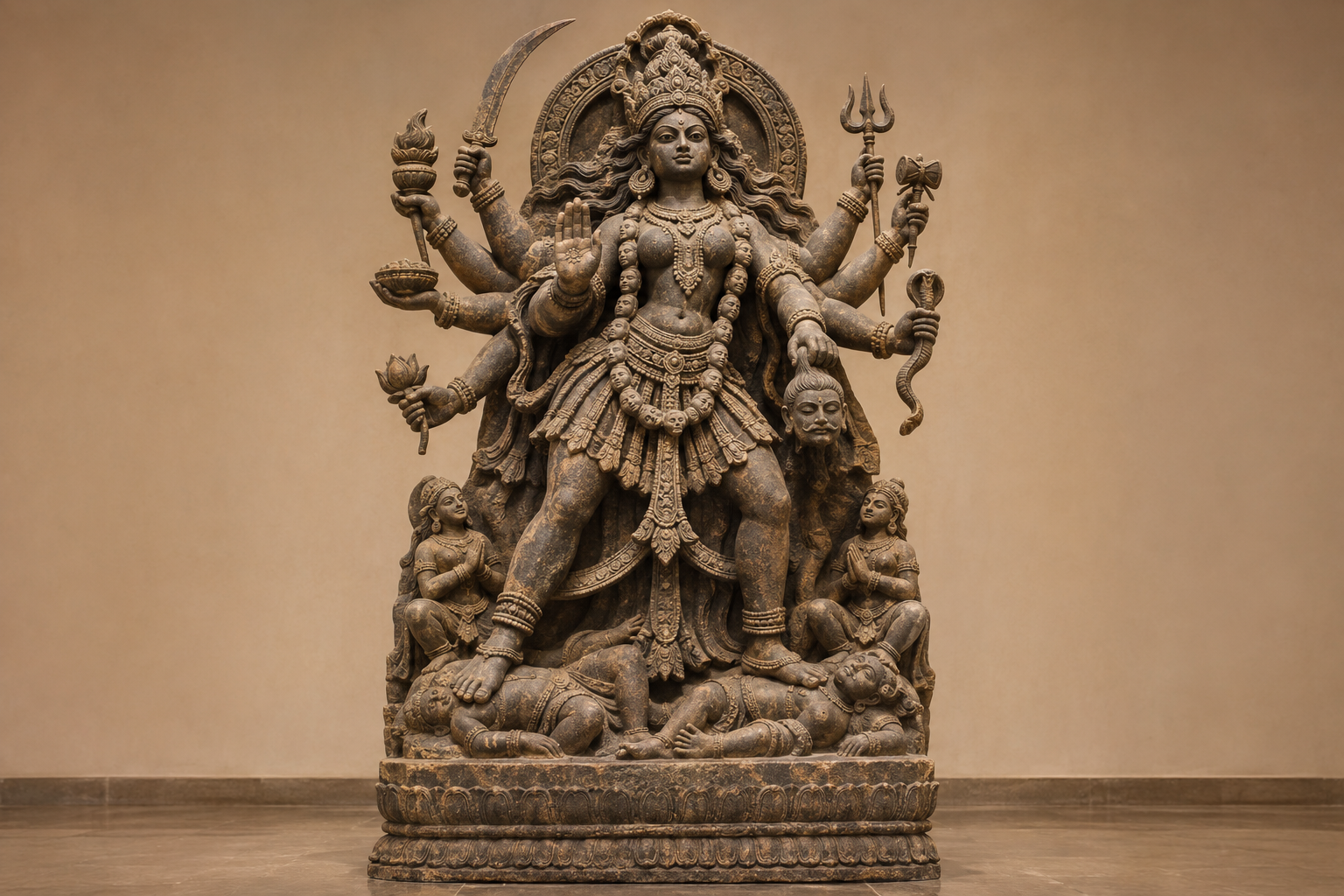
You are looking at a Hindu sculpture when one detail stops you: a deity holds a severed human head. Is the image glorifying violence, recording a killing, or asking you to see something beyond the disturbing surface?
The safest answer does not come from the head alone. You have to read its iconographic role, the other attributes, the deity’s gestures, and the larger composition. Once you do that, the shiras becomes legible as a sign of victory, instruction, and transcendence rather than merely an image of bodily harm.
Key takeaways
- The shiras is a severed human head carried as an iconographic attribute.
- Unlike a trishula, khadga, or chakra, it is not primarily the instrument by which an action is performed. It usually presents an outcome already achieved.
- Its trophy function can point beyond a defeated adversary to a spiritual teaching about identity, mortality, attachment, or limitation.
- No single interpretation applies to every sculpture. Read the whole image before assigning a meaning to the head.
First distinguish a weapon from the result of its use
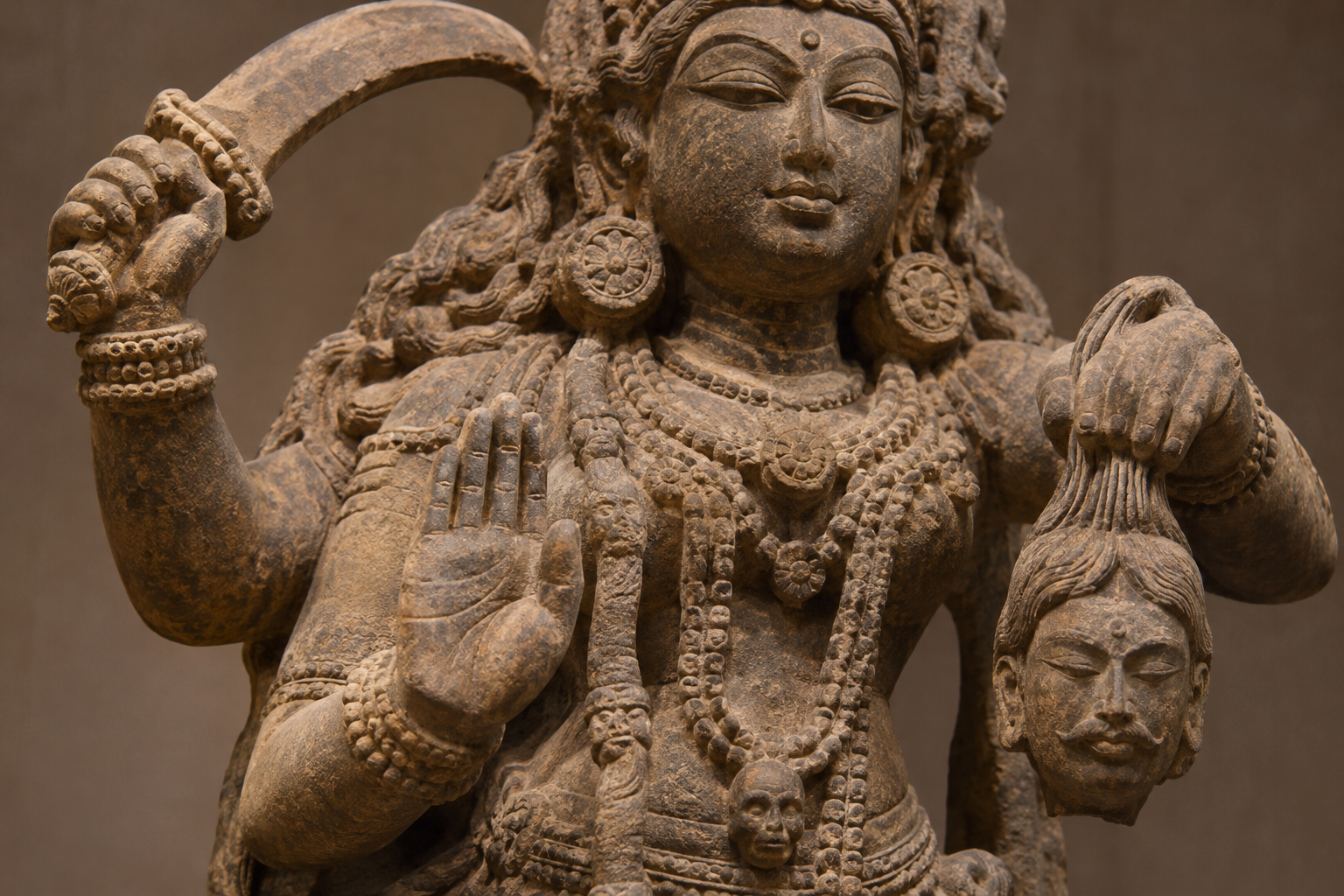
The most important distinction is grammatical. Hindu sculpture communicates through objects, postures, gestures, relationships, and placement. Each element performs a different kind of work. Some objects show what a deity can do. Others show what has already been accomplished.
The trishula, khadga, and chakra belong to the first kind when represented as primary weapons. They make divine power available within the image: piercing, cutting, or overcoming. The shiras belongs to a different category. It is a secondary, trophy-class attribute rather than an instrument of action. It does not normally tell you how the decisive act was carried out. It shows you that something has been decisively overcome.
Here, “secondary” describes function, not spiritual importance. The head may occupy less of the action than a weapon, yet carry the central teaching. A weapon directs your attention toward power in operation. A trophy directs it backward toward a completed victory and forward toward the meaning of that victory.
This gives you a practical first question: is the object doing something, or displaying the consequence of something already done? If the deity holds a shiras as a completed result, do not read the scene as if the violence were still the image’s main action. Ask instead what condition, obstruction, or identity has been brought to an end.
The shiras can operate on several levels at once
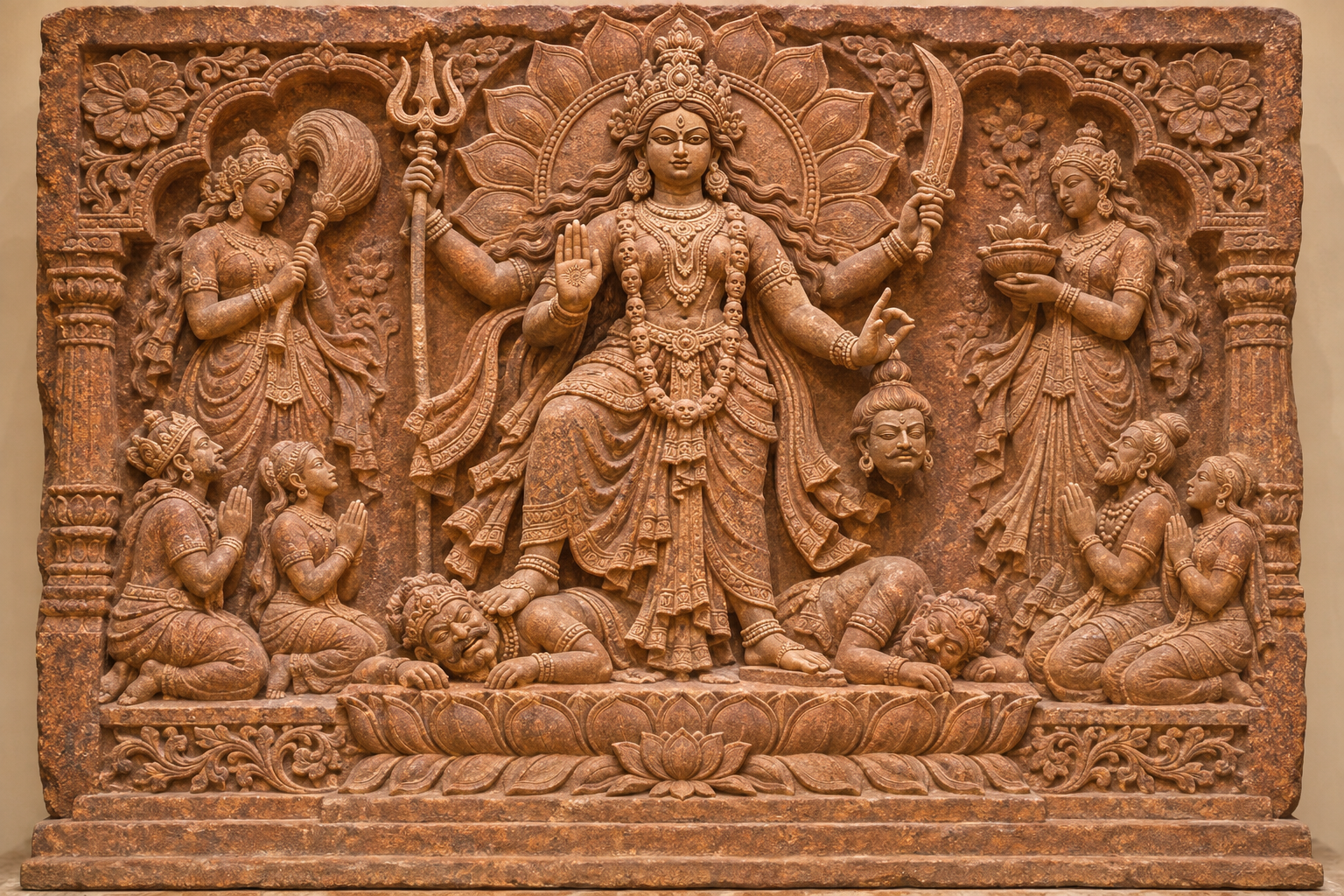
A sacred image does not have to choose between narrative and philosophy. A head may belong to the story represented by a particular form while also teaching the viewer how to understand bondage and liberation. These levels can reinforce one another, but you should not assume that every level is equally prominent in every sculpture.
Victory over an adversarial force
At the most immediate level, a trophy signifies defeat. An opponent or hostile force has lost its power to obstruct divine order. The held head makes the victory visible and final: the threat is no longer merely restrained or pushed aside.
Do not turn that general function into a specific story unless the rest of the icon supports it. A head by itself does not identify an adversary, name an episode, or establish the historical circumstances of a sculpture. If a museum caption, temple tradition, inscription, or reliable iconographic description identifies the figure, use that context. If none is available, stay with the narrower conclusion that the image displays conquest.
Removal of a limiting identity
The human head naturally concentrates ideas of personal identity. It bears the face by which a person is recognised and contains the faculties through which ordinary thought organises experience. Its removal can therefore become a visual language for the ending of a confined or falsely absolute sense of self.
This is why “the destruction of ego” is often an attractive interpretation. It can be useful, but it should not become a reflex. Ego is not a master key that automatically decodes every fierce Hindu image. Look for evidence that the composition is concerned with self-mastery, knowledge, delusion, or transcendence before making that the dominant reading.
A confrontation with mortality
A severed head also refuses to let the viewer treat embodied life as permanent. Beauty, rank, strength, and social identity cannot prevent the body’s end. The image may use that discomfort deliberately. Instead of decorating mortality until it becomes easy to ignore, it places mortality in the deity’s hand, contained within a reality larger than bodily existence.
When this level is active, the useful question is not whether the image is pleasant. Ask what attachment your discomfort exposes. Are you reacting to violence alone, or to the loss of the face, status, and bodily continuity through which a person says “this is me”?
Transcendence of what has been overcome
The movement from trophy to teaching reaches its fullest depth in transcendence. Something that appeared dominant within ordinary experience has been reduced to an object held by the divine. The deity is not controlled by it. What terrifies the human viewer no longer commands the centre of the image.
This does not require you to pretend that the form is gentle. Fierce iconography works through severity. Its spiritual force lies partly in showing that liberation is not always represented as soothing, and that a binding condition may have to end rather than be cosmetically improved. The head can thus communicate both a victory and the passage beyond the limitation that made the victory necessary.
Use the whole sculpture to choose the right reading
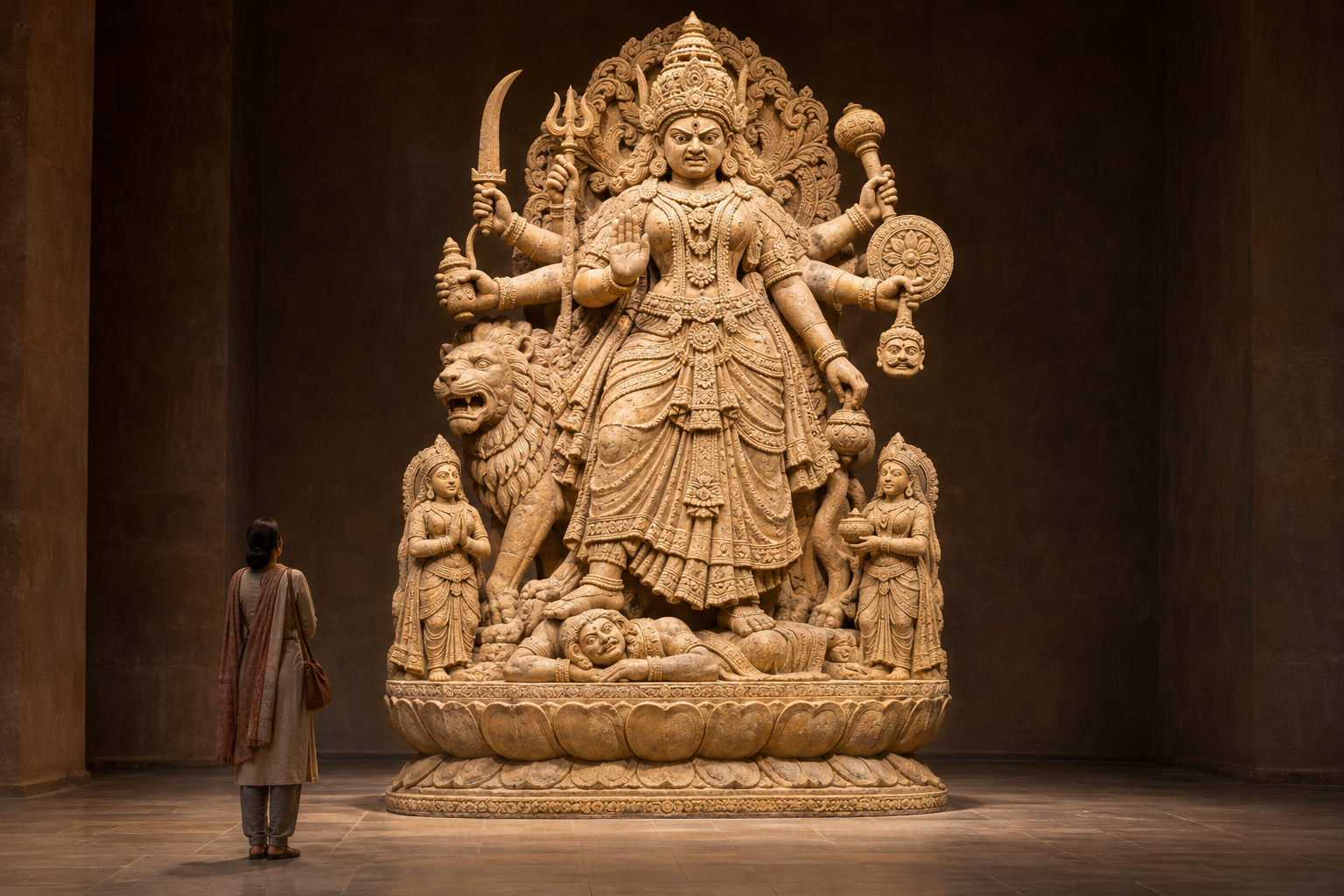
If you encounter a shiras in a temple, museum, photograph, or book, use the following sequence. It will not solve every identification, but it will prevent the most common interpretive errors.
- Look at the uncropped image. A close-up of the head removes the very evidence needed to understand it. Find a view that includes the complete figure, all visible hands, the posture, surrounding figures, and the base or architectural setting.
- Identify the deity or form only when the evidence permits it. Use an inscription, a dependable catalogue entry, the temple’s own identification, or a distinctive combination of attributes. Do not infer an exact identity from fierceness alone.
- Inventory every attribute. Note which hands hold weapons, which display results or trophies, and which make gestures. The shiras may appear severe in isolation but participate in a composition that also communicates protection, assurance, knowledge, or blessing.
- Separate action from aftermath. Determine whether the image depicts combat or displays a victory already completed. A held trophy usually shifts the emphasis from the act of striking to the condition that has been overcome.
- Ask what kind of obstacle fits the complete image. The answer may be narrative, moral, psychological, existential, or metaphysical. Begin with the narrowest reading supported by the sculpture, then consider broader teaching only where the remaining elements make it plausible.
- Check for damage and restoration. Missing hands, eroded attributes, replaced pieces, and poor photographic angles can change the apparent meaning. If a crucial feature is unclear, leave the interpretation provisional instead of filling the gap with a dramatic story.
Pay particular attention to relationships. Is the head raised for display, held away from the body, or integrated quietly among several attributes? Does the deity appear dynamically engaged or firmly composed? Is the shiras visually dominant or subordinate? These formal choices can tell you whether the sculptor emphasised triumph, warning, instruction, or transcendence. They cannot be interpreted reliably from the object alone.
Context also controls how confidently you should speak. If you know the deity, the associated narrative, and the original setting, you may be able to offer a precise interpretation. If you have only an isolated photograph, a disciplined reading will remain conditional: “the head functions as a trophy of an overcome force” is sounder than assigning it to a named episode without evidence.
Avoid the shortcuts that flatten fierce Hindu imagery
The first shortcut is literalism. It treats sacred sculpture as though it were a frozen record of an ordinary physical event. That approach sees a severed head and stops at killing. It misses the distinction between a weapon and a trophy, between narrated action and spiritual instruction, and between the visible form and the reality the form asks you to contemplate.
The opposite shortcut is over-spiritualisation. It immediately translates every head into “ego” and leaves nothing of the deity’s particular form, story, or theological setting. This sounds elevated, but it erases the visual precision of the sculpture. Begin with what is actually shown before moving toward an inward interpretation.
A third mistake is moral judgement from a cropped or decontextualised image. Modern visual culture often reserves severed heads for horror, cruelty, or spectacle. Hindu iconography can use the same physical form within a very different grammar: the terrible object has been subordinated, held, and turned into teaching. You do not need to suppress your initial reaction. You do need to test it against the composition.
Finally, do not assume that fierceness is the opposite of sacred protection. A form may be alarming precisely because the force being overcome is not trivial. The severity tells you that the transformation is decisive. Whether that transformation concerns a narrative enemy, an inner bondage, mortality, or a metaphysical limit must still be established from context.
The next time you meet this symbol, pause before naming it gruesome or reducing it to a slogan. Locate the shiras within the sculpture’s visual grammar, identify what has already been overcome, and then choose the most specific interpretation the complete image can support. That small discipline turns shock into attention, and attention is where the sculpture’s teaching begins.
References

Leave a Reply
You must be logged in to post a comment.