
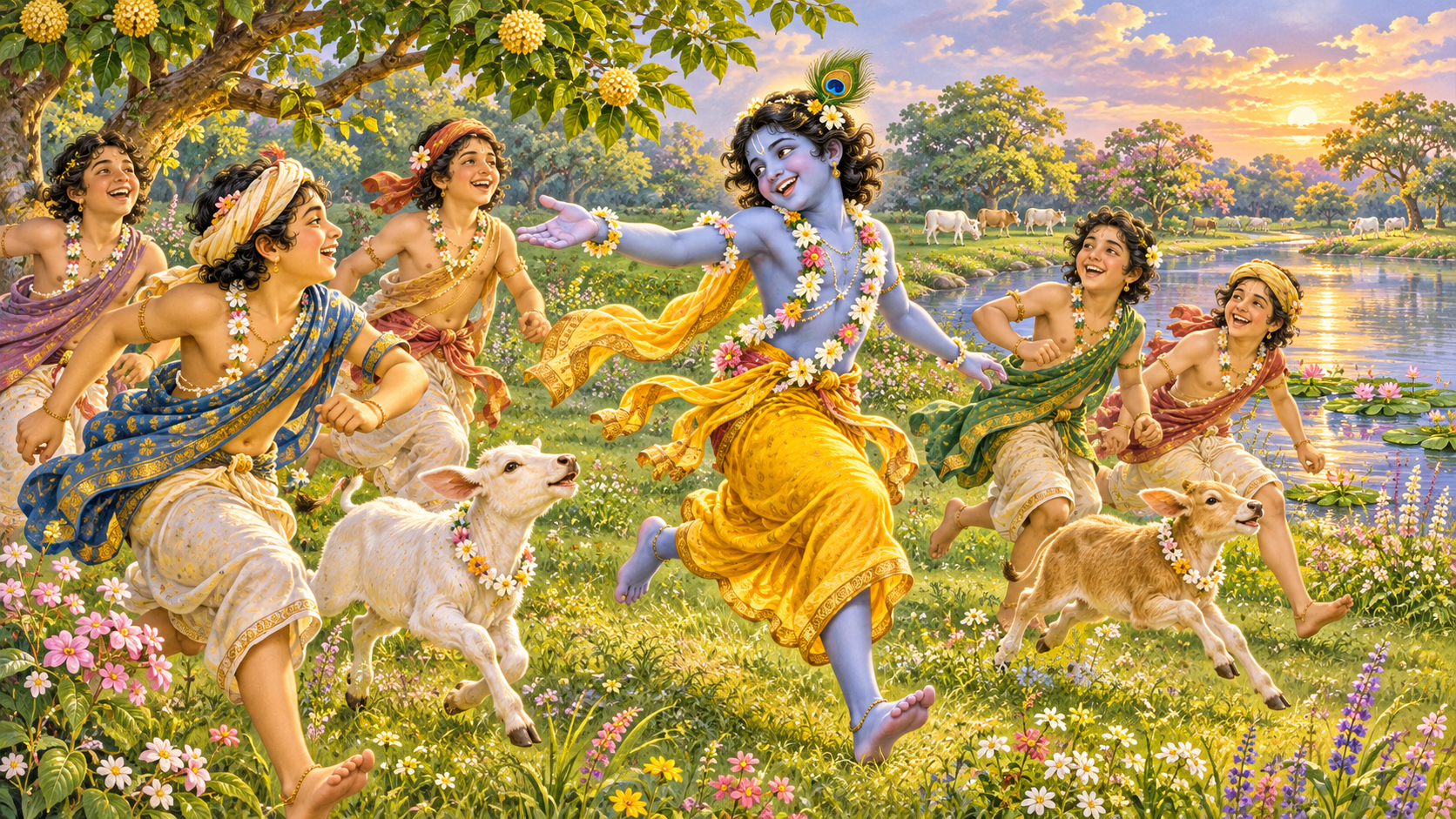
If you have heard of Krishna calling His cowherd companions to a game, dancing after a victory, or subduing a serpent through dance, you may have wondered why the Supreme would need to play. Within the Vaishnava understanding, the question turns on one decisive word: need. Krishna does not play because He lacks happiness. He plays because divine fullness naturally overflows into relationship, movement and joy.
That distinction keeps lila from becoming either a charming diversion or an excuse for human recklessness. It also gives you a practical way to approach recreation: Krishna’s play purifies and draws others into communion, while our play must be examined by what it cultivates, what it consumes and what it displaces.
Lila begins where need and fear end
Most human action is motivated by something we want but do not possess. We train because we want a result. We compete because victory is uncertain. We seek entertainment because we are tired, restless or dissatisfied. Even a pleasant game is usually tied to a need: exercise, companionship, recognition, relief or excitement.
Krishna’s lila begins from the opposite condition. The complete Divine has nothing to acquire, defend or prove. Divine play is therefore unforced. It is not a strategy for becoming fulfilled; it is an expression of fullness already present.
Calling lila “unmotivated” does not mean calling it meaningless. It means that no deficiency outside Krishna compels Him to act. He can pursue a serious purpose without being burdened by it. He can protect, confront evil or restore order while remaining entirely free.
This freedom appears across divine descents. Matsya moves through the waters of the deluge, while Varaha enters combat in the form appropriate to His role. Krishna goes further into intimacy: in Srimad-Bhagavatam 10.18.19, He gathers the cowherd boys and divides them into two even teams. The Supreme does not merely permit play from a distance. He enters the game and allows His companions to meet Him within it.
Key takeaways
- Lila is divine activity arising from completeness, not an attempt to satisfy a lack.
- Krishna’s joy and His serious purpose can operate in the same act; play does not make the purpose trivial.
- Relationship is central to lila: Krishna calls companions, forms teams and shares victory.
- Krishna’s confrontations purify and liberate; they are not permission for human beings to imitate divine violence.
- Ordinary recreation has a proper place when it supports health and fellowship, but it becomes a problem when it displaces duty, devotion or moral judgment.
- You participate in lila through attentive hearing and remembrance, not by claiming Krishna’s freedom from karma for yourself.
Divine play can carry a serious purpose
We often divide life into serious work and optional play. Krishna’s lila does not obey that division. Purpose and delight are not rivals in Him. His play can defeat arrogance, protect others and transform an antagonist without ceasing to be play.
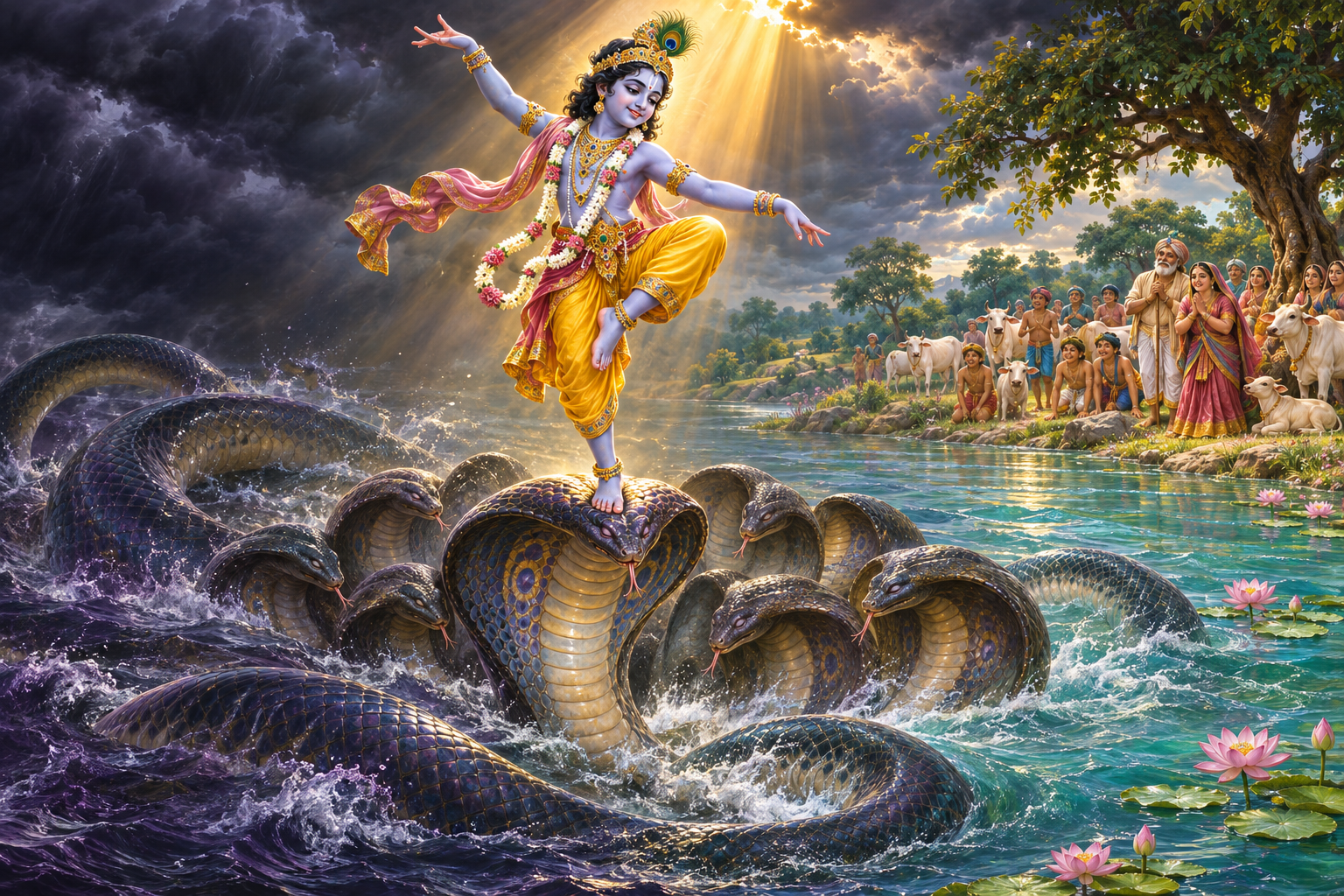
After Krishna and Balarama defeat Kamsa’s wrestlers, they do not stand apart as solemn conquerors. Srimad-Bhagavatam 10.44.29 places their cowherd friends beside them as they dance in celebration, accompanied by music and the sound of ankle bells. Victory returns immediately to companionship. Power does not close the circle around the victor; it opens the circle to beloved friends.
The encounter with Kaliya reveals another feature of lila. Krishna’s dance upon the poisonous serpent’s hoods is graceful, but it is not decorative. The dance humbles and purifies Kaliya. Beauty, judgment and mercy occur within the same movement.
Even the destruction of hostile attackers is presented as transformative rather than vindictive. Srimad-Bhagavatam 2.7.34-35 gives the demons slain by Krishna a spiritual destination, either the brahmajyoti or His personal abode in Vaikuntha. The theological point is exacting: no one finally defeats Krishna, yet contact with Him is not spiritually barren even when it comes through opposition.
When you hear one of these episodes, do not ask only, “What did Krishna accomplish?” Also ask, “Whom did the act draw into relationship, and what did that contact transform?” Those questions help you see why lila is more than an entertaining sequence of supernatural events.
Why imitation turns play into bondage
The human love of games is compelling because it resembles something original: the delight in play found in Krishna. Yet resemblance is not equality. Krishna acts from completeness and is not bound by karma. We act through limited bodies, mixed motives and consequences that continue after the excitement has ended.
This difference matters most in the dramatic lilas. Krishna’s subduing of Kaliya cannot be converted into a licence for cruelty. His killing of a bull-demon does not make the killing of an ordinary bull a sacred sport. Divine action produces purification; an imitative human act can inflict suffering and implicate the actor and approving spectators in its consequences.
The same caution applies in less extreme forms to modern sport. Physical participation can provide exercise and recreation. Skill, discipline and teamwork can be appreciated for what they are. The confusion begins when athletic excellence is treated as proof of moral excellence, or when spectators give a player the devotion that belongs to the Divine. A person’s ability to win a contest tells you nothing by itself about that person’s character.
There is also a cost in attention. Srila Prabhupada’s sorrow on seeing golfers repeatedly striking a small ball was directed at the misvaluation of finite human time. Krishna describes material existence in Bhagavad-gita 8.15 as marked by suffering and impermanence. In such a world, even a hard-won championship passes quickly. The trophy remains incapable of answering the deeper human problem.
You do not need to pretend that a game has no appeal. You need to decide its proper rank. Before giving sport a fixed place in your week, use these five questions:
- What is it serving? Playing for bodily health or fellowship is different from consuming spectacle simply because you cannot tolerate an unstimulated evening.
- What does it displace? Name the actual cost: japa, scriptural hearing, seva, sleep, family responsibility or work that must still be done.
- What are you admiring? Appreciate skill without transferring that admiration into an unwarranted judgment about the athlete’s moral or spiritual stature.
- What comes bundled with it? Notice whether the surrounding culture draws you toward gambling, intoxication, aggression or products and habits you would otherwise reject.
- Can you keep the boundary you set? If one match repeatedly becomes an abandoned duty or a lost evening, judge the pattern rather than the intention with which you began.
This is not a demand to label every ball game sinful. It is a demand for proportion. Recreation should remain a servant of a well-ordered life. Once it commands your schedule, loyalties and emotional equilibrium, it is no longer merely recreation.
How to let lila reshape your own recreation
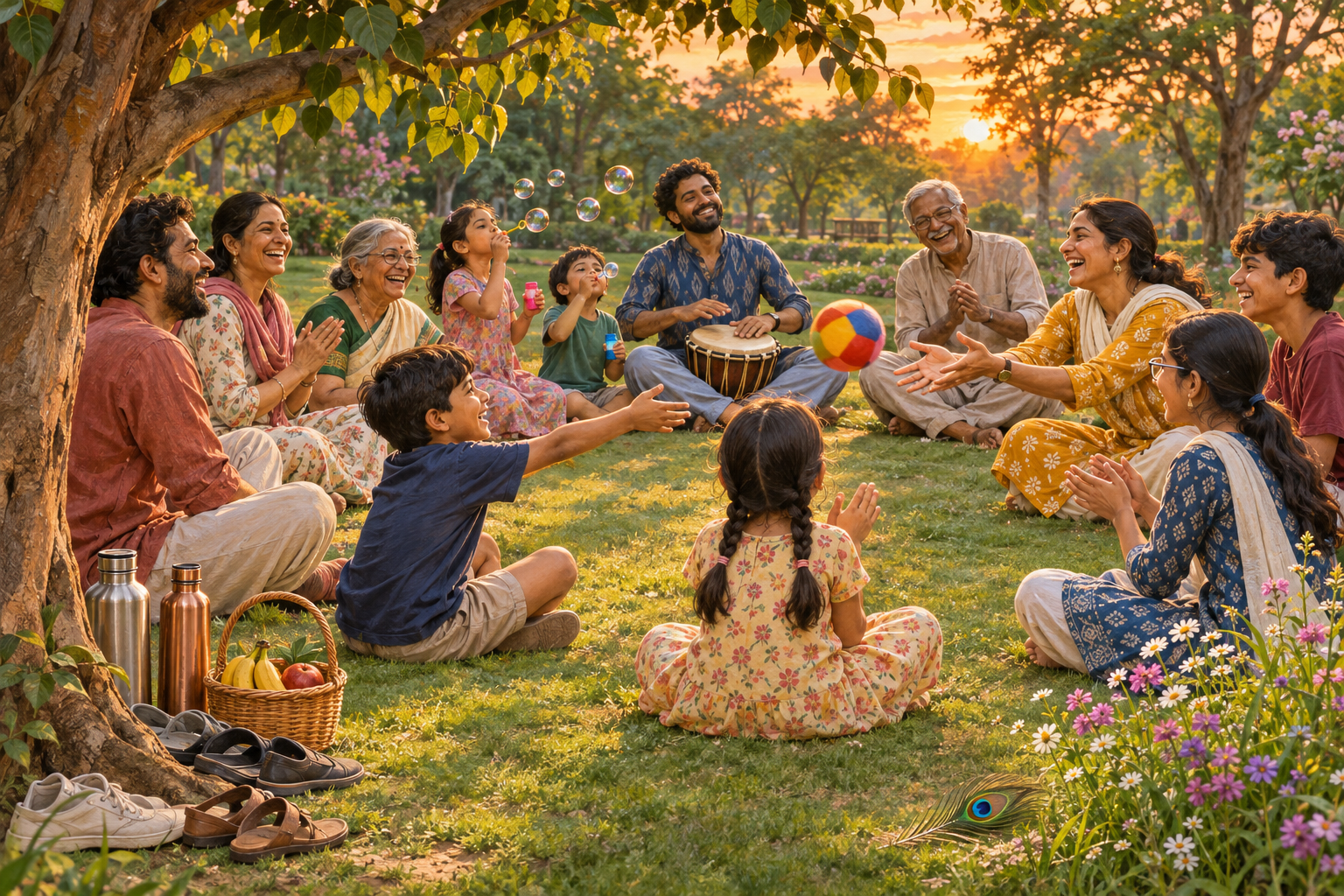
You receive Krishna’s sporting nature most fruitfully through hearing and remembrance, not imitation. A spectator at an ordinary contest wants the excitement of an uncertain result. A listener approaching lila attends to the character of the Divine, the relationships Krishna accepts and the transformation His presence creates.
Use this five-step practice with one lila at a time:
- Locate the relationship. Identify whether Krishna is acting with cowherd friends, an opponent or a being in need of correction. Do not reduce the other participants to scenery.
- Separate fullness from need. Ask what Krishna would have to gain if He were an ordinary person. Then notice that lila proceeds without that deficiency.
- Hold joy and purpose together. Look for the serious work occurring through play: companionship, protection, the humbling of pride or purification.
- Trace the result for everyone involved. Do not stop with Krishna’s victory. Notice what happens to His friends, His opponents and those who hear the account.
- Make one concrete change. If the episode exposes an entertainment habit that is consuming devotional attention, replace part of that habit with hearing or reading lila. Keep the change small enough to repeat and definite enough to observe.
The fifth step prevents reflection from remaining ornamental. If you regularly lose the time intended for spiritual practice to highlights, commentary or arguments about teams, make the boundary before the next event begins. Decide what devotional duty comes first and begin the recreation only after that duty is complete.
Krishna’s lila does not ask you to become hostile to joy. It teaches you to recognize joy’s source and to stop demanding permanence from its temporary reflections. The next time you encounter Krishna at play, listen for the freedom behind the action, the relationship within it and the purification that follows. Then give your own recreation a place that serves remembrance rather than replacing it.
References

Leave a Reply
You must be logged in to post a comment.