
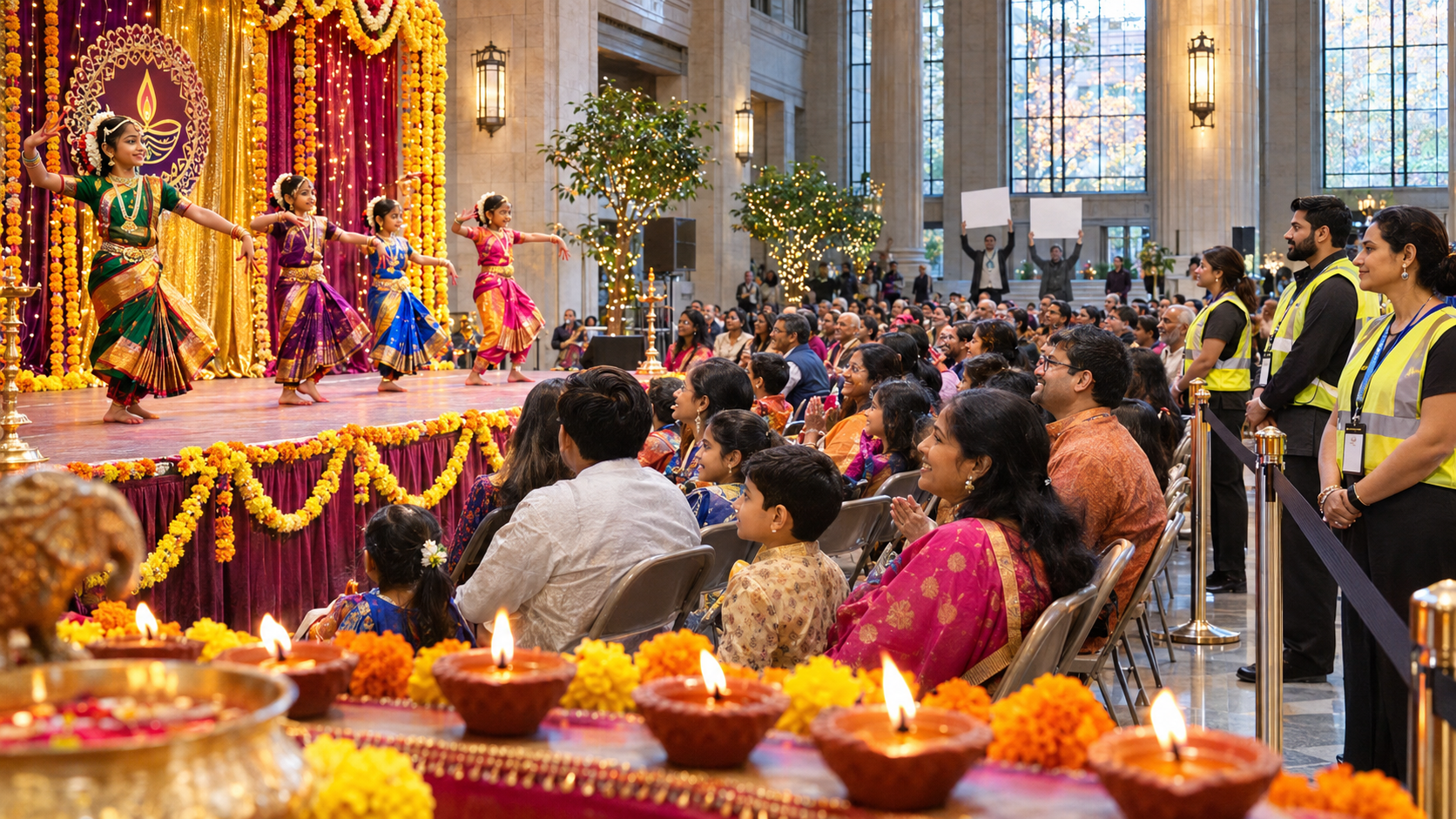
If you help organize Diwali in North America, the disruption in Seattle leaves you with an immediate question: how do you protect families and children without letting provocateurs take control of the celebration? The answer is neither panic nor passivity. Treat explicit anti-Hindu harassment as a foreseeable event risk, prepare a narrow response, document it accurately, and keep the festival at the center of the day.
At the Seattle Center Armory, Jake Lang and Thomas Allen disrupted a Diwali celebration while children were performing. They displayed signs saying “Deport all Dotheads” and “Stop Hindu Replacement of Christians.” People present removed them, but the concern does not end at that venue: the men were also reported to have announced plans to disrupt other Diwali events.
Name the conduct accurately without outrunning the facts
Not every criticism of Hinduism, a Hindu organization, or the Government of India is anti-Hindu hatred. That distinction matters because a community that labels every disagreement as bigotry weakens its credibility when unmistakable bigotry appears.
The Seattle messages crossed an obvious line. One used an ethnic slur and demanded deportation; the other portrayed the presence of Hindus as the replacement of Christians. Neither message offered a criticism of doctrine, policy, leadership, or conduct. They targeted people as an unwanted group and brought that hostility into a religious and cultural celebration where children were on stage.
The word “dothead” also has a specific history. It recalls the Dotbusters era of the 1970s and 1980s, when Hindus in New Jersey were terrorized under that label. An organizer does not need to deliver a history lecture during an incident, but should record the exact word. Its meaning can disappear when an official account reduces the episode to a generic “disturbance.”
Use the term “anti-Hindu harassment” or “anti-Hindu bigotry” when the evidence supports it. Do not automatically call an incident a hate crime; that is a legal classification that depends on the applicable law and the facts established by authorities. Precision is stronger than exaggeration.
A useful initial statement is short: “Individuals disrupted our Diwali celebration with a sign using an anti-Hindu slur and another calling for Hindus’ deportation. Children were performing at the time. The individuals were removed, and we are preserving evidence and reviewing safety measures.” Change each detail to match what you can verify, including who carried out the removal.
Prepare roles and response thresholds before the doors open
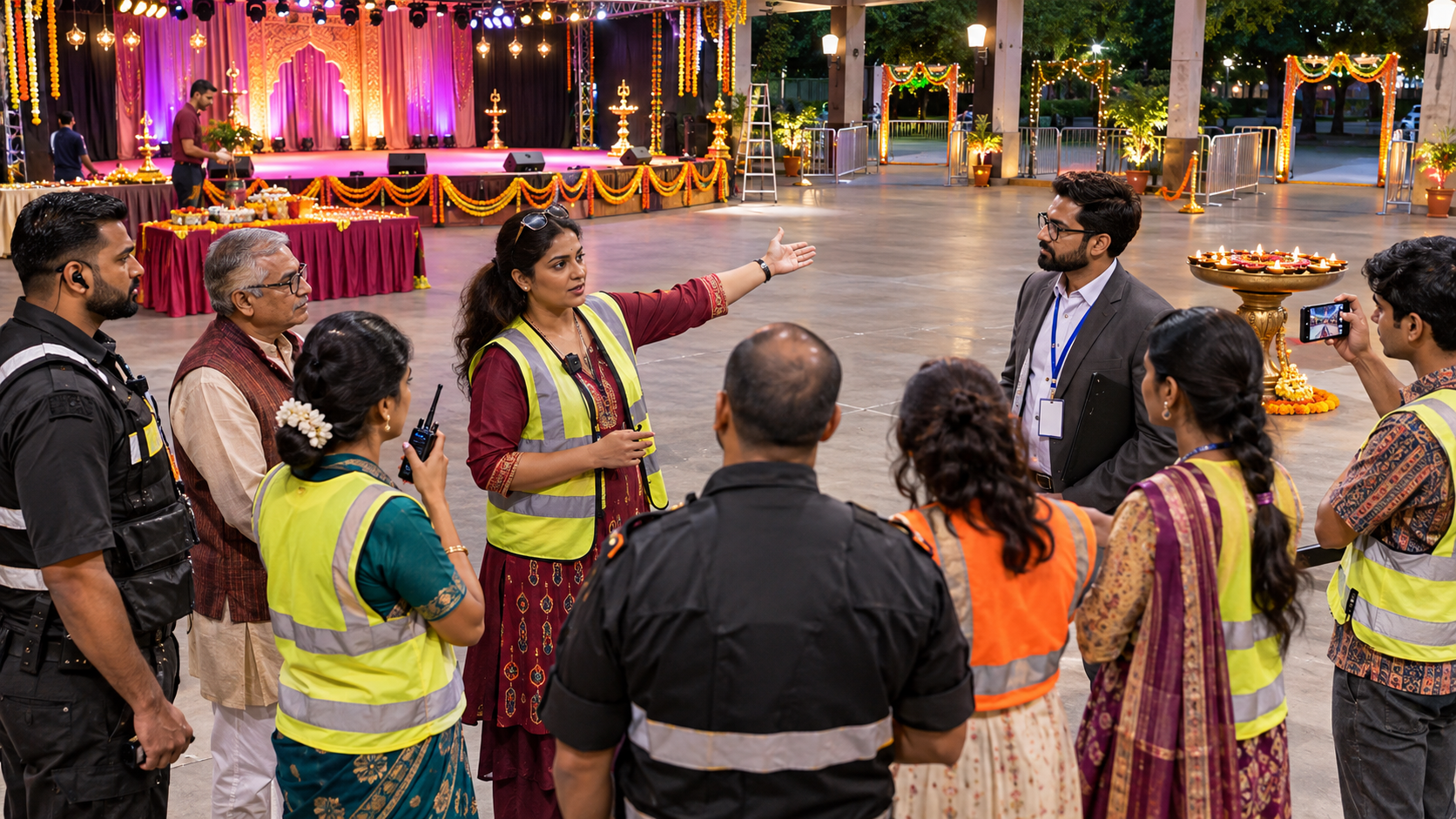
A diya is not a security plan, and having a security plan is not a surrender. Preparation lets volunteers respond with restraint because they do not have to invent a solution while a crowd is watching.
Assign the work to named people rather than to “the organizing team” in general:
- Incident lead: decides when the response plan is activated and keeps volunteers from issuing competing instructions.
- Venue liaison: remains in direct contact with venue management or security and knows who has authority to remove a person.
- Child-safety lead: moves performers away from the confrontation, controls backstage access, and helps children reconnect with their parents or guardians.
- Evidence keeper: records the time, place, conduct, exact language, and available witnesses without obstructing the response.
- Program lead: decides whether the performance can continue, pause, or move to another part of the program.
Give every role a backup. A plan that depends on one person fails as soon as that person is on stage, outside, or helping a family.
Agree on conduct-based thresholds with the venue. Venue rules and local law determine what staff can do, especially at a public facility. Ask management to put its response and removal process in writing before the event. Do not assume volunteers have authority to expel someone merely because a message is offensive.
| Observed conduct | Proportionate response |
|---|---|
| Peaceful expression that does not enter the event, block access, threaten anyone, or violate venue rules | Do not treat disagreement as an emergency. Observe from a distance and follow the venue’s established policy. |
| Targeted slurs, interruption of performances, harassment of attendees, unauthorized entry, or refusal to follow event rules | Activate the incident lead, contact venue staff or security, state the applicable conduct rule once, protect children, and preserve evidence. |
| A weapon, assault, credible threat, dangerous crowd movement, or blocked exit | Move attendees away, call 911, follow emergency instructions, and do not ask untrained volunteers to perform a physical removal. |
Because further Diwali disruptions were reportedly announced, monitor public posts tied to your event name, venue, and date. Preserve direct threats or declared plans to interfere and share them with the venue. Do not build dossiers on ordinary critics, publish private information, or treat political disagreement as evidence of a security threat.
Control the first minutes without feeding the spectacle
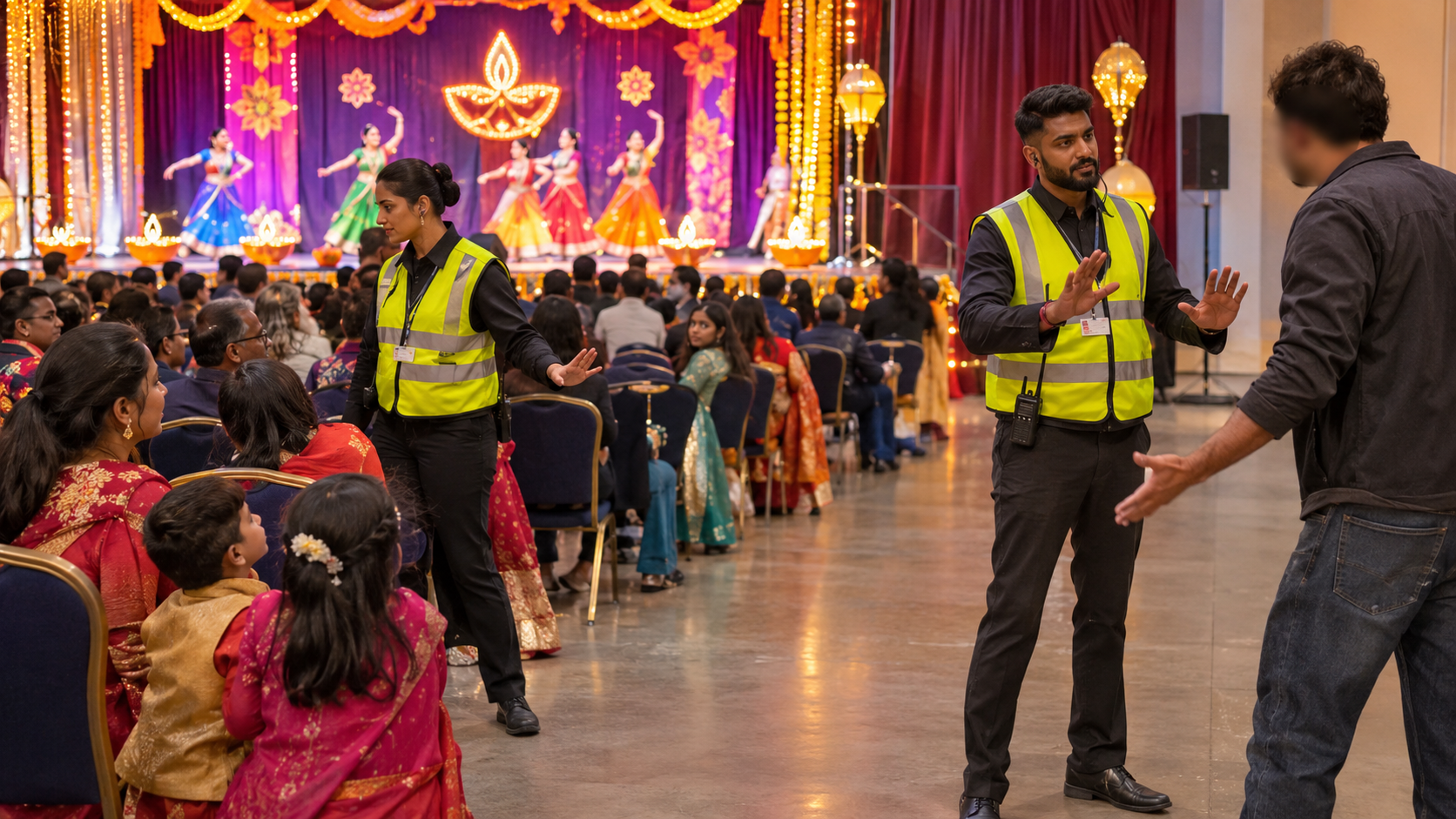
A provocateur may want an angry crowd, a chaotic video, or a debate that shifts attention from the harassment to the community’s reaction. Your response should therefore be brief, visible enough to guide attendees, and centered on conduct rather than ideology.
- Confirm what is happening. Distinguish a person expressing a view from someone interrupting the program, targeting attendees, entering a restricted area, or creating an immediate danger.
- Move children out of the confrontation. Use the planned route and adult escorts. Do not ask young performers to remain in place for the sake of appearances, and do not turn them into spokespeople afterward.
- Give one conduct-based instruction. A suitable formulation is: “This is a family religious and cultural event. Harassment and disruption are not permitted. Please follow venue staff’s instructions.” Do not begin an argument over theology, immigration, or politics.
- Document from a safe position. Capture the signs, spoken words, location, sequence of events, and response. Avoid unnecessary close-ups of children, and preserve original files rather than relying only on edited social-media clips.
- Hand the physical response to authorized personnel. Do not surround the disruptors, seize their signs or phones, or improvise a crowd ejection. Those actions can produce injuries and competing accounts of who initiated physical contact.
- Resume when it is safe. Continuing the celebration denies the disruptors control of the program. If the event cannot safely resume, tell families plainly what is happening and where they should go.
The fact that people present removed the disruptors in Seattle should not be read as a general instruction for attendees to do the same. The useful lesson is that open bigotry need not be tolerated. The operational lesson is that future events should place removal in the hands of trained, authorized people.
Build a record that authorities and the public cannot misread
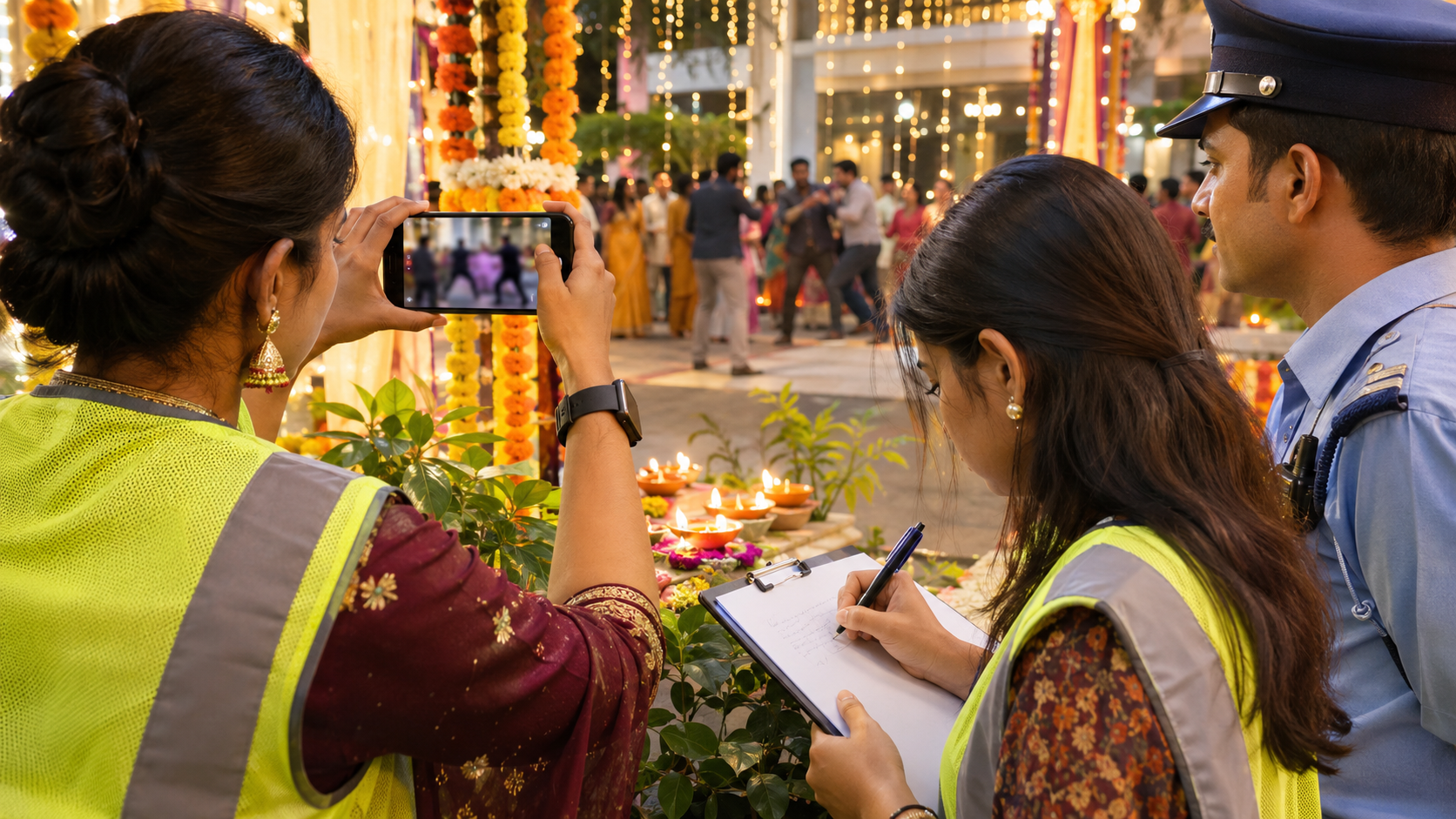
Once immediate safety is restored, create a single incident record before memories blur. Collect the material in its original form and limit access to the people responsible for follow-up.
- A chronological account of what happened, including where the disruption began and how it ended.
- The exact language displayed or spoken, clearly separated from any paraphrase.
- Names and contact details of willing witnesses, along with their role at the event.
- Original photographs, videos, screenshots, links, and available metadata.
- The names or roles of venue personnel who responded and any venue incident number.
- A police report number if law enforcement became involved.
- Copies of public statements announcing an intention to target other celebrations.
Separate observations from conclusions. “A sign displayed these words” is an observation. “The message targeted Hindus as a group” is a conclusion supported by those words. Claims about a person’s undisclosed motives, associates, or future conduct remain unverified unless you have direct evidence.
If an official record describes only a protest or disturbance, ask that the reported slur, the anti-Hindu message, the interruption of a Diwali event, and the presence of child performers be included. You are not asking an official to adopt a slogan. You are asking for the material facts that explain whom the conduct targeted.
The public statement should identify what occurred, who was targeted, what immediate action was taken, and what practical safeguards will change. Do not lead a social-media graphic with the slur or repeat it more than necessary. Preserve the exact words in the evidentiary record while denying them free circulation as promotional material for the provocateurs.
The Network Contagion Research Institute at Rutgers University warned in 2022 that deliberate online fomentation of anti-Hindu hate could move into physical settings. That does not mean every hostile post predicts violence. It means direct threats, announced disruption plans, repeated targeting of a venue, and attempts to identify event access points deserve a different response from insults or criticism posted in the abstract.
Send credible, event-specific concerns to venue management and the appropriate authorities. Report threatening platform content through the platform’s process and retain a copy before it disappears. Do not invite followers to confront, expose, or retaliate against an individual. A Hindu community protects itself by creating reliable evidence and disciplined institutions, not by reproducing the behavior it condemns.
Key takeaways
- Name explicit anti-Hindu targeting accurately, but reserve legal terms such as “hate crime” for the proper legal process.
- Assign an incident lead, venue liaison, child-safety lead, evidence keeper, and program lead before the event.
- Base intervention on conduct and danger, not merely on whether a viewpoint is offensive.
- Protect children first and leave physical removal to venue staff, security, or law enforcement.
- Preserve exact language and original files, then issue a narrow public statement containing only verified facts.
- Monitor direct threats and announced disruption plans without treating ordinary dissent as a security case.
If your Diwali celebration is still ahead, contact the venue now and turn these roles, thresholds, and reporting steps into a one-page plan. Then brief every volunteer who may be near the entrance, stage, or children’s area. The purpose is not to organize the festival around fear. It is to make sure that, if hatred arrives, it cannot decide what happens next.
References

Leave a Reply
You must be logged in to post a comment.