
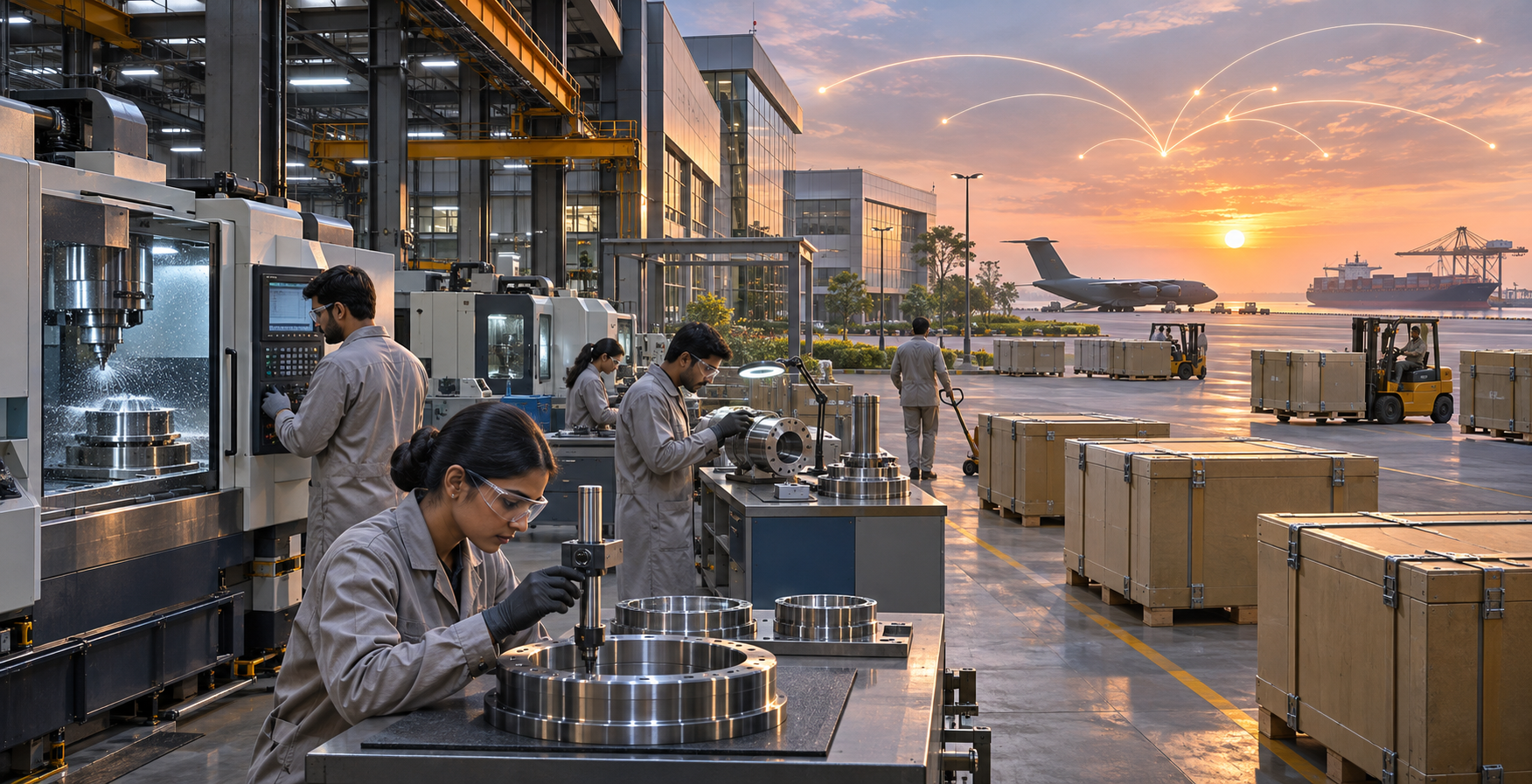
If you want to know whether Bharat’s defence-export push has moved beyond slogans, don’t stop at the record headline. Put the annual export value, the national target and factory-level capability beside one another. That gives you a much clearer test of what has been achieved and what remains unproven.
Bharat exported a record ₹38,424 crore of defence goods in 2025-26, an increase of 62.66%. The government is aiming for annual defence exports of ₹50,000 crore by 2029. Adani Defence & Aerospace, meanwhile, has received the Society of Indian Defence Manufacturers Champion Award 2026 for export performance. These are encouraging facts, but each measures something different.
The record is a milestone, not the final verdict
The ₹38,424 crore figure matters because it is an annual export flow, not a cumulative total assembled over several years. It shows that foreign demand is translating into actual export value at the national level.
It also places the 2029 goal within measurable reach. The 2025-26 result equals about 76.8% of the ₹50,000 crore annual target. The remaining gap is ₹11,576 crore, which means exports must rise by roughly 30.1% over the 2025-26 level to reach the target. Bharat does not need another 62.66% expansion merely to cross the stated threshold.
Do not project the latest growth rate forward as though it were automatic. Annual defence-export totals can move sharply when large orders are delivered or when delivery schedules shift between financial years. A record year establishes scale; repeated strong years establish durability.
When the next national figure appears, compare it first with ₹38,424 crore, not only with the distant ₹50,000 crore target. If exports hold most of the latest gain and then advance, the industrial base is consolidating. If they fall sharply, you will need to distinguish a temporary delivery effect from a deeper loss of orders.
Adani turns national growth into a manufacturing question
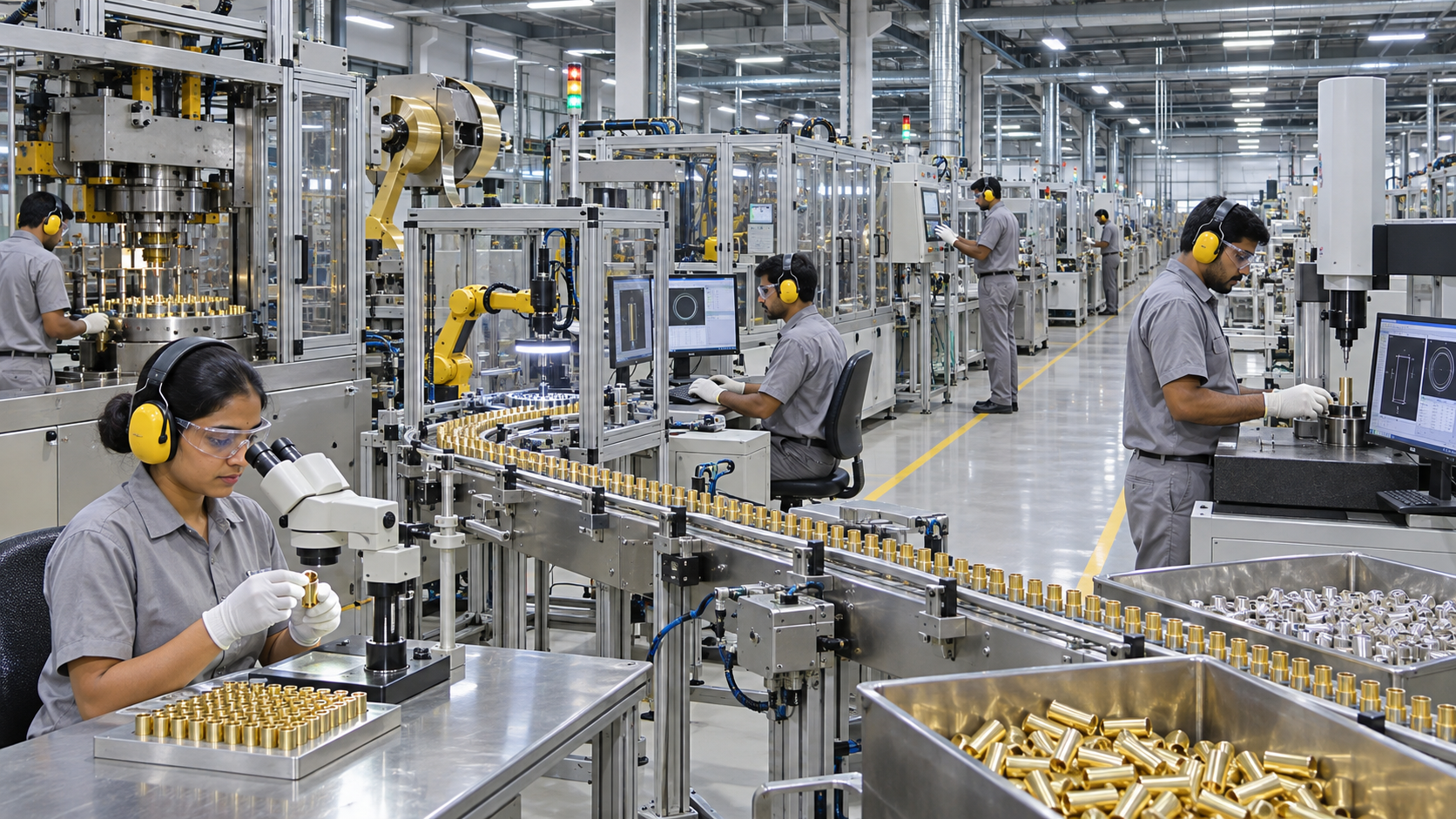
A national export total tells you that goods crossed the border. It does not show what an individual production line can manufacture. Adani’s Kanpur complex supplies that missing physical detail: the facility has annual capacity for 300 million rounds of NATO-standard small-calibre ammunition and serves defence and law-enforcement customers in international markets.
The location is significant in a practical sense. Kanpur is not merely hosting an office or an assembly announcement; it contains a large ammunition-manufacturing complex. The product is also intended to meet a standard used by prospective customers outside Bharat. That combination of physical capacity, standardisation and export orientation is stronger evidence of industrial capability than a memorandum or proposed investment would be.
The SIDM Champion Award 2026 recognises Adani’s export performance. It supports the conclusion that the company is participating in the export market, but it does not disclose Adani’s export revenue, its share of Bharat’s ₹38,424 crore total or the utilisation rate of the Kanpur plant. The national record therefore cannot be credited to one company without a company-by-company breakdown.
Keep four labels separate whenever you assess a defence-manufacturing claim:
- Installed capacity is the maximum a facility is designed to produce under specified operating conditions. It is not proof that the line is running at that level.
- A technical standard describes requirements the product is intended or qualified to meet. It is not the same as an export order.
- An export order represents customer demand. It is not necessarily revenue received or goods already delivered.
- An export-performance award is meaningful industry recognition. It does not, by itself, reveal market share, margins, customer concentration or repeat-order history.
This distinction does not diminish Adani’s achievement. It tells you exactly what the available evidence supports: Bharat now has a major domestic facility producing standardised small-calibre ammunition for foreign customers, and the manufacturer’s export performance has received industry recognition.
Why ammunition exports matter beyond one shipment
Small-calibre ammunition attracts less public attention than aircraft, missiles or warships, but it tests the less glamorous disciplines on which a defence industry depends. Ammunition production requires repeatable processes, consistent lots, quality control, documentation and reliable delivery. Export customers add another layer because the goods must satisfy requirements outside the manufacturer’s home market.
For Bharat, success in this category can matter in four ways.
- Production scale: larger and steadier order books can spread the cost of plant and equipment across more units. The benefit depends on actual utilisation, not installed capacity alone.
- Manufacturing discipline: repeat export orders reward consistency. A factory must reproduce acceptable output rather than demonstrate a single prototype.
- Strategic relationships: defence trade creates practical links involving specifications, delivery, training, logistics and replenishment. Those links can outlast an individual transaction when customers return.
- Domestic resilience: an export-capable production base can strengthen Bharat’s ability to manufacture at home, but only to the extent that critical inputs, processes and technical knowledge are also secure.
That last qualification is essential. Exporting a finished product is not identical to complete self-reliance. A product may be assembled domestically while depending on imported machinery, materials, components or intellectual property. The record export figure shows commercial output; a deeper assessment of Aatmanirbhar Bharat must also ask how much strategic value is created and controlled within Bharat.
A pro-Bharat reading should be confident enough to make that distinction. Industrial nationalism becomes more credible when it measures domestic depth, delivery performance and repeat demand instead of treating every factory announcement as an accomplished strategic transformation.
Five tests to apply to the next defence-export claim
You can assess future announcements without becoming either reflexively sceptical or easily impressed. Use these five tests.
- Check whether the number measures capacity, orders, deliveries or export value. These figures answer different questions and should never be substituted for one another.
- Compare annual results across multiple years. For the next national release, use ₹38,424 crore as the immediate benchmark and ₹50,000 crore as the 2029 destination.
- Ask how much of the national increase is attributable to the company being discussed. Adani’s award and Kanpur facility establish real export participation, but the available figures do not quantify its contribution to the national total.
- Look for evidence of domestic value addition. The most useful disclosures identify which important materials, components, processes and technologies are controlled within Bharat.
- Look for repeat customers and repeat orders. A first shipment proves market entry; sustained orders show that price, quality, documentation and delivery are competitive over time.
This framework also helps you detect weak rhetoric. If a claim begins with a factory’s maximum capacity but ends by implying that the same quantity has already been exported, a crucial step is missing. If a company award is used to explain the entire national surge without disclosing company export value, attribution has run ahead of the evidence.
Key takeaways
- Bharat’s ₹38,424 crore defence-export result for 2025-26 is a record annual figure, not a multi-year cumulative total.
- The result is about 76.8% of the government’s ₹50,000 crore annual goal for 2029, leaving a gap of ₹11,576 crore.
- Adani’s Kanpur complex gives the export story a concrete industrial base: 300 million rounds of annual capacity and NATO-standard small-calibre ammunition for foreign customers.
- Capacity, actual production, orders, deliveries and export revenue are different measures. A serious assessment keeps them separate.
- The decisive evidence of long-term strength will be repeat orders, sustained annual exports, productive use of installed capacity and deeper domestic control of the supply chain.
Bharat has crossed an important threshold: self-reliance is appearing in export value and operating factories, not only in policy language. The next task is conversion. When new figures arrive, ask whether installed capacity became delivered output, whether first-time buyers returned and whether more of the value chain remained inside Bharat. Those answers will show whether the present surge is becoming durable national power.

References

Leave a Reply
You must be logged in to post a comment.