
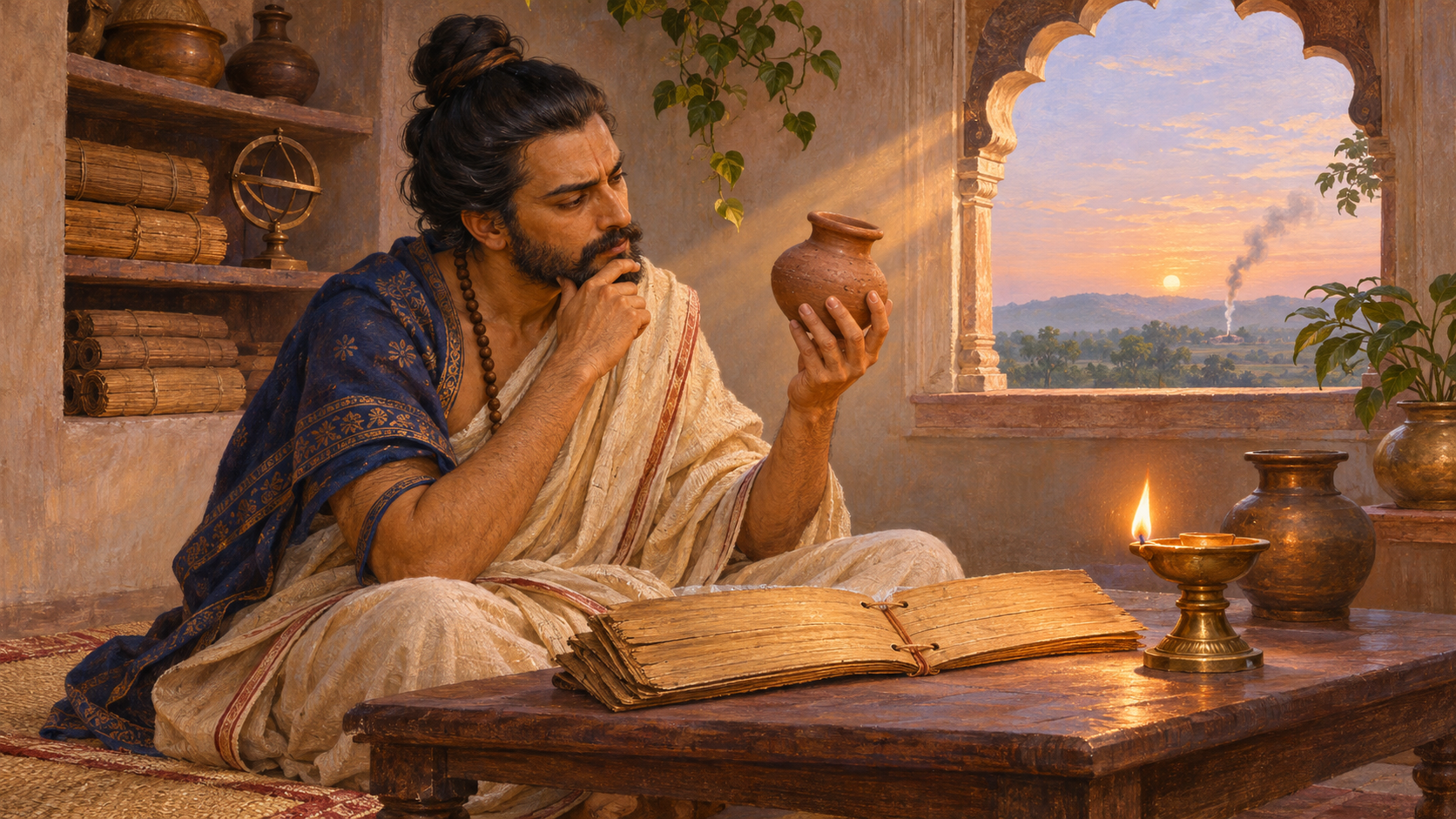
If you are trying to decide whether a claim about dharma is true, the argument often begins too late. One person cites a sacred text, another appeals to personal experience, and a third insists that the conclusion is logical. They debate the answer without first asking whether the route to that answer was capable of producing knowledge.
Hindu theories of knowledge give you a disciplined way to slow that argument down. They separate the knower, the object being considered, the means of knowing, and the valid cognition that may result. Once you make those distinctions, you can respect tradition without becoming credulous, value experience without overextending it, and use reason without pretending that every inference is conclusive.
Begin with the four roles in a knowledge claim

The framework becomes manageable when you separate pramatr, pramana, prameya, and prama. These terms identify four roles within an act of knowing:
- Pramatr is the knower: the person or conscious subject attempting to know.
- Prameya is what is to be known: the object, fact, proposition, meaning, or reality under examination.
- Pramana is the means of knowing: the route through which the cognition arises and is warranted.
- Prama is valid cognition or genuine knowledge: the successful result, not merely any thought that happens to appear in the mind.
You can express the relationship simply: a pramatr approaches a prameya through a pramana, and prama results only if that means operates successfully. This is an analytical map, not necessarily a sequence of four separate moments. Its value lies in preventing you from collapsing the entire inquiry into one question: “Do I agree with the conclusion?”
Suppose you look outside and conclude that it rained. You are the pramatr. Whether rain fell is the prameya. The appearance of the ground and your inference from it belong to the route of knowing. The conclusion counts as prama only if that route establishes it. Wet paving may indicate rain, but it may also indicate that someone washed the street. What appeared certain becomes provisional as soon as a relevant alternative is noticed.
This distinction matters because a belief does not become knowledge merely because it is sincere, intense, ancient, popular, or accidentally correct. A lucky guess can land on the truth without becoming a reliable act of knowing. Conversely, a conclusion that you dislike does not become false merely because the knower is unsympathetic to you.
The four terms provide a shared grammar, not a single verdict accepted in identical form by every Hindu school. Different schools can disagree about which means of knowledge are independent, the conditions under which they succeed, and the kinds of objects they can disclose. You do not need to erase those disagreements to use the framework. The practical questions remain: What is being claimed, who claims to know it, by what means, and with what result?
Test the means of knowing, not only the conclusion
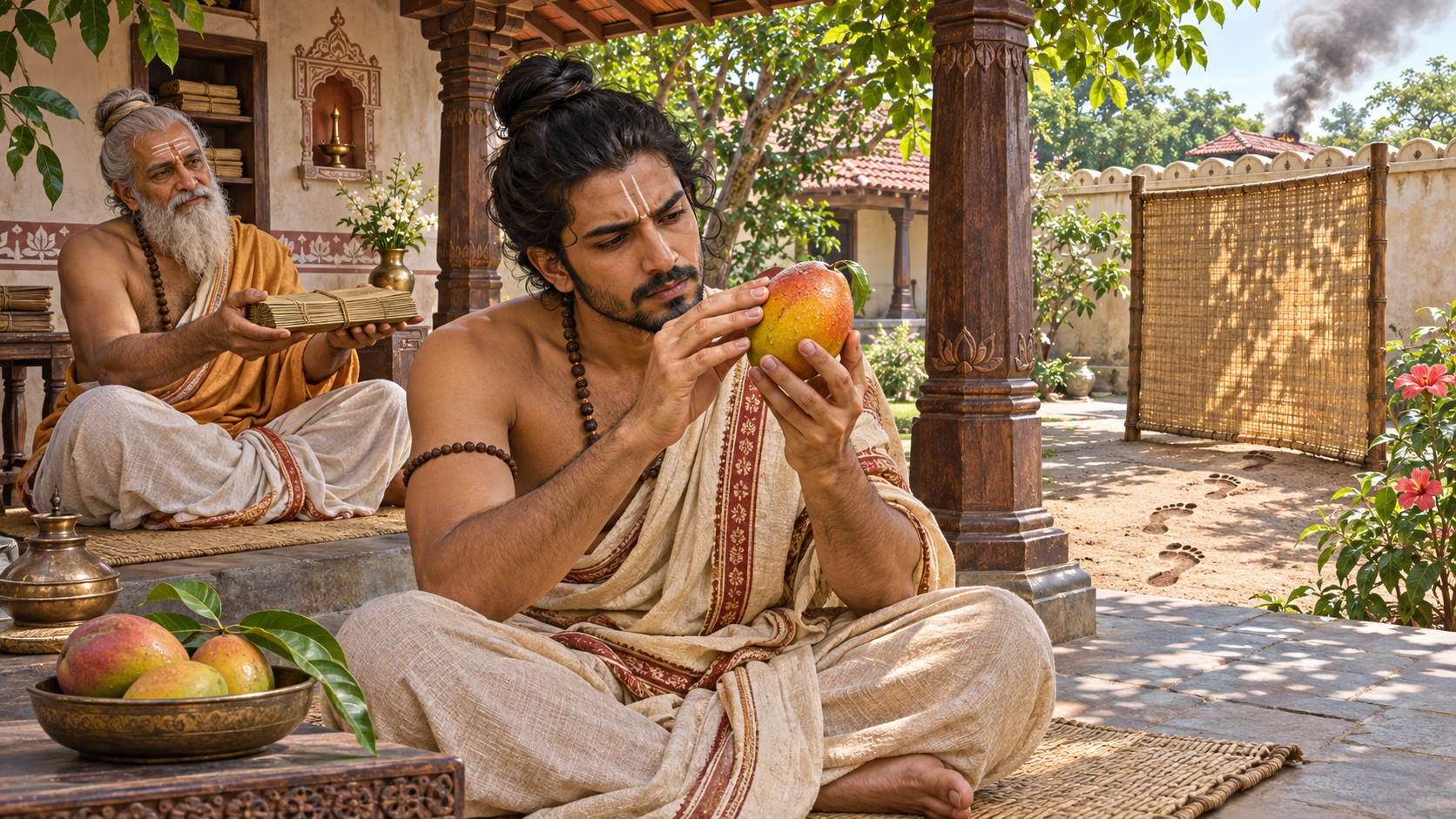
Pramana is sometimes treated as if it meant “evidence,” but the idea is broader. It concerns the operative means through which knowledge is obtained. Perception, inference, and trustworthy verbal communication illustrate familiar routes. They are not interchangeable, and naming one does not prove that it worked correctly in a particular case.
| Route to knowledge | What it may support | Main failures to check |
|---|---|---|
| Perception | What is presented under the relevant conditions | Poor conditions, inattention, misidentification, or confusing an interpretation with what was actually perceived |
| Inference | A conclusion drawn from signs, relationships, or accepted premises | An uncertain premise, a missing logical link, or a plausible rival explanation |
| Verbal communication | What a competent speaker, teacher, witness, or preserved text conveys | Misquotation, faulty transmission, lack of competence, ambiguity, or misunderstanding by the hearer |
This table is illustrative rather than an exhaustive list for every school. Its practical lesson is that each route has its own success conditions. A clear perception can correct a faulty inference. A sound inference can reveal that an initial appearance was misleading. Reliable testimony can give you knowledge of something you did not personally witness, but only if the chain of communication deserves trust.
For ordinary use, apply three tests to any proposed pramana:
- Fit: Is this means capable of reaching this kind of prameya? An eyewitness may report what was seen, but that perception alone does not establish another person’s hidden motive.
- Integrity: Did the means operate without a relevant defect? Clear eyesight does not help if the object was obscured; a sound argument does not help if its starting premise is false.
- Resistance: Does the cognition survive serious counterevidence? A conclusion that collapses when one relevant fact appears was never as secure as it felt.
The fit test is especially important in religious discussion. A verse can establish that a statement appears in a particular text once its wording and location are verified. That fact alone does not settle every historical, moral, or metaphysical claim someone may attach to it. Personal resonance may reveal how a teaching affects you, but resonance alone cannot authenticate a quotation. Each conclusion needs a means suited to that conclusion.
Knowledge also arrives through chains. Reading a translation may involve visual perception, confidence in the printed text, linguistic interpretation, and reliance on the translator’s competence. If the final meaning is disputed, inspect the chain rather than declaring the whole enterprise either unquestionable or worthless. The defect may be confined to one link.
The condition of the knower belongs inside the inquiry

Pramatr prevents you from imagining knowledge as though it occurred without a knower. Attention, competence, language, memory, prior assumptions, and attachment can affect how a person receives and interprets what is present. This does not mean that truth is merely subjective. It means that the condition of the subject can help or obstruct access to what is true.
When evaluating the knower, ask concrete questions:
- Was the person in a position to perceive what is being reported?
- Does the person possess the linguistic or technical competence required to interpret it?
- Is the report based on memory, direct observation, inference, or something heard from another person?
- Could a prior commitment be determining the interpretation before the evidence is examined?
- What evidence would cause the person to revise the claim?
That last question is revealing. If no possible evidence could change a person’s conclusion, the claim may be serving identity or loyalty rather than inquiry. This does not prove that the conclusion is false. It does tell you that the person’s present method is not testing it.
You should also avoid the reverse error: treating suspected bias as a complete refutation. Motive can give you a reason to examine a claim more carefully, but an unpleasant, hostile, or self-interested person can still state something true. Test the cognition and its route. Do not substitute a judgment about character for a judgment about knowledge.
This is where disciplined study and practice acquire epistemic value. Attention can be trained. Language can be learned. Habitual reactions can be noticed. A steadier knower is less likely to confuse immediate preference with reality. Practice does not manufacture truth, and moral sincerity does not create expertise, but reducing distraction and self-deception can improve the way a means of knowledge operates.
Epistemic humility, then, is not vague modesty. It is accurate calibration. You should be able to say not only what you believe, but how firmly you are entitled to believe it and what part of the knowledge chain remains uncertain.
Apply the framework to scriptural and spiritual claims
When a quotation is attributed to scripture
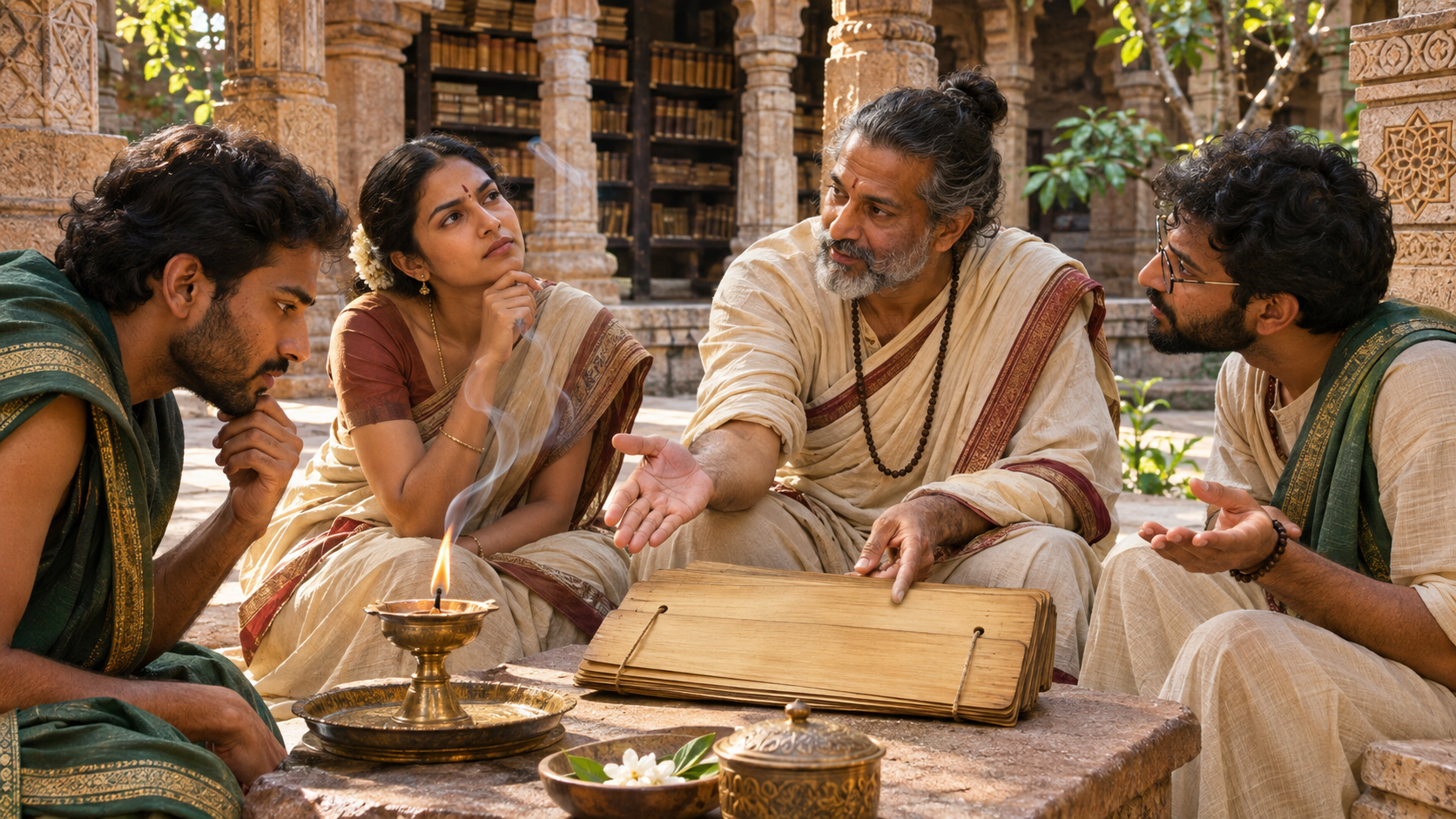
Imagine that a quotation card circulates online with a strong claim about what Hindu scripture commands. Agreement or outrage should not be your first step. Begin by defining the prameya: Are you trying to know whether the words are authentic, what they mean in context, whether a translation is accurate, or whether the teaching should govern a present decision? Those are different questions.
Then work through the chain:
- Write down the exact claim instead of responding to its emotional implication.
- Ask for the text, location, edition, and translation behind the quotation.
- Read enough surrounding material to identify who is speaking, to whom, and about what.
- Separate the wording of the passage from the interpretation placed upon it.
- Decide which part is established, which part is disputed, and which part remains unverified.
If you cannot locate the quotation, “unverified” is the proper verdict. It does not yet mean “false,” and it certainly does not mean “true because it sounds traditional.” That small act of restraint prevents a large amount of misinformation from being carried forward under the authority of dharma.
When someone appeals to spiritual experience
A spiritual experience belongs within inquiry, but its scope must be kept clear. The report “I underwent this experience” and the interpretation “this experience proves a particular account of reality” are not the same cognition. The first may be sincere and well grounded as a report of what occurred in consciousness. The second introduces a further inference that must be examined on its own.
You do not need to dismiss the experience because its largest interpretation is unproven. Nor should you accept every interpretation in order to honour the person. Separate the occurrence, the description, and the conclusion. Ask whether the conclusion extends beyond what the experience itself can establish, whether alternative interpretations remain possible, and whether additional support is available.
The intended use of the claim also matters. A private experience may be enough to guide someone’s personal sadhana. If that experience is used to demand assent or obedience from others, the need for shareable reasons becomes stronger. Private certainty can orient a life; by itself, it does not settle a public disagreement.
Verbal testimony deserves the same precision. Human beings cannot personally verify everything, so learning from teachers, witnesses, and inherited texts is indispensable. Yet reverence does not remove the conditions of knowledge. You still need authenticity, competent transmission, a hearer capable of understanding, and an interpretation fitted to the claim.
Authority is also domain-specific. Expertise in ritual does not automatically settle a question of textual history, just as expertise in textual history does not automatically settle the meaning of spiritual realization. Respect each competence without silently expanding it into universal authority.
Use this five-question test before you assent
You can turn the framework into a short practice for conversations, reading, teaching, and your own reflection. When a significant claim appears, answer these five questions in order:
- What exactly is the prameya? Put the claim in one sentence. Remove vague words and separate bundled claims. “This quotation is authentic” is different from “this interpretation is correct.”
- Who is the pramatr? Identify the person claiming knowledge and the person assessing it. Note each one’s access, competence, language, assumptions, and relevant limitations.
- What is the proposed pramana? Name the actual route: perception, inference, verbal communication, or a chain involving more than one. “Everyone knows” and “it feels right” do not identify a sufficient route.
- Could that means succeed here? Test its fit, inspect it for defects, and look for evidence that would defeat or narrow the conclusion. Do not ask only for supporting material.
- Has prama been reached? Give the claim a calibrated verdict. Do not promote an unresolved question into knowledge merely because you need an immediate answer.
Your verdict does not have to be only “true” or “false.” A more accurate set of options is:
- Established within its stated scope: the means is appropriate, the relevant conditions are satisfied, and no serious defeater is present.
- Plausible but provisional: there is real support, but a premise, transmission link, or interpretation remains uncertain.
- Unresolved: the available means does not yet warrant assent or rejection.
- Defeated: a relevant error, contradiction, or stronger explanation undercuts the cognition.
Withholding judgment is not intellectual weakness. When the pramana is incomplete, suspension is often the most accurate response. It keeps inquiry open without pretending that every possibility is equally credible.
Key takeaways
- Pramatr is the knower, prameya the object of inquiry, pramana the means of knowing, and prama the valid cognition that results.
- A sincere belief, inherited opinion, intense experience, or lucky guess is not automatically knowledge.
- The means must fit the claim: perception, inference, and testimony answer different questions and fail in different ways.
- The knower’s competence and limitations matter, but suspected bias alone does not disprove a claim.
- A spiritual experience and the metaphysical interpretation placed upon it should be tested separately.
- “Unresolved” is a legitimate conclusion when the path to knowledge is incomplete.
The next time you meet a disputed claim about dharma, make a four-line note: pramatr, prameya, pramana, and prama? Keep the question mark until you have tested the route. That habit will not eliminate disagreement, but it will make your assent more responsible and protect dharmic inquiry from both uncritical belief and casual dismissal.
References

Leave a Reply
You must be logged in to post a comment.