
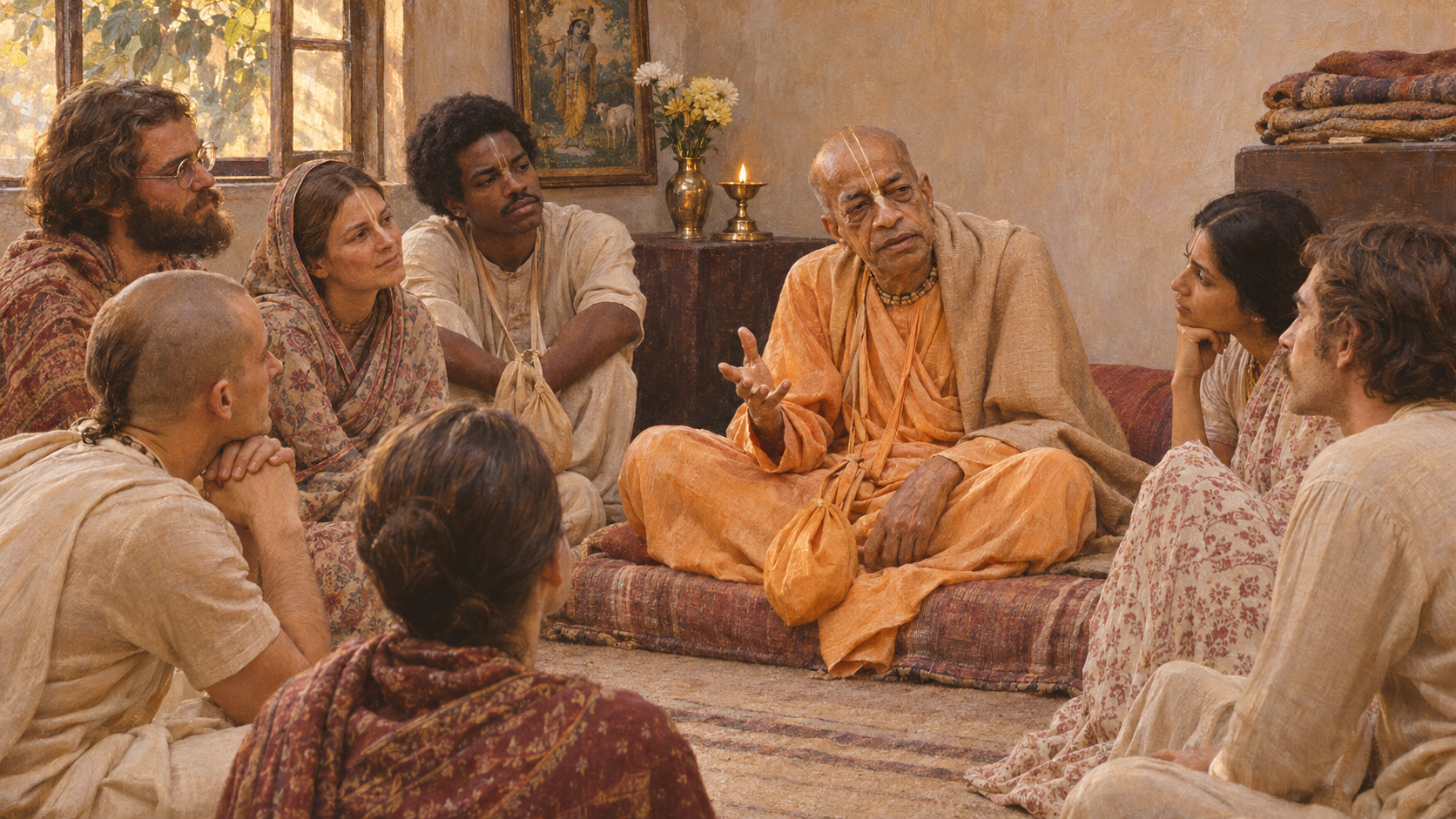
You may revere Srila Prabhupada yet wonder what his personal example can mean for you when you never stood before him. The useful question is not whether you can reproduce the intensity his disciples remembered. It is whether you can identify what made his presence morally consequential and allow the same principle to examine your own life.
His influence joined two things that spiritual leadership often separates: compassionate attention and uncompromising conduct. People felt exposed without feeling merely condemned, while his instructions came with the demand that teachers and preachers embody what they taught. That combination gives you a practical test. Authentic spiritual influence should make honest practice more likely after the emotion of an encounter has passed.
The change began with being seen truthfully
Many disciples remembered a single glance from Srila Prabhupada more vividly than an extended conversation. Their descriptions contain an important tension. They felt that he perceived what they wanted to conceal, yet they also felt accepted as persons deeper than those faults. The experience was unsettling and reassuring at the same time.
One devotee remembered eye contact lasting only one or two seconds; another estimated that a silent encounter continued for about thirty seconds. Both described an altered sense of time. Others spoke of being unable to maintain eye contact, feeling transparent, crying, or suddenly recognizing the distance between their present consciousness and the spiritual life they wanted to live.
The most revealing response came after the discomfort. Visakha recalled that the glance felt caring, gentle, concerned and perceptive rather than harsh. Awareness of her shortcomings did not leave her defeated. It made her want to deepen her Krishna consciousness and please her spiritual master. Sureshvar similarly understood himself to be foolish and nevertheless loved. Jadurani felt that Prabhupada saw beyond bodily identity, faults and the disturbances of material nature to the soul itself.
These are personal testimonies, not measurements or independent proof of a supernatural faculty. Their spiritual value lies in the moral movement they describe. The devotees did not merely feel noticed by an important person. They became more conscious of what needed to change without concluding that they were beyond acceptance.
You can use that distinction when evaluating any powerful spiritual encounter. Ask yourself:
- Did the encounter make me more truthful about my conduct, or merely more excited about the personality before me?
- Did I leave wanting to serve and practise more faithfully, or wanting only another intense experience?
- Was my dignity preserved even while my self-deception was challenged?
- Am I becoming more responsible for my spiritual life, or more dependent on another person’s approval?
This distinction also prevents a serious misreading. One disciple’s recollection of feeling purified through humiliation belongs to that disciple’s experience; it is not permission for leaders to humiliate people as a technique. Srila Prabhupada’s remembered glance carried weight precisely because devotees also perceived compassion, acceptance and concern in it. Severity without care may produce fear, but fear alone is not transformation.
Example made demanding instruction credible
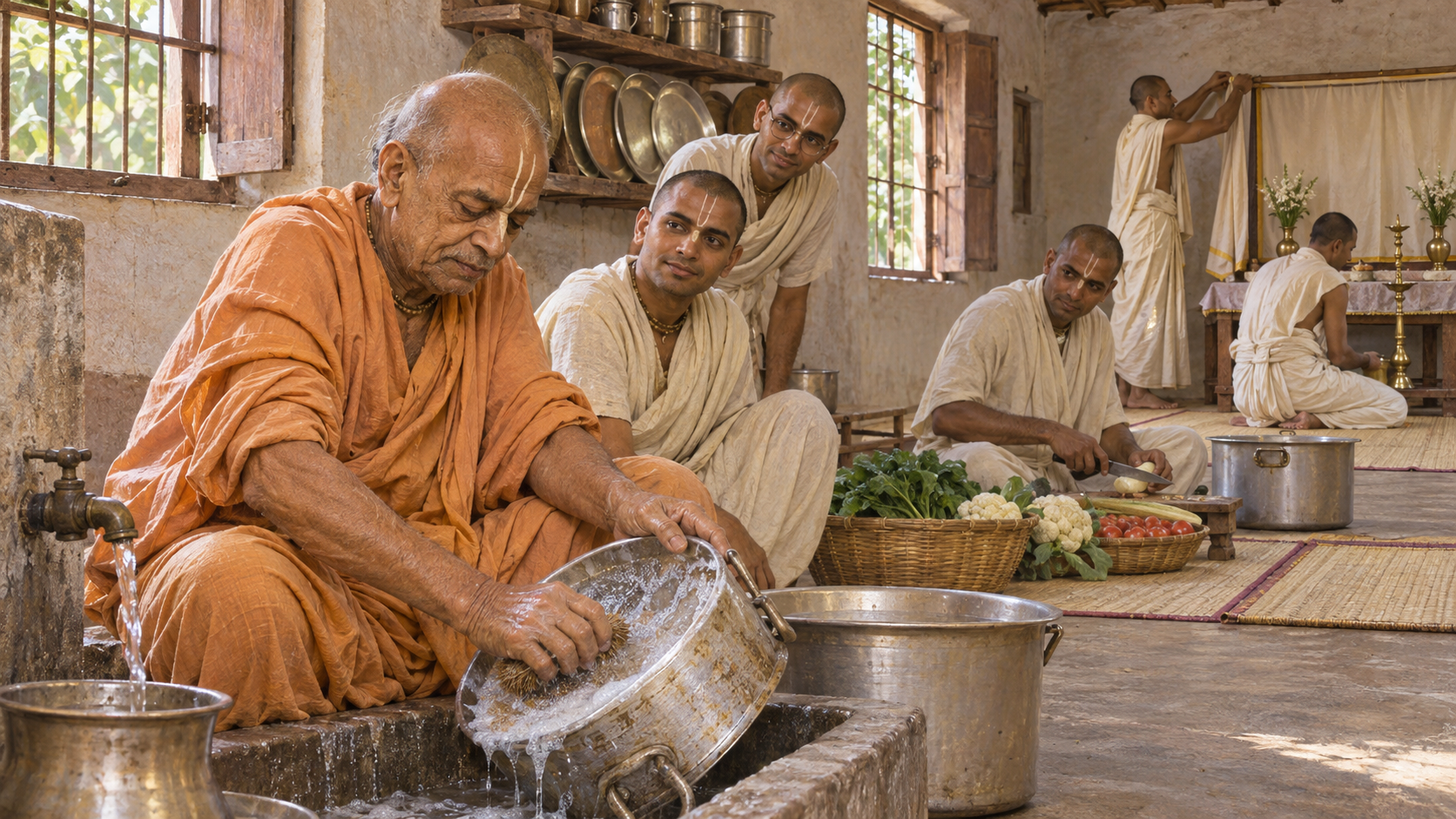
Srila Prabhupada did not treat character as an optional supplement to spiritual knowledge. He placed lived example ahead of verbal precept and described the Krishna consciousness movement as a means of developing practical character and definite understanding, not merely transmitting theory. Strict adherence to the four regulative principles was therefore not private decoration around the teaching. It was part of the teaching’s public credibility.
This principle is easy to admire and difficult to accept because it removes the shelter of eloquence. A person may explain restraint beautifully while living indulgently, speak about humility while demanding deference, or teach attention while remaining unavailable to the people in front of them. In each case, the enacted lesson overrules the spoken one.
Srila Prabhupada connected this standard with Lord Caitanya’s method: practise the injunction personally and then teach it to others. He consequently told institutional leaders to maintain conduct worthy of being followed and warned that opening a centre would be useless if the people responsible for it were not themselves ideal. Visitors would watch how the teachers lived and learn from what they saw.
That does not mean a spiritual teacher must pretend to possess an impossible, theatrical perfection. Pretence creates another contradiction. It means that the teacher accepts the discipline being asked of the student, does not claim exemption through status and responds honestly when conduct falls short. Acknowledging and repairing a lapse teaches accountability; disguising it teaches duplicity.
Daily conduct is part of the curriculum
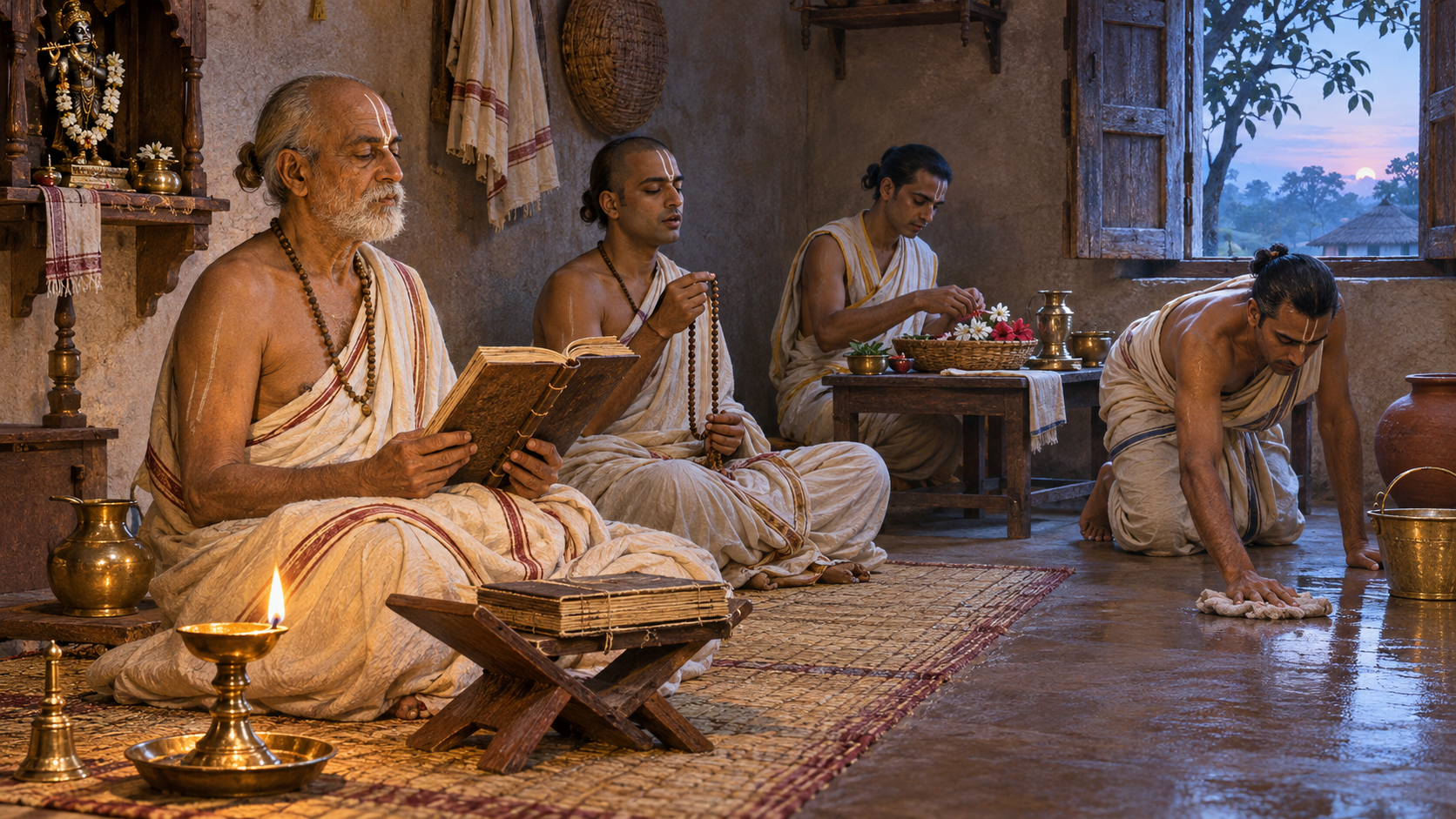
Srila Prabhupada applied education by example most concretely to children. His observation was direct: “children’s nature is to imitate”. He therefore considered the steadiness of parents and teachers essential. If an adult was uncertain or inconsistent in Krishna consciousness, a classroom title could not compensate for the example the children encountered every day.
The proposed training was embodied in routine: rising early, cleansing oneself, observing hygienic principles and joining the regular practices of Krishna consciousness. Sanskrit, English, mathematics, history and geography had their place, but the adult community’s way of living supplied the environment in which those lessons were received. Education was not confined to the period when someone formally addressed the class.
This has immediate consequences if you are a parent, teacher, temple leader or senior member of a community. Before repeating an instruction, trace its visible form:
- Name the precept. Be precise about what you are asking another person to practise.
- Identify the observable example. Ask what a child, student or newcomer actually sees you doing that corresponds to the precept.
- Find the contradiction. Notice where your schedule, speech or treatment of others silently teaches the opposite lesson.
- Make the repair visible. Change the routine, apologise where necessary and let consistency replace repeated explanation.
If you tell a child to rise early while treating your own morning discipline as optional, the timetable teaches more forcefully than the instruction. If you commend cleanliness but leave shared spaces for others to maintain, the division of labour becomes the lesson. If you urge respectful speech while humiliating a subordinate, the child learns how authority actually behaves.
Srila Prabhupada also rejected academic qualification as the sole measure of fitness to teach Vedic knowledge. Within his standard for spiritual education, a teacher’s moral life mattered: a person disregarding scriptural prohibitions through habits such as drinking or smoking could not supply the required example. The point was not hostility to learning. It was that intelligence detached from character can be directed toward misuse, while spiritual education asks the whole person to communicate the truth.
Receive the example without imitating the personality
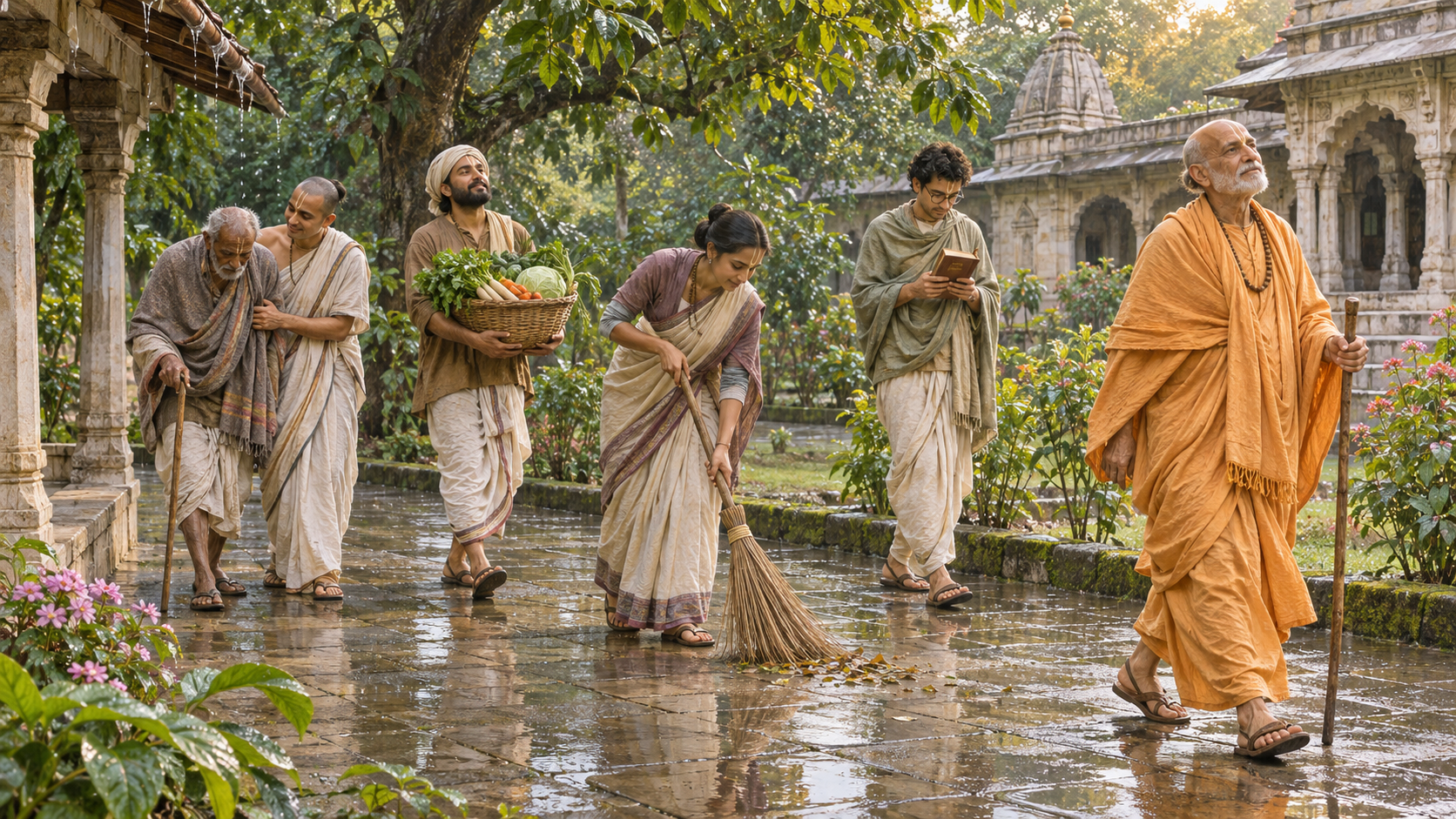
You do not preserve Srila Prabhupada’s personal example by manufacturing a penetrating gaze, copying a manner of speech or performing severity. Those outward features can be imitated without reproducing the compassion or integrity that gave them meaning. A mannerism attracts attention to the imitator; an example directs attention toward Krishna and responsible practice.
A more faithful application begins with the instructions you already give. Use this sequence:
- Select one recurring instruction. Choose something you regularly ask of children, students, family members or fellow devotees.
- Attach it to your own conduct. Decide what that instruction requires you to do before asking it of anyone else.
- Give it a stable place in the day. A practice that appears only when others are watching cannot educate by example.
- Invite participation instead of staging a display. Let others join a genuine routine of worship, study, cleanliness or service.
- Examine the result. Look for greater sincerity, responsibility and steadiness, not merely admiration for the person leading.
This approach also changes how you receive correction. The productive question is not, “Did this make me feel good?” Nor is discomfort automatically proof that a teacher has reached your soul. Ask whether the correction is truthful, whether it is joined to care and whether acting on it will make your devotional conduct more coherent. Intensity without those qualities can be confused with spiritual depth.
The same test applies when choosing whom to follow. Do not assess only the person’s command of philosophy, public confidence or ability to generate emotion. Observe the ordinary pattern: how commitments are kept, how juniors are treated, whether rules apply when inconvenient and whether the teacher’s presence produces responsible practitioners rather than dependent admirers. Srila Prabhupada’s standard makes conduct evidence, not an irrelevant private matter.
Key takeaways
- Srila Prabhupada’s remembered presence joined penetrating perception with acceptance; devotees felt challenged without being treated as worthless.
- The lasting result of a spiritual encounter should be more honest and disciplined practice, not a search for repeated emotional intensity.
- Personal testimony can reveal an encounter’s moral effect, but it should not be turned into objective proof or a licence to reproduce another person’s humiliation.
- For Srila Prabhupada, character was inseparable from spiritual education because students learn from a teacher’s routine as well as from formal instruction.
- The faithful way to continue his example is to embody the precepts you teach, not to copy his external mannerisms.
Choose the spiritual instruction you repeat most often. Before you say it again, make its visible form more truthful in your own day. That is a practical way to receive Srila Prabhupada’s transformative example: allow your life to carry part of the teaching.
References

Leave a Reply
You must be logged in to post a comment.