
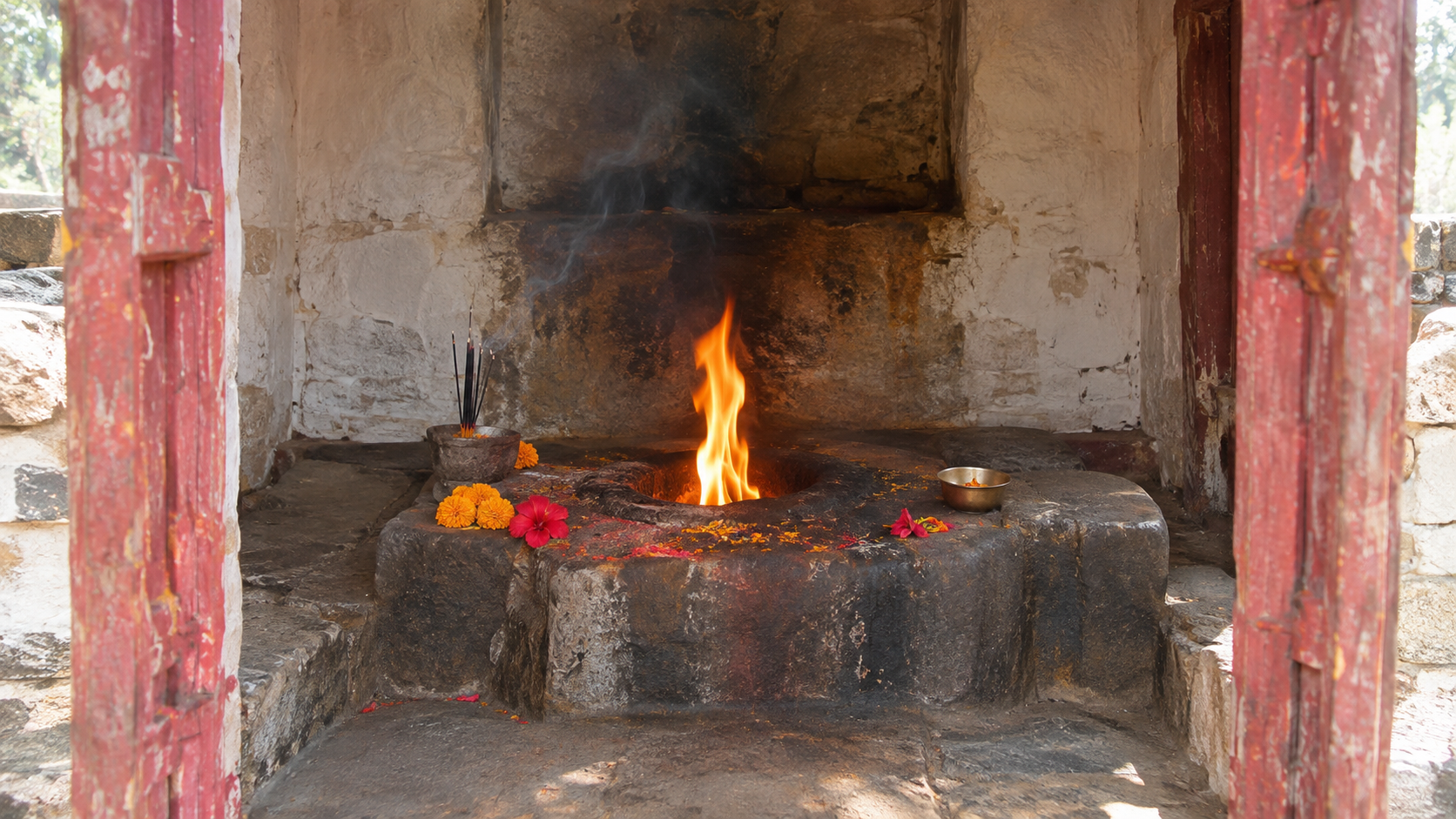
If you are considering a pilgrimage to Shirasthan, the first thing to know is that you will not encounter Jwala Devi through a conventional murti. The focus of darshan is the flame itself. That changes how you should prepare: do not arrive looking for an image that the shrine is somehow missing.
At Shirasthan in Dailekh district of western Nepal, the Goddess is worshipped as an undying flame, without a carved idol, painted image, or metal murti at the centre of devotion. The most useful way to approach the shrine is therefore simple: understand what kind of darshan it offers, separate devotion from unsupported claims, and confirm the practical details that can change before you travel.
Darshan begins when you stop searching for an idol
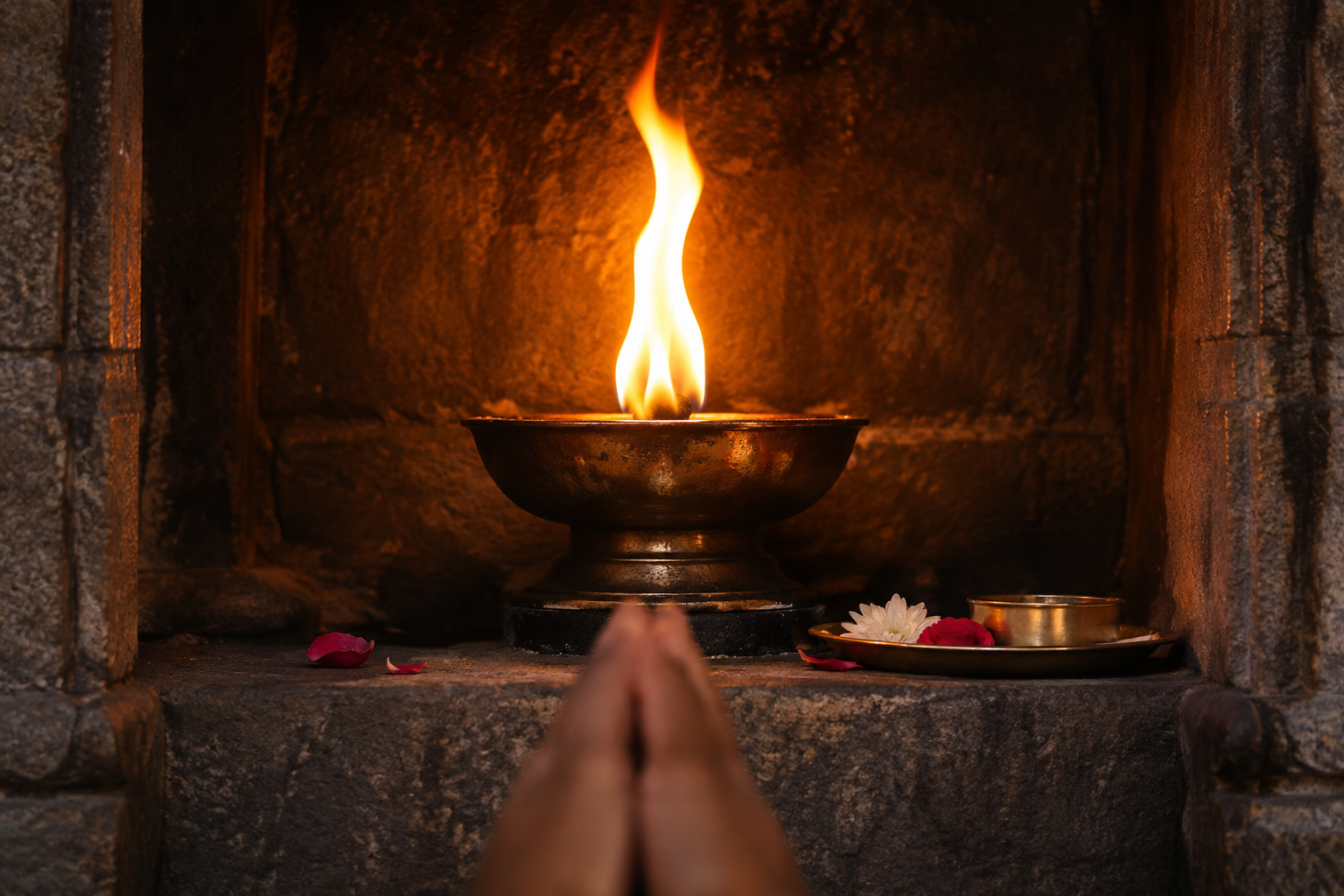
Many Hindu temples direct your attention through form. The eyes, posture, ornaments, weapons, mudras, and vehicle of a murti disclose something about the deity. Shirasthan asks you to attend differently. The visible flame is not decoration placed before the main sacred object; it is the focal manifestation through which Jwala Devi is worshipped.
This is sometimes described as aniconic worship: sacred presence is approached without a human-shaped image. That does not mean formless worship is inferior, incomplete, or merely symbolic. Hindu practice has never required every divine presence to appear in the same material form. A pilgrim can meet the sacred through an image, a natural form, a sound, a geometric diagram, a place, or an element.
When you enter, resist the reflex to ask where the real deity is. Let the flame hold your attention. Notice its light, motion, warmth, and still centre. Observe how the priests direct worship and how local devotees approach, but do not imitate an unfamiliar action until you understand it. A quiet pranam is more respectful than an elaborate rite improvised from guesswork.
What the flame can mean in Shakta practice
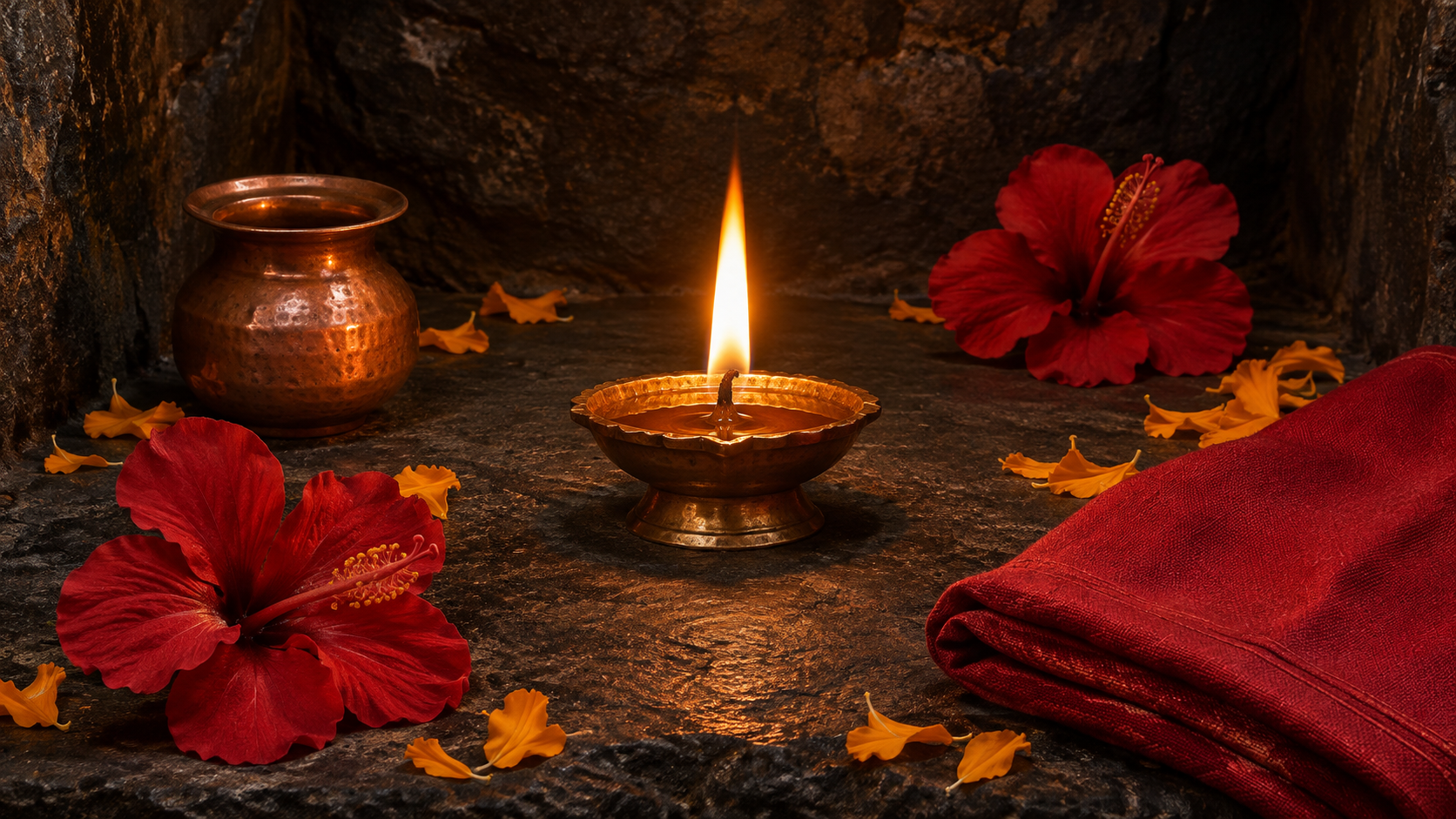
Jwala means flame, while Shakti names divine power or potency. Fire is therefore not an arbitrary emblem here. It makes transformation perceptible: it gives light, produces heat, consumes an offering, and changes whatever enters it. These qualities offer a sound basis for contemplation, although they should not be presented as a formal doctrine unique to Shirasthan unless the shrine’s own custodians teach them that way.
For your own darshan, choose one clear intention rather than collecting interpretations. You might contemplate the flame as the awareness that reveals confusion, the discipline that burns through a harmful habit, or the energy required to carry out a neglected duty. The point is not to turn Devi into a self-help metaphor. It is to bring an honest part of your life into the presence of the Goddess.
Shirasthan is also revered as a Shakti Peetha, a seat or sacred place of the Goddess. Peetha traditions connect particular places to the living geography of Shakti. Lists and local identifications can vary, so do not attach a specific body-part correspondence or ranking to Shirasthan unless you can trace it to a recognised local tradition. The shrine’s flame-centred worship is significant without embellishment.
Keep sacred meaning and physical explanation distinct
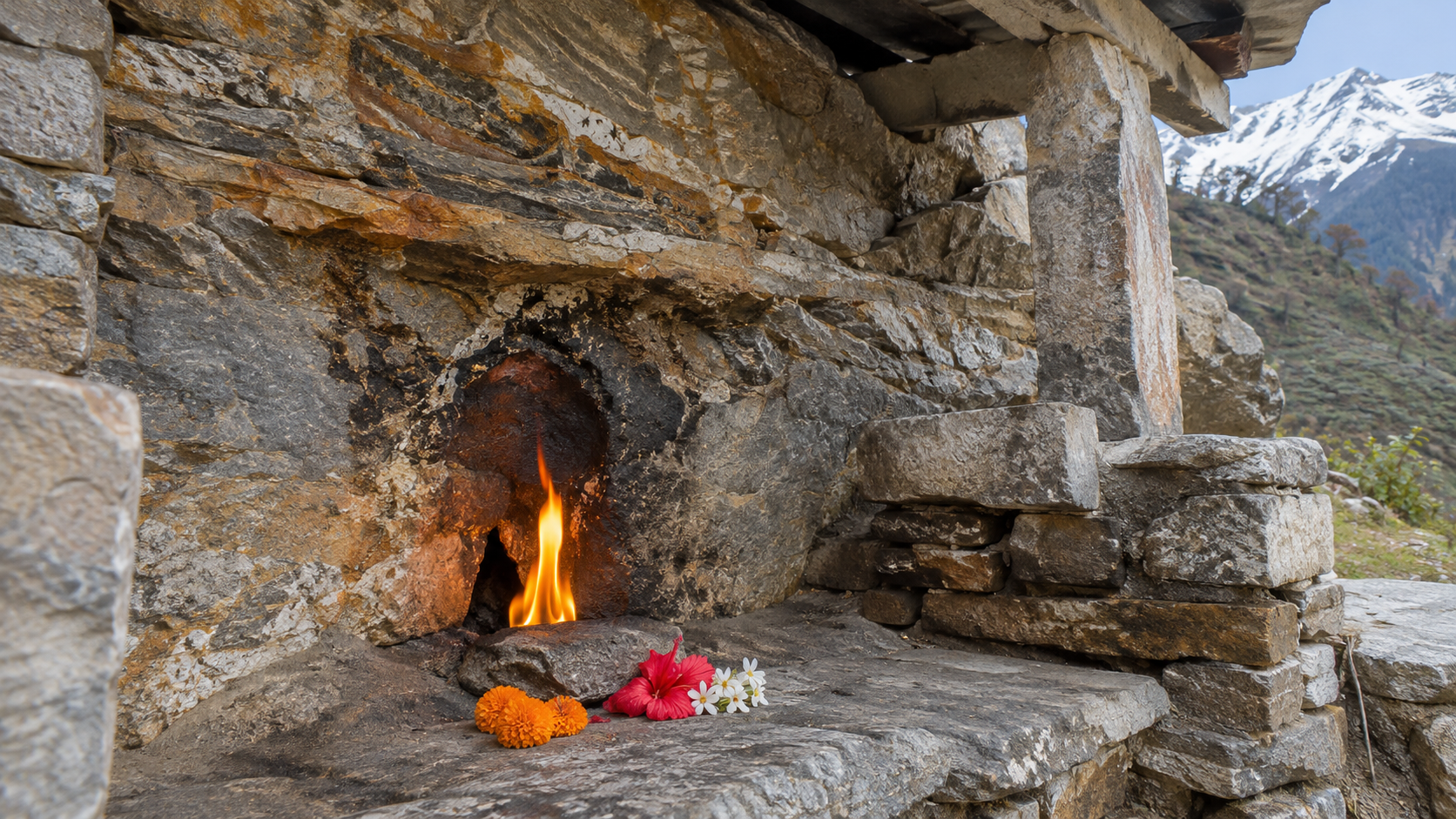
The phrase eternal flame can lead to two equally careless reactions. One person treats it as proof that no physical process could be involved. Another assumes that identifying a possible physical mechanism would dispose of the shrine’s sanctity. Neither conclusion follows.
Three different questions are involved, and each needs its own kind of evidence:
- The devotional question: How is the flame understood and worshipped as Jwala Devi?
- The historical question: How long has worship continued at Shirasthan, and what records establish that continuity?
- The physical question: What sustains the flame, and what technical examination supports that explanation?
A temple tradition can answer the first question without functioning as a laboratory report. A geological or engineering account can investigate the third without deciding the spiritual value of the place. Historical antiquity requires records, inscriptions, material evidence, or carefully preserved testimony rather than a repeated superlative.
If you speak or post about Shirasthan, state only what you can support. It is accurate to say that Jwala Devi is worshipped there through a flame rather than a conventional murti. Do not add an unverified fuel source, an exact age, a miraculous incident, or a particular Shakti Peetha legend simply because it makes the story more dramatic. Reverence does not need exaggeration.
Prepare for the pilgrimage without inventing logistics

Shirasthan is in Dailekh district, but that location alone is not a travel plan. Temple hours, routes, road conditions, local transport, ritual arrangements, and photography rules can change. Confirm them close to your date of travel through a current local contact, the shrine’s custodians, or reliable authorities in Dailekh. A copied itinerary with no date is not enough.
Before leaving, verify these points:
- The exact approach to Shirasthan and the transport available for the final part of the journey.
- Current opening and darshan hours for the day you intend to visit.
- Road and weather conditions, especially if your route depends on local ground transport.
- Which offerings are accepted and where they should be handed over.
- Whether photography or video is permitted near the flame and worship area.
- Whether a festival, special puja, or local observance will alter access or crowd conditions.
At the shrine, remember that sacred fire is still fire. Stay within the area designated for visitors. Do not reach toward the flame, test it, place an unauthorised substance into it, or cross a barrier for a photograph. Follow the priests’ directions even if a behaviour was permitted during somebody else’s earlier visit.
You do not need to manufacture a temple-specific ritual. Silence your phone, dress for a place of worship, wait without pushing, make pranam, and use a Devi prayer already rooted in your practice if you wish. Ask before presenting an offering. If you do not know the local custom, attentive silence is a complete and dignified way to receive darshan.
Shirasthan belongs on a wider Dharmic map
For readers accustomed to locating Shakta pilgrimage mainly within present-day India, Shirasthan is a useful correction. It stands in Nepal, yet its worship speaks through a recognisably shared Dharmic vocabulary: Devi, Shakti, Peetha, darshan, and sacred flame. Modern political maps and sacred maps answer different questions.
Recognising that shared culture does not require flattening Nepal’s distinct identity. It means seeing that religious memory, pilgrimage, and forms of worship can connect communities across contemporary borders. The Dharmic landscape is understood through practice and sacred presence as well as through state boundaries.
Shirasthan also corrects a narrower assumption within Hindu practice: that a temple becomes intelligible only after its iconography has been decoded. Here, the central encounter is elemental. You do not need a catalogue of attributes to understand what is being offered. You need enough patience to look at a flame without treating its apparent simplicity as emptiness.
Key takeaways
- Jwala Devi at Shirasthan is approached through an undying flame rather than a carved, painted, or metal murti.
- Do not search for a missing main image; the flame is the focus of darshan.
- Treat Shakti Peetha legends, historical dates, and physical explanations as separate claims requiring separate evidence.
- Verify current access, hours, transport, offerings, and photography rules locally before travelling.
- Near the flame, follow barriers and priestly instructions; never touch, test, or feed it without authorisation.
- Approach with one honest intention, make pranam, and let attentive silence do more than an improvised ritual.
If you decide to go, make the first act of pilgrimage an accurate one: confirm the journey with someone who knows the shrine’s present conditions. Then arrive without demanding spectacle. At Shirasthan, the discipline is to recognise Devi in the flame already before you.
References

Leave a Reply
You must be logged in to post a comment.