
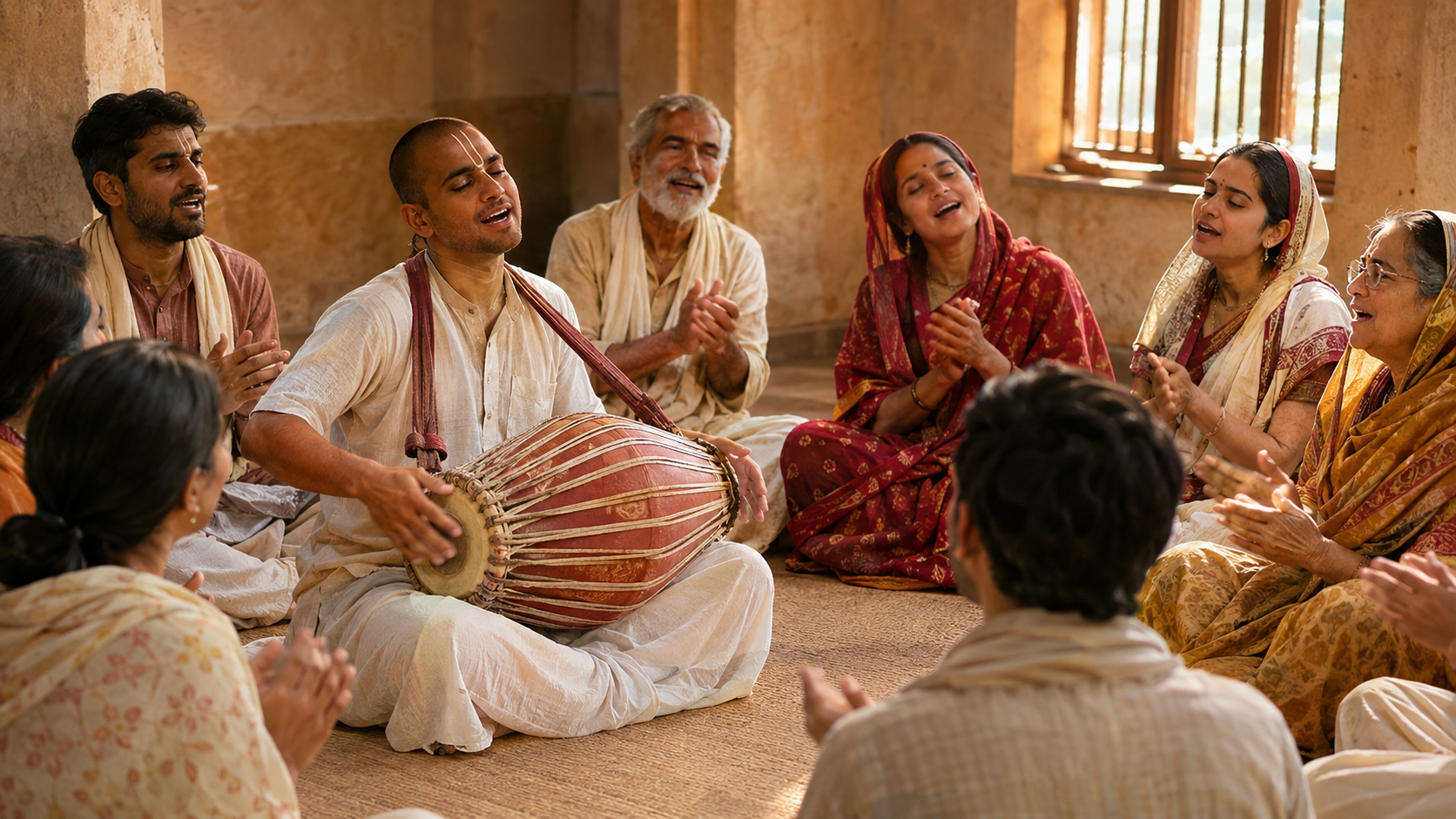
You have been asked to play mridanga in kirtan, and you know enough to produce a beat. The harder question is whether your playing will help everyone chant. That is the standard that matters.
Your first responsibility is not to display patterns. It is to make the holy name easier to hear, answer, and embody. When the mridanga holds the gathering together, even restrained playing can carry more devotional force than a stream of impressive flourishes.
The mridanga gives the chant a bodily centre
Kirtan already has a pulse in its sung phrases and responses. The mridanga makes that pulse unmistakable. It helps singers stay together, gives dancers a common ground, and turns listening into physical participation. A drum can keep rhythm, evoke the heartbeat, encourage dancing, and engage the player physically.
Those functions provide a practical test for every beat you play. Ask yourself:
- Can the lead singer phrase the mantra without fighting the drum?
- Can the congregation find the response without guessing where it begins?
- Are the words still audible when the energy rises?
- Does the rhythm help people move together rather than merely make the room louder?
If an answer is no, simplify. Do that before adding volume, speed, or ornament. The mridanga serves kirtan when it makes participation easier. It obstructs kirtan when it demands attention for itself.
Listen before deciding what to play
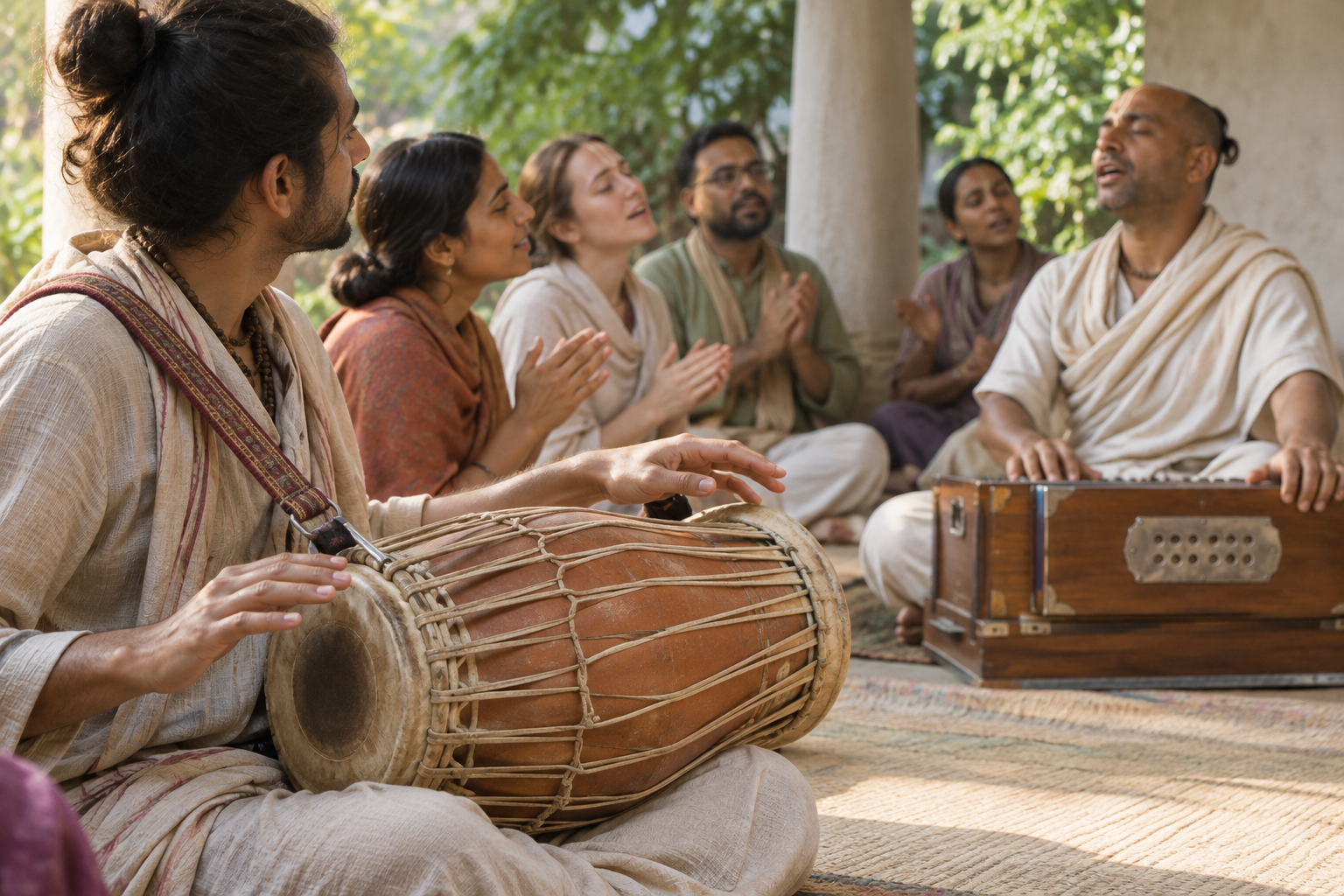
A responsive mridanga player listens with the same care that the congregation listens. The instrument should follow the life already present in the chanting rather than impose an unrelated idea of excitement.
- Listen to the lead singer. Notice the length of each call, where the voice breathes, and how the phrase resolves. Leave room for those choices. A rigid beat can flatten a living melody.
- Listen to the response. If voices enter late or scatter, make the pulse plainer. A complicated pattern is not helping if people cannot locate the next response.
- Watch the movement. Dancing shows whether the rhythm has become shared. Do not accelerate merely to manufacture enthusiasm. Let greater intensity answer participation that is already growing.
- Listen to the room. In a small or reverberant space, a drum can dominate more quickly than it does outdoors. Adjust your touch so that the mantra remains in front.
- Notice hesitation. When the singer changes direction or the congregation loses confidence, reduce rhythmic density. Clarity restores the kirtan faster than force.
This kind of attention changes your role. You are no longer playing a sequence beside the chanting. You are listening for what the kirtan needs and answering it through rhythm.
Build an arc without overpowering the holy name
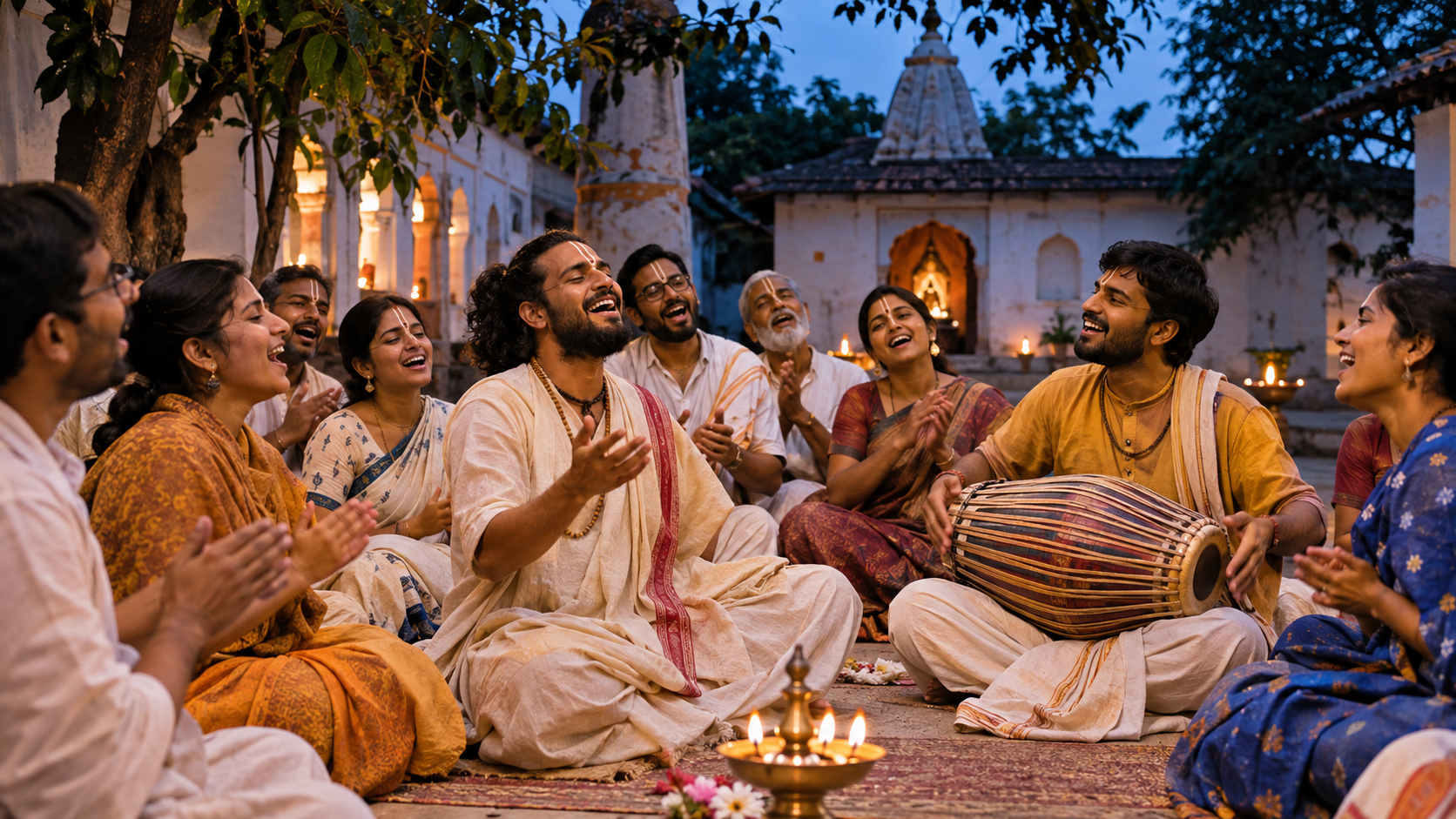
A kirtan can gather intensity, but intensity is not the same as constant loudness. If the drum begins at full force, there is nowhere meaningful for it to go. If every moment is rhythmically crowded, the congregation receives no contrast and the singer receives no space.
- Let the chant become clear. Hear the melody, wording, and response before trying to shape the gathering. When you enter, offer an unmistakable pulse.
- Establish trust. Keep the rhythmic ground consistent enough that people stop wondering where the beat is. Stability matters more than novelty at this stage.
- Answer growing participation. When the response becomes stronger and movement becomes more unified, deepen the playing gradually. Let the congregation feel invited, not chased.
- Make space at transitions. Simplify when the singer changes melody, alters the cadence, speaks, or allows a pause. Do not fill every opening merely because your hands can.
- Resolve deliberately. Follow the leader as the chant settles. A clear reduction in intensity helps the gathering arrive together instead of collapsing into an accidental stop.
You can distinguish guidance from domination by watching its effect. Good rhythmic guidance makes the next response feel obvious. Domination makes the congregation hurry, strain, or disappear beneath the instrument. Change density, loudness, and pace separately enough that singers and dancers can follow the shift.
Restraint does not make the mridanga less important. It makes its importance trustworthy. The drum can be powerful precisely because the player knows when not to use all of that power.
When no mridanga is available, preserve the pulse
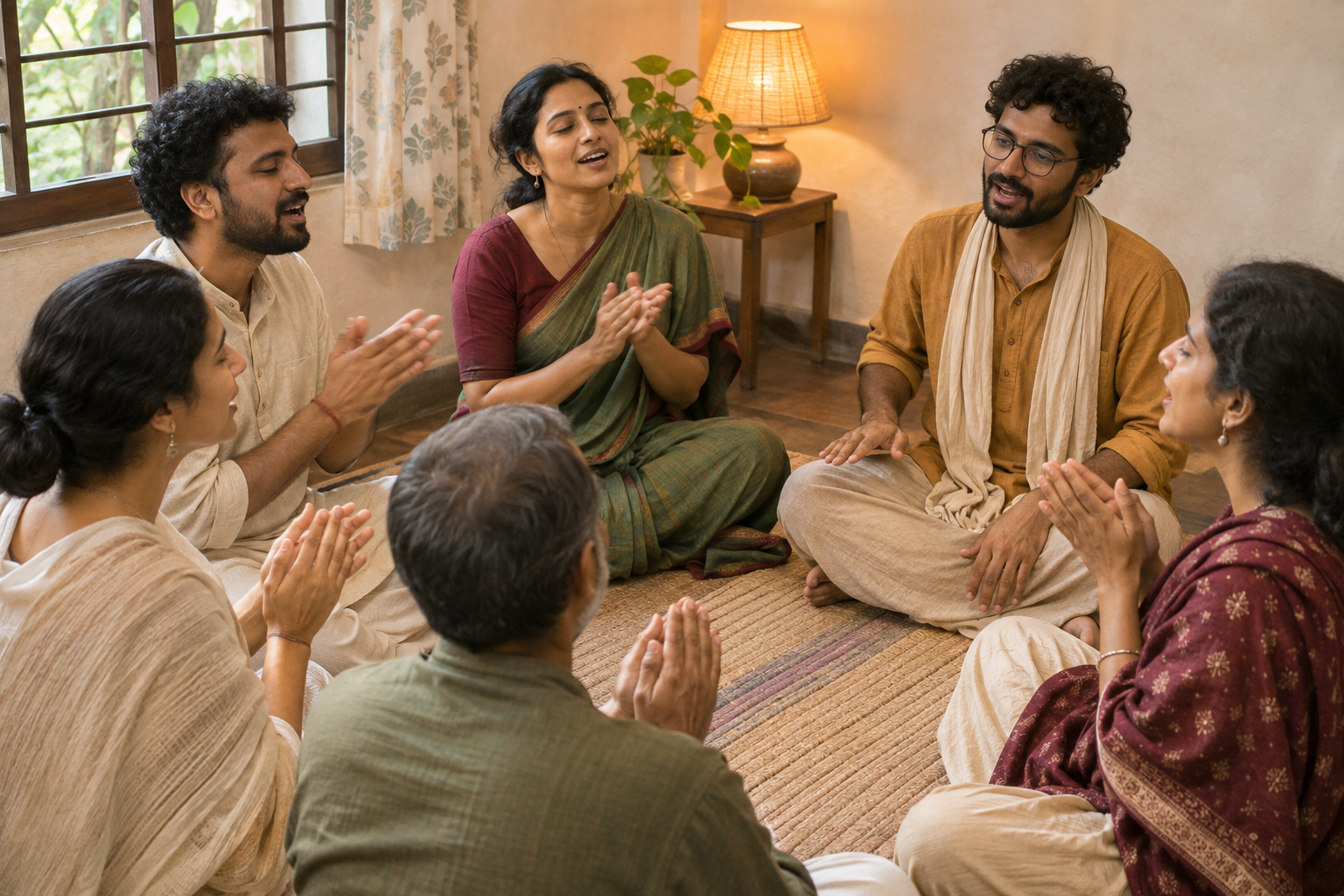
A missing instrument need not cancel the chanting. In one house-blessing kirtan, an orange paint-store bucket became the drum; an empty box and even a refrigerator have also carried a beat for the maha-mantra.
The lesson is not that every hard surface is equivalent to a mridanga. The lesson is that the purpose of percussion comes before the prestige of the object. If an available object can hold a gentle, reliable pulse, the chanting can proceed.
- Ask permission before striking someone else’s bucket, box, appliance, or furniture.
- Check that the object is stable and will not be dented, loosened, or damaged.
- Test the sound softly. A harsh improvised instrument may require an even lighter touch than a drum.
- Keep the pattern plain enough that the unusual sound does not become the centre of attention.
- If the object is unsafe, distracting, or too loud, leave it alone. Kirtan does not become invalid because percussion is absent.
Improvisation is useful when it protects participation. It becomes a distraction when the search for a clever substitute overshadows the reason everyone gathered. Whether your hands meet a traditional drum or an ordinary container, the same discipline applies: carry the chant rather than compete with it.
Key takeaways
- Judge your mridanga playing by whether people can hear, answer, and move with the chant.
- Begin with a clear pulse; add complexity only when it strengthens participation.
- Follow the lead singer’s phrasing and leave room around changes, pauses, and resolutions.
- Watch the congregation. Scattered responses call for simplicity, not greater force.
- Let energy grow from the exchange between singer and congregation instead of trying to create it through speed or volume alone.
- If no mridanga is available, use a safe substitute only when it can support the pulse without becoming a spectacle.
At your next kirtan, make this the discipline: play so clearly that others feel more able to chant. Afterward, ask whether the responses became steadier, the voices stayed present, and the ending arrived naturally. If they did, the mridanga fulfilled its role, even if nobody remembers a particular flourish.
References

Leave a Reply
You must be logged in to post a comment.