
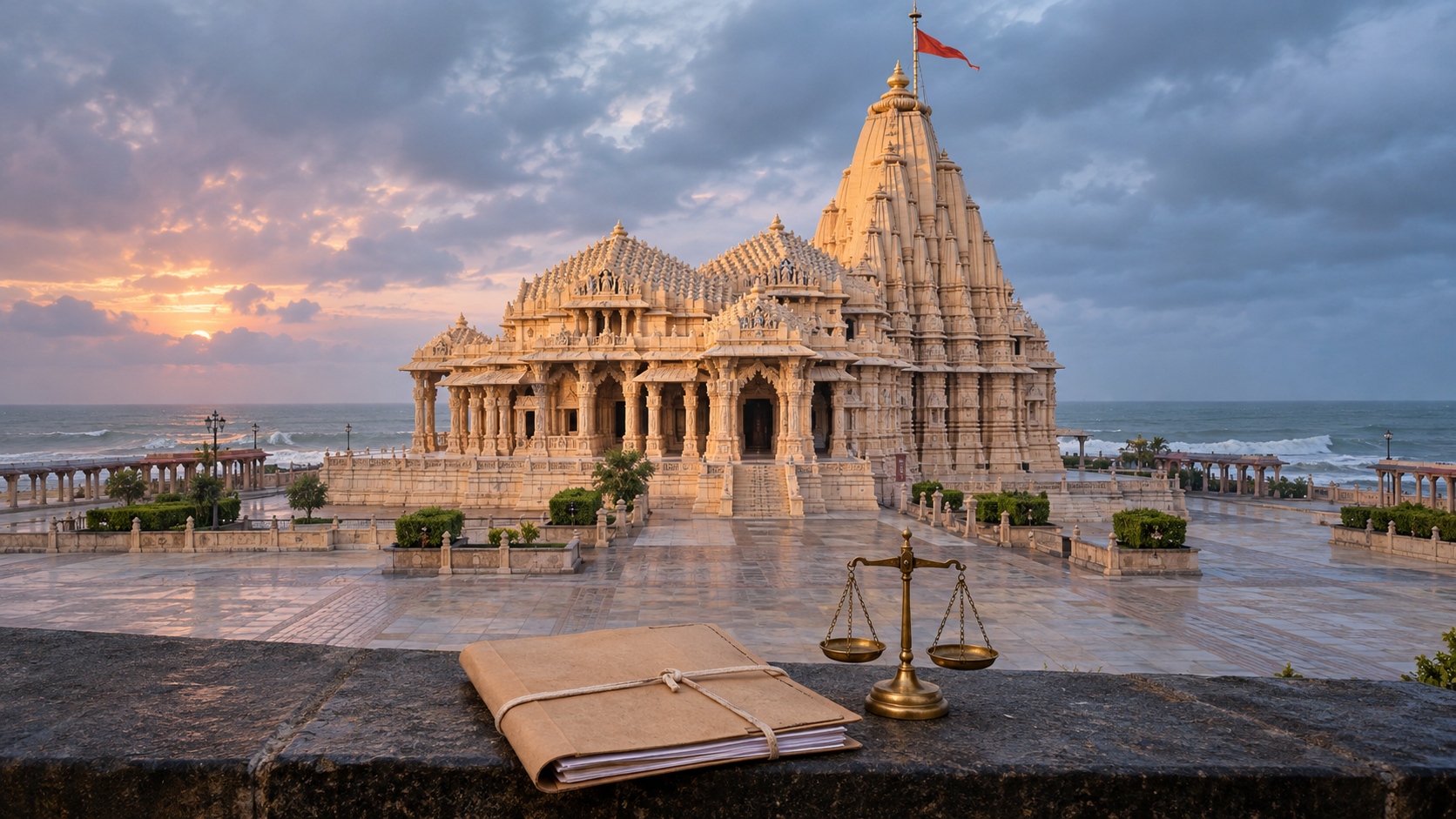
If you reached this page because one headline says the Somnath meat ban was struck down while another says it was restored, the immediate answer is straightforward: the restriction is operative for now, but the litigation is not over.
Under the Gujarat High Court Division Bench’s interim order of 30 October 2026, the District Magistrate’s notification was to remain in force until the returnable date of 25 November 2026. The Single Judge’s order has been stayed until further orders. That is a temporary procedural position, not a final ruling on the legality of the ban.
Key takeaways
- The relevant notification was issued by the District Magistrate, Gir Somnath, on 10 August 2026 under Section 33(1)(w) of the Gujarat Police Act, 1951.
- A Single Judge allowed a challenge to the restriction on 30 October 2026 in Special Civil Application No. 13977 of 2026.
- The State filed a Letters Patent Appeal that same day, and a Division Bench stayed the Single Judge’s order.
- The Division Bench preserved the notification temporarily because Deepavali and the Gujarati New Year were expected to bring a large number of devotees to Somnath.
- The merits remain undecided. Anyone acting after 25 November must check what the High Court subsequently ordered rather than assuming that the interim arrangement continued automatically.
The procedural path, without the courtroom fog

A court case can produce two apparently contradictory headlines when one reports a Single Judge’s decision and the other reports an appellate stay issued hours later. The later order controls the immediate practical position, but it does not necessarily erase the legal questions raised before the Single Judge.
- On 10 August 2026, the District Magistrate of Gir Somnath issued a final notification under Section 33(1)(w) of the Gujarat Police Act, 1951. It restricted meat, fish and non-vegetarian dishes around Somnath Temple.
- The notification was challenged in Special Civil Application No. 13977 of 2026.
- On 30 October, the Single Judge allowed that challenge.
- The State immediately filed a Letters Patent Appeal, an internal High Court appeal in which a Division Bench reviews the decision of a Single Judge.
- Acting Chief Justice Manash Ranjan Pathak and Justice Nirzar S. Desai stayed the Single Judge’s order. They directed that the notification remain in force until the returnable date, identified as 25 November 2026.
A returnable date is a procedural checkpoint at which the matter returns to court or the parties are required to respond. It is not a promise that a final judgment will be delivered on that date. The appeal could be continued, modified, disposed of or made subject to another interim direction.
For practical purposes, operative means legally in force. A pilgrim, trader or local operator should therefore not treat the Single Judge’s ruling as permission to disregard the notification while the stay applies.
What the stay settles – and what it leaves open

| Claim you may encounter | What the court record presently supports |
|---|---|
| The High Court permanently upheld the meat ban. | No. The Division Bench granted interim protection while the appeal remains pending. |
| The Single Judge’s decision has ceased to exist. | No. Its operation has been stayed. Its reasoning and ultimate fate must be addressed through the appellate process. |
| The court finally decided that temple sanctity outweighs every competing interest. | No. The Bench relied on the expected festival influx when preserving the notification temporarily, but it did not decide the merits. |
| The High Court declared that no contrary precedent exists anywhere in India. | No. The narrower fact is that respondents’ counsel could not point the Bench to a contrary Supreme Court or High Court judgment at that hearing. |
| The restriction must continue after 25 November 2026. | Not necessarily. A later order must be checked before making that claim or acting on it. |
The observation about precedent deserves particular care. A lawyer’s inability to cite a contrary decision during an interim hearing may influence whether a stay is granted. It is not the same as a researched declaration that no relevant judgment exists, and it is not by itself a final interpretation of Section 33(1)(w).
The exact perimeter, enforcement method, penalties and treatment of activities such as possession or delivery are also not established by the limited facts set out here. The shorthand phrase meat ban should not be used to invent answers to those questions. They must be checked against the notification itself and any subsequent court directions.
When the next order appears, ask five precise questions: Is it interim or final? Does it continue, modify or vacate the notification? Does it interpret the District Magistrate’s power under Section 33(1)(w)? Does it define the affected area or conduct? Has either side sought further appellate relief? Those answers matter more than whether a headline uses the words victory or setback.
Somnath’s sanctity is real, and precision strengthens its defence
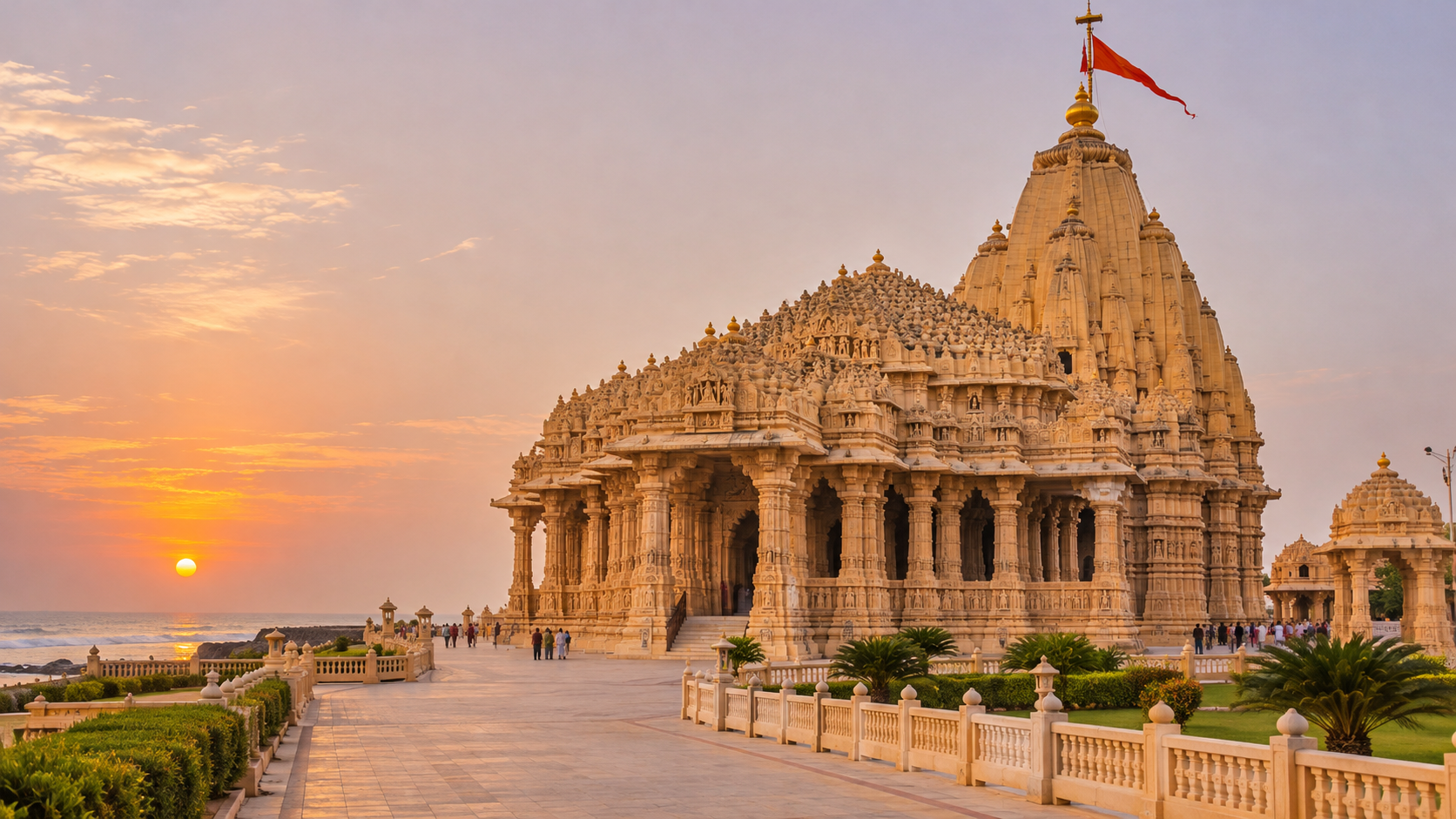
Somnath is not merely a building with a religious use. It is revered as the first of the twelve Jyotirlingas, carries the memory of repeated destruction and rebuilding, and receives lakhs of pilgrims. For a devotee undertaking a yatra, the character of the immediate surroundings can be part of the sacred experience rather than an incidental matter outside the temple gate.
That gives the restriction a morally intelligible purpose. A tirtha is a living sacred geography, and treating its immediate precinct as indistinguishable from any commercial street can miss how pilgrimage works. The expected arrival of large numbers of devotees during Deepavali and the Gujarati New Year was also the specific practical circumstance the Division Bench considered when preserving the notification temporarily.
But moral intelligibility and final legal validity are different questions. A durable defence of a sacred precinct should be able to identify the lawful authority, the geographic boundary, the regulated conduct, the period of operation and the method of enforcement. Asking for those particulars is not a concession that sanctity is unimportant. It is how sanctity becomes a clear and enforceable public accommodation rather than a slogan vulnerable to avoidable litigation.
Religious accommodation is not peculiar to Bharat. Meat and liquor shops around Anuradhapura in Sri Lanka close during Poson week, Thailand halts alcohol sales on Buddhist holy days, and Germany restricts public dancing on Good Friday. Such examples show that modern legal systems can make room for sacred times and places.
They do not, however, decide this appeal. A rule made under another country’s law cannot establish what Section 33(1)(w) permits in Gujarat. The strongest use of these comparisons is limited: they rebut the idea that every religiously sensitive restriction is inherently alien to modern public life. They should not be presented as binding precedent or as proof that every restriction, regardless of its scope, must be valid.
What you should do while the appeal remains live
If you are visiting Somnath
Plan on the notification being enforced for as long as the stay preserves it. Follow local notices and do not rely on an older report of the Single Judge’s ruling. If food arrangements are important to your journey, ask your accommodation or local organiser what is currently available before arriving.
Do not guess the restricted boundary from phrases such as near the temple or around Somnath. Those descriptions are not measurements. If your plans depend on the exact boundary or on whether a particular activity is covered, obtain the operative notification or confirm the position with the district administration.
If your business may fall within the restricted area
Do not treat the Single Judge’s order as an operational shield while it is stayed. Obtain the 10 August notification and the latest appellate order, then check your premises against the notified boundary. Confirm exactly which items and activities are regulated, the dates involved, and whether later directions have changed the position.
This is a live legal matter with possible financial and regulatory consequences. If you are deciding whether to sell, prepare, display or deliver affected food, seek advice from an Indian lawyer who can examine the actual orders. A news summary cannot safely answer a premises-specific compliance question.
If you are discussing or advocating for the ban
Use a formulation that preserves the procedural truth: On 30 October 2026, a Gujarat High Court Division Bench stayed the Single Judge’s order and kept the Gir Somnath District Magistrate’s 10 August notification in force until the 25 November returnable date; the merits remained undecided.
Avoid saying that the ban was permanently upheld, that every objection was rejected, or that the court conclusively found no contrary precedent. Those claims go beyond the interim order and make a legitimate case for temple sanctity easier to challenge.
Set 25 November 2026 as a verification checkpoint, not as an assumed end date. Before republishing, organising around the restriction or advising anyone affected by it, check whether the Division Bench continued, changed or ended the interim arrangement.
If you care about Somnath’s sanctity, legal precision is part of its defence. Anchor every claim to the operative order, state plainly that the merits are open, and update your position when the court does. That serves devotees better than declaring a victory the Bench has not yet delivered.
References

Leave a Reply
You must be logged in to post a comment.