
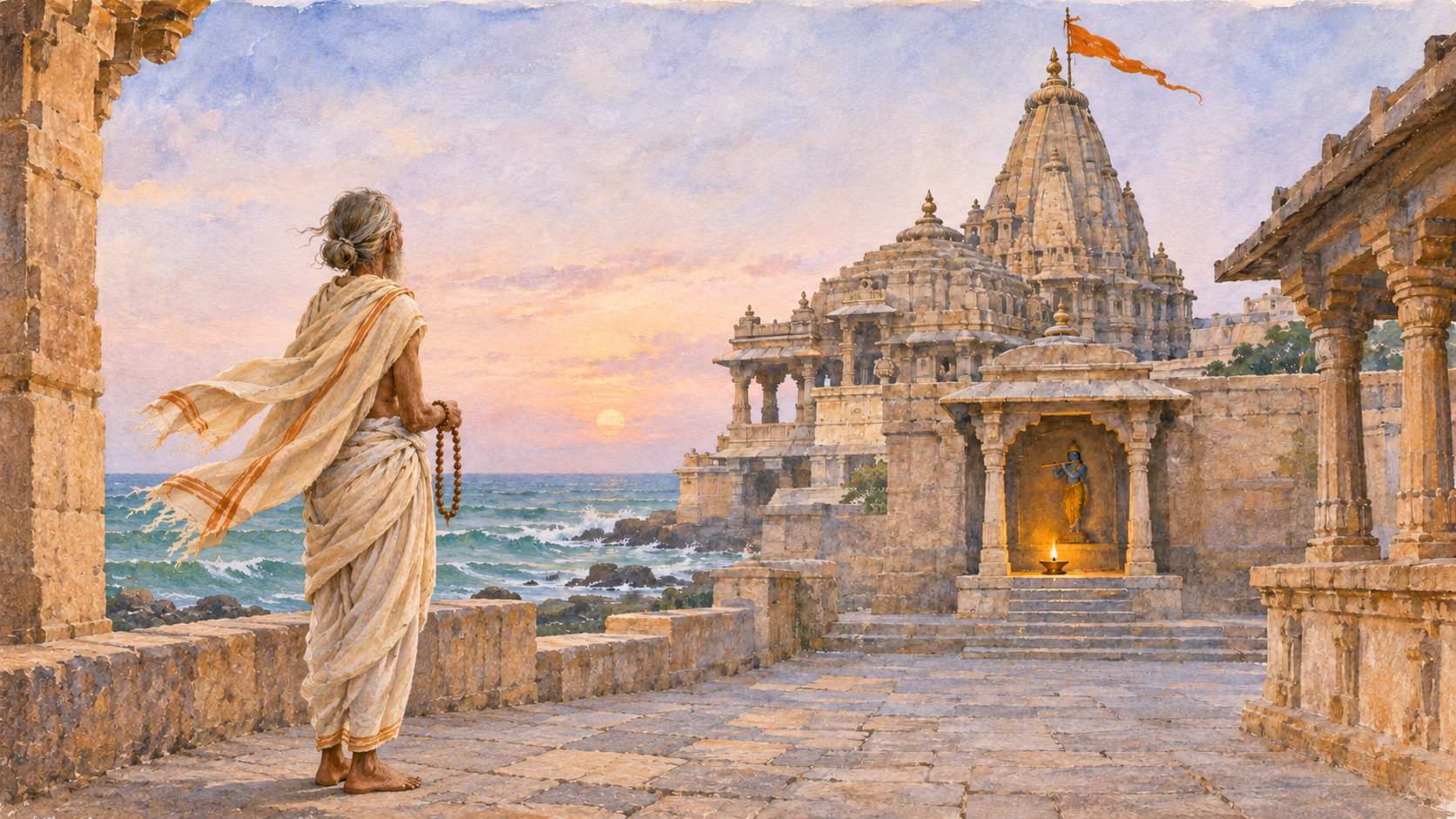
You may have encountered the name Sant Rishidas while exploring Gujarat’s Krishna traditions and wondered whether he was a poet, temple priest, sectarian teacher, or wandering ascetic. The honest answer begins with a modest but meaningful biographical core: he was remembered as a Krishna devotee, while many details that would place him within a particular lineage or body of literature remain unspecified.
That restraint need not make his life irrelevant. It helps you see what is actually distinctive: a saintly figure formed within a Brahmin family connected to Dwaraka’s Dwarkadhish Temple, yet remembered for his own devotion to Krishna. Read carefully, this is a window into the meeting of household formation, temple culture, and personal bhakti.
Key takeaways
- Rishidas was a 14th-century saint and Krishna devotee who lived in a village in Gujarat.
- He was born into a pious Brahmin family, and his father served as a priest at the Shree Dwarkadhish Temple in Dwaraka.
- His father’s priesthood supplies important religious context, but it does not by itself prove that Rishidas was a temple priest, lived at the temple, or held a formal office there.
- You can honor his devotional orientation through Krishna worship and seva, but you should not attribute a mantra, song, miracle, sect, or ritual to him without reliable evidence.
The dependable biographical core
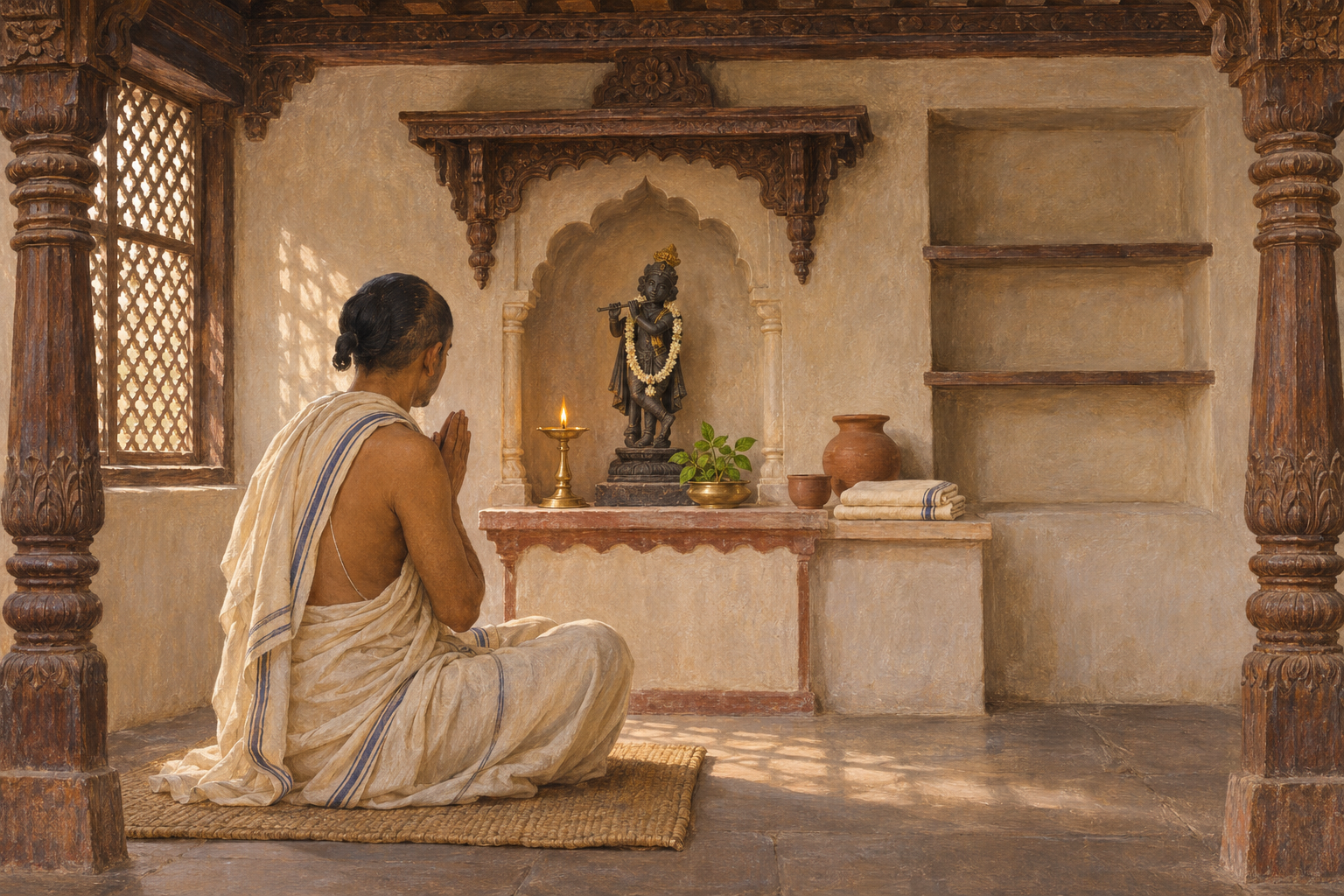
Rishidas lived during the 14th century in a Gujarat village and became known as a saint and devotee of Krishna. He came from a pious Brahmin household. His father served as a priest at the well-known Shree Dwarkadhish Temple in Dwaraka.
Each part of that outline answers a different question. The century places him in medieval Bharat. Gujarat supplies his regional setting. Krishna devotion identifies the spiritual center of his remembered life. His family background connects him to an environment in which temple worship was not distant or merely theoretical.
Those facts should not be collapsed into a more elaborate biography. A priest’s son is not automatically a priest. A family association with the Dwarkadhish Temple does not prove that Rishidas was born in Dwaraka, held authority at the temple, or taught its particular procedures. Likewise, calling him a Gujarati saint does not establish that he composed works in Gujarati. Geography, family background, vocation, language, and literary authorship are separate claims.
The title “Sant” should also be handled with care. It marks a person received as spiritually exemplary, but it does not tell you whether that person was a renunciant, householder, institutional leader, poet, or founder of a lineage. If a retelling assigns one of those identities to Rishidas, look for the evidence attached to that specific claim.
Why the Dwaraka connection matters without proving too much
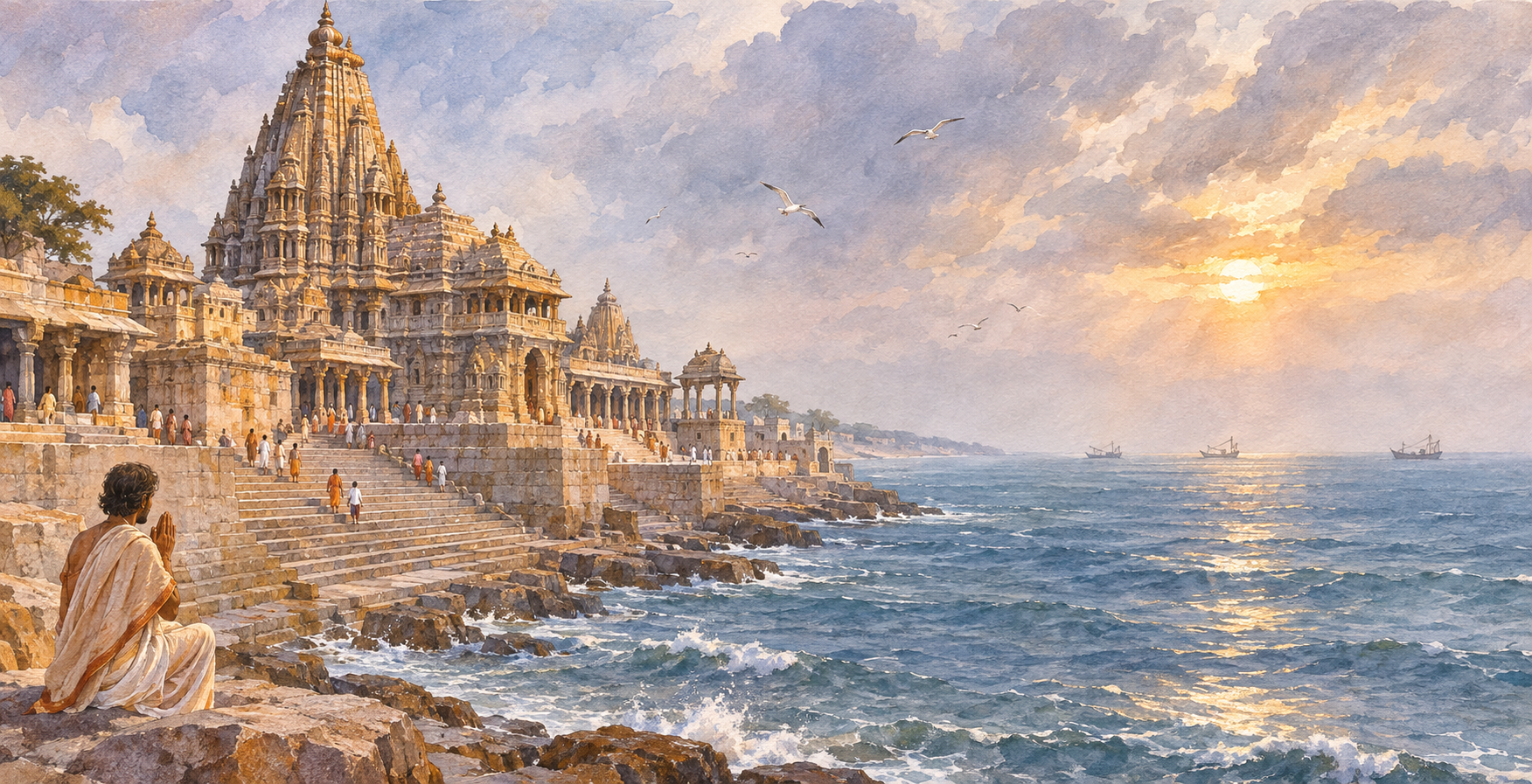
Dwarkadhish means the Lord of Dwarka, a royal form and title of Krishna. A family serving at a Dwarkadhish temple would have encountered Krishna not only as a subject of private belief but as the focus of recurring worship, darshan, offering, remembrance, and community reverence. That is the proper scale of the inference: the father’s service places the household close to an established Krishna-centered sacred world.
This distinction matters because devotional biographies are easily overfilled. A plausible influence can become an alleged event after enough repetition. It is reasonable to say that his family environment may have helped form his Krishna devotion. It is not responsible to invent a childhood scene inside the temple, an initiation from a particular guru, or a ritual taught by his father.
You can therefore read the Dwaraka connection in two ways at once. Historically, it is a concrete family link to a major center of Krishna worship. Spiritually, it reminds you that bhakti is often cultivated through repeated contact with sacred names, images, services, and duties. The first statement belongs to Rishidas’s biographical setting; the second is a broader lesson you may draw from it.
Three layers of Gujarati Krishna devotion in his life
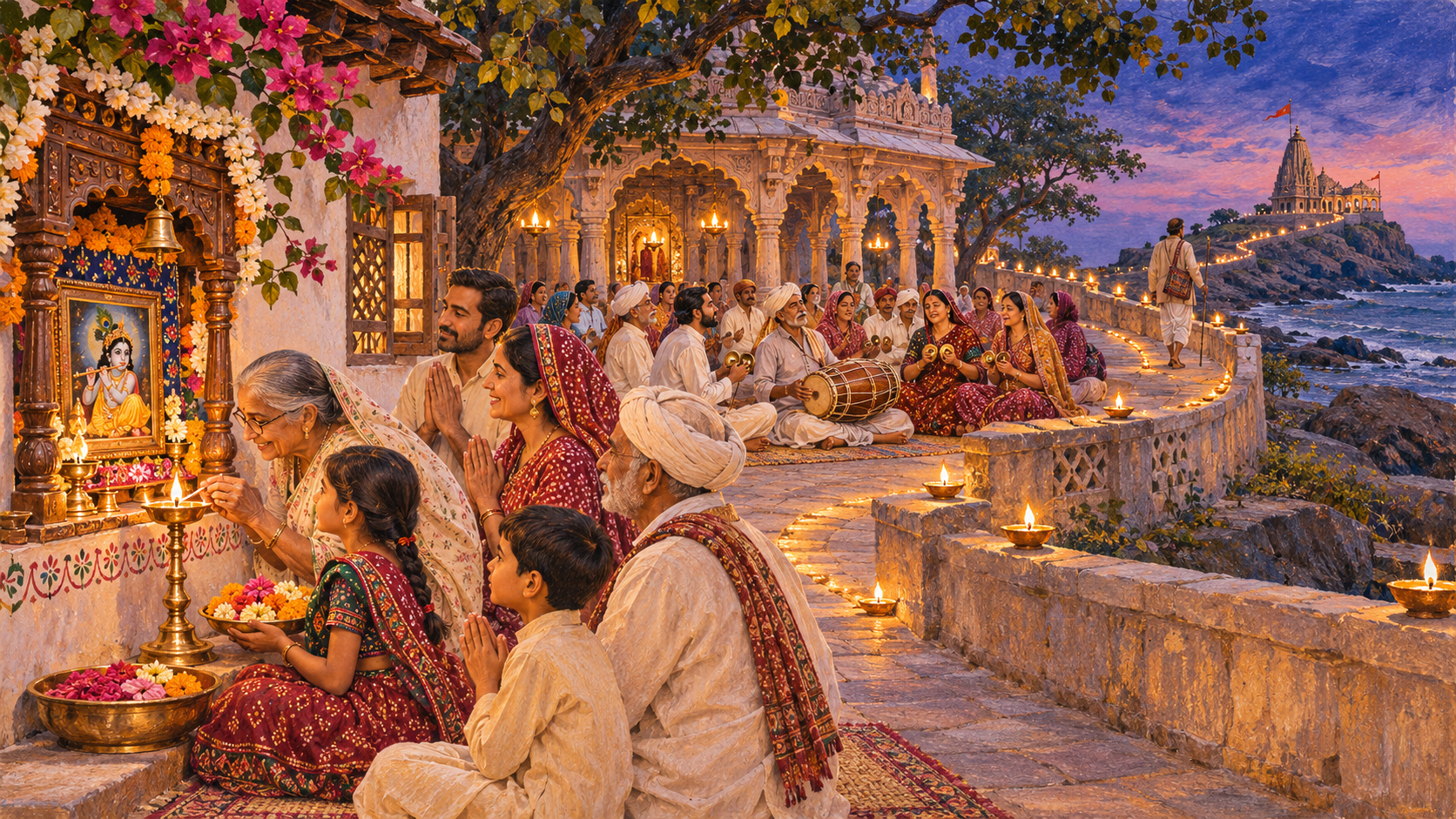
Rishidas’s brief profile is useful because it lets you notice three layers of devotional transmission without pretending that one mechanically caused the next.
- Inherited setting: Birth into a pious Brahmin household gave him a religious environment before it tells us anything about his later choices.
- Temple connection: His father’s priestly service connected the family to public, disciplined worship of Dwarkadhish rather than devotion existing only as a private sentiment.
- Personal orientation: Rishidas is remembered in his own right as a Krishna devotee. The family’s religious standing provides context, but his saintly identity rests on devotion being associated with him personally.
That final distinction is especially important. Lineage may introduce a person to a sacred world, but inherited identity and lived bhakti are not identical. In Dharmic life, family, temple, and personal sadhana can reinforce one another; none should be used as a careless substitute for the others.
This also helps you avoid reducing Rishidas to caste background. His Brahmin birth explains part of his social and religious setting. It does not exhaust the meaning of his remembrance as a sant. The biographical emphasis falls on Krishna devotion, not merely on inherited status.
How to separate remembrance from later embellishment
Sparse saintly biographies require disciplined reading. Reverence is not served by turning an attractive possibility into a historical fact. If you are preparing a talk, temple note, social-media thread, or family lesson about Rishidas, use this sequence:
- Begin with the secure outline. Say that he was a 14th-century Krishna devotee and saint living in a Gujarat village, born into a pious Brahmin family whose father served at Dwaraka’s Dwarkadhish Temple.
- Mark interpretation as interpretation. Use wording such as “this family setting may have shaped his devotion” rather than declaring an undocumented childhood history.
- Test every added attribution. Before assigning him a guru, sampradaya, composition, quotation, miracle, mantra, or temple office, ask for a named text, inscription, manuscript, edition, temple record, or clearly identified oral tradition.
- Preserve the status of oral memory. A community tradition can be spiritually and culturally meaningful without being presented as contemporary documentary evidence. Name the community and the form in which the memory is carried whenever that information is available.
- Do not fill gaps with details borrowed from another sant. Shared Krishna devotion does not make the biographies, teachings, or songs of different saints interchangeable.
A quotation needs particularly careful handling. Ask where it appears, in which language, and under whose attribution. A devotional saying that sounds appropriate is not thereby Rishidas’s saying. The same rule applies to bhajans: enjoy a song as Krishna bhakti, but do not attach his name unless its attribution can be traced.
A present-day devotional response that stays truthful
You do not need an invented ritual to make Rishidas’s memory spiritually useful. The known center of his life is Krishna devotion, so the most fitting response is to strengthen your own relationship with Krishna through practices already recognized in your household or sampradaya.
- Begin with darshan of a Krishna murti or image, or with quiet remembrance if no image is available.
- Make a simple offering, such as water, a flower, or food, in accordance with your established devotional custom.
- Repeat a recognized name or mantra of Krishna that you have received or learned through a trusted tradition.
- Read or sing a Krishna bhajan, including a Gujarati bhajan if that connects you more closely to the regional devotional setting.
- Carry the remembrance into seva through one concrete duty performed with care, honesty, or compassion.
This is a contemporary devotional response, not a reconstructed “Rishidas practice.” Keeping that distinction explicit lets you draw inspiration from the sant without manufacturing history in his name.
When you next encounter Sant Rishidas, hold together devotion and discernment. Preserve the small but significant outline that is known, resist decorative claims that cannot be supported, and let his remembered orientation toward Krishna prompt steadier bhakti in your own life.
References

Leave a Reply
You must be logged in to post a comment.