
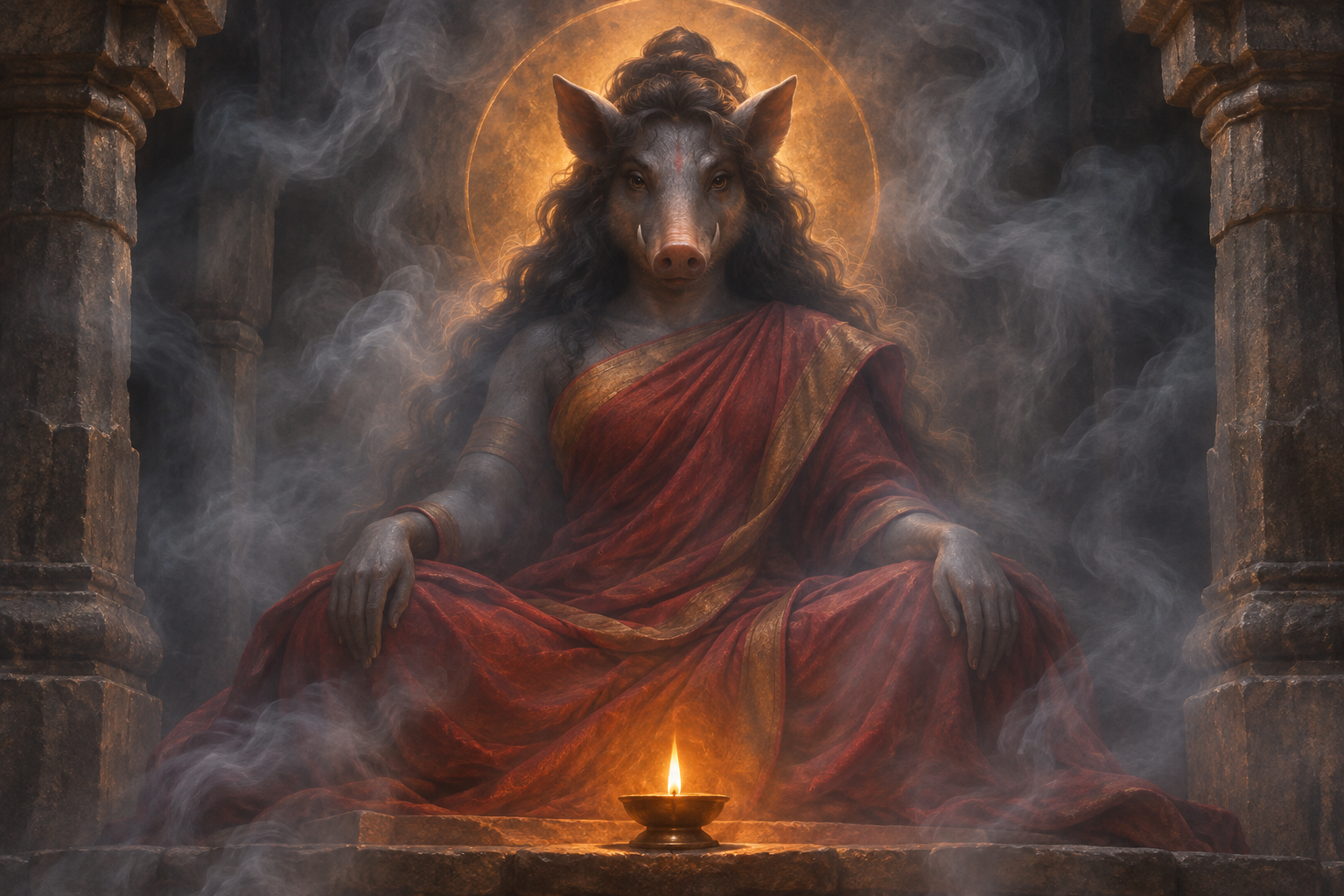
If you have encountered Dhumra Varahi through an image, a temple reference, or another devotee, you may be wondering what her smoke-coloured form means and whether you can worship her without entering a complex ritual system. You can begin with simple, respectful devotion. The important boundaries are equally simple: do not invent iconography, copy an unexplained mantra, or treat protection as permission to harm someone.
Dhumra Varahi is approached as a protective form of Devi. Her symbolism is especially useful when your real difficulty is not the absence of power but the presence of confusion: you cannot yet see the whole situation, fear is distorting your judgement, or the dharmic course is being obscured by anger and desire.
Begin with her place among the Matrikas
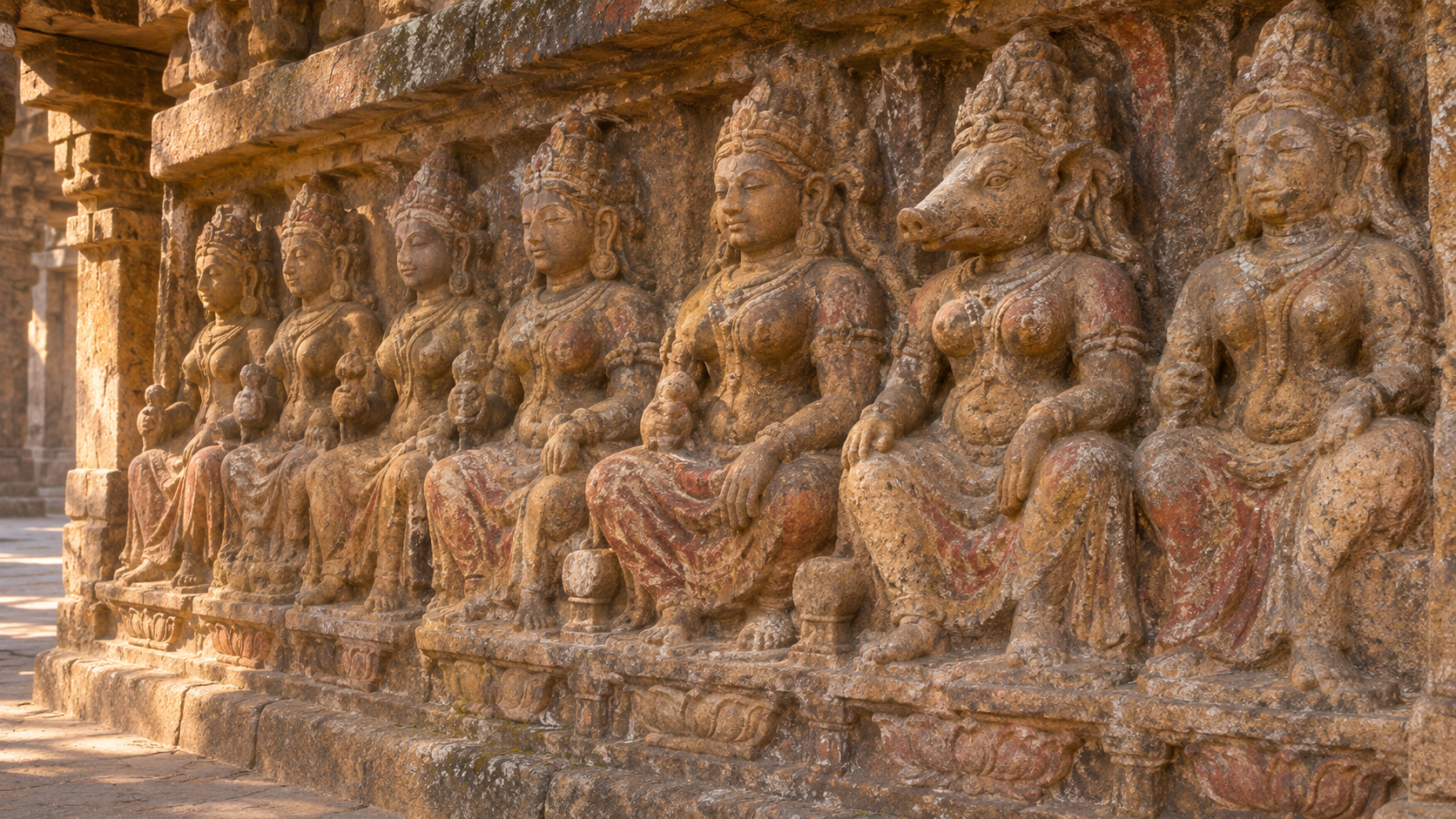
Varahi is one of the Sapta Matrikas, the seven mother goddesses who aid Devi in the struggle against adharma. Dhumra Varahi is her smoke-hued manifestation. This relationship matters because it keeps you from reducing her to an isolated occult figure or to an intimidating image found online.
The identities of mother and protector are not opposites. Maternal power in the Matrika framework is active: it guards, confronts and restores order. Dhumra Varahi should therefore be approached neither as a decorative symbol nor as a supernatural instrument for winning personal disputes. Her protective character remains situated within Devi’s opposition to adharma.
You may encounter the spellings Dhumra and Dhoomra in English. Spelling alone is not a sound reason to assume that you have found two separate forms. Transliteration varies, so identify a form through the tradition, temple or teacher presenting it rather than through one Roman spelling.
Apply the same caution to images. Do not assemble a supposedly complete Dhumra Varahi iconography by combining details from unrelated pictures. Attributes, ritual settings and visual conventions can differ across traditions. If a temple or teacher guides your worship, use that tradition’s representation and instructions consistently. If you have no such connection, simple prayer is more honest than pretending certainty about an elaborate form.
Read the smoke as a discipline of discernment
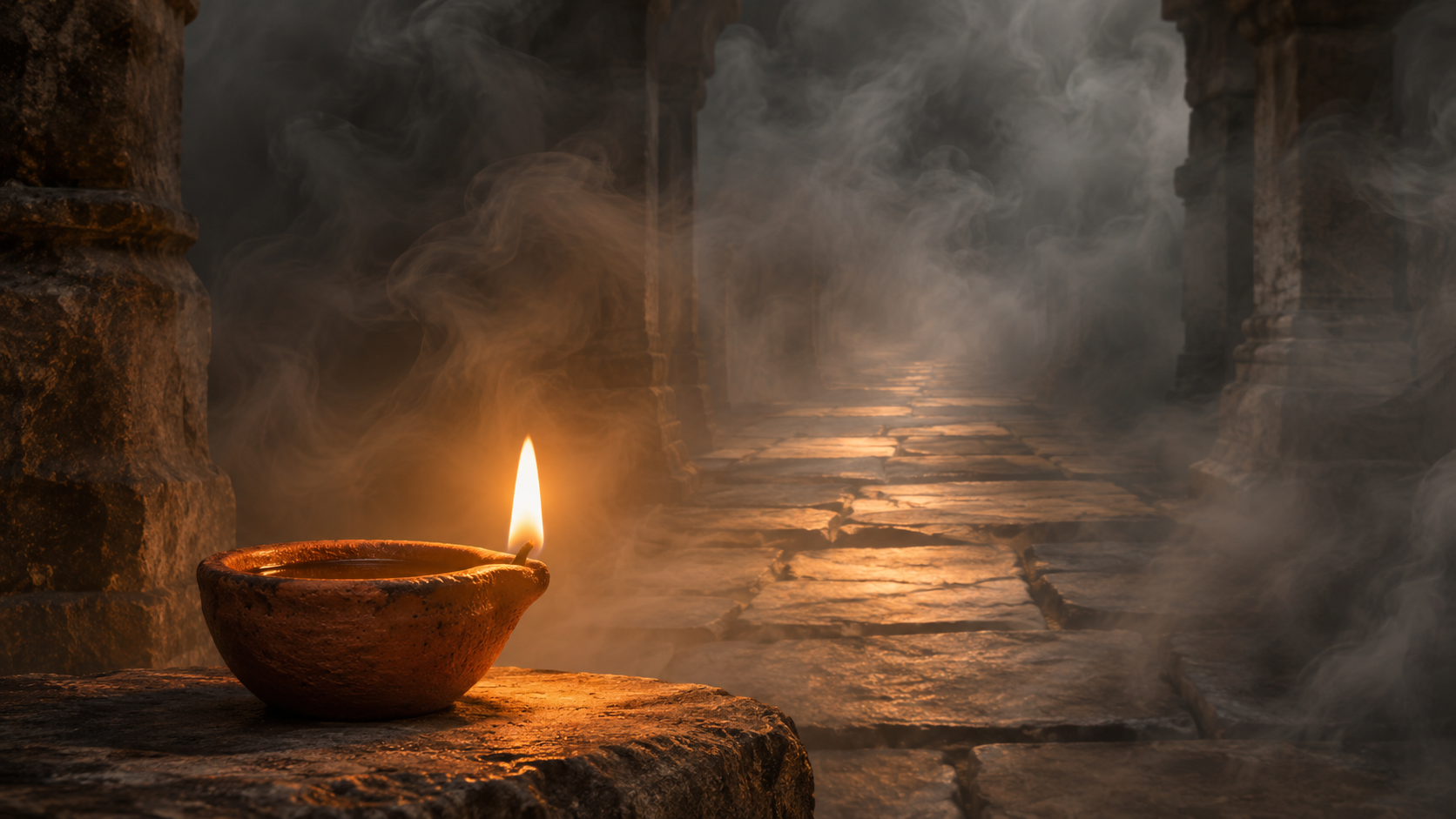
Smoke has a striking double character. It indicates that a fire is present, yet it can conceal the fire’s location and blur everything beyond it. That makes it a useful symbolic language for situations in which something consequential is happening but your perception of it remains incomplete.
Read this as symbolism, not as a claim that every lineage gives the name exactly the same philosophical explanation. A grounded contemplation of Dhumra Varahi asks you to notice the forces that cloud judgement: fear masquerading as intuition, anger presenting itself as justice, attachment editing inconvenient facts, or secrecy allowing an unhealthy situation to continue.
The smoke-coloured form does not make darkness morally evil. Nor does it require you to fill a room with literal smoke. A deity’s complexion is not a crude moral colour code, and a symbolic name does not automatically prescribe a physical offering. If incense is not already part of your household practice, the name Dhumra is no reason to improvise with smoke.
When you sit before Dhumra Varahi, bring a real question rather than a demand for a prediction:
- What fact am I avoiding because it would require me to change?
- Is this fear warning me about something concrete, or is it feeding a story for which I have no evidence?
- Which duty remains clear even while the final outcome is uncertain?
- Can I protect what is right without becoming unjust in the process?
- What would I do next if anger were not choosing for me?
This is a practical way to understand the hidden truth associated with the form. The point is not secret information that gives you superiority over others. It is the truth already present but concealed by the smoke of confusion, self-deception or fear. Worship becomes useful when it helps you face that truth and act in accordance with dharma.
Protection must remain governed by dharma
Devotees often turn toward a protective deity when they feel threatened, betrayed or powerless. That is precisely when intention needs scrutiny. A request for strength, clarity, courage or a just boundary is different from a demand to dominate, frighten or punish another person.
You can test a prayer for protection at three levels. Inwardly, does it help you move from panic toward clarity? Relationally, does it support a truthful boundary rather than revenge? Practically, does it lead you to take responsible action instead of waiting for a miraculous result? A prayer that intensifies obsession while excusing your own conduct has moved away from its dharmic centre.
Do not treat devotion as a guarantee that a preferred outcome will occur. Protection may require you to recognise an unpleasant fact, leave a harmful pattern, admit your own mistake or seek help. The revealing of danger can itself be part of protection, even when the revelation is uncomfortable.
If your situation involves immediate danger, abuse, stalking, a health crisis or a legal threat, take the relevant ordinary protective steps and contact qualified help. Worship can accompany those actions; it should not replace them. Waiting passively for a ritual result can allow preventable harm to continue.
Be particularly cautious when someone markets Dhumra Varahi worship as a guaranteed means of controlling another person, destroying a personal enemy or securing an outcome for a fee. Such promises turn a protective form into a commodity and bypass the question that should come first: is the intention itself dharmic?
Keep your first worship simple and know where to stop

There is a meaningful difference between uncomplicated devotion and formal sadhana. You do not need to imitate advanced ritual in order to offer pranama, remember Devi or ask for clarity. In fact, restraint is the better beginning when you do not yet belong to a lineage that has taught you a specific practice.
- State a dharmic intention. Ask for clear perception, courage, protection from adharma and the strength to act without hatred. If your intention is revenge or control, pause rather than ritualising it.
- Prepare a clean, quiet place. Use a representation you trust from the tradition through which you encountered Dhumra Varahi. If you cannot verify an unfamiliar image or yantra, do not adopt it merely because it looks impressive.
- Offer only what fits your household practice. A respectfully lit lamp, clean water or flowers can accompany simple devotion where your custom permits. The smoke-coloured name does not oblige you to burn anything, and fire should never be left unattended.
- Offer pranama and speak plainly. You may ask Dhumra Varahi to remove confusion, reveal what you need to face and help you choose a dharmic response. A sincere prayer in words you understand is preferable to reciting sounds whose source and meaning you cannot verify.
- Sit with one concrete difficulty. Name the fact you know, the uncertainty you cannot yet resolve and the next responsible action available to you. This prevents contemplation from becoming vague or escapist.
- Close according to your family custom. Express gratitude, handle offerings respectfully and carry the chosen action into daily life. Do not invent restrictions or promises that no competent teacher has given you.
No universal day, recitation count or special offering should be fabricated from the meaning of the name. If you already have instructions from a legitimate guru, temple or inherited family tradition, follow those instructions instead of a generic routine. Consistency within a living tradition is more important than collecting practices from several unrelated places.
When you need direct instruction
Pause and seek a competent teacher when a proposed practice introduces an exact mantra, bija syllables, prescribed repetitions, nyasa, mudra, yantra installation, fire ritual, initiation, vows, secrecy or special restrictions. These elements can belong to lineage-specific systems; fragments detached from their method do not become safer merely because they are publicly available.
A trustworthy teacher should be able to explain the practice’s lineage, the conduct expected of you, whether initiation is required, what you should not do and how mistakes are corrected. Be wary of anyone who discusses only promised power, demands urgency, discourages reasonable questions or treats fear as a sales method. If no reliable instruction is available, remain with simple devotion. Reverence is not measured by ritual complexity.
Key takeaways
- Dhumra Varahi is the smoke-hued protective manifestation of Varahi, who belongs among the Sapta Matrikas.
- Smoke can be contemplated as a symbol of obscured perception: something important is present, but fear, anger or attachment prevents clear sight.
- Protection is dharmic when it supports truth, responsible boundaries and right action; it is not a licence for domination or revenge.
- Simple prayer, pranama and familiar household offerings are a sound beginning when you have no lineage-specific instruction.
- Do not copy an exact mantra, yantra procedure or advanced rite without understanding its lineage, requirements and limits.
Begin with one honest question: what is the smoke preventing you from seeing? Offer a simple pranama, identify the clearest dharmic action available to you and take it. If your devotion later develops toward formal sadhana, let competent instruction deepen it without sacrificing discernment.
References

Leave a Reply
You must be logged in to post a comment.