
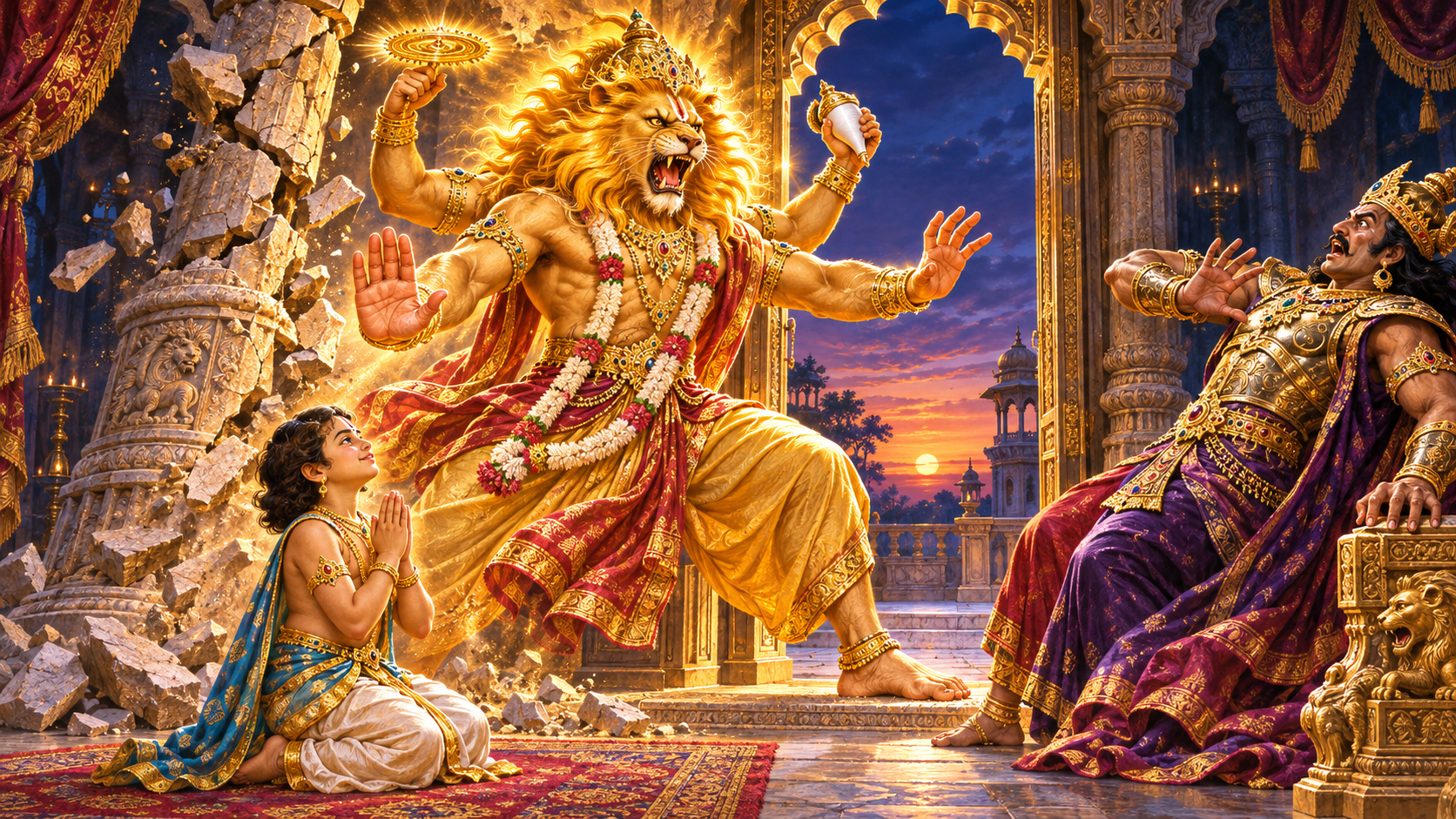
You may know the final image: Narasimha, fierce and impossible to classify, appearing to protect Prahlada from Hiranyakashipu. The harder question is why Vishnu assumes this particular form, rather than simply removing the danger.
The answer changes how you read the entire account. Narasimha is not an ornamental addition to Prahlada’s story. His form reveals why worldly power cannot make itself absolute, while Prahlada reveals what a person can preserve when nearly everything outside that person is controlled.
Narasimha’s form answers Hiranyakashipu’s central mistake
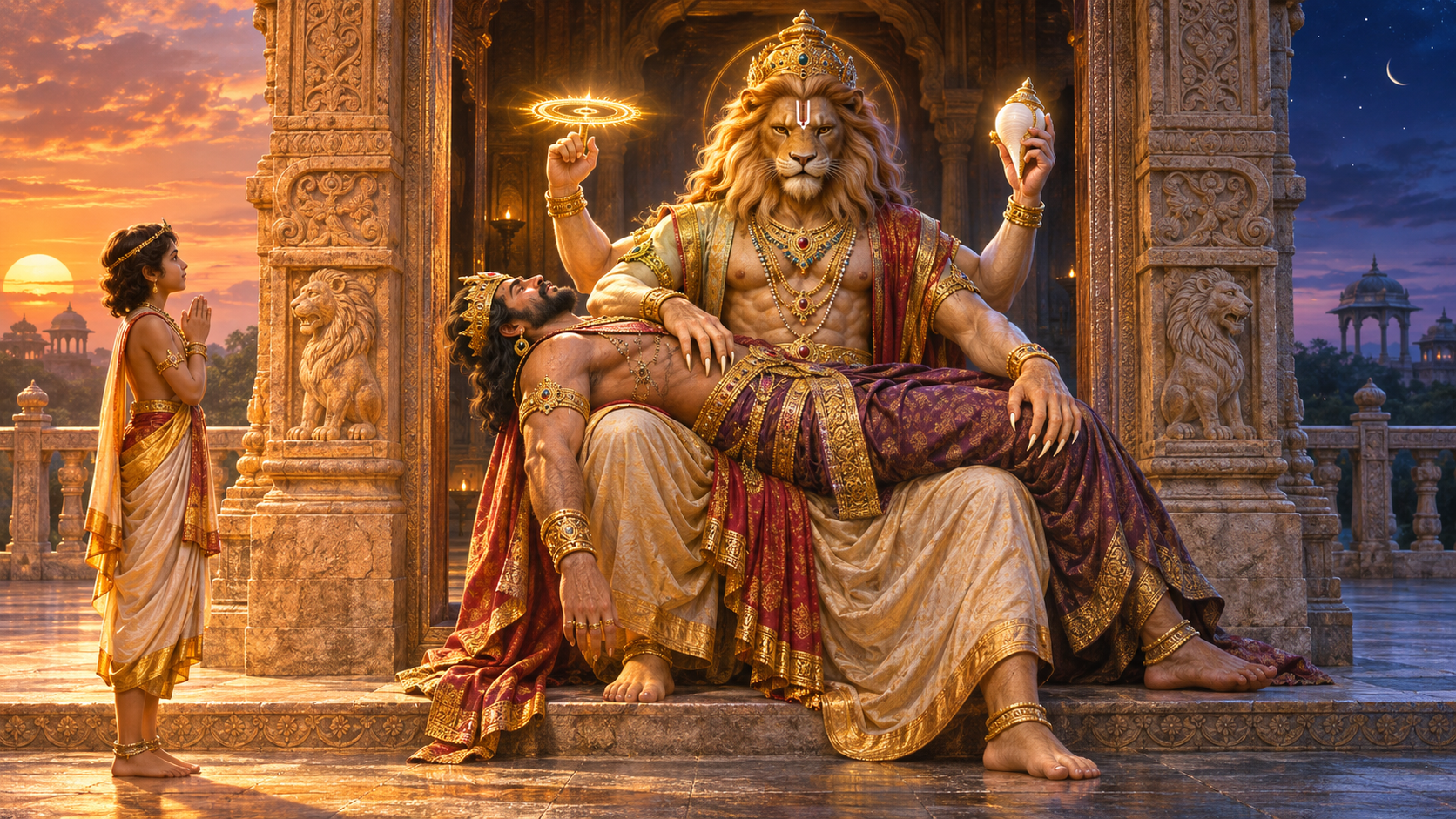
Vishnu is traditionally understood as the protector, and the Dashavatara identifies ten principal avatars among his various manifestations. That distinction matters. The ten are a major devotional framework, not a claim that divine action must be confined to ten appearances.
An avatar is therefore best understood here as a response fitted to a particular crisis of dharma. The useful question is not merely, “Which avatar appears?” It is, “What does this form disclose and accomplish that another form would not?”
Hiranyakashipu’s mistake is deeper than cruelty. He treats conditional security as absolute sovereignty. His apparent invulnerability depends on categories, distinctions and carefully framed conditions. Narasimha, the man-lion form, does not sit comfortably inside those categories. The divine response meets the tyrant at the supposed boundary of his protection and shows that finite intelligence cannot write terms that bind the Absolute.
This is why Narasimha’s unusual form is not a puzzle beside the story; it is the theological answer at its centre. Hiranyakashipu believes reality can be arranged so that no authority remains above him. Narasimha demonstrates that the ruler’s map is not the whole territory.
The fierceness also needs to be read accurately. It is not uncontrolled anger, and it does not give a devotee permission to imitate divine violence in an ordinary quarrel. Narasimha’s force is directed toward ending persecution and protecting the devotee. If you invoke this account during a conflict, do not begin by deciding which person you may demonise. Begin by asking which boundary of dharma must be defended without allowing your own anger to become another form of domination.
Prahlada is protected before the climactic appearance
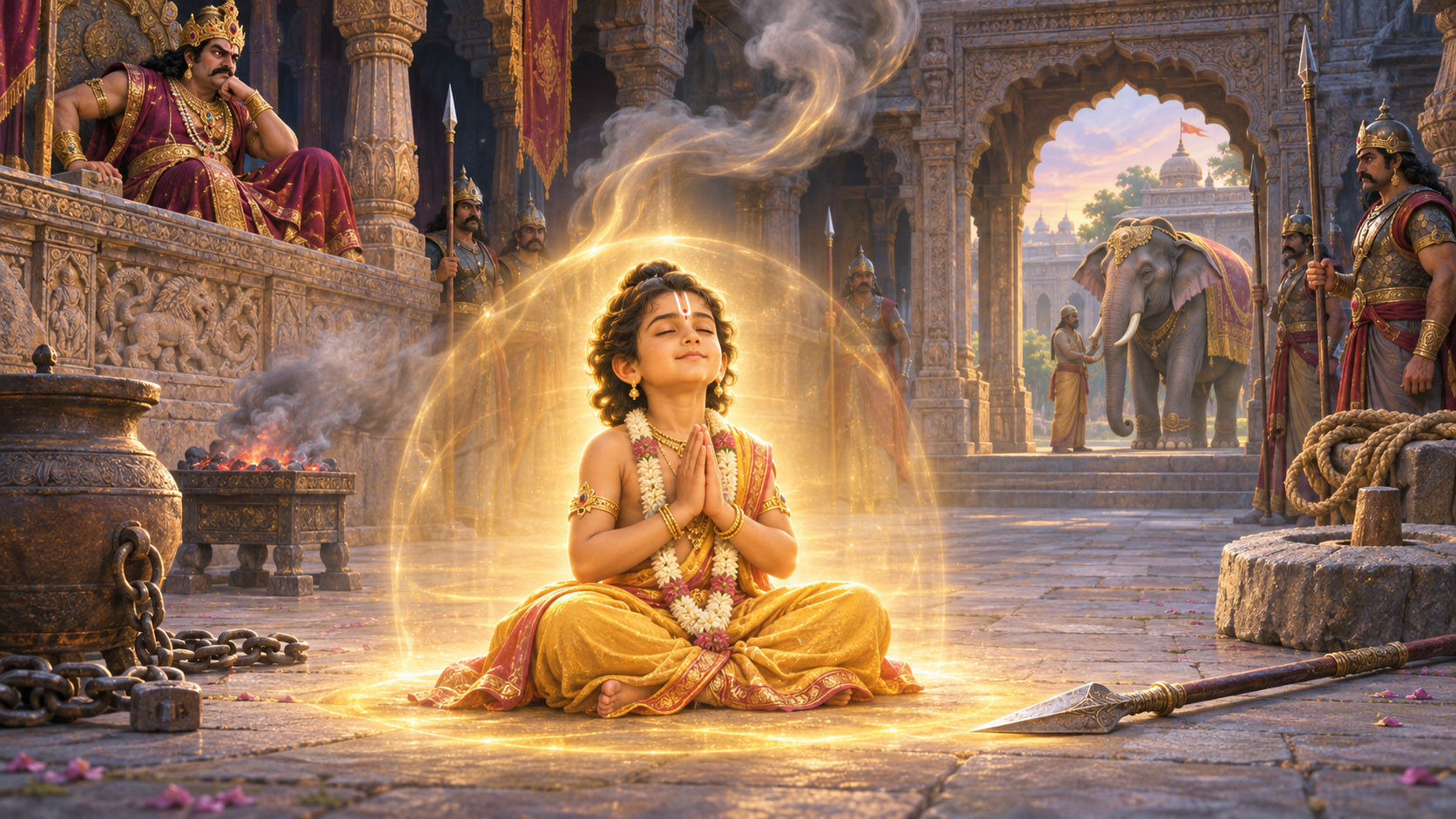
The dramatic manifestation of Narasimha can overshadow everything that precedes it. Yet a traditional enumeration describes eighteen attempts by Hiranyakashipu to kill Prahlada, all countered by Vishnu’s protection. The cycle is associated with the thirteenth chapter of the Vishnu Purana.
That repetition changes the meaning of protection. Vishnu does not become relevant only at the final instant. Protection is already present through the repeated failure of coercion to destroy Prahlada or capture his allegiance. Narasimha makes visible at the climax what the preceding episodes have steadily demonstrated.
This gives you three distinctions with which to read the account.
- Protection is not the same as comfort. Prahlada is subjected to danger even though the danger does not achieve its intended end. Do not use the story to conclude that a protected life must be an undisturbed life.
- Bhakti is not a bargain for immediate relief. Prahlada’s devotion is not presented as a transaction that lasts only while circumstances improve. Its strength lies in its object: his allegiance remains with Vishnu rather than shifting toward whoever controls the surrounding world.
- Courage is not deliberate exposure to harm. Prahlada’s preservation should never be turned into an instruction to remain in preventable danger. No child or adult should be told to endure abuse in order to imitate him. If a threat is real, move toward safety, tell trustworthy people and use appropriate community or public protection.
The second distinction is especially important. Hiranyakashipu can command outward behaviour, punish refusal and attempt to isolate Prahlada. He still cannot make the child regard him as the ultimate reality. The story locates spiritual freedom precisely there: power can exert pressure without acquiring rightful ownership of conscience.
Use Prahlada’s example without turning suffering into a virtue

Prahlada’s steadiness is easy to praise in the abstract. It becomes useful when you translate it into choices appropriate to your own situation. The aim is not to reproduce his ordeal. It is to keep fear, social pressure or authority from deciding what you hold sacred.
- Name the allegiance being tested. Write one sentence beginning, “Even under pressure, I will not surrender…” Complete it with a dharmic commitment rather than a grievance against another person. Truthfulness, devotion, non-cruelty and refusal to treat a human authority as absolute are examples of the right scale.
- Choose a practice that survives disruption. Keep one short act of remembrance that you can perform consistently: repeat a chosen name of Vishnu, read a brief scriptural passage, offer a simple prayer or sit in silent recollection. A small practice maintained under pressure forms a stronger centre than an elaborate routine abandoned whenever life becomes difficult.
- Separate firmness from hatred. You can refuse an unjust demand without allowing the person making it to dictate the condition of your mind. State the boundary in plain language. Avoid fantasies of retaliation. Narasimha’s role in the sacred account is not a licence for you to appoint yourself the punisher.
- Match your response to the actual danger. Social disagreement may call for calm speech and visible practice. Threats, confinement or violence call for a safety plan, trusted allies and appropriate authorities. Faith can guide those actions; it should not be used to cancel them.
This approach keeps two common misreadings apart. One misreading reduces Prahlada to passive obedience, even though the defining feature of his conduct is that he does not transfer his highest loyalty to his father. The other turns Narasimha into an emblem for personal rage, even though his intervention restores a moral limit that tyranny tried to erase.
Prahlada’s bhakti is therefore neither submission to oppression nor an excuse for recklessness. It is disciplined non-surrender at the level of conscience. Practical safety and spiritual fidelity can operate together: you may leave danger without abandoning faith, seek help without denying divine protection, and establish a boundary without cultivating hatred.
Key takeaways for reading and applying the story
- Read an avatar’s form as part of the teaching. Narasimha’s liminal form exposes the limits of Hiranyakashipu’s carefully constructed security.
- Notice protection throughout the ordeal, not only in its climax. The repeated failure of the attacks prepares the meaning of Narasimha’s appearance.
- Do not confuse divine protection with a promise that a devotee will never encounter danger, pressure or delay.
- Treat Prahlada’s bhakti as freedom of conscience under coercion, not as a command to tolerate abuse.
- Apply the account by naming a dharmic non-negotiable, maintaining a repeatable practice and taking proportionate steps toward safety.
The next time you encounter an image or recitation of Narasimha and Prahlada, pause over three questions: What form of adharma is being stopped? What could coercion not take from Prahlada? What faithful but non-reckless action does your own situation require? Write down your answers. That turns a familiar sacred episode into a disciplined examination of power, devotion and the boundary you must be prepared to keep.
References
- Hindu Pad – Dashavatara Moorthy | Lord Vishnu in Ten Incarnations
- Hindu Pad – How Lord Vishnu protected Prahlada from Hiranyakashipu

Leave a Reply
You must be logged in to post a comment.