
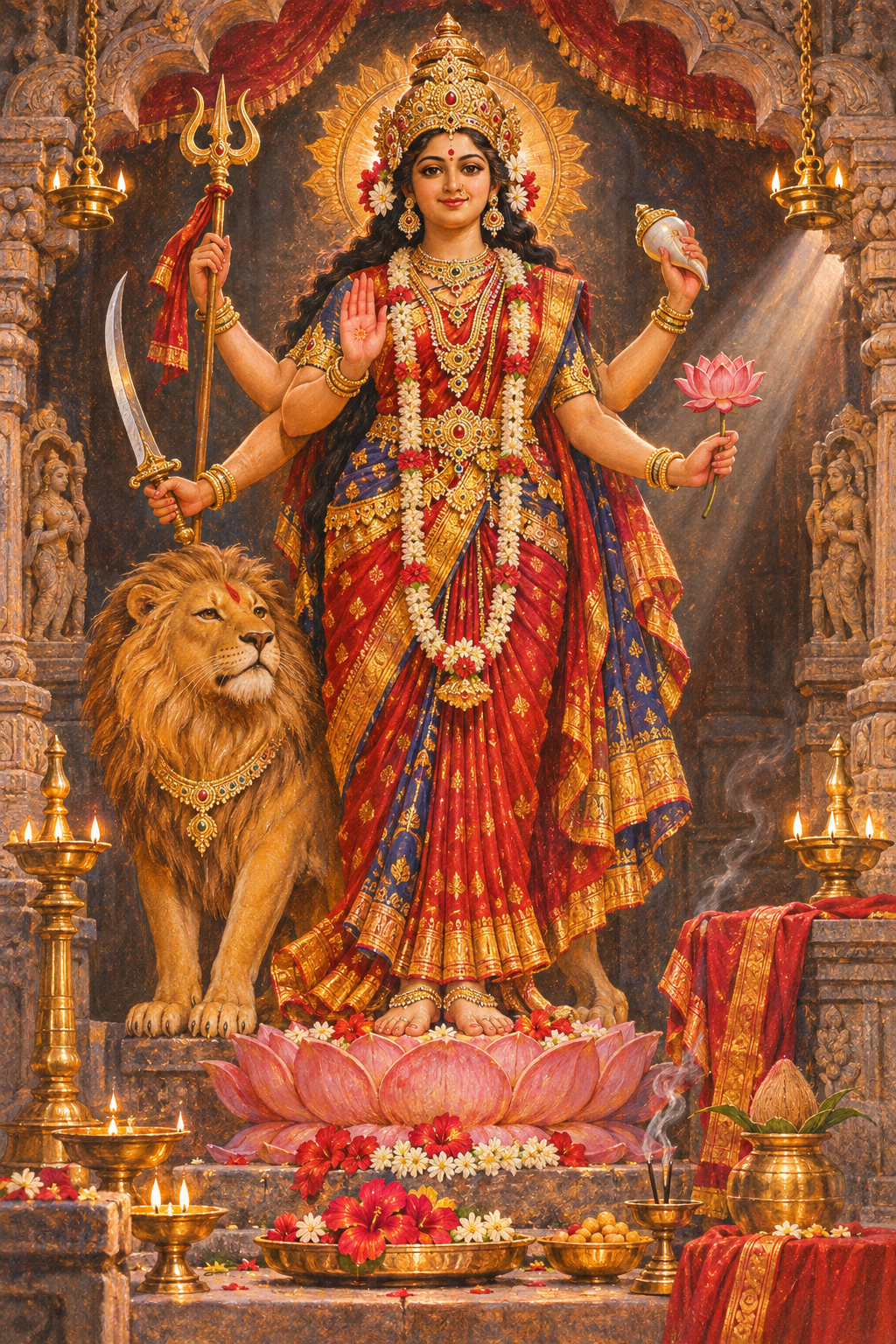
You have found a temple murti, devotional print, or sculpture called Jaya Durga, but its details do not match the neat checklist you expected. Before you decide that the name is wrong, slow down. Jaya Durga cannot be identified responsibly by isolating one colour, weapon, gesture, or pose.
The sounder approach is to bring three kinds of evidence together: the name preserved by the worshipping community, the complete visual composition, and the image’s ritual or historical setting. That method will help you understand what is certain, what is locally inherited, and what remains an interpretation.
Begin with the victory expressed by the name
Jaya Durga is the victorious aspect of Devi, the Divine Mother. Her central meaning is the triumph of righteousness over adversity. Victory is therefore not a decorative adjective added to an otherwise interchangeable image of Durga. It is the theological centre of the form.
This immediately gives you a better way to look. Do not begin with, “Which object proves that this is Jaya Durga?” Begin with, “How does the whole image present righteous victory and protective power?” An emblem may contribute to the answer, but it cannot carry the entire identification by itself.
Ask what kind of moment the composition presents. Does it suggest confrontation with adversity, the decisive overcoming of it, or the composure that follows victory? What is being defended or restored? Does the Goddess’s power appear directed toward protection, rather than aggression for its own sake? These questions do not prove the name, but they keep your interpretation aligned with the form’s defining meaning.
This distinction matters in devotional reading. Jaya Durga does not turn victory into permission for pride, domination, or personal vengeance. Her triumph is meaningful because it serves righteousness and protection. If you remember only one interpretive principle, use this one: read the display of power through the purpose it serves.
Why a one-attribute checklist will mislead you
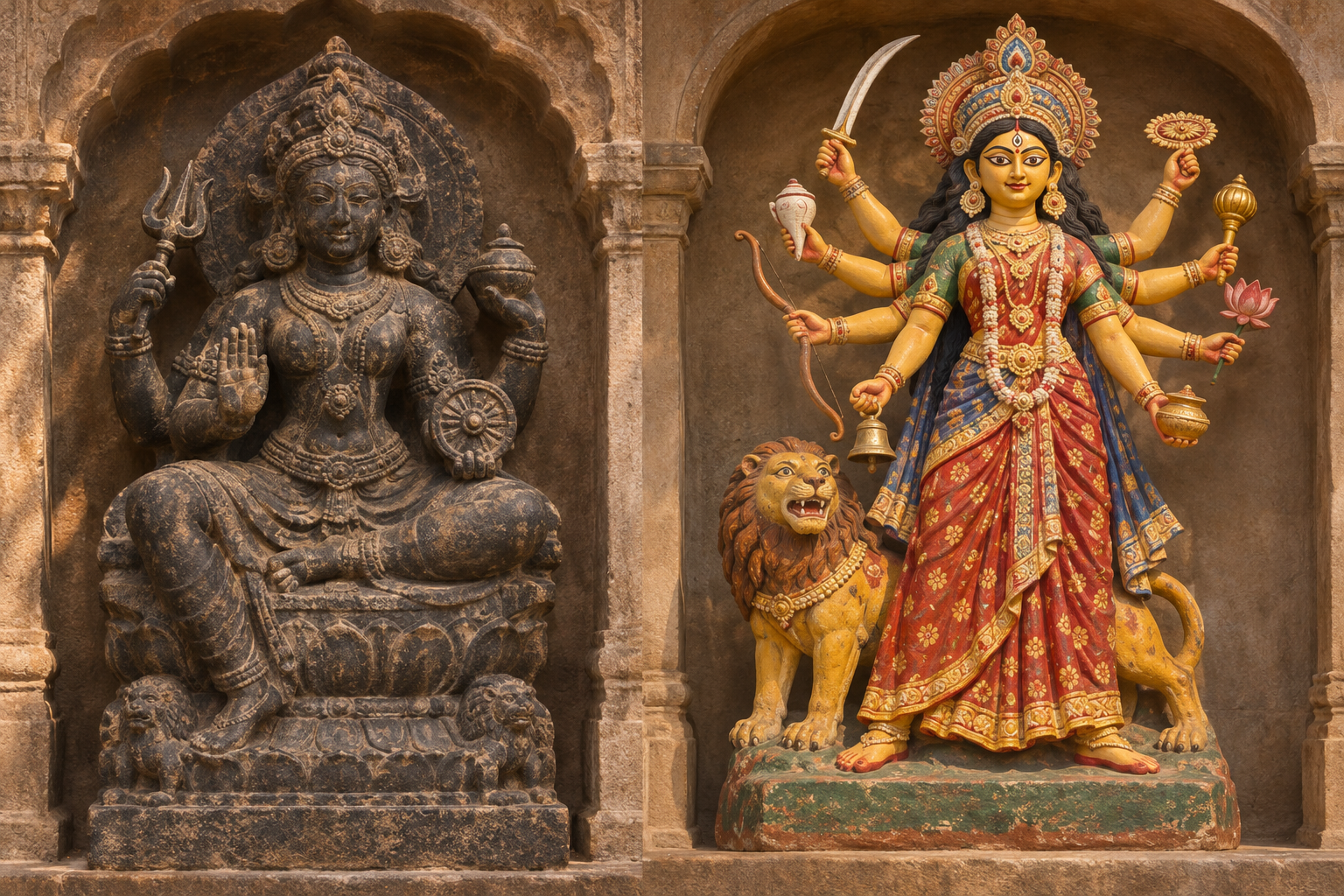
Jaya Durga receives comparatively little space in mainstream iconographic compendiums, and her form has to be approached through scattered references. That does not mean that any image may be called Jaya Durga. It means that you should not pretend an exhaustive, universally fixed visual formula exists when the available description does not support one.
For practical purposes, treat identification as cumulative. Confidence becomes stronger when several kinds of evidence converge:
- The image is explicitly named Jaya Durga in its shrine, inscription, catalogue, family tradition, or ritual setting.
- The composition can reasonably be read through victory, restored righteousness, and protection.
- The visible attributes belong together as a coherent iconographic programme rather than as a collection of guessed meanings.
- The identification is supported by people or records connected to the image’s actual tradition.
The reverse is also important. A resemblance to a more familiar Durga image does not automatically cancel an inherited identification as Jaya Durga. Nor should one expected feature, especially when copied from an unrelated modern picture, be allowed to overrule a temple’s established name without stronger evidence.
Allow for the possibility that material, regional practice, artistic convention, restoration, or workshop choice has affected what you see. Variation is not the same as error. At the same time, variation must not become an excuse to invent details and call them canonical.
Use this six-step method to identify an image
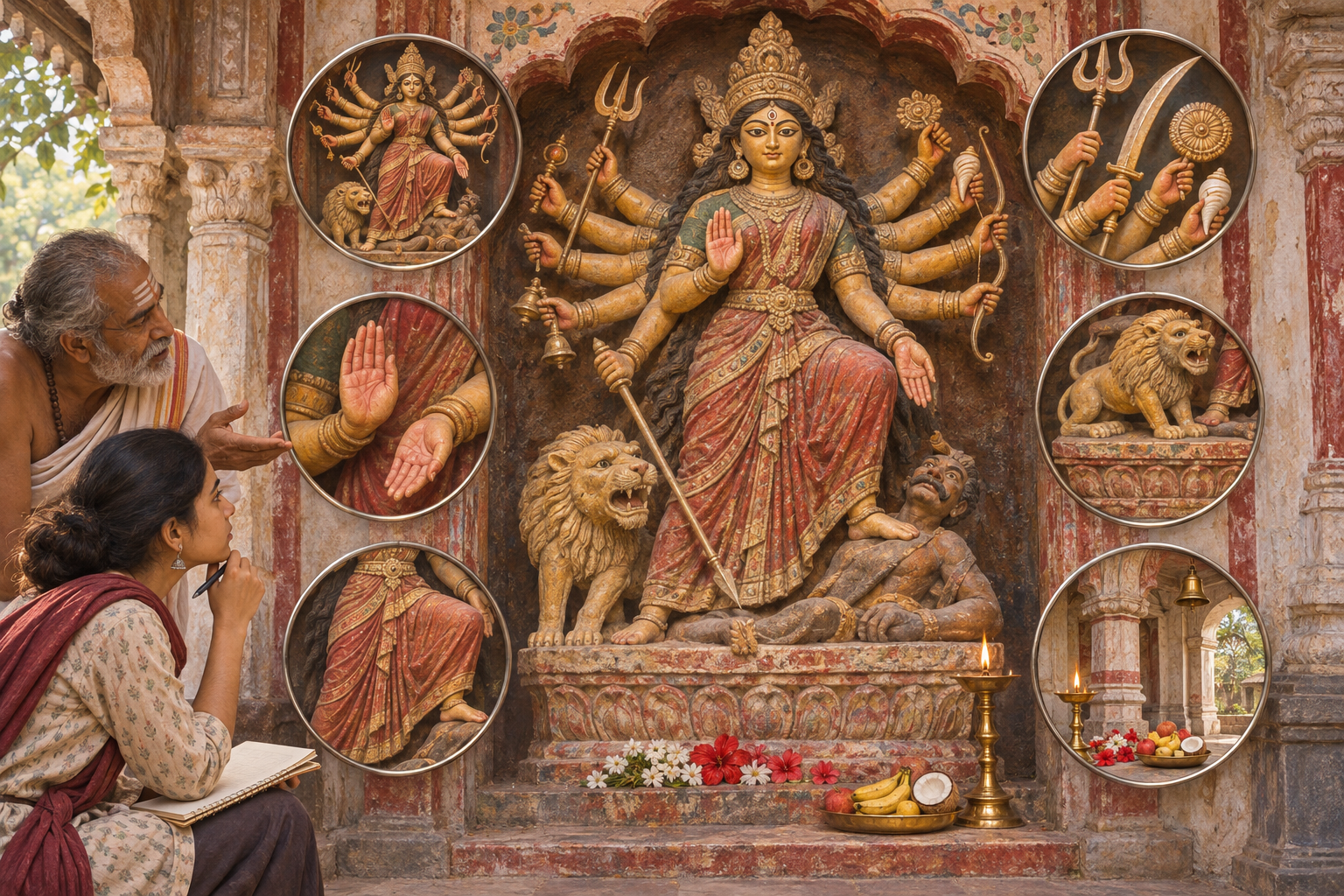
If you are examining a murti, photograph, manuscript image, or recent devotional print, use the following sequence. It prevents an attractive interpretation from quietly turning into a false statement of fact.
- Record the given name before interpreting the image. Write down the exact wording of the shrine label, inscription, catalogue entry, print caption, or oral identification. Note where the name came from and when you recorded it. Do not silently shorten “Jaya Durga” to “Durga,” because the qualifier carries the form’s central meaning.
- Inventory only what is visible. Note posture, the number and arrangement of arms, held objects, hand gestures, seat or mount, attendants, opposing figures, crown, halo, and surrounding symbols. At this stage, describe rather than explain. “The upper hand holds a round object” is safer than naming an object you cannot see clearly.
- Mark damage, concealment, and later additions. A broken hand, repainting, heavy ornament, cropped photograph, or replaced attribute can distort identification. Record the limitation instead of filling the gap from memory.
- Ask how the living tradition names the form. If the image remains in worship, ask the priest, caretaker, hereditary custodian, artisan, or family that maintains it. Find out whether the name is inherited, used in ritual, attached to a festival, or recently introduced. Record the answer as local testimony, not as a universal rule.
- Compare like with like. Begin with images from the same temple network, community, region, period, or artistic tradition when such material is available. A collection of unrelated internet images can create a composite form that belongs to no actual tradition.
- State your confidence honestly. Use a label such as “named Jaya Durga in this shrine,” “attributed to Jaya Durga in the catalogue,” or “tentatively identified as Jaya Durga from the theme of victory.” Each phrase tells the reader what kind of evidence supports the name.
Keep three separate columns in your notes: what is visible, what the community or record calls it, and what you think it means. That small discipline is especially useful for researchers, photographers, museum volunteers, teachers, and writers. It lets another person review your reasoning without confusing observation with interpretation.
Read, teach, and reproduce the form without flattening it
For devotional reflection
Let the relationship between victory and protection guide your attention. Power is present, but it is not directionless. The form asks you to consider what must be overcome so that righteousness can stand and the vulnerable can be protected.
Before worship or contemplation, name the adversity in ethical rather than merely personal terms. Ask what response would preserve courage without cruelty, firmness without hatred, and success without abandoning duty. This keeps the devotional use of the image connected to its defining symbolism instead of reducing Jaya Durga to a mechanism for obtaining whatever outcome you happen to want.
Do not force a private code onto every visual detail. An object’s meaning should come from a recognised tradition, a reliable record, or its place within the composition. If that support is absent, it is enough to say that the significance is uncertain.
For captions, lessons, and commissioned images
- In a caption, preserve provenance. Write “Jaya Durga, as identified by the temple” when that is the basis of the name. Do not convert local testimony into a claim that every Jaya Durga image must look the same.
- In a lesson, separate identity from interpretation. First show what can be observed, then give the inherited name, and only then discuss victory, righteousness, and protection. Students will be able to see which conclusions are secure.
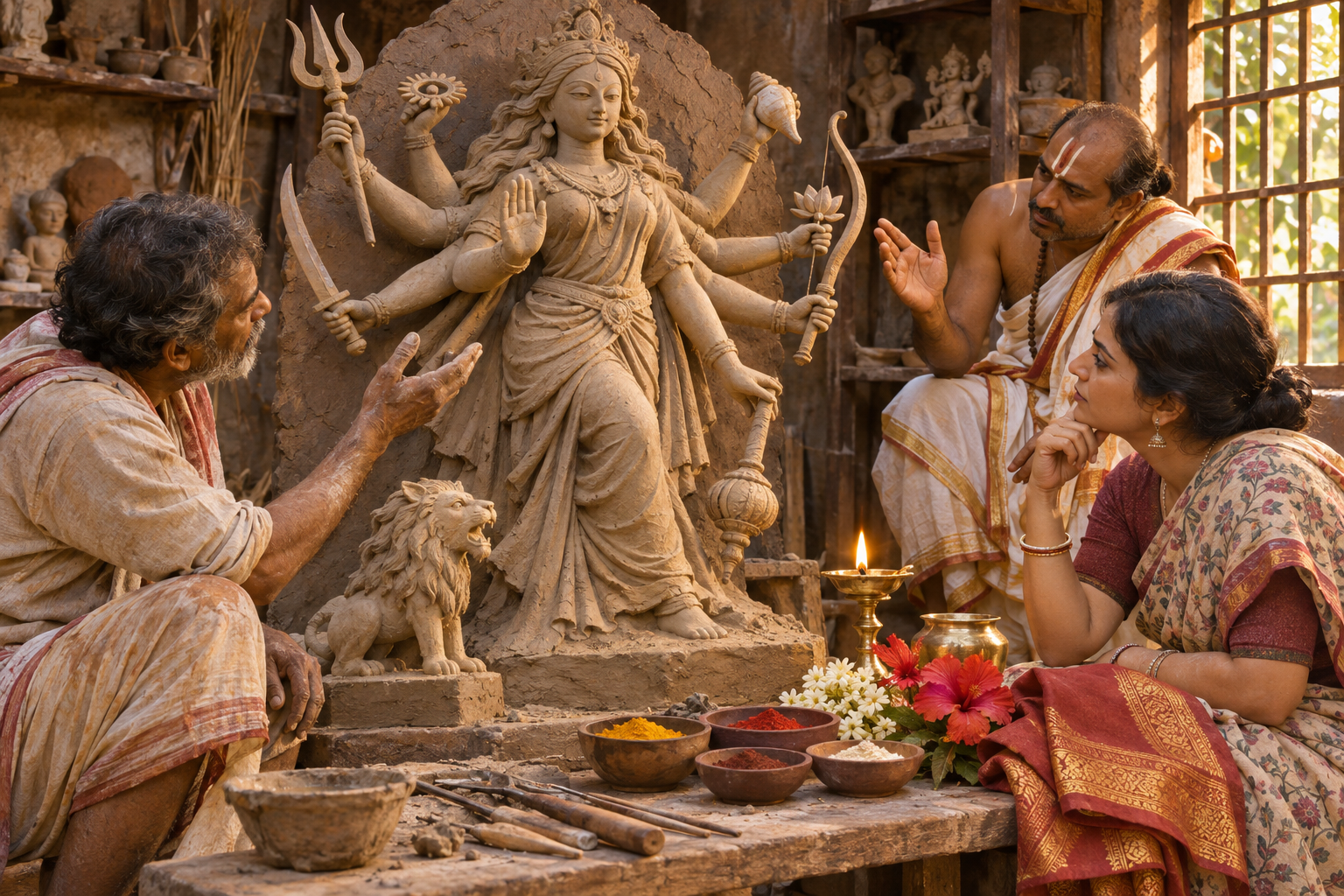
- In a commission, establish the authority for the design. Ask the relevant priest, custodian, lineage representative, or text specialist which features are required for that particular setting. Give the artisan a written brief distinguishing fixed elements from choices of material, ornament, and style.
- Do not create a false composite. Combining attractive details from unrelated images may produce devotional art, but it does not establish an ancient or universal Jaya Durga formula.
- Keep the design record. Save the names of consulted authorities, reference images, requested attributes, and approved changes. Future worshippers and custodians should not have to guess why the image was made as it was.
If tradition-specific instructions are unavailable, describe the result modestly. “A contemporary devotional interpretation of Jaya Durga” is more accurate than “the canonical form of Jaya Durga.” Precision sometimes means acknowledging the limit of what can be established.
Key takeaways
- Jaya Durga is distinguished first by the theological centre of her form: righteous victory joined to protection.
- No single colour, weapon, gesture, or pose should bear the full weight of identification.
- Use converging evidence from the inherited name, complete composition, provenance, and living worship context.
- Keep observation, local identification, and your own interpretation separate in notes and captions.
- When evidence is incomplete, state the uncertainty instead of inventing a universal rule.
The next time you encounter an image called Jaya Durga, begin by recording its name and setting before searching for visual matches. Then read every attribute through the union of victory, righteousness, and protection. That sequence will give you a more faithful understanding than a checklist assembled without context.
References

Leave a Reply
You must be logged in to post a comment.