

If you are arranging family worship or a Tirumala visit for Deepavali 2026, reserve Sunday, November 8. The important distinction is not between competing festival dates. It is between the civil date, the exact tithi interval, your family’s aarti practice, and Tirumala’s temple schedule.
Deepavali and Naraka Chaturdashi both fall on November 8 in 2026. That settles which day to keep free, but it does not by itself establish a universal minute-by-minute muhurta for every city or sampradaya.
Key takeaways
- Keep November 8, 2026, free for Deepavali and Naraka Chaturdashi observances.
- Many communities perform Deepavali aarti on Naraka Chaturdashi because Amavasya is not considered preferable for taking aarti in their practice.
- Tirumala’s Deepavali Asthanam is scheduled from 7 a.m. to 9 a.m. on November 8.
- Use a panchang calculated for your location before fixing the exact household ritual time. A festival date and a tithi interval are related, but they are not interchangeable.
What November 8 settles – and what it does not
A civil date runs from midnight to midnight. A tithi is a lunar calendar unit that can begin or end during a civil day. Consequently, saying that Naraka Chaturdashi falls on November 8 identifies the festival day without proving that Chaturdashi occupies every hour of that date.
| Date | What is established | How you should use it |
|---|---|---|
| November 8, 2026 | Deepavali and Naraka Chaturdashi fall on the same civil date. | Reserve the day for family observances. Confirm the exact ritual clock locally. |
| November 8, 2026 | Tirumala Deepavali Asthanam is scheduled from 7 a.m. to 9 a.m. | Use this as the Asthanam window, not as a universal household aarti muhurta. |
| November 11, 2026 | A later panchang entry lists Shukla Paksha Dwitiya until 2:13 p.m. and Tritiya afterward. | Use it as a clear example of a tithi changing within a civil day, not as an alternative Deepavali date. |
The November 11 transition makes the calendar principle concrete: Shukla Paksha Dwitiya continues only until 2:13 p.m., after which Tritiya begins. You should not transplant that time into another date or locality. It simply shows why a date label cannot replace the full panchang entry.
For November 8, the reliable planning facts are the festival date, its Naraka Chaturdashi association, and Tirumala’s stated Asthanam window. The available calendar information does not establish the beginning and ending clock times of Chaturdashi for your location. Any schedule that adds a precise household aarti time without a location-specific panchang is adding certainty that the date alone cannot support.
Plan household aarti without inventing a universal muhurta
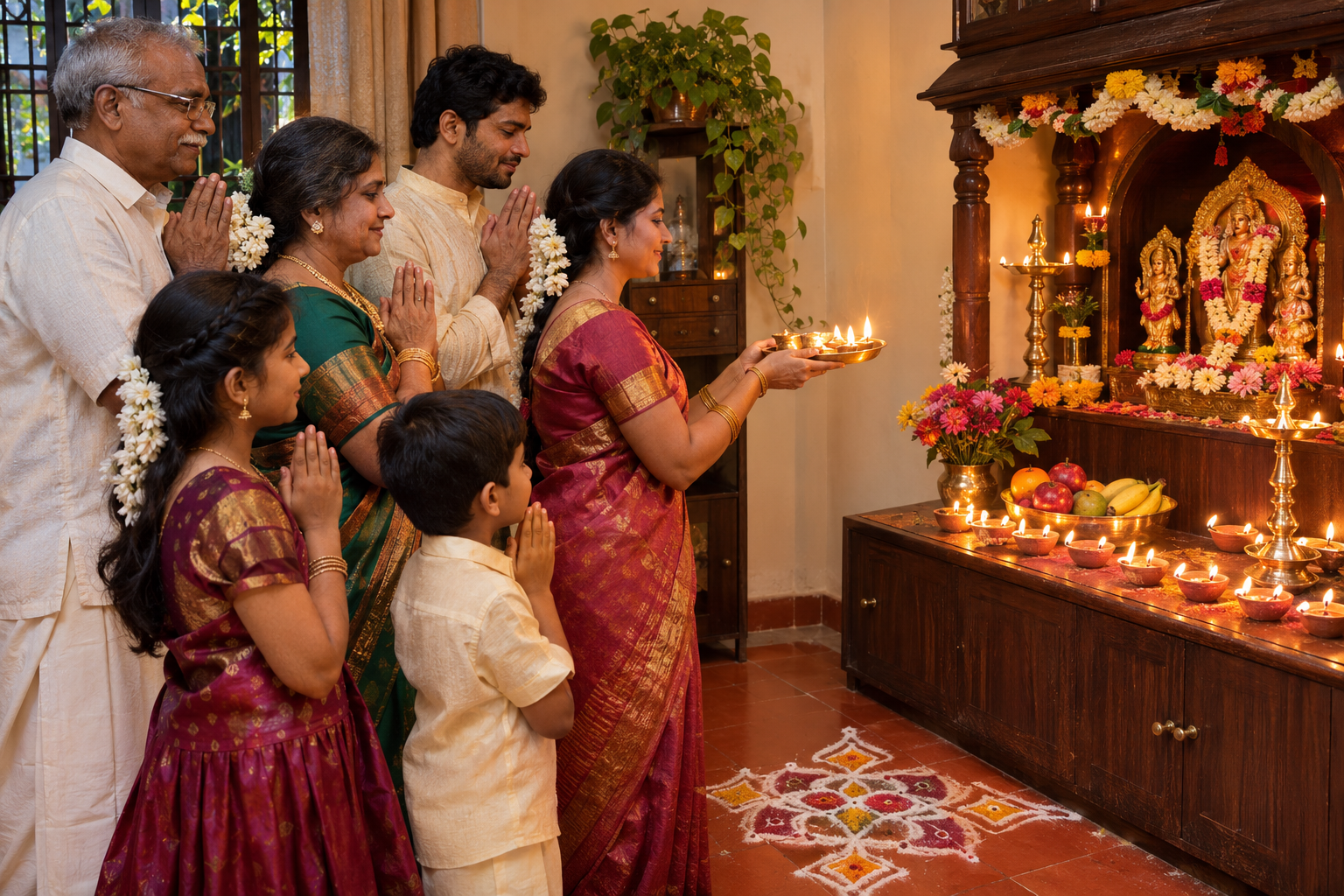
Many communities assign Deepavali aarti to Naraka Chaturdashi rather than Amavasya. This is a community practice, not permission to erase differences among family traditions. If your home has an inherited sequence, follow that sequence first and use the panchang to place it correctly on the clock.
A practical home-planning checklist
- Mark November 8 once. Do not create separate November 8 and November 9 events merely because Deepavali and Naraka Chaturdashi appear as different labels. In 2026, both are assigned to November 8.
- Name each family observance. Write down aarti, puja, Abhyanga Snana, or any other practice your family actually follows. This prevents the generic word “Deepavali” from hiding which act needs a tithi-based time.
- Ask one precise question. Instead of asking, “What time is Diwali?” ask, “At our location, when should our family’s Naraka Chaturdashi aarti be performed?” That gives a knowledgeable priest or panchang reader the information needed to apply the appropriate rule.
- Check the panchang for your city. Record the relevant tithi start and end times, the applicable ritual rule, and the local time zone. Do not copy a clock time published for another place merely because the civil date matches.
- Put the reason in the calendar entry. A note such as “Naraka Chaturdashi aarti – time confirmed from local panchang” is much less likely to be misread by relatives than “Diwali puja.”
If your family has no settled practice, do not manufacture one from a generic online timetable. Begin with the November 8 date, then seek guidance appropriate to your location and sampradaya. The useful answer is not the most precise-looking time; it is the time derived from the rule your household actually observes.
How Tirumala observes Deepavali in 2026

At Tirumala, Deepavali Asthanam will be held on November 8 from 7 a.m. to 9 a.m. Sri Malayappa Swamy, accompanied by Sridevi and Bhudevi, will receive worship on the Sarvabhoopala Vahanam while facing Garudalwar. Sri Vishvaksena, the divine commander-in-chief, is also included in the Asthanam arrangement.
This temple observance gives devotees a distinct way to understand Deepavali. The festival is not confined to a private celebration or a household lamp-lighting schedule. At Tirumala, it is marked through formal seva, the presence of the utsava murti with the two Devis, the Sarvabhoopala Vahanam, Garudalwar, and Sri Vishvaksena.
What the 7-9 a.m. window means for a visitor
- Treat 7 a.m. to 9 a.m. as the scheduled Asthanam period. It is not a universal aarti time for homes outside Tirumala.
- Do not treat 7 a.m. as a suggested arrival time or as a promise of individual access. The ritual timetable and visitor arrangements answer different questions.
- Check the temple’s current visitor and entry instructions before travelling. The Asthanam schedule alone does not tell you how access will be managed.
- If you will also perform family aarti, keep that decision separate. Fix it through your household tradition and local panchang rather than copying the temple’s institutional schedule.
Create two clear calendar entries if Tirumala is part of your plan: “Deepavali family observances – November 8, local time to be confirmed” and “Tirumala Deepavali Asthanam – November 8, 7-9 a.m.” That small separation prevents the most common planning error: turning one temple’s scheduled ceremony into a supposedly universal muhurta.
Your next step is simple. Reserve November 8, identify the practices your family will actually perform, and verify their clock times against a panchang for your location. If you are going to Tirumala, plan around the 7-9 a.m. Asthanam window while separately confirming the temple’s visitor arrangements.
References
- Hindu Pad – Diwali Aarti Time 2026 | Timings for Deepavali Harathulu 2026
- Hindu Pad – Deepavali Asthanam 2026 at Tirumala Tirupati Temple
- Hindu Blog – November 11 2026 Tithi – Panchang – Hindu Calendar – Good Time – Nakshatra – Rashi

Leave a Reply
You must be logged in to post a comment.