

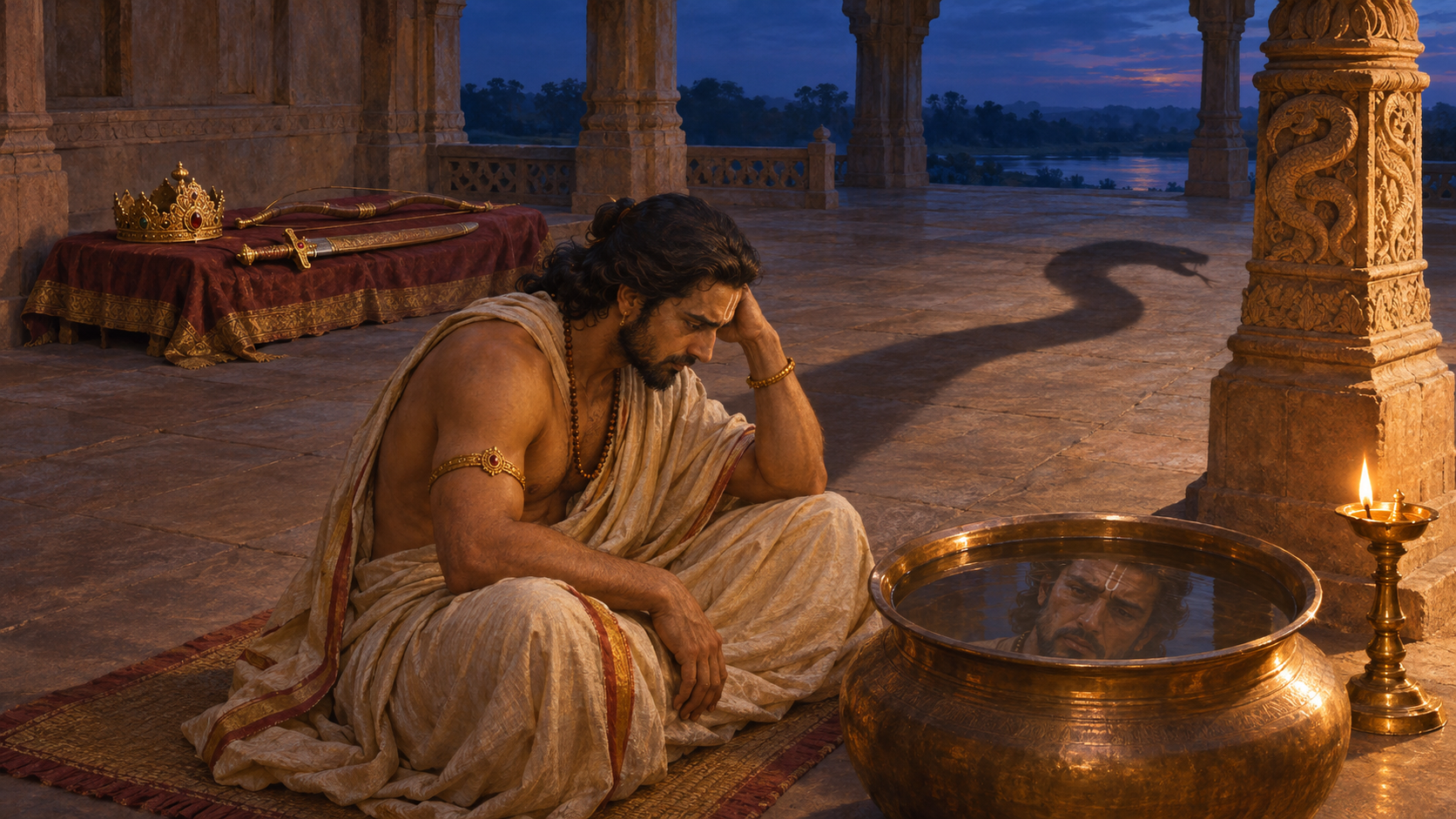
You may come to Parikshit’s final days with a practical question: if Takshaka was still going to strike, what did hearing the Bhagavata accomplish? Sacred listening did not make the consequence disappear. It changed the field in which Parikshit still had freedom: his attention, his priorities, and the way he would meet the end.
That distinction saves the episode from fatalism. Parikshit could not command the approaching result, but he did not surrender his remaining time to panic, distraction, or resentment. If you are facing any consequence you cannot fully reverse, that is the part of his example you can use.
Keep the death, the consequence, and the hearing distinct
Two different questions are often compressed into one. The first is narrative: how did Parikshit die? In Chapter 39 of the Astika Parva in the Adi Parva, the king, a grandson of the Pandavas, meets his foretold end through the serpent king Takshaka. The familiar image of a worm concealed in fruit shows the fatal threat arriving in a form that ordinary vigilance fails to stop.
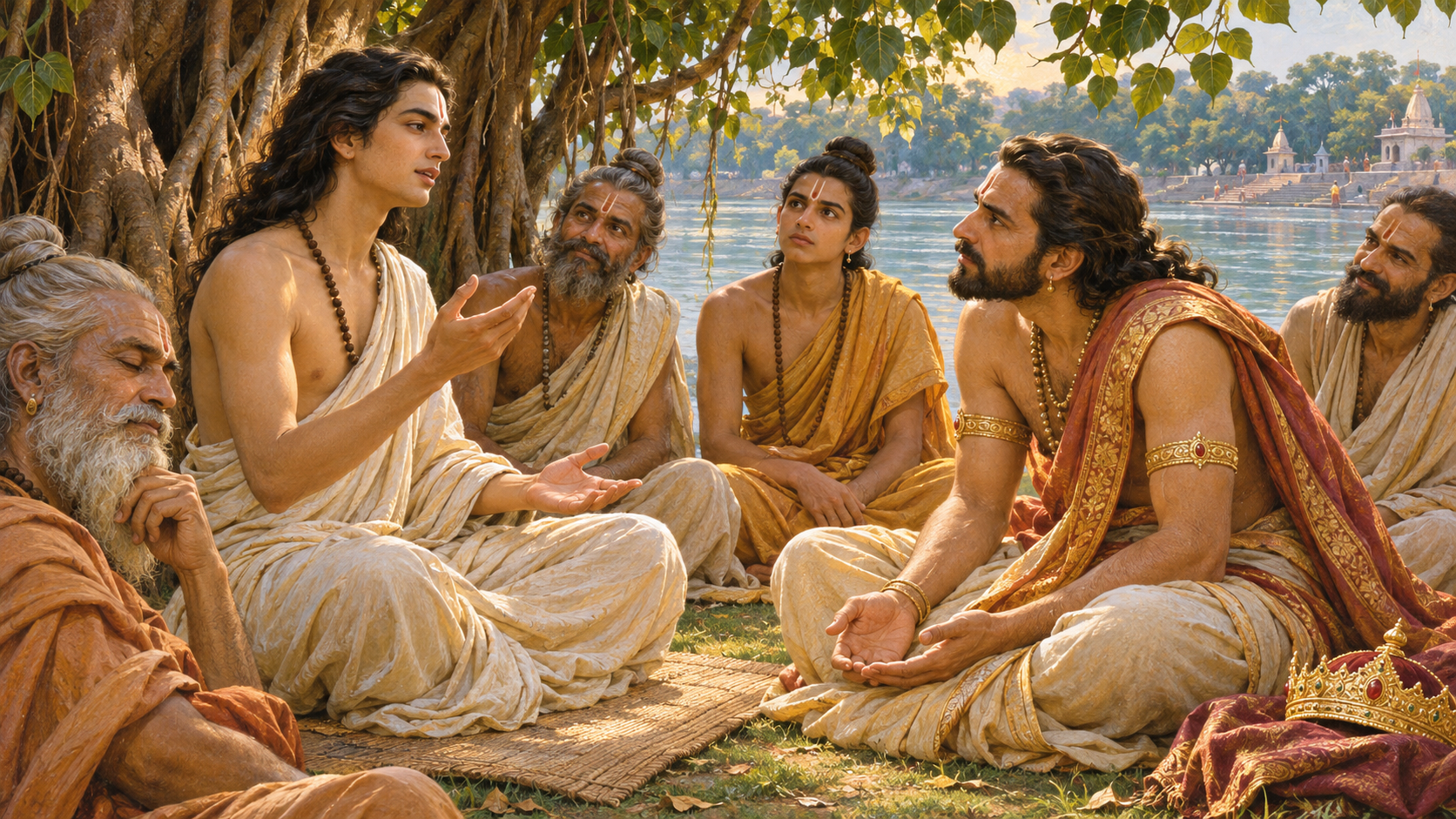
The second question is spiritual: what did Parikshit do when the horizon of his life narrowed? The answer is Bhagavata-sravana, the disciplined hearing of sacred teaching. This is not an alternative account of the physical event. It addresses the condition of the listener before that event.
It helps to read the episode as three movements:
- Consequence: an action has created a result that cannot be dismissed merely because the person now regrets it.
- Limit: Takshaka embodies the point at which political authority, possessions, and defensive arrangements cannot guarantee control.
- Response: hearing the Bhagavata directs the remaining freedom toward truth rather than toward frantic attempts to preserve an old sense of mastery.
This separation matters whenever you read a Dharmic narrative. Asking only who caused the death can reduce the episode to a contest between king and serpent. Asking only about destiny can make human choice appear meaningless. Parikshit’s hearing holds both truths together: consequences are real, and the quality of your response still matters.
Takshaka reaches the body, but need not possess the mind
On the level of plot, Takshaka is the agent of Parikshit’s death. On the contemplative level, he can also represent the unavoidable limit waiting inside every apparently secure life. The worm in the fruit is powerful because it overturns the assumption that danger will always announce itself at the gate. What ends a period of life may already be moving through something that appears harmless, familiar, or controlled.
That symbolism should sharpen responsibility, not weaken it. Destiny is not a licence to neglect precautions, abandon duties, or excuse harmful action. Nor does an earlier mistake make every later injury morally good. Dharmic reflection can recognise personal agency, the ripening of consequences, and the limits of control without confusing them.
The practical mistake is to give an approaching consequence authority over the whole mind before it actually arrives. A person can lose days to rehearsing humiliation, anger, illness, separation, or death. In that condition, the feared event has already begun governing attention. Parikshit’s turn toward sacred hearing presents another possibility: let the consequence define the boundary of the situation, but do not let it choose the content of consciousness.
When you feel trapped by an outcome, make two lists. Under fixed, place only what truly cannot now be changed. Under open, place what remains yours to govern: the next truthful statement, an apology, an unfinished duty, the company you keep, and what you allow into your mind. This simple distinction prevents acceptance from decaying into passivity.
Bhagavata-sravana is disciplined reception, not background audio
Bhagavata-sravanam means more than being within earshot of a recitation. Sravana is receptive attention. You allow the sacred teaching to interrupt your preferred explanation of yourself. You listen long enough for its moral and spiritual order to become clearer than the noise competing with it.
This is why hearing is especially significant in Parikshit’s situation. Reading can tempt you to move quickly, search for a favourite line, or stop whenever the teaching becomes uncomfortable. Attentive hearing places you in a humbler position. The teaching arrives in an order you do not control, and your first duty is to receive it before turning it into an argument.
You can test the quality of a Bhagavata hearing by what happens after it:
- Attention: Can you state the central teaching, or do you remember only the speaker’s style and the atmosphere of the gathering?
- Self-examination: Did the hearing expose a habit, attachment, fear, or excuse that you normally protect?
- Application: Can you name one duty that now needs to be performed differently?
- Continuity: Will you return to the teaching after the emotion of the occasion has faded?
A moving performance can still leave the listener unchanged. Conversely, a quiet recitation may become decisive if it causes someone to tell the truth, release resentment, repair a relationship, or remember the Divine when fear rises. The proper measure is not how intense the session felt. It is whether the hearing reordered attention and conduct.
Use Parikshit’s example when an outcome cannot be undone
You do not need to imitate the external circumstances of a king awaiting Takshaka. The usable pattern is internal: acknowledge the consequence, stop bargaining with what is already fixed, place yourself before a teaching larger than your fear, and use the freedom that remains.
- Name the situation accurately. Replace a vague declaration that everything is ruined with a precise statement of what has happened, what may follow, and which duties remain.
- Choose a coherent passage or recitation. Do not assemble only reassuring fragments. Hear enough of the teaching to encounter its demands as well as its consolations.
- Bring one honest question. Ask what you are being called to relinquish, remember, repair, or complete. A concrete question gives your attention somewhere to work.
- Remove competing inputs. Put aside the stream of messages, commentary, and reaction that keeps returning you to agitation. Hearing cannot become sadhana while it is treated as background sound.
- Write down one instruction in your own words. If you cannot express what the teaching asks of you, listen again before collecting more material.
- Complete one corresponding action. Make the apology, perform the neglected duty, simplify the attachment, or establish the next hearing. Let sravana pass into conduct.
This practice also protects you from a common misuse of Parikshit’s story. Acceptance does not mean announcing that every event was meant to happen and therefore requires no response. It means seeing the present limit without falsifying it. You may still need to seek justice, protect another person, correct an error, or fulfil a worldly obligation. Sacred hearing should make those duties clearer, not provide a religious vocabulary for avoiding them.
When choosing a communal Bhagavata programme, look beyond reputation and presentation. Favour a setting where attention remains on the sacred teaching, explanations illuminate dharma rather than drift into gossip, and listeners are encouraged toward practice rather than dependence on the personality of the speaker. The goal is not merely to admire a discourse. It is to become capable of hearing truth when your own preferences resist it.
Key takeaways
- Takshaka answers the question of how Parikshit’s death arrived; Bhagavata hearing answers the question of how the king oriented himself before it.
- Sacred hearing is not a technique for cancelling every consequence. Its immediate work is to reorder attention, discernment, and action.
- The episode does not teach helpless fatalism. It asks you to distinguish the outcome that is fixed from the response that remains open.
- The worm in the fruit challenges confidence in external security, but it does not excuse negligence or erase moral agency.
- Bhagavata-sravana becomes sadhana when attentive reception produces self-examination and one definite act of dharma.
At your next Bhagavata hearing, arrive with one unresolved duty rather than a general wish to feel peaceful. Listen for what must be faced, released, or completed, and act on it while the instruction is still clear. Parikshit’s example matters because he did not need control over Takshaka in order to take responsibility for the direction of his own attention.


References
- Hindu Blog – How Takshaka Killed King Parikshit
- Dandavats – Bhagavata Sravanam – HG Madan Gopal Prabhu

Leave a Reply
You must be logged in to post a comment.