

Suppose a foreign headline tells you India is approaching an uprising. Your first task is not to defend the government or join the excitement. It is to identify exactly what happened, where it happened, and what evidence turns a protest into a national political rupture.
That discipline protects Bharat twice: from inflated narratives that convert limited unrest into fantasies of regime collapse, and from reflexive denial that treats every criticism as foreign hostility. You can reject a misleading frame without pretending that grievances, protests, or political opposition do not exist.
Separate the protest from the claim of revolution
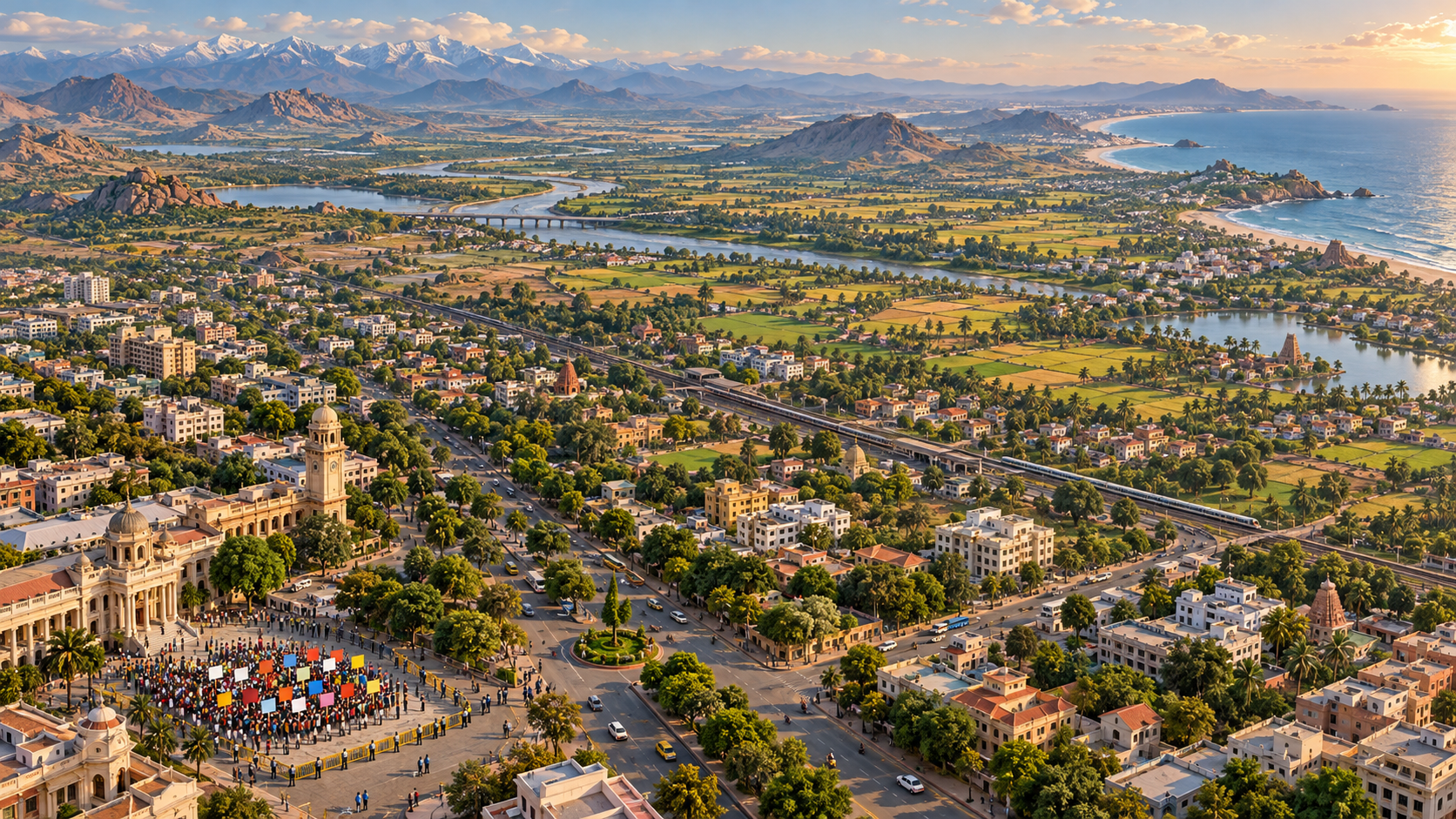
A protest is an event. A revolution is a conclusion about the scale, persistence, breadth, and political consequences of many events. Coverage becomes unreliable when it quietly substitutes the second for the first.
Use a four-rung ladder whenever you encounter a dramatic description of unrest:
- Grievance: People are dissatisfied with a policy, price, institution, party, or condition.
- Protest event: People gather, march, strike, or otherwise express that grievance collectively.
- Sustained movement: Mobilisation continues across time, develops organisation, and reaches beyond one gathering or constituency.
- National uprising: Broad and persistent mobilisation creates a serious nationwide challenge to political authority.
Evidence for one rung does not automatically establish the next. A blocked road can confirm disruption. It cannot tell you how many Indians support the demonstrators, whether mobilisation extends beyond that locality, or whether the government faces a national crisis.
The distinction mattered during the October demonstrations. One observer who had spent nearly three weeks around IIT Delhi, IIT Kharagpur, streets, markets, and hostels found ordinary activity continuing around him. People he encountered were more preoccupied with rising prices and blocked roads than with protest politics, while some students who knew a protest was occurring could not state its demands. He also described the October 10 disruption as largely a traffic problem and the October 16 Tiranga march as failing to produce the predicted uprising.
That observation weighs against a portrayal of an unmistakable national revolution in those places at that time. It does not prove that every Indian was satisfied, that the protesters had no legitimate complaint, or that nothing significant happened elsewhere. A grounded counterexample can puncture an absolute claim; it cannot serve as a complete map of a vast country.
Match every conclusion to evidence of the same scale

The easiest way to test political reporting is to separate what was observed from what was inferred. The gap between those columns is often where a narrative outruns reality.
| What you can observe | What it can support | What it does not establish |
|---|---|---|
| A crowd gathers at one location | A protest occurred there | A nationwide movement exists |
| Roads are blocked | The event caused local disruption | The public supports the organisers |
| People discuss prices more than protests | Material concerns are salient among those people | They approve of the government |
| Some students cannot identify the demands | The campaign has limited salience within that observed group | The campaign is irrelevant everywhere |
| A predicted uprising fails to appear | The forecast deserves less confidence | All future mobilisation is impossible |
After making that separation, ask for the denominator. How many cities were involved? For how long? Did the same people return after the first gathering? Did mobilisation cross regional, class, linguistic, or organisational boundaries? Were institutions affected beyond temporary traffic disruption? Did the demands become clearer and more widely recognised over time?
You do not need an answer to every question before believing that a protest happened. You do need substantially broader evidence before accepting words such as “uprising,” “revolution,” “national revolt,” or “regime collapse.” A dramatic video shows what entered the camera frame. It does not supply the national denominator.
Audit the narrative without inventing a conspiracy

Distorted coverage does not always require central coordination. It can emerge through selection: which predictions receive space, which voices are treated as representative, which images are repeated, and whether failed forecasts receive the same attention as the original claim.
Watch for five warning signs:
- The thesis survives every outcome. A large turnout proves revolution; a small turnout is recast as hidden revolutionary anger. Nothing is allowed to reduce confidence.
- Forecasts become descriptions. What activists hope will happen is written as if it is already unfolding.
- A constituency becomes “India.” The views of a particular activist, student, intellectual, or diaspora circle are allowed to stand in for a country of immense internal variety.
- Disruption becomes legitimacy. Traffic, police deployment, or striking footage is treated as proof of mass political support.
- The follow-up disappears. A promised date passes without the predicted event, but the original interpretation remains unchanged.
These signs justify scrutiny, not automatic accusations of an organised regime-change operation. “Manufactured regime change” is itself a large claim. To establish it, you would need evidence of deliberate coordination, not merely similar opinions, sensational framing, or a failed prediction.
Vivek Wadhwa says that his critics did not reduce their confidence after the expected October 16 uprising failed to materialise. If that characterisation is accurate, it reveals a serious problem of falsifiability: a forecast that cannot lose credibility after failure is functioning as conviction, not analysis.
He also says several US publications declined his observations from Kashmir in 2022. That experience raises a legitimate question about editorial gatekeeping. By itself, however, it cannot prove universal censorship across Western media or a centrally directed campaign. Keep the concern proportional to the evidence. That is precisely the standard we should demand from those making sweeping claims about India.
Use this five-minute test before sharing a dramatic claim

You can evaluate most political-unrest coverage with a short written check. Do it before forwarding the headline, especially when the framing already confirms what you want to believe.
- Rewrite the claim as a testable sentence. Replace “India erupts” with something precise, such as “A sustained protest movement is spreading across multiple regions and challenging national authority.”
- Place it on the four-rung ladder. Is the available material showing a grievance, an event, a movement, or a national uprising? Do not let the headline choose the rung for you.
- Sort the material into four boxes. Mark each element as direct observation, attributed fact, interpretation, or prediction. Photographs of a march belong in the first box; claims about what the march will become belong in the fourth.
- Check the map, clock, and sample. Record where the observation occurred, when it occurred, how long it lasted, and whose voices were included. “Students” at one institution are not all students; a capital-city demonstration is not the whole republic.
- Write down what would disprove the claim. If no turnout, failed date, geographic limit, or absence of follow-through could weaken it, you are dealing with a closed narrative.
- Give a bounded verdict. Use “supported,” “plausible but unproven,” “contradicted,” or “insufficient evidence.” Avoid jumping between “nothing happened” and “the government is about to fall.”
A responsible note may be as simple as this: “A protest occurred and caused disruption, but the available evidence does not establish a nationwide uprising.” That sentence recognises the event while refusing to inflate it.
A Bharat-first standard should be harder to fool
Being pro-Bharat does not mean accepting every favourable claim or rejecting every uncomfortable one. It means insisting that India be described at its actual scale, with Indian political agency intact. Protesters are not automatically foreign puppets. Foreign commentators are not automatically neutral. Governments are not beyond criticism. Nor is every demonstration the opening scene of a revolution.
Key takeaways
- A protest confirms political activity; it does not by itself confirm a national uprising.
- Match the geographic and temporal scale of the evidence to the scale of the conclusion.
- Treat everyday normality as a limit on dramatic claims, not as proof of universal political contentment.
- Lower your confidence when a prediction fails. A narrative that cannot be falsified is not reliable analysis.
- Question editorial selection, but do not allege coordination without evidence of coordination.
- Apply the same evidentiary standard to Western coverage, Indian government claims, opposition messaging, diaspora commentary, and your own preferred interpretation.
The next time an uprising is predicted, save the exact wording and the promised date. Then return after that date and compare the forecast with the map, duration, public salience, and political consequences. Forcing a narrative to meet the calendar is one of the quickest ways to learn whether it describes India or merely imagines it.
References

Leave a Reply
You must be logged in to post a comment.