
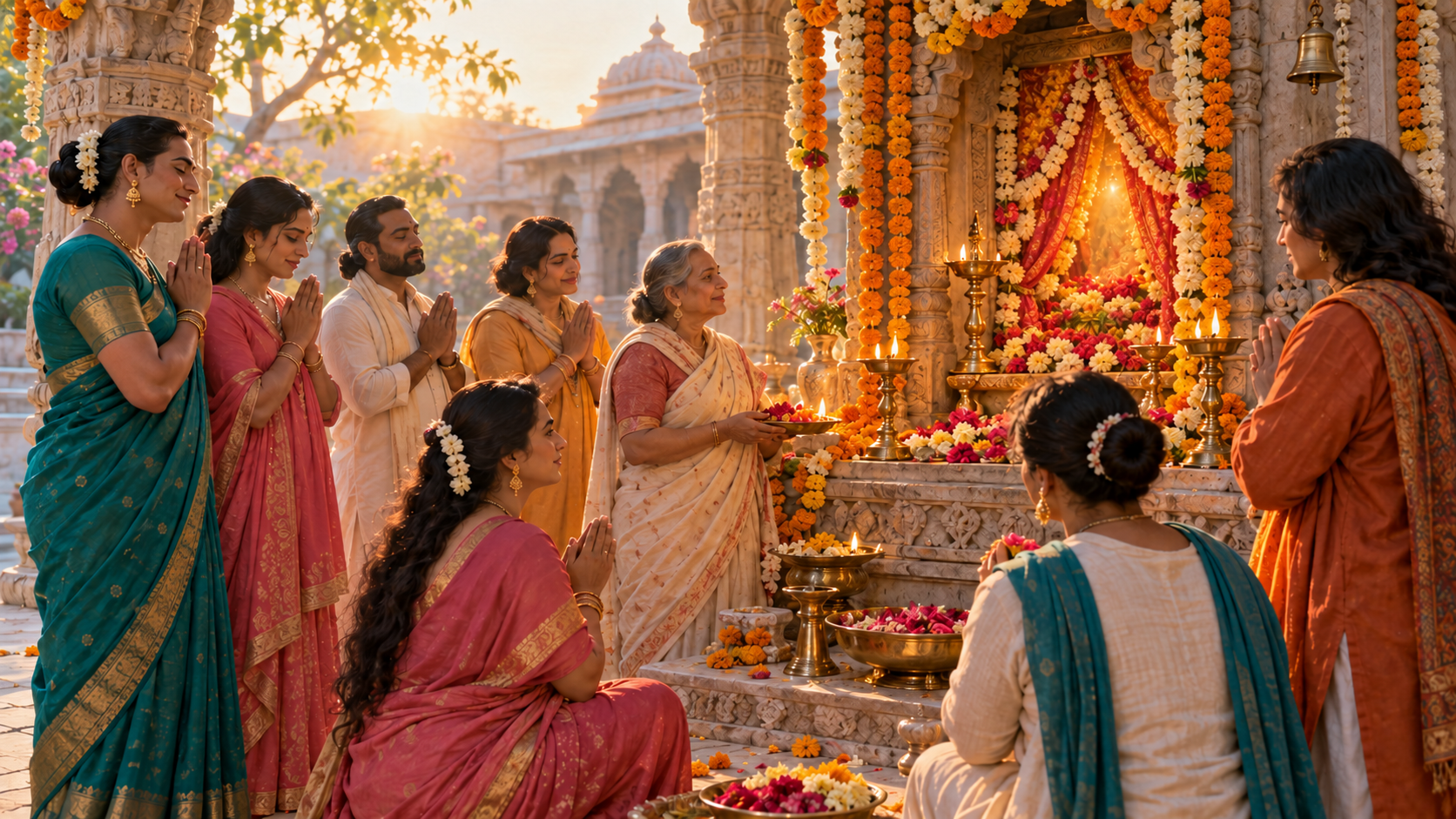
If you have heard Bahuchara Mata called the patron goddess of the Hijra community, the easy mistake is to treat that relationship as a curiosity about gender. A devotee encounters something more serious: a sacred bond with the Devi, expressed through worship, trust and belonging.
You can understand that bond without making claims the tradition does not support. Begin with the established devotional facts, distinguish a community identity from a broad modern label, and approach the temple and its worshippers with the same dignity you would expect at any Hindu shrine.
Begin with the complete devotional picture
Bahuchara Mata is revered as a Hindu goddess of fertility and regarded as a form of Parvati. Her worship is associated with people seeking the blessing of children as well as transgender devotees in northern India. Her principal temple is in Gujarat.
These facts belong together. Describing her only as a fertility goddess leaves out her importance to the Hijra community. Calling her only a patroness of Hijras obscures her place within the wider worship of the Devi and her association with couples who hope to have children.
- Her theological setting is Hindu worship of the Devi: Bahuchara Mata is understood as a manifestation of Parvati.
- Her fertility association explains why people seeking children turn to her for blessings.
- Her relationship with Hijras is devotional, not merely sociological.
- Her Gujarat temple is a place of worship, not an attraction built around gender difference.
If you need a concise introduction, use all three elements: Bahuchara Mata is a form of Parvati associated with fertility, worshipped by people seeking children, and honored as a patroness of the Hijra community. That sentence is more accurate than reducing her to any one constituency.
Fertility does not reduce the relationship to reproduction
Modern readers often hear fertility and think only of biological reproduction. That narrow frame creates a false puzzle: why would a fertility goddess be especially important to a gender-diverse community?
The puzzle disappears when you stop treating divine patronage as a statement about a devotee’s reproductive capacity. Hijras do not need to be explained through fertility, infertility or anatomy before their devotion can be taken seriously. The relationship is between worshippers and the Devi.
The two groups associated with Bahuchara Mata also approach her from different circumstances. People hoping for children seek her fertility blessings. Hijra devotees honor a patron deity with whom their community has a particular sacred connection. Those relationships can meet at one shrine without becoming identical.
A careful Dharmic reading can notice something further without turning it into a rigid doctrine: the Devi receives people whom ordinary social categories may keep apart. The sacred centre is not a theory about their bodies. It is the presence of Mata and the act of turning toward her.
This distinction matters when fertility is personally painful. Do not promise that worship will produce a pregnancy, and do not present puja as a replacement for medical care. You can describe a prayer as an act of devotion and hope without converting divine grace into a guaranteed clinical result.
Use Hijra and transgender with precision
Hijra is a specific South Asian community identity. Transgender is a broader contemporary term for people whose gender differs from the sex assigned to them at birth. The categories can overlap, but they are not interchangeable. A transgender person is not automatically a Hijra, and you should not assume that every Hijra uses transgender as a personal identity.
That distinction changes how you should speak about Bahuchara Mata. The phrase patroness of the Hijra community names a particular cultural and devotional relationship. The broader statement that transgender people worship her describes a wider group of devotees. Neither statement permits you to generalize about every Hijra or every transgender person.
- Say that Bahuchara Mata is revered by Hijras; do not say that every Hijra must be her devotee.
- Do not use Hijra as a catch-all label for every gender-diverse person in India.
- Do not assume that every Hijra follows the same religion, practice or personal interpretation.
- Avoid turning anatomy, initiation or private community customs into casual conversation.
- If a person tells you how they identify, use their own term rather than correcting it to fit your vocabulary.
Two other claims should be avoided. Bahuchara Mata is not worshipped only by Hijras, because her devotees also include people seeking children. Nor does her Hijra patronage place the community outside Hindu sacred life. The relationship itself is evidence that gender-diverse devotees participate in a living Hindu devotional world.
Read the icon before inventing an interpretation
Bahuchara Mata is depicted with four hands and a rooster as her vehicle. Those are useful identifying features when you encounter her image.
Stop there unless you have reliable information about the particular murti, local tradition or object in her hand. It is tempting to assign a symbolic meaning to every detail, especially when explaining an unfamiliar deity. Guesswork presented as theology does not deepen respect. It makes the tradition harder to understand accurately.
The same discipline applies to the rooster. You can identify it as her vahana without claiming that it proves a particular theory about gender, fertility or social identity. Iconography can carry layers of meaning, but those meanings should come from an established tradition rather than a convenient modern analogy.
Approach the Gujarat temple as a pilgrim, not a spectator
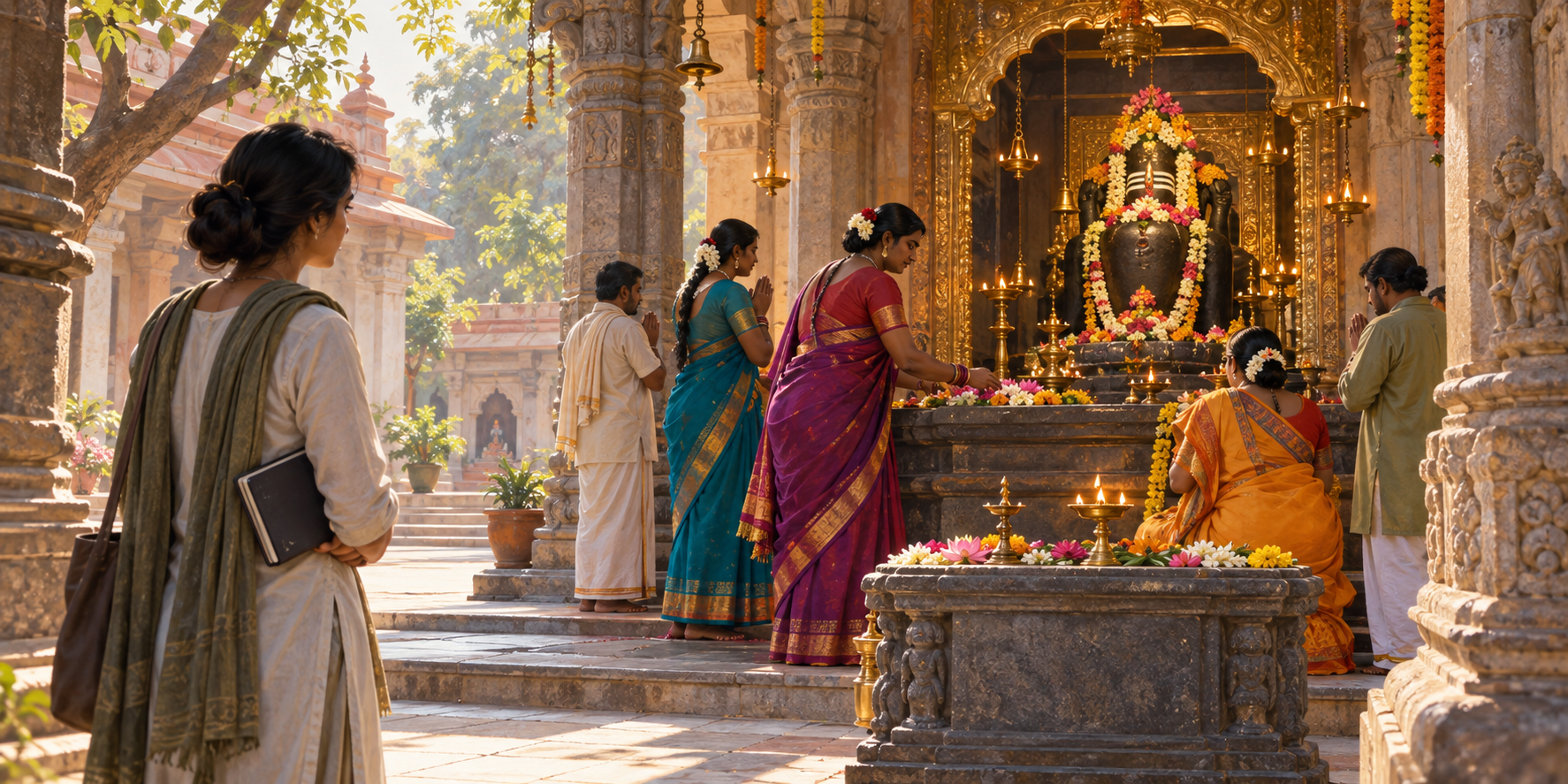
Bahuchara Mata’s main temple is in Gujarat. If you plan to visit, verify current opening times, dress requirements, photography rules, offerings and festival arrangements directly with the temple. Such practical details can change, and assumptions copied from another shrine may not apply.
- Enter for darshan first. Learn about the community relationship without treating worshippers as an exhibit.
- Follow the temple’s queue, footwear, offering and photography instructions even if another Hindu temple follows different customs.
- Ask before photographing any person. Permission to photograph a building or murti is not permission to photograph devotees.
- Do not single out Hijra worshippers for photographs or personal questions because of their appearance.
- Ask a temple representative about temple practice. Ask an individual about personal identity only when that person has invited the conversation.
- If someone declines a photograph or question, accept the answer immediately and without demanding an explanation.
This is not elaborate etiquette. It is the ordinary discipline of recognizing that darshan belongs to the devotee before it becomes information for the visitor. Mata is the centre of the shrine; no community member should be made into its spectacle.
Key takeaways
- Bahuchara Mata is a Hindu goddess of fertility and a form of Parvati.
- She is worshipped by people seeking children and is revered as a patroness of the Hijra community.
- Hijra is a particular South Asian community identity, while transgender is a broader term; overlap does not make them synonyms.
- Her four hands and rooster vahana help identify her icon, but they should not be burdened with invented meanings.
- At her temple, seek darshan, follow local rules and treat Hijra devotees as worshippers rather than subjects of curiosity.
The next time this relationship comes up, begin with the Devi rather than with a debate about identity. Name Bahuchara Mata as a form of Parvati, explain both her fertility association and Hijra patronage, and leave room for devotees to describe their own bond with her. If you visit her temple, let your conduct carry the same understanding: verify the local rules, seek darshan and grant every worshipper the privacy and dignity you would want for yourself.
References

Leave a Reply
You must be logged in to post a comment.