
Maybe you know the refrain in My Sweet Lord but not the devotee on the ladder. If you are trying to understand how Krishna’s names entered George Harrison’s worldwide No. 1 solo single, Shyamasundar Das is the missing human link.
The careful answer is that Shyamasundar helped bring the mantra into a live musical moment, while friendship and service made Harrison receptive to it. His importance is larger than one remembered exchange: his life shows how a Dharmic tradition can cross cultural boundaries without surrendering its sacred vocabulary.
Begin with the ladder, but keep the claim precise

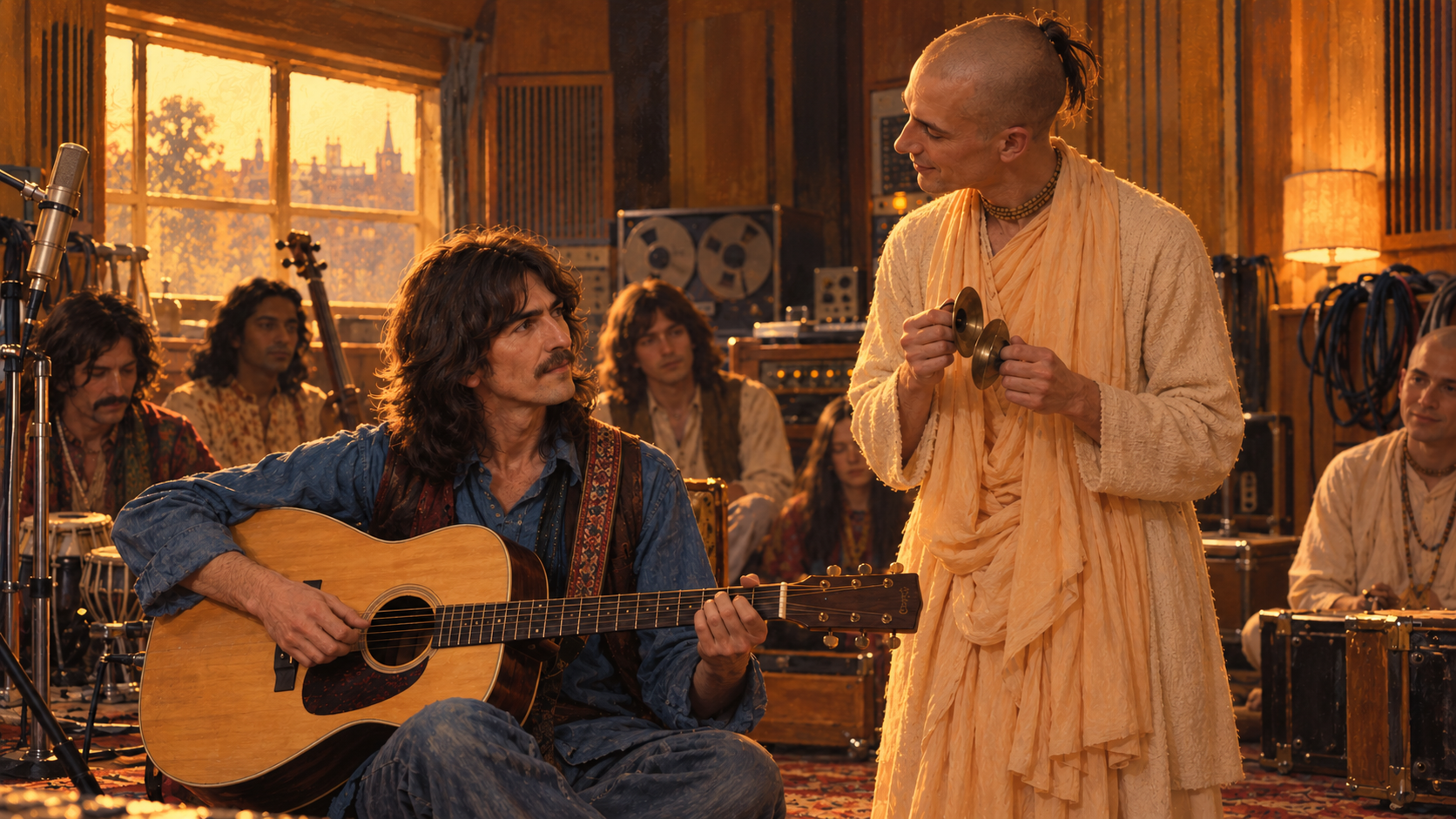
In Shyamasundar’s later recollection, the decisive moment came at Friar Park, Harrison’s neo-Gothic home in Henley-on-Thames. It was 1970, and Shyamasundar was doing handyman work in the early hours, scraping paint near the kitchen fireplace while standing on a ladder. Harrison returned from Abbey Road Studios with Billy Preston and Klaus Voormann.
The musicians began working through gospel chord changes under him, singing lines built around Hallelujah and My Sweet Lord. Shyamasundar responded from the ladder with his preferred Sanskrit refrain. Harrison took it up, and the Hare Krishna mantra became part of the song that was eventually released.
The words “later recollection” matter. This scene should be presented as the memory of a participant, not as a contemporaneous transcript of a songwriting session. That distinction does not make the account unimportant. It simply separates the exact remembered exchange from the outcome we can plainly identify: the released song contains the mantra, became a worldwide No. 1, and carried Harrison’s spiritual direction into public view.
This is a useful standard whenever you encounter a beloved spiritual anecdote. Ask three separate questions: Who is remembering it? What part depends on memory? What visible result followed? You do not have to choose between uncritical celebration and cynical dismissal.
Shyamasundar’s influence grew from service and friendship

Shyamasundar was not a stranger who happened to shout a chant at a famous musician. He was a young American pioneer of the International Society for Krishna Consciousness who had travelled to Britain to meet The Beatles. He became Harrison’s friend, joined the Radha Krishna Temple group, and participated in recordings associated with The Beatles’ Apple Records.
By the time of the Friar Park encounter, the relationship already contained several layers: spiritual mission, music, friendship, and ordinary practical work. The ladder matters because it reveals the unglamorous setting in which influence often takes shape. Shyamasundar was not on a formal stage presenting a polished argument about Krishna bhakti. He was making himself useful when an unexpected opening appeared.
Notice the sequence. Service created presence. Presence allowed familiarity. Familiarity made a spontaneous spiritual contribution possible. Musical readiness allowed that contribution to fit the moment. None of those elements alone would have produced the same result.
For anyone involved in Dharmic outreach, the lesson is concrete. Do not begin by asking how to gain access to someone else’s audience. Begin by asking what genuine work you can share, what trust you have earned, and whether you are prepared to express the tradition clearly when the opening comes. Shyamasundar did not dilute the sacred name to make it acceptable. He offered it in a form that could enter the music already being made.
Why the mantra worked inside a Western pop song
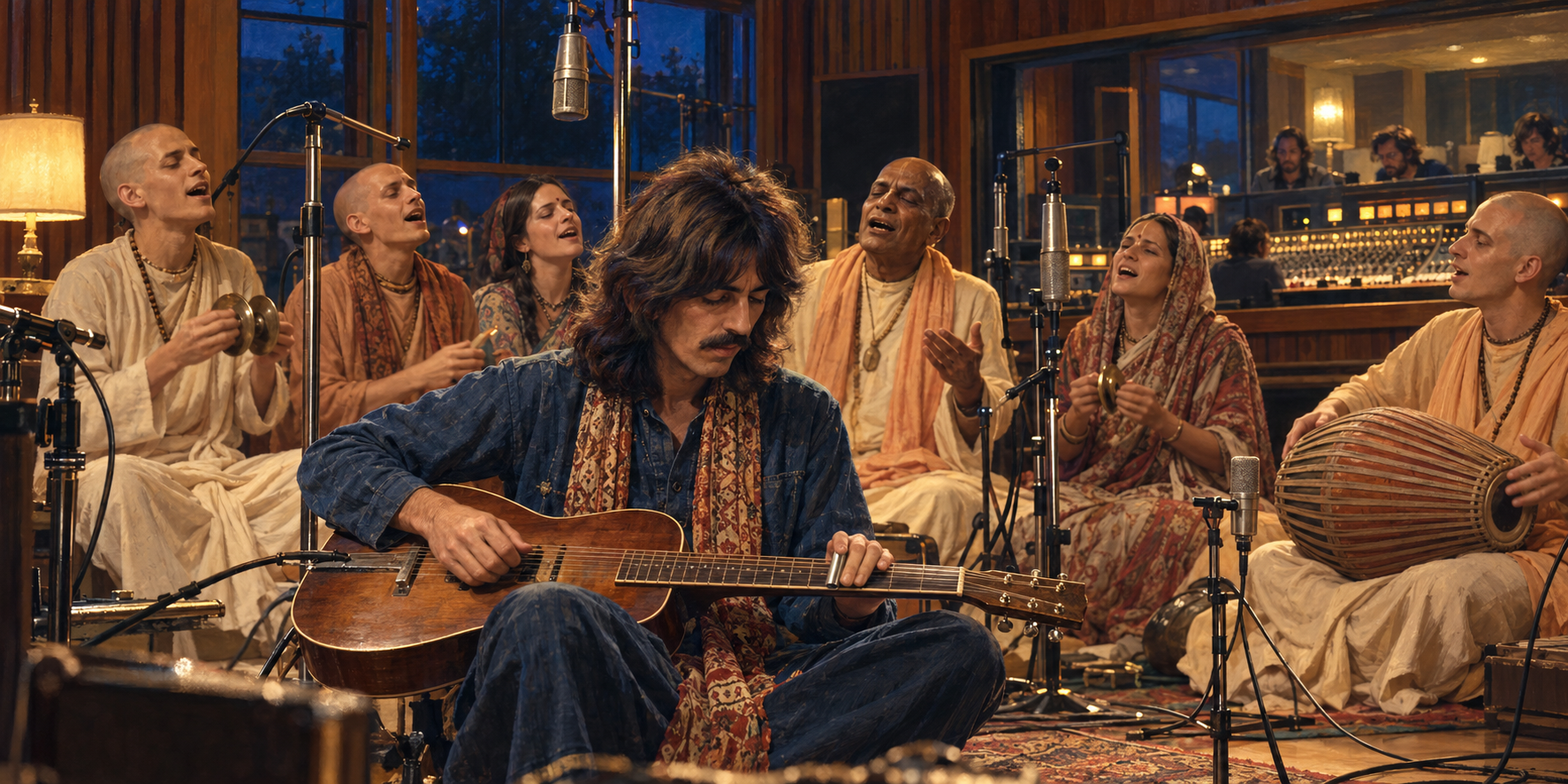
The musical setting provided a bridge. Hallelujah belonged naturally within the gospel-inflected progression Harrison and his companions were exploring. The Sanskrit names then entered a sound that listeners could already follow. The song did not require its audience to understand a theological system before hearing or repeating the chant.
Harrison later confirmed that the approachable form was deliberate. In a September 1982 interview with Mukunda Goswami, a Krishna devotee he had befriended in 1968, he explained his method in unusually direct language.
“My idea in ‘My Sweet Lord’ was, because it sounded like a ‘pop song,’ to sneak up on them a bit.”
George Harrison, interview with Mukunda Goswami, September 1982
“Sneak up” can sound like concealment, but the sacred names were not hidden in the finished performance. Harrison was describing the order of the encounter. A listener could enter through a familiar popular song and then find the Hare Krishna mantra inside it. The entry was gradual; the devotional content remained audible.
That distinction helps you avoid two opposite errors. One is to treat the Sanskrit refrain as decorative exoticism with no devotional intention. Harrison’s own explanation does not support that reading. The other is to treat chart success as proof that every listener, or even Harrison himself, acquired a particular formal institutional identity. The episode establishes public devotion and deliberate incorporation of the mantra; it does not tell us what every listener believed or establish every detail of Harrison’s religious status.
When you hear My Sweet Lord, therefore, listen to its sequence rather than treating it as a vaguely spiritual song. Its movement from familiar praise into Krishna’s names is the method. The form invites participation before demanding explanation.
The Hare Krishna movement was larger than one celebrity
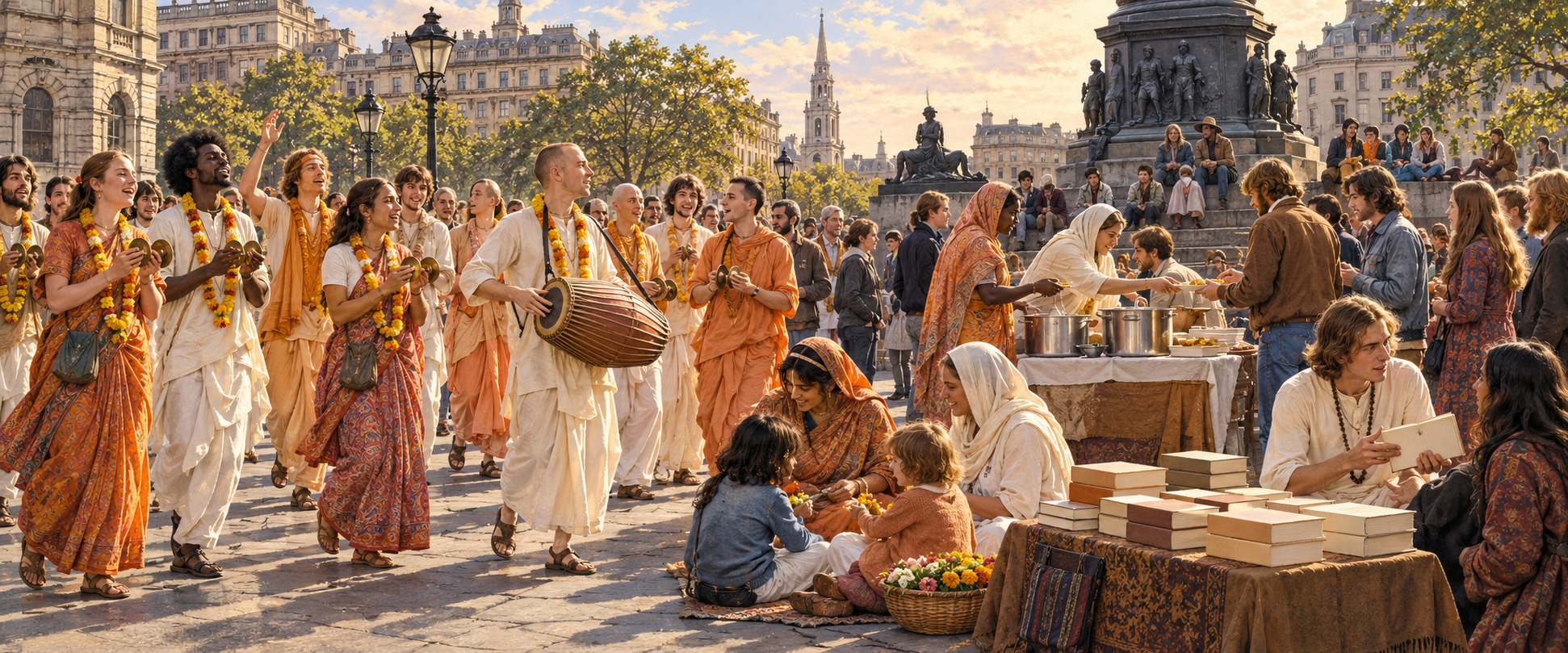
George Harrison’s fame gave the mantra extraordinary reach, but fame alone does not explain how the encounter became possible. Shyamasundar represented the personal connection. The Radha Krishna Temple provided a devotional community and musical ensemble. Apple Records provided a route into contemporary recording culture. Harrison supplied creative authority and chose to make his spiritual interest public.
You can understand this transmission through three connected lenses:
- The person: Shyamasundar’s service, confidence, and friendship allowed him to speak naturally when the moment arrived.
- The form: congregational chanting could enter a song because repetition and response already belonged to the music being explored.
- The community: the Radha Krishna Temple’s Apple recordings show that the relationship extended beyond a private exchange between two individuals.
Use those lenses when assessing any claim about Dharmic influence abroad. If only the celebrity is named, ask which practitioners did the patient relationship-building. If only the attractive cultural artifact is discussed, ask which spiritual practice it carries. If only one dramatic moment survives, ask which community gave that moment continuity.
This also corrects a common way of measuring influence. Formal conversion is not the only meaningful outcome of a religious encounter. Public chanting, serious friendship, artistic collaboration, and the refusal to hide a sacred name can all change what a wider culture is able to hear. At the same time, cultural visibility should not be confused with complete understanding. A mantra can become familiar long before its philosophy does.
Key takeaways
- Shyamasundar Das was an ISKCON pioneer, Harrison’s friend, a member of the Radha Krishna Temple group, and a participant in its connection with Apple Records.
- The ladder episode comes from Shyamasundar’s later recollection and should be identified as such, even though the mantra’s presence in the released song is unmistakable.
- Harrison deliberately used an accessible pop form to introduce listeners to devotional language they might not otherwise have encountered.
- The lasting lesson is not celebrity endorsement by itself. It is the combination of service, trust, musical fluency, spiritual clarity, and community.
If you want to remember Shyamasundar well, do not reduce him to the man who gave a Beatle a line. Listen for the discipline behind the moment: travel, service, friendship, community, and readiness. The next time My Sweet Lord plays, hear the transition into Krishna’s names and remember that global cultural influence can begin with a devotee doing ordinary work and recognizing an extraordinary opening.
References

Leave a Reply
You must be logged in to post a comment.