
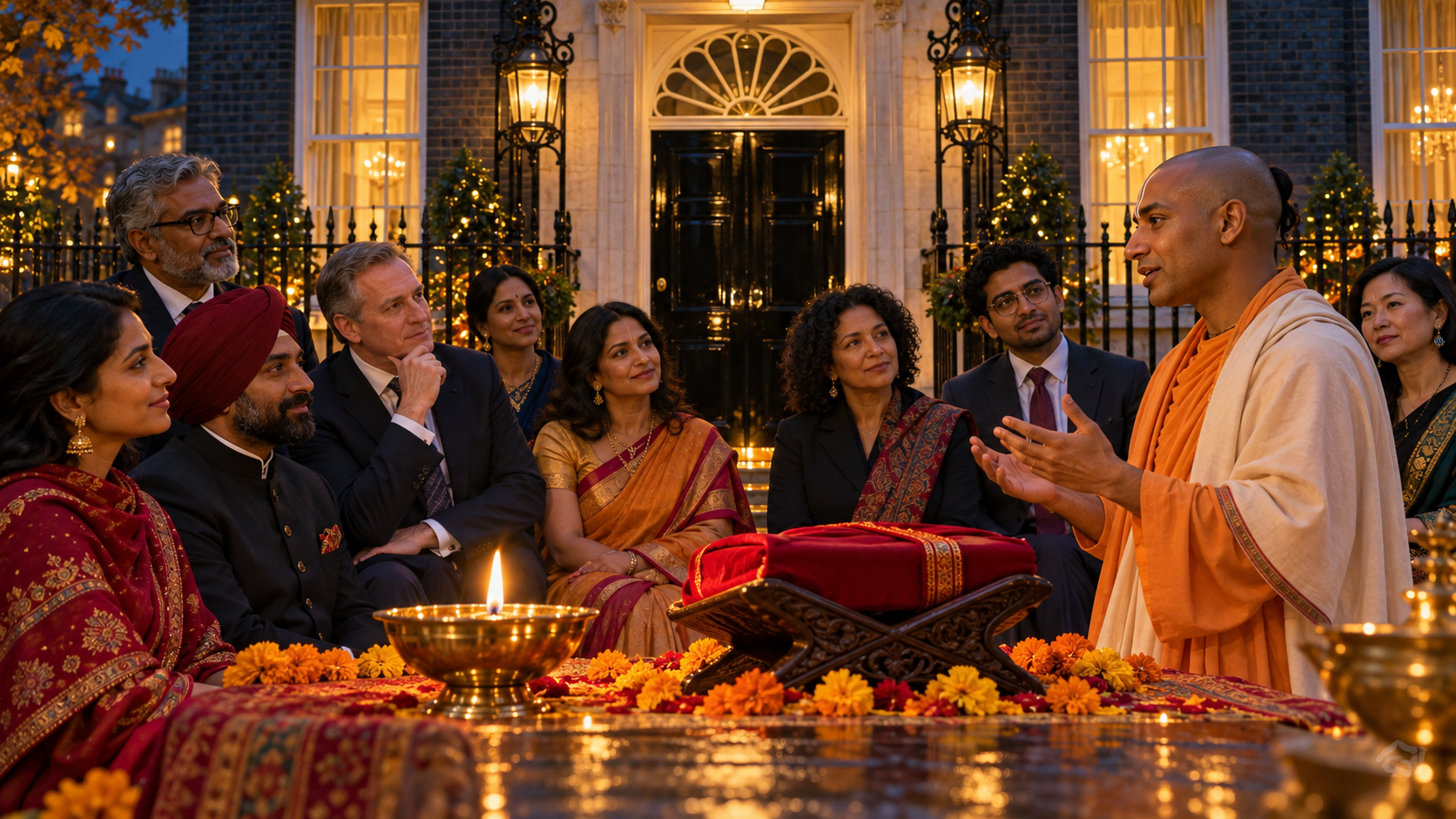
If you are wondering whether Diwali at 10 Downing Street represents meaningful recognition or merely polished ceremony, apply a harder test: did Dharma remain visible in its own voice, and did its message place a real obligation on the people in the room?
The answer matters beyond one reception. Public recognition becomes worthwhile when a Hindu symbol is explained through Hindu wisdom and then translated into conduct. That gives you a practical way to judge such occasions without either dismissing them as optics or exaggerating them into political victories.
The verse that keeps the ceremony honest
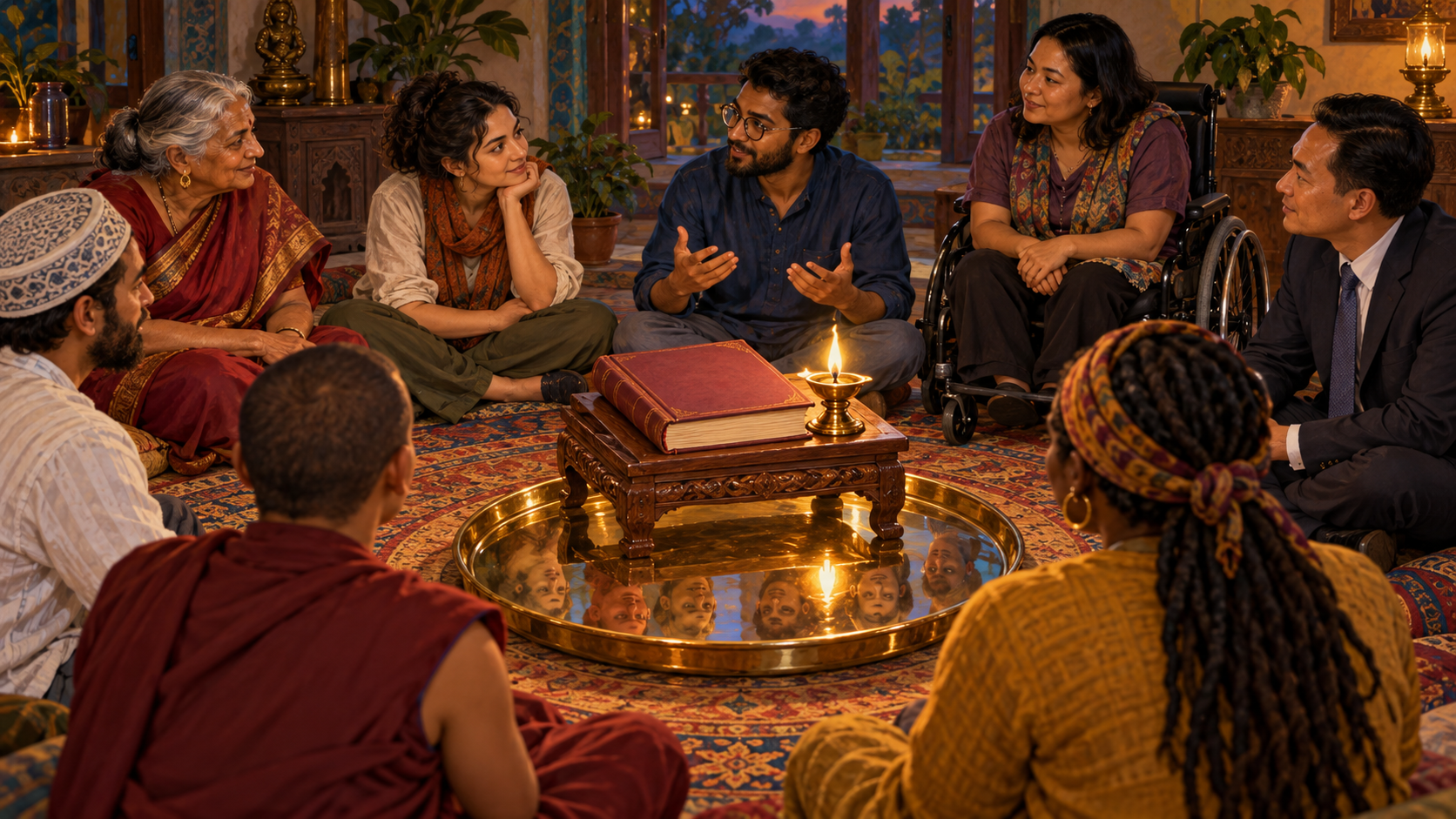
At a Diwali celebration at 10 Downing Street attended by the prime minister and other guests, Visakha Dasi, Temple President of Bhaktivedanta Manor, connected the festival’s lights with the knowledge that dispels darkness within the heart. She grounded that meaning in Bhagavad-gita 6.32, drawing attention to genuine empathy for people who suffer, regardless of their background or circumstances.
That scriptural connection changes the character of the occasion. The lamp is no longer just attractive festival decor. It becomes a question directed at each participant: what remains dark in the way you see another being?
Bhagavad-gita 6.32 asks the practitioner to take another’s happiness and distress seriously, using one’s own experience as the moral point of reference. This is more demanding than being friendly to people who already belong to your family, community, party or tradition. It asks whether your concern survives when familiarity, advantage and agreement disappear.
You can therefore read the Diwali lamp as a test of perception. Inner darkness includes the habits that make another person’s pain seem remote, convenient to ignore or less important than our own. Knowledge begins to dispel that darkness when it changes whom we notice and how we respond.
What public recognition can prove – and what it cannot
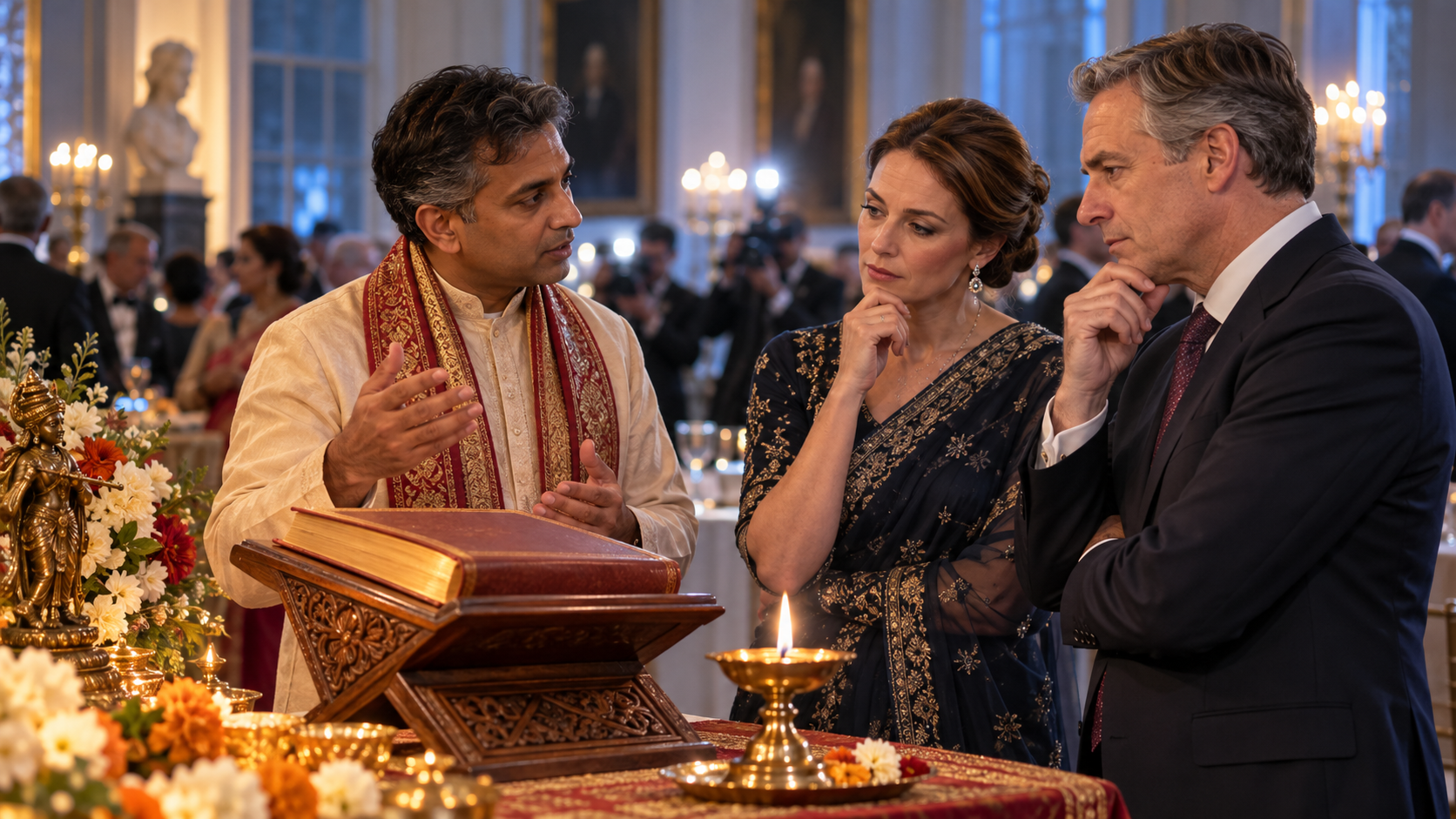
A Hindu festival inside a prominent government setting has legitimate cultural value. It tells Hindu families, including younger generations, that their tradition can enter civic life openly. When a Hindu leader can name the Bhagavad-gita and explain a particular verse in that setting, Dharma is being presented as a source of ethical thought rather than as food, clothing and spectacle alone.
But one ceremony cannot prove that a government has absorbed the teaching, changed its policies or resolved every concern affecting Hindu communities. A speech establishes that a message was voiced. It does not establish what every listener believed or what an institution will subsequently do.
Use these four questions whenever you assess a public Diwali event:
- Was Dharma named? Look for a recognisable scripture, teaching or tradition, not just vague language about light and togetherness.
- Was the symbol interpreted? A diya should communicate something deeper than the fact that Diwali is colourful.
- Was the audience challenged? A Dharmic teaching should ask for self-examination or a change in conduct, not merely invite admiration.
- Is there a path to follow-through? Look for a relationship, service commitment, recurring conversation or other action capable of surviving after the lamps are removed.
The Downing Street address clearly meets the first three tests: it identifies the Bhagavad-gita, explains the light as knowledge overcoming inner darkness and directs listeners toward empathy and compassion. The fourth test cannot be answered by a ceremonial address alone. It belongs to everyone who heard the message and everyone who now invokes the occasion as evidence of progress.
This distinction lets you be appreciative without becoming credulous. You can welcome an important moment of Hindu visibility while still asking what will endure after it.
Carry Bhagavad-gita 6.32 beyond the gates

The verse becomes useful when you attach it to a real relationship. Do not begin with humanity in the abstract. Begin with one person, community or living being whose distress you find easy to minimise.
- Name the boundary. Identify why your concern stops where it does: unfamiliarity, resentment, political difference, social distance or simple inconvenience.
- Reverse the viewpoint. Ask what you would want others to notice if you were living with the same fear, loss, exclusion or vulnerability.
- Separate empathy from agreement. Understanding another person’s suffering does not require approving every belief or action. It requires seeing the suffering accurately before deciding how to respond.
- Choose one bounded act. Contact someone who has been neglected, offer practical help, refuse dehumanising language or support a local act of service. Make the action small enough to complete within the coming week.
- Widen the circle. Because the address called for becoming well-wishing friends of all living beings, include one choice that reduces avoidable harm beyond your immediate social group.
- Review the motive. Ask whether you would still perform the act if nobody praised you for it. That question separates service from self-display.
This practice prevents compassion from collapsing into sentiment. Empathy notices another being’s condition; compassion accepts some responsibility for the response; well-wishing refuses to make personal benefit the only measure of action.
It also keeps the teaching balanced. Compassion is not passivity, the suspension of judgment or an instruction to ignore wrongdoing. It changes the spirit in which judgment is exercised. You can oppose harmful conduct without treating the person before you as disposable.
A better standard for public Diwali events
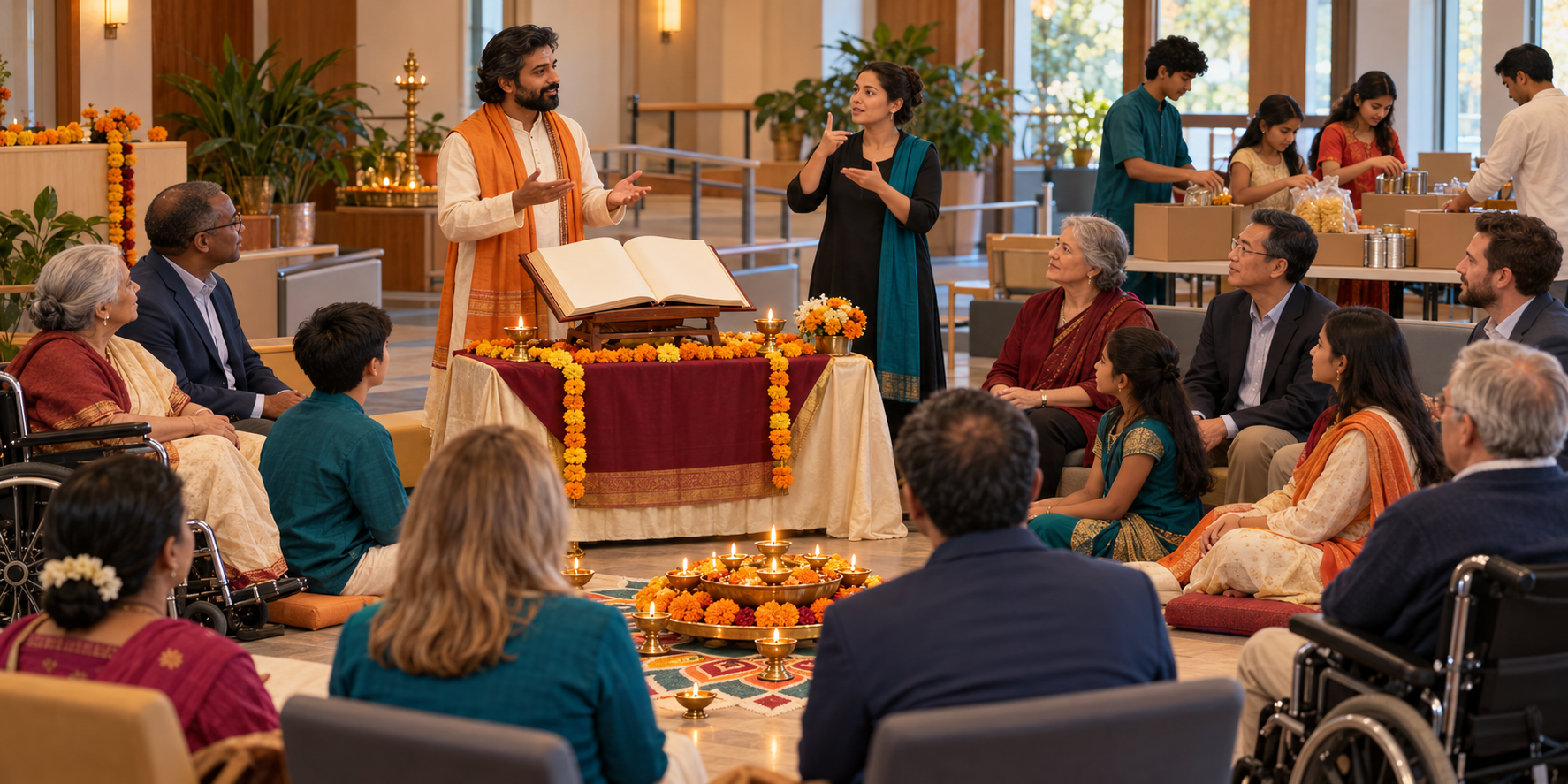
If you organise, host or speak at a civic Diwali celebration, use a simple three-layer structure: explain the symbol, locate its meaning in a named Dharmic teaching, and give the audience one corresponding action. This preserves the tradition’s integrity while making it understandable to people who may have no prior knowledge of Hindu scripture.
- Begin with the symbol: explain what the lamp asks people to notice within themselves.
- Name the teaching precisely: identify Bhagavad-gita 6.32 rather than presenting empathy as an unattributed modern slogan.
- State the moral demand: connect inner illumination with concern for suffering beyond one’s own group.
- Offer one next step: give listeners an action they can complete after leaving the venue.
- Preserve the provenance: translate the teaching into accessible language without erasing its Hindu origin.
This is the difference between representation and decoration. Representation permits Hindus to explain the festival from within the tradition. Decoration borrows the lamp while leaving its knowledge outside the room.
Public hosts should also allow the teaching to retain its edge. If every spiritual message is reduced to a painless endorsement of unity, the audience never has to confront self-interest, indifference or exclusion. Bhagavad-gita 6.32 is valuable in civic life precisely because it asks each person to cross the boundary between concern for oneself and concern for another.
A pro-Hindu response should therefore avoid two equal mistakes. Do not dismiss every official Diwali observance as empty simply because it is ceremonial. Do not treat ceremonial access as proof of substantive political change. Welcome the opening, preserve the scripture’s voice and judge the outcome by what follows.
Key takeaways
- The significance of Diwali at Downing Street lies not only in Hindu visibility but in the Bhagavad-gita being presented as a living source of civic ethics.
- Bhagavad-gita 6.32 turns the lamp inward by asking whether we recognise another being’s suffering with the seriousness we give our own.
- A public celebration can demonstrate recognition and create an opening; it cannot by itself prove institutional or political change.
- You can test any civic Diwali event by asking whether it names Dharma, interprets the symbol, challenges the audience and creates a path to follow-through.
- The most credible response is a specific act of compassion toward someone outside your usual circle of concern.
When you next light a diya or attend a public Diwali gathering, choose one boundary your compassion will cross before the week ends. That is how the light carried into a room of power becomes more than ceremony: it first changes the person who sees by it.
References

Leave a Reply
You must be logged in to post a comment.