
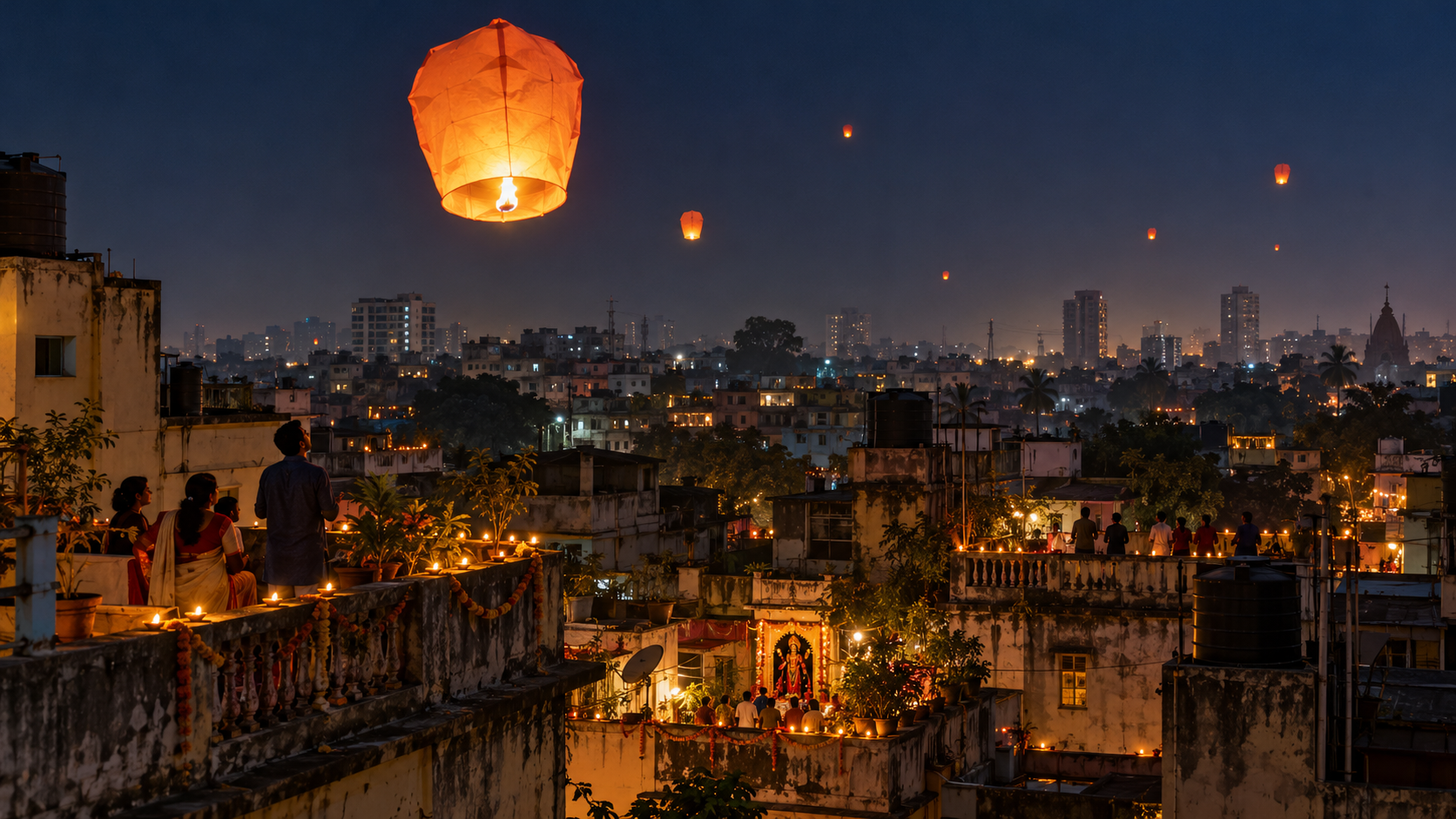
You’re watching Kali Puja night unfold in Kolkata when a warm point of light rises above the rooftops. It may resemble a simple sky lantern, but calling it only that misses the local story. In Kolkata, it is a fanus: a festive practice carried through neighbourhood memory, craft and repetition.
To appreciate a fanus properly, you need to distinguish what is known from what is merely assumed. You also need to place it within Kali Puja without turning a regional custom into a universal Hindu ritual. That distinction will help you observe, document or participate in the tradition with greater care.
Why fanus belongs to Kolkata’s festival memory
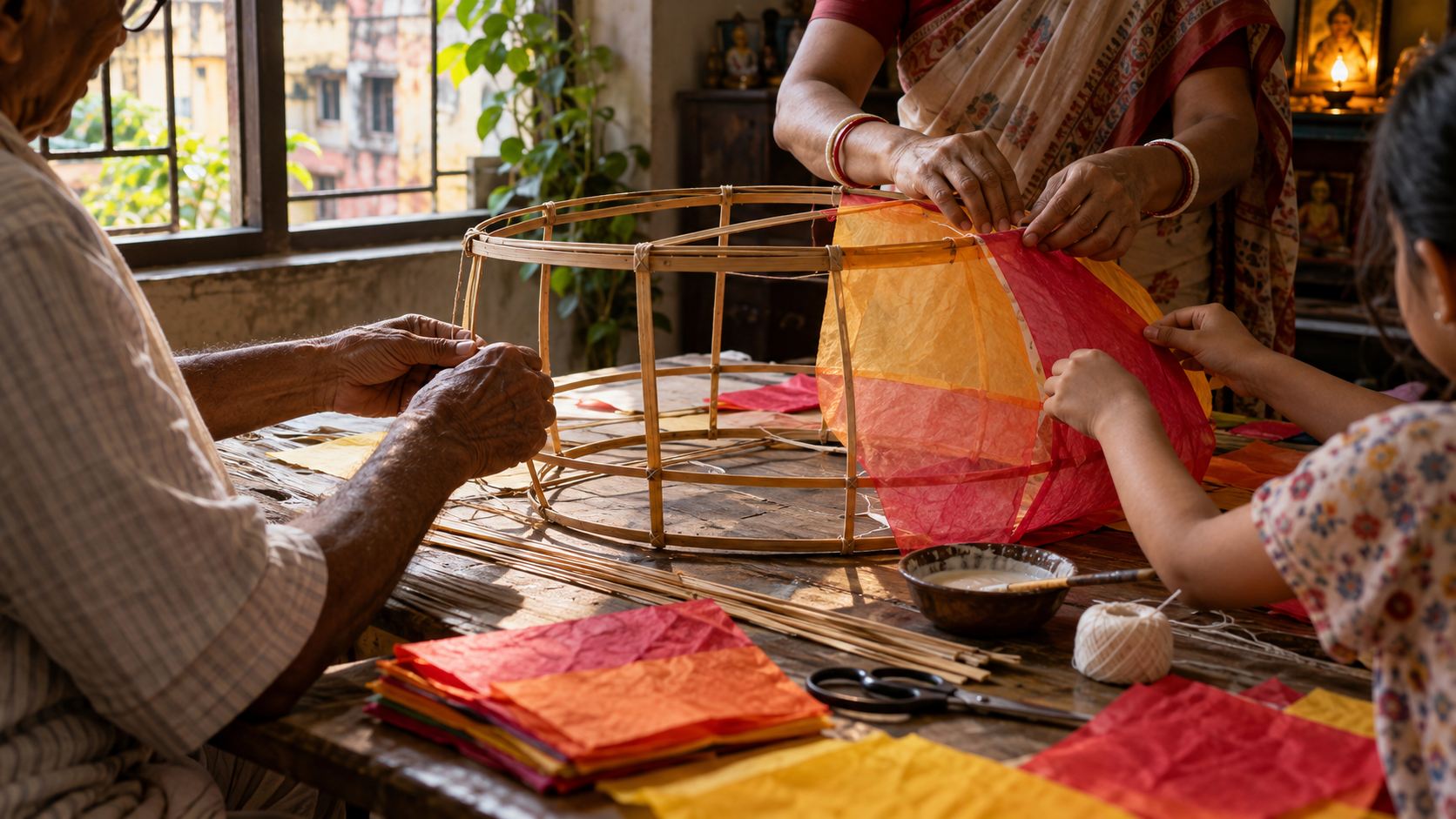
Fanus has formed part of Kolkata’s Kali Puja and Diwali celebrations for nearly a century. That longevity matters. It places the custom within the city’s inherited festive culture rather than among recently imported seasonal attractions.
The connection is especially strong in the old Sutanuti area, where fanus release was once so widespread that almost every household was said to take part on Kali Puja night. Picture the scale of that participation: the spectacle did not depend on one central display. It emerged from many homes sending light into the same night sky.
That does not give us an exact birthday for the custom. No surviving written record fixes the first Kolkata launch. If someone assigns the tradition a precise founding year or a single inventor, ask for evidence. The honest historical position is narrower: the practice has deep roots in Kolkata’s modern festive life, while its exact beginning remains uncertain.
This is an important lesson in reading cultural history. A tradition does not have to be ancient, scriptural or traceable to one founder to deserve preservation. Repeated participation can make a practice part of a city’s identity. You can honour that continuity without manufacturing a more dramatic origin story.
What you are actually watching when a fanus rises
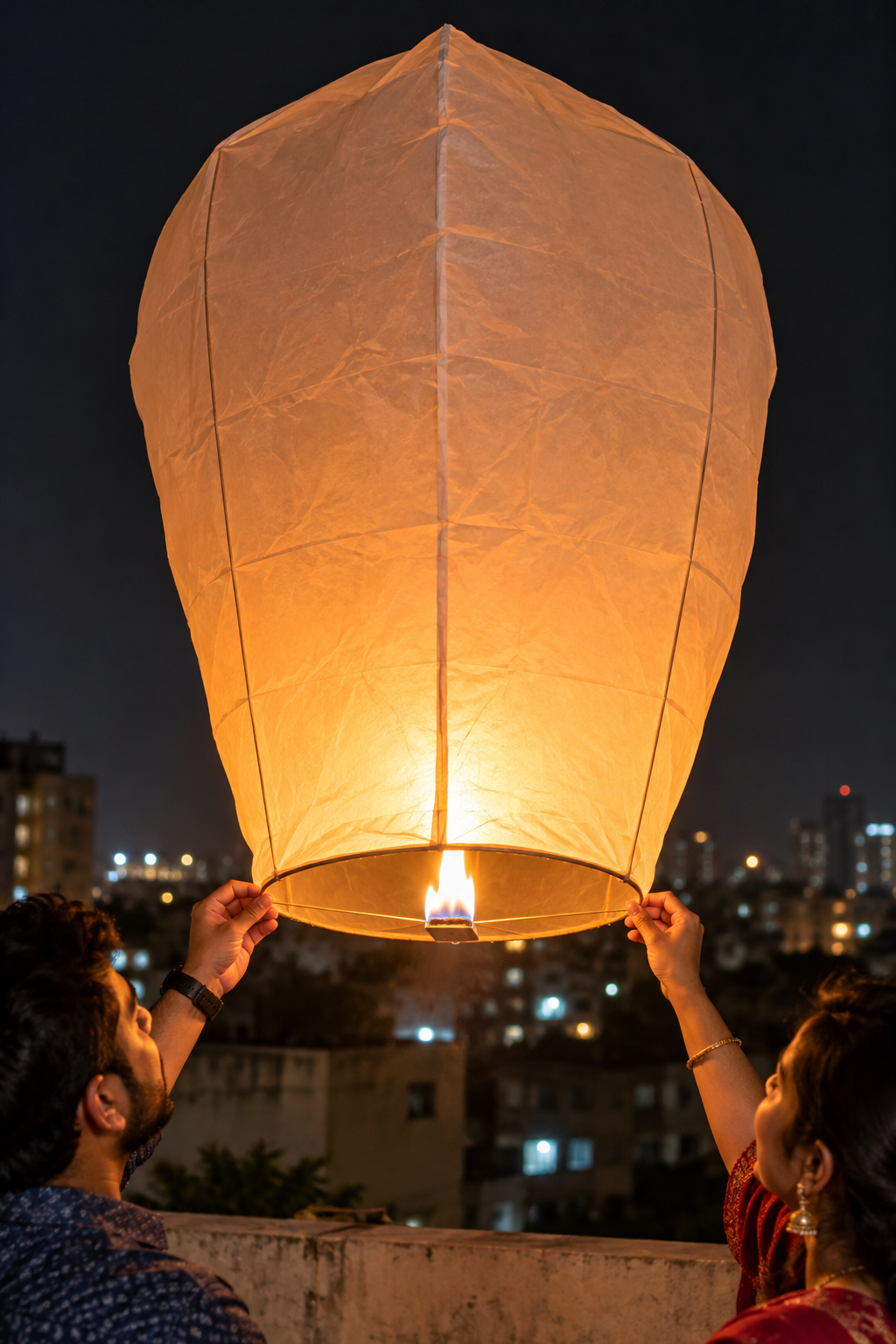
A conventional fanus is a lightweight sky lantern. A flame heats the air inside its paper envelope; the warmer air provides the lift that carries the lantern upward. The principle is simple, but the object has to move from a fragile form on the ground to a stable, illuminated shape in the air.
Watch the interval before release. The lantern cannot simply be lit and thrown upward. Its envelope must fill, take shape and generate enough lift. That pause is part of the practical craft. It also turns the launch into a shared moment: people gather around the light on the ground, wait, release it and follow its ascent together.
You can learn more by watching the whole sequence instead of photographing only the final glow. Notice the lantern’s proportions, the way its envelope holds its shape, any decorative work and the number of people involved. Ask whether it was made for a household, a neighbourhood programme or another gathering. These details reveal how the tradition is being transmitted.
There is also a practical limit you should not romanticise. A free-flying fanus moves with the surrounding air and cannot be steered after release. The same mechanism that gives the lantern its visual beauty creates responsibility for where it may travel and descend.
Keep Kali Puja at the centre of the description
Religious precision matters. Kali Puja is the worship of Maa Kali; fanus is a local festive practice associated with Kolkata’s Kali Puja and Diwali celebrations. The lantern should neither replace the religious meaning of the night nor be presented as though every Hindu community observes the festival in this way.
If you are captioning a photograph, cataloguing an object or explaining the custom to someone outside Bengal, a reliable description is: “A fanus, or sky lantern, released as part of Kolkata’s Kali Puja and Diwali celebrations.” That wording identifies the object, preserves its Bengali name and locates the practice without declaring it a universal ritual.
Avoid attaching a ready-made spiritual symbolism unless a participant gives you one. The rising lantern may have a particular meaning for a family or maker, but you should not automatically label it a prayer, an offering or a symbol of the soul. Ask what the design and release mean to the people involved. If the answer is simply celebration, neighbourhood continuity or visual beauty, preserve that answer rather than embellishing it.
This local specificity is not a limitation. It is precisely what makes fanus valuable. Diwali is not expressed through one uniform catalogue of customs across Bharat. Kolkata’s festival culture shows how a shared sacred season can acquire a distinctive regional form.
Participate safely and leave a usable record
If you plan to release a fanus
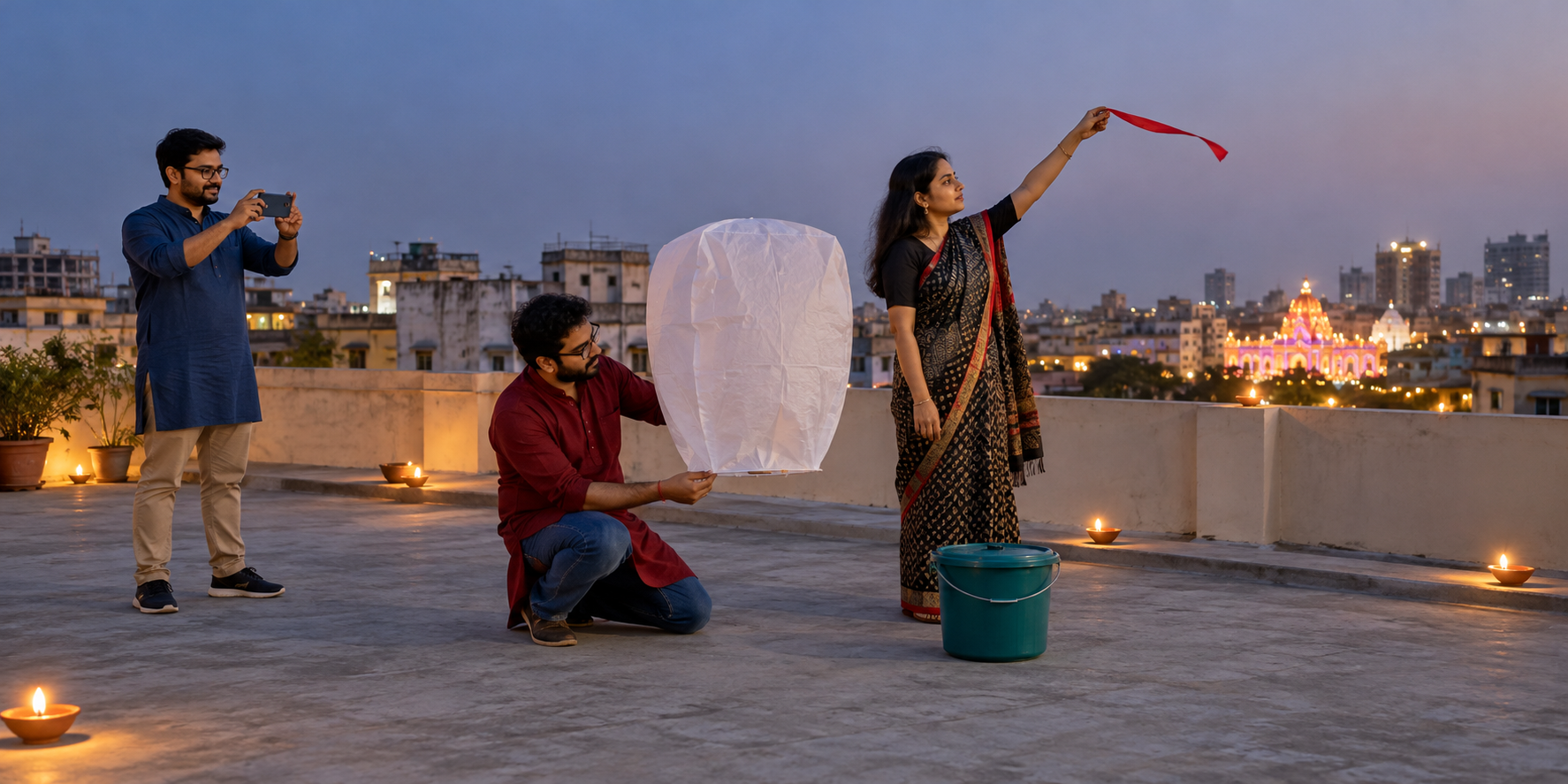
A fanus combines an open flame with an object that will travel beyond your control. Before taking part, check the current instructions of the municipal, fire-safety or event authority responsible for the location. Do not assume that a past neighbourhood practice automatically establishes what is permitted or safe at a present-day site.
Use a responsibly managed launch area with knowledgeable supervision. Keep the ignition point clear of buildings, overhead wires, trees, traffic and dry material. Do not proceed in wind or in a place where the lantern’s initial path is visibly obstructed. Keep an appropriate means of extinguishing fire at the launch point, and never ask children to manage the flame.
If the conditions or rules are uncertain, do not release the lantern. You can still attend an organised display, exhibit an unlit fanus or document the craft. Choosing not to launch is the correct decision when the alternative transfers fire and litter risk to people who did not choose it.
If you want to preserve the tradition
Record provenance, not just spectacle. Note the neighbourhood, year, local name, maker or organising group, materials, decorative features and relationship to the Kali Puja celebration. Ask who taught the maker and whether the fanus was constructed locally or obtained elsewhere. Get permission before publishing identifiable people or private family memories.
Keep three kinds of information separate: what you personally observed, what a participant remembered and what you inferred. A recollection such as “we released these when I was young” is valuable oral history, but it does not prove when the citywide custom began. Labelled honestly, both the observation and the memory remain useful to future readers.
Give photographs functional captions and retain the original files. A caption should identify the place, occasion, year and maker or event when known. “Fanus over Kolkata” may work on social media, but it gives a future archive almost nothing to work with. “Fanus prepared for Kali Puja in Sutanuti, Kolkata, [year]” preserves context.
Key takeaways
- Fanus has been part of Kolkata’s Kali Puja and Diwali celebrations for nearly a century.
- Sutanuti is strongly associated with the tradition, but the exact date and circumstances of its beginning are not established in writing.
- Describe fanus as a Kolkata festive custom associated with Kali Puja, not as a universal Hindu ritual.
- Because a lit fanus cannot be steered after release, current rules, weather and site safety must decide whether a launch proceeds.
- Preserve the tradition by recording makers, neighbourhoods, memories and designs with clear dates and honest attribution.
At the next Kali Puja, choose one useful contribution. Learn the local vocabulary from a maker, write an accurate caption, record an elder’s dated memory with permission or support a responsibly managed display. Fanus will remain meaningful when its craft, religious setting and neighbourhood history rise together—and when responsibility remains on the ground.
References

Leave a Reply
You must be logged in to post a comment.