
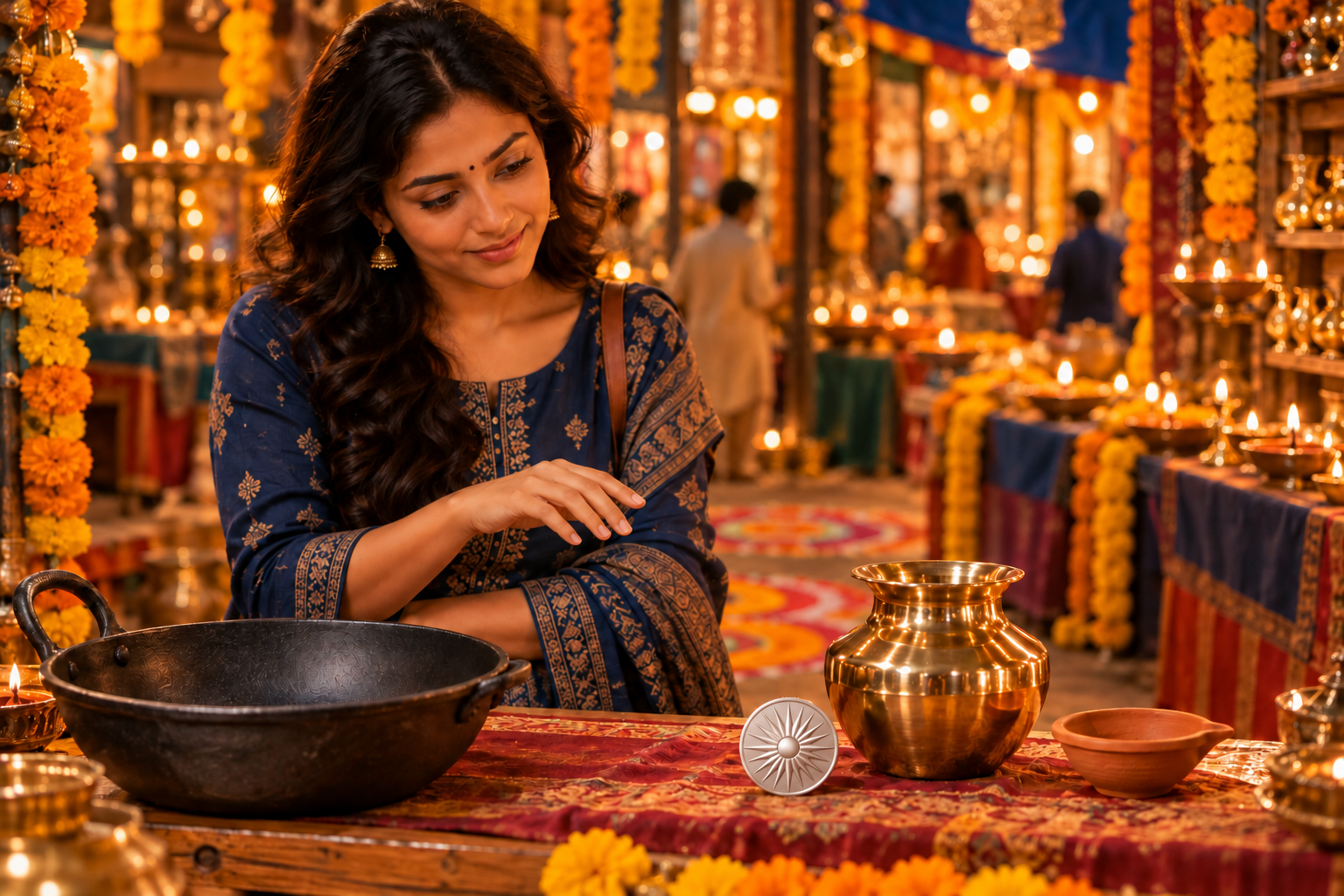
You are shopping for Dhanteras, and the item you need contains iron. Should you leave it in the shop, choose stainless steel, or ignore the warning as an old superstition?
The practical answer is simple: if your household observes the custom, do not buy an item that is recognisably sold as iron on Dhanteras. Buy it before or after the festival. You do not need to discard iron already in your home, avoid necessary medical products, or inspect every purchase for microscopic traces of the metal.
The Dhanteras rule concerns acquiring iron goods
A widely followed Dhanteras custom advises people not to purchase iron vessels or other objects made of iron. The restriction concerns what you acquire on that day. It does not mean that iron is permanently impure or that an iron object already in your kitchen suddenly becomes unsuitable.
The customary explanation is astrological: acquiring iron on this auspicious shopping day is treated as unfavourable. That is a statement about ritual timing and symbolism, not a scientific claim about the physical properties of the metal. Unless your family, guru, temple, or sampradaya teaches a more specific rule, it is sensible to treat the restriction as a household observance rather than a universal test of Hindu fidelity.
This distinction also keeps the practice proportionate. Respecting a vrata or festival convention can cultivate attention and continuity. Turning an accidental purchase into a prediction of misfortune replaces observance with fear.
What counts as an iron purchase in practice
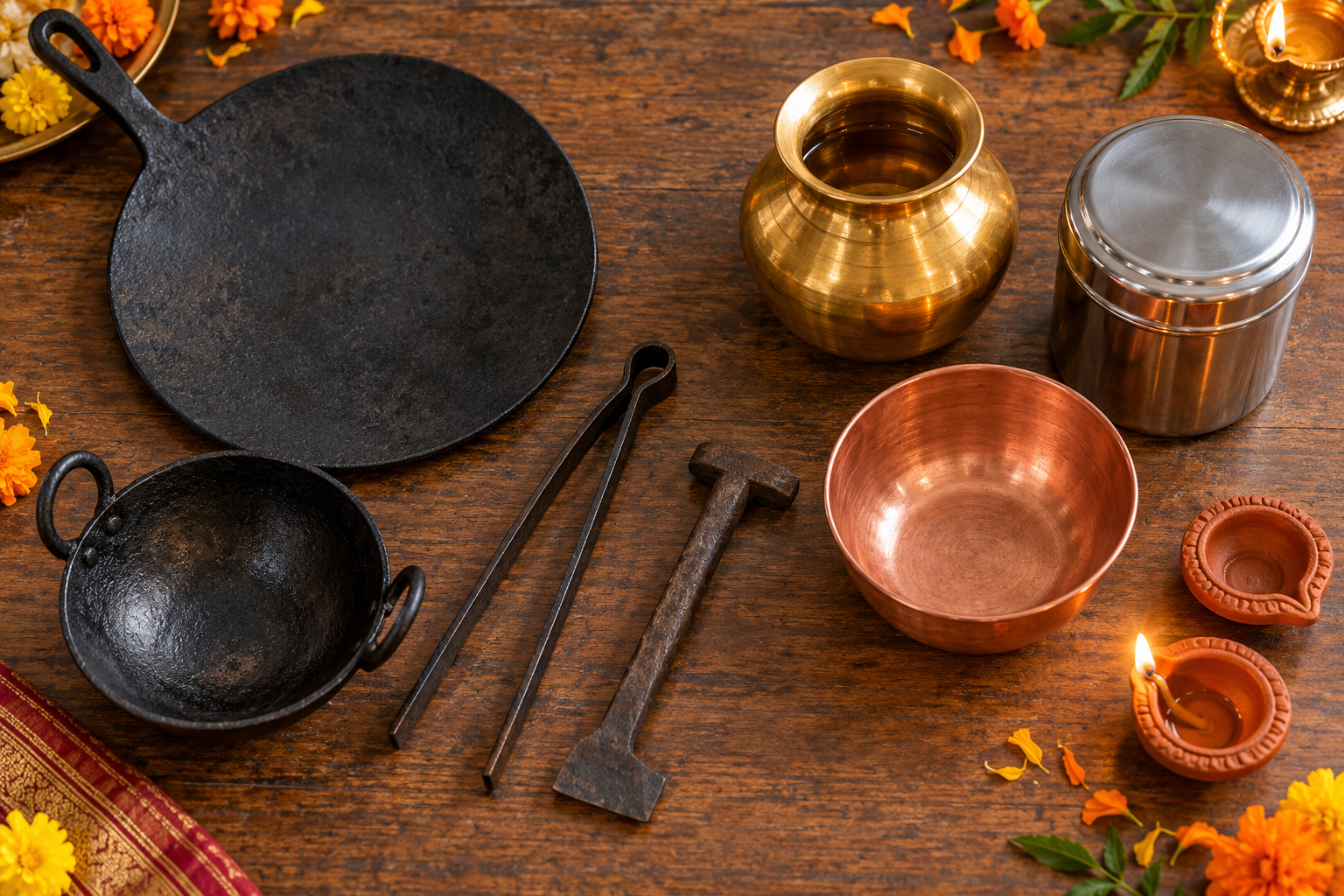
Use the ordinary identity of the object, not a laboratory definition. If a shopkeeper, manufacturer, or household would naturally call it an iron product, it falls within the customary restriction. If iron is merely an incidental internal component, the answer is less clear and family practice should decide.
- Clearly avoid when observing the custom: an iron tawa, iron kadhai, cast-iron pan, iron tools, iron hardware, or furniture marketed as iron.
- Usually treated differently: steel utensils. The same Dhanteras practice that discourages iron purchases commonly includes steel among the utensils people do buy.
- Mixed-material objects: ask what the object is principally understood to be. A wooden item with a few screws is not ordinarily bought as an iron object. A cast-iron appliance with a wooden handle is.
- Large or ambiguous purchases: if a vehicle, machine, or appliance has created doubt in your family, moving the transaction to another day is the cleanest option when doing so carries no serious cost.
Steel illustrates why the classification is cultural rather than chemical. Most steel contains iron, yet many households distinguish a steel utensil from an iron utensil in ordinary speech and ritual practice. You do not have to overturn that inherited distinction with a chemistry lesson. Ask what your tradition means by the word it uses.
The restriction is about goods, not nutritional iron. It gives you no reason to avoid iron-rich food, postpone necessary treatment, or skip an iron supplement prescribed by a qualified health professional. Festival symbolism should not be expanded into an unsupported medical rule.
Choose a suitable Dhanteras purchase without overcomplicating it
If you want to mark Dhanteras through a purchase, choose an object your household regards as auspicious and useful. People commonly favour gold, silver, copper, brass, or steel utensils. Brooms and salt are also among the customary purchases associated with the day.
You do not need an expensive purchase to observe the occasion sincerely. Choose within your means. The desire for prosperity is poorly served by debt, family pressure, or buying an object that will never be used. A modest brass, copper, or steel household item can carry the ritual intention without turning Dhanteras into a display of spending.
- Check your shopping list before Dhanteras and identify anything explicitly made or marketed as iron.
- Move non-urgent iron purchases to the preceding or following day.
- For steel, mixed materials, or a major purchase, settle the household rule before reaching the checkout counter.
- Choose an affordable permitted item if you want to make a customary Dhanteras purchase.
- Keep the receipt or delivery date from becoming a source of argument: if your family follows a strict interpretation, schedule the order, payment, and delivery outside Dhanteras.
If you already bought iron, respond without fear
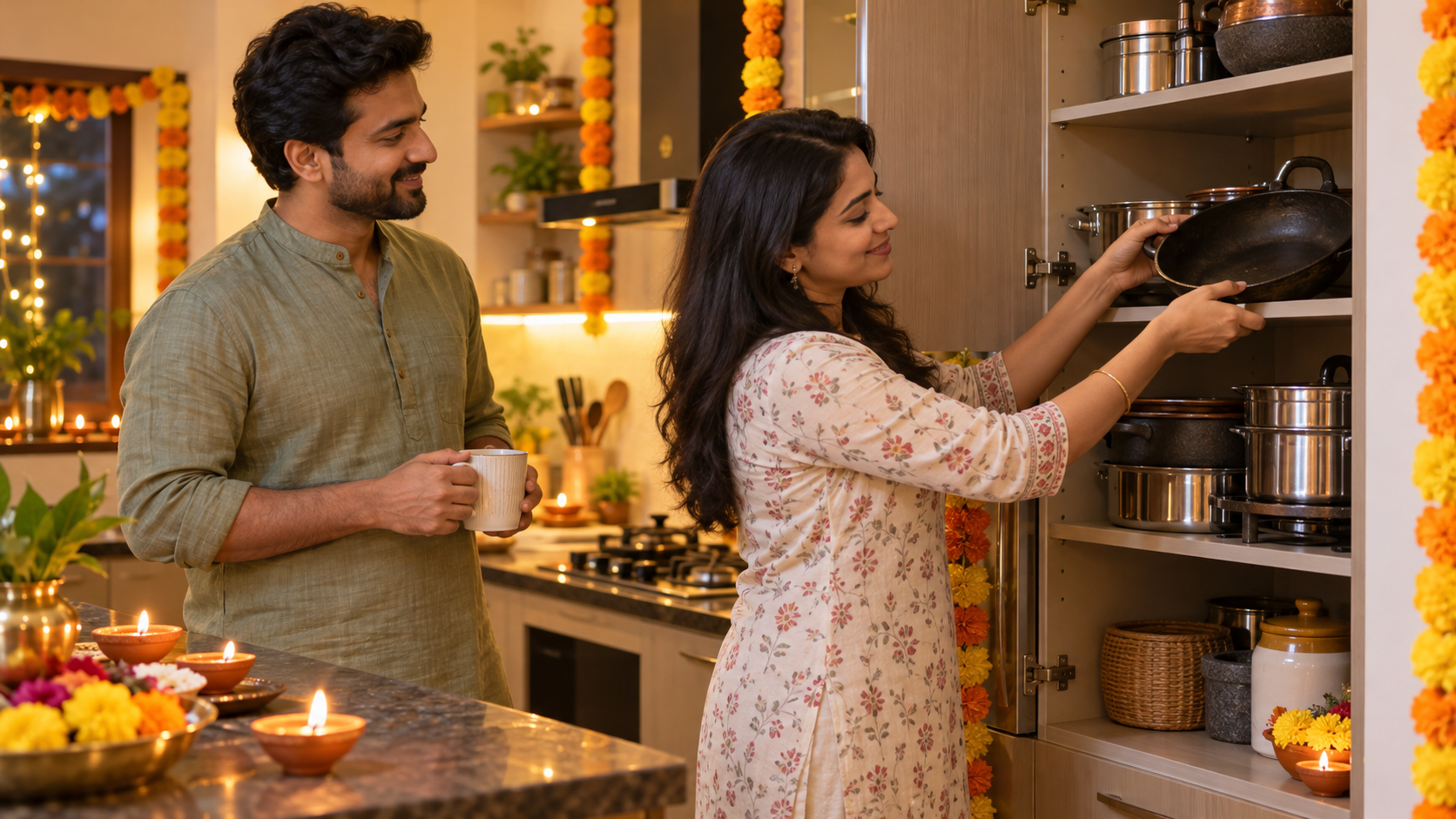
An accidental purchase does not justify panic, waste, or an invented remedy. Do not throw away a useful object. Do not pay someone for an elaborate corrective ritual merely because a social-media message frightened you. If the item can be returned or delivered on another day without inconvenience, that is an available practical choice, not an emergency.
If it cannot be changed, acknowledge the mistake and continue with your household’s normal Dhanteras worship. Ask a trusted family elder, acharya, or temple priest only if your lineage has a defined procedure. The honest answer may simply be to remember the convention next year.
The same calm approach applies when relatives disagree. One home may avoid every object containing substantial iron; another may prohibit only traditional iron vessels; a third may not observe the restriction. Before giving or criticising a gift, ask what the receiving household follows. Respect is more Dharmic than using a festival custom to measure another family’s devotion.
Key takeaways for your Dhanteras shopping
- The customary restriction concerns buying recognisable iron goods on Dhanteras, not owning or using iron already at home.
- Steel utensils are commonly treated as permissible even though steel contains iron; ritual categories do not always follow metallurgical categories.
- Gold, silver, copper, brass, steel utensils, brooms, and salt are customary alternatives.
- Move a doubtful purchase to another day when that is easy, but do not allow the custom to interfere with safety, medical care, or an urgent household need.
- If you bought iron accidentally, avoid fear and waste. Follow the guidance of your own family or sampradaya rather than inventing a punishment.
Before your next Dhanteras shopping trip, ask one clear question at home: “What does our family count as an iron purchase?” Decide once, shop within your means, and let the observance bring attentiveness rather than anxiety.
References

Leave a Reply
You must be logged in to post a comment.