

Someone asks what the Divine is, what happens after death, or whether a difficult experience was a sign. You feel pressure to produce a confident answer. Saying “I don’t know” can seem like a failure of learning or faith.
Hindu thought offers a more demanding alternative: don’t manufacture certainty, but don’t romanticise confusion either. Sacred unknowing is the disciplined ability to meet mystery without filling it with guesses. Practised properly, it makes your inquiry more honest, your devotion less performative, and your decisions more responsible.
Not every absence of certainty is wisdom

Knowledge is not the enemy of spiritual life. Study, careful reasoning, instruction, debate, and repeated practice all matter. Sacred unknowing begins only where your concepts outrun what you can honestly claim to understand.
That boundary is easy to blur. Four very different conditions can all sound like “I don’t know”:
- Honest uncertainty: You know precisely which part of a question remains unresolved.
- Confusion: You cannot yet separate the question, the evidence, and your assumptions.
- Indifference: You don’t know because you have made no effort to learn.
- Sacred openness: You have inquired sincerely, yet refuse to reduce what exceeds your present understanding to a convenient formula.
The first and fourth states can serve spiritual growth. The second calls for clarification. The third calls for effort. Treating all four as wisdom merely gives negligence a sacred name.
You do not commit a spiritual offence by admitting the limits of your knowledge. Not knowing is not a moral failure. Pretending to know, however, can harden an untested opinion into part of your identity. Once that happens, a question feels like an attack and correction feels like humiliation.
The familiar image of an empty cup should therefore not be mistaken for praise of mental blankness. You don’t empty the mind by discarding everything you have learned. You loosen your grip on the conclusion you arrived with, creating enough room to hear, examine, and practise before deciding.
Use one diagnostic question: after saying “I don’t know,” have you become more attentive or less responsible? Sacred unknowing increases attention. Evasion ends the inquiry.
Turn an impressive answer into an honest inquiry

A vague declaration that “everything is a mystery” will not take you far. Productive unknowing is exact. It identifies what is known, how it is known, and where interpretation begins.
Take one question that carries spiritual weight for you. It might concern the meaning of a ritual, the nature of the self, a teaching about karma, or an experience during prayer. Then work through this sequence:
- Write the question without answering it. Replace a vast question such as “What is ultimate reality?” with the actual uncertainty in front of you: “What do I mean when I use the word ‘ultimate,’ and what am I claiming to know about it?”
- Separate observation from interpretation. Write what you directly encountered in plain language. On a separate line, write the meaning you assigned to it. A powerful feeling is an experience; calling it a divine instruction is an interpretation.
- Identify borrowed knowledge. Note what you received from family, community, a teacher, a scripture, or a commentary. Received teaching can be valuable, but remembering a statement is not the same as realising its truth.
- Name the unresolved part. Avoid saying “I know nothing.” State the boundary precisely: “I understand the teaching as an idea, but I cannot claim direct knowledge of what it describes.”
- Choose the next honest action. Study the relevant teaching, ask a competent teacher, continue the appropriate practice, seek better evidence, or suspend judgement. Different questions require different next steps.
This method also exposes the hidden motive behind premature certainty. You may want to appear learned, defend your community, obtain comfort, win an argument, or escape the discomfort of an unresolved question. Naming that motive does not answer the question. It prevents the motive from answering on your behalf.
Before accepting or rejecting a spiritual claim, ask:
- What have I directly experienced, and what have I merely inferred?
- Which words am I repeating without being able to explain them?
- What evidence or reasoning would cause me to revise my view?
- Does this answer change how I should act, or does it only decorate my self-image?
- Who is genuinely qualified to help with this particular question?
A reliable teacher need not provide an instant answer to every question. Look for someone who can distinguish an established teaching from a personal opinion, explain the basis of an interpretation, and say plainly when a matter remains beyond their competence. Certainty performed through charisma is still performance.
Use unknowing differently in practice, study, and action
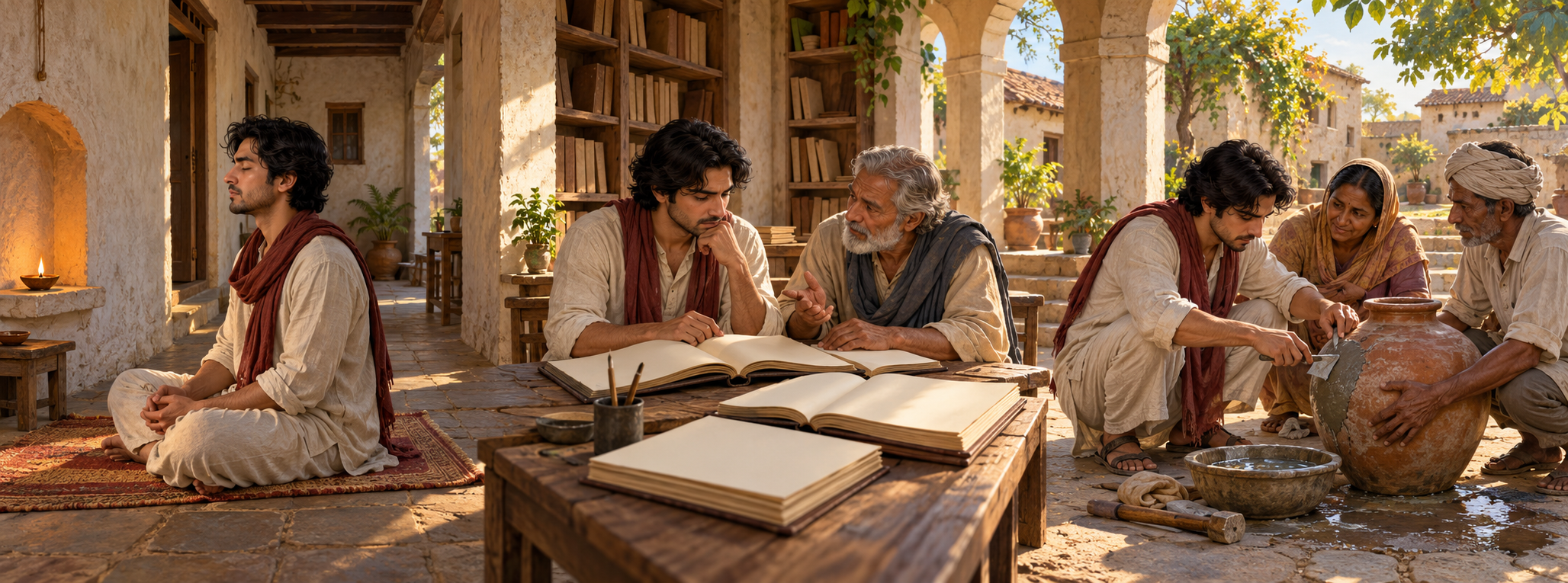
Sacred unknowing is not one technique applied mechanically to every part of life. Its proper use depends on what you are doing.
During prayer or meditation
When an unusual feeling, image, silence, or insight arises, resist the rush to classify it. Describe it before interpreting it. “I felt a strong sense of stillness” is more honest than “I received a revelation.” The first statement keeps the experience available for reflection. The second closes it inside a conclusion.
This restraint does not belittle the experience. It protects it from exaggeration. Continue the practice and watch what follows in your conduct. An experience that seems elevated but makes you more vain, careless, or hostile deserves scrutiny, not a grander label.
While reading scripture or commentary
Keep three layers distinct: the words before you, the interpretation you received, and the conclusion you formed. Readers often collapse these into one and then defend their own conclusion as though it were the only possible meaning of the text.
When interpretations differ, locate the disagreement. Is it about the meaning of a term, the purpose of a passage, the authority given to a commentary, or the larger philosophical framework? “These people disagree” is a dead end. “They assign different meanings to this premise” gives you something specific to investigate.
In debate about Dharma
You do not defend Dharma by improvising facts. If you lack the knowledge needed to answer a historical, textual, or philosophical claim, say so and narrow the discussion to what you can support. An honest boundary protects credibility better than a sweeping claim that collapses under examination.
Try this form: “I cannot establish that broader claim. The narrower point I can support is this.” It allows the conversation to continue without turning uncertainty into surrender or bluffing into courage.
When a decision must be made
The whole of reality may remain mysterious, but the next responsible action is often visible. You may not know why suffering has entered a life, yet you can still offer help. You may not know the final nature of the self, yet you can still speak truthfully and avoid needless harm.
Do not use metaphysical uncertainty to avoid practical evidence. If a question can be investigated, investigate it. If a duty is clear, perform it. If consequences are concrete, assess them carefully. Sacred unknowing belongs where knowledge reaches its honest limit, not where effort becomes inconvenient.
Recognise when mystery has become an excuse

The language of mystery can conceal intellectual laziness, fear, or a desire to escape accountability. Watch for these warning signs:
- You invoke uncertainty only when your own belief is challenged, never when judging someone else’s.
- You treat openness as proof that every claim must be equally sound, even when claims contradict one another.
- You place a teacher’s factual or practical claim beyond examination merely because the teacher has spiritual authority.
- You postpone an evident responsibility while waiting for a cosmic sign.
- You call emotional withdrawal “detachment” because examining the feeling would be uncomfortable.
- You keep repeating “no one can know” without making any attempt to learn what can, in fact, be known.
Humility and passivity can look alike from the outside, but they move in opposite directions. Humility makes you easier to teach. Passivity makes you unavailable to learning. Humility corrects an error when evidence appears. Passivity remains vague so that no correction is ever required.
There is also a difference between silence and shutdown. Chosen silence can create space for attention. Shutdown avoids the question, the relationship, or the duty attached to it. If your silence consistently reduces honesty, care, or capacity to act, it is not serving spiritual clarity.
Key takeaways
- Sacred unknowing is a precise recognition of your limits, not a celebration of ignorance.
- Separate direct experience, interpretation, received teaching, and unresolved questions before claiming certainty.
- Let mystery slow premature judgement, but never let it replace study, evidence, or a clear duty.
- Judge the practice by its fruit: honest unknowing should make you more attentive, teachable, and responsible.
Choose one spiritual question that currently makes you reach for a polished answer. Write four lines: what you experienced, what you inferred, what you received from others, and what remains unknown. Then take one appropriate next step. Read, ask, practise, observe, or wait without pretending. That small act of precision is how unknowing becomes a discipline rather than a pose.
References

Leave a Reply
You must be logged in to post a comment.