

You may have seen the applause from Los Angeles and wondered what it proves. Does the reception mean that a major Ramayana adaptation has crossed into global culture, or are Hindu audiences being asked to celebrate before they have judged the film for themselves?
The sensible answer lies between automatic celebration and automatic suspicion. The premiere is a meaningful sign of cultural reach. It is not a certificate of scriptural fidelity. You can welcome the first while reserving judgment on the second.
What the Los Angeles premiere actually tells you

The Los Angeles event placed Ramayana: Rise of a Legend before an international entertainment audience with actors Ranbir Kapoor, Yash and Sai Pallavi, producer Namit Malhotra and director Nitesh Tiwari on the red carpet. The production is a two-part epic whose first instalment was released ahead of Diwali. That combination of location, scale and festival timing indicates an attempt to speak to Hindu audiences at home while presenting the Ramayana as world cinema.
The event’s most repeated image is a reported ten-minute standing ovation following the screening. That is evidence of an enthusiastic response inside one room. It is not evidence that every audience will respond in the same way, that the film has interpreted every character correctly, or that applause has settled questions Hindus may raise after seeing the complete work.
This distinction matters because cultural confidence does not require credulity. A Hindu audience should be able to appreciate the sight of a sacred civilisational narrative receiving serious international treatment without outsourcing its judgment to a premiere crowd. You do not have to choose between pride and discernment.
The two-part format is also worth noticing. No feature film can contain the Ramayana’s entire scriptural, philosophical and cultural life. Dividing the production into two instalments provides more narrative room, but duration alone cannot guarantee depth. What matters is how that room is used: whether moral decisions are allowed to develop, whether relationships carry their proper weight, and whether spectacle supports rather than replaces meaning.
Global filmcraft can serve a Dharmic story, but it cannot define it

The production has deliberately assembled talent associated with large international films. Its contributors include stunt coordinator Terry Notary, second-unit director Guy Norris and composers Hans Zimmer and A.R. Rahman. Their participation signals an effort to give the epic global cinematic scale.
That expertise can matter enormously. Movement, sound, visual effects and action design determine whether an unfamiliar viewer experiences the world as coherent or dismisses it as weightless fantasy. Strong craft can make forests, kingdoms, battles and extraordinary beings feel as though they belong to one moral and visual universe. It can help an audience remain attentive long enough to encounter the ideas beneath the images.
But technical excellence answers a different question from Dharmic integrity. A beautifully staged scene can still misread a character. A powerful score can intensify an emotion that the narrative has not earned. A dazzling battle can obscure the duty, restraint or consequence that gives the conflict its meaning. International prestige should therefore raise your expectations for craft, not lower your standards for interpretation.
The most useful test is whether the global cinematic language carries the Ramayana outward without hollowing it out. You can look for four things:
- Context without embarrassment: Does the film help an unfamiliar viewer understand the world of the story without apologising for its sacred character?
- Wonder without reduction: Are divine and extraordinary elements allowed religious and moral significance, or are they treated only as superhero mechanics?
- Complexity without inversion: Can an antagonist be compelling without the story confusing charisma with righteousness?
- Emotion without manipulation: Do music and spectacle deepen the consequences of a choice, or merely instruct the audience when to cheer?
These questions are more revealing than asking whether the film looks expensive. Production scale can open a global door. It cannot decide what should pass through it.
Judge the adaptation on three separate questions

Arguments about sacred adaptations often become confused because people collapse craft, adaptation and fidelity into a single verdict. A film may be visually accomplished yet philosophically thin. It may alter an incident while preserving its moral function. It may also reproduce familiar scenes while changing their meaning through tone or characterisation. Separate the questions before deciding what you think.
- Does it work as cinema? Look at whether the geography of a scene is clear, the performances make relationships intelligible, and action reveals character instead of interrupting it. If a sequence is impressive but leaves you unable to explain why a decision mattered, scale has displaced story.
- Do its adaptation choices have a defensible purpose? Compression, reordered events and composite scenes are normal tools of filmmaking. Ask what each substantial change accomplishes. A change that makes a moral conflict legible is different from one that manufactures a fashionable conflict absent from the narrative’s ethical world.
- Does it preserve Dharmic orientation? Watch how the film treats duty, truth, kinship, sacrifice, restraint and the consequences of desire. Dharma should not become a decorative word attached to a generic contest between heroes and villains. It should shape what characters owe, what they risk and why difficult choices remain difficult.
This framework also avoids a common mistake: treating literalism as the only form of faithfulness. The Ramayana has lived through recitation, performance, poetry, temple culture, regional storytelling and family memory. A film must make choices suited to its medium. The real issue is not whether every scene is identical to one preferred telling, but whether a change clarifies, compresses or distorts the moral architecture.
After watching, name one scene under each of the three headings: cinematic craft, adaptation choice and Dharmic meaning. That small discipline will tell you more than a sweeping declaration that the film is either perfect or offensive. It also gives you something precise to discuss with people who reached a different conclusion.
Turn the attention into cultural literacy
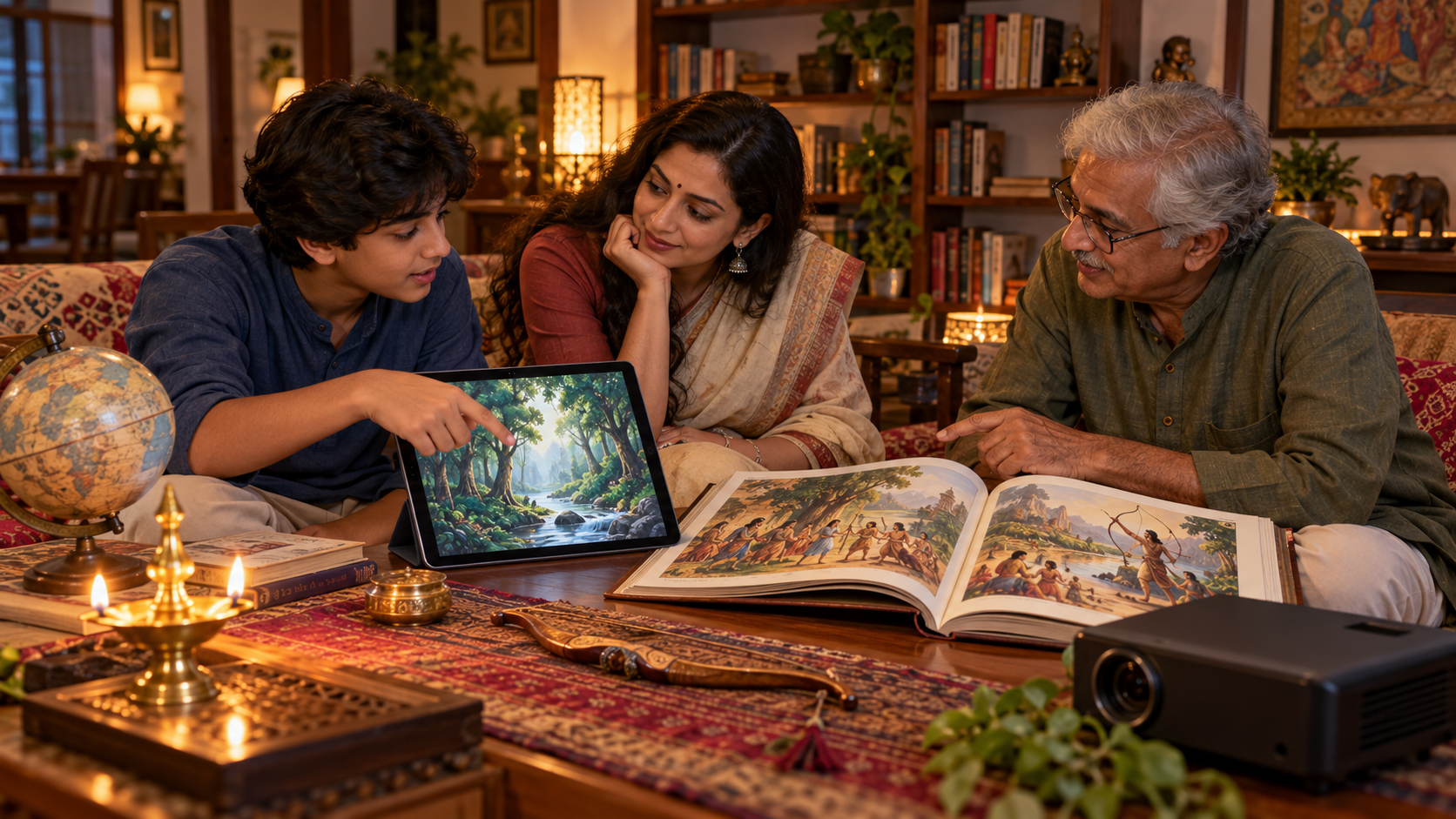
A global premiere can create curiosity, but curiosity becomes cultural understanding only through follow-through. If you are watching with relatives, friends or children who know the Ramayana mainly through popular media, decide in advance what you will do after the credits. The film should be an entry point, not the final authority.
- Choose a reference point before debating. Return to the Ramayana text, translation, commentary or performance tradition that your family or sampradaya actually studies. State which telling you are using. Disagreement becomes clearer when everyone knows the basis of comparison.
- Ask about a decision, not just an image. Instead of beginning with visual effects or casting, ask why a character accepted, refused or delayed a course of action. The answer reveals whether the film has communicated dharma or merely reproduced iconography.
- Distinguish omission from reversal. A film cannot include everything. Leaving out an episode may be a practical choice; changing the moral significance of an episode is a more substantial intervention. Criticism should identify which one occurred.
- Give younger viewers one clear follow-up. If a child asks whether a scene happened exactly that way, explain that a film is an adaptation and then examine the corresponding episode in your chosen tradition. That turns uncertainty into study rather than either blind acceptance or instant rejection.
- Verify prestige claims before sharing them. Premiere applause, celebrity praise and early reactions circulate quickly because they provide social proof. Look for the original footage or statement before attaching a famous name to a claim. Cultural advocacy loses force when enthusiasm outruns verification.
- Use exact language in public criticism. Name the scene, the adaptation choice and the principle at stake. Precision is harder to dismiss than anger, and it helps other viewers decide what to examine for themselves.
This is especially important for Hindus in the diaspora. A major screen adaptation may become the first sustained encounter that classmates, colleagues or neighbours have with the Ramayana. You do not need to answer every question on behalf of an entire civilisation. You do need to distinguish the film from the tradition: appreciate what it conveys well, identify what it compresses, and direct genuine interest toward deeper engagement.
The Los Angeles setting therefore matters less as foreign approval than as an opportunity for encounter. The durable gain will not be that an international audience applauded. It will be that viewers who arrived for cinema leave knowing that the story carries a moral and spiritual world larger than the screen.
Key takeaways for Hindu viewers
- The Los Angeles premiere is a credible sign of international ambition and enthusiastic early reception, not proof of universal approval or scriptural fidelity.
- The involvement of global film talent raises expectations for scale, music, movement and action; it does not transfer authority over the Ramayana’s meaning.
- Assess cinematic craft, adaptation choices and Dharmic integrity separately. A useful judgment explains where the film succeeds or fails in each area.
- Compare substantial choices with a named Ramayana tradition rather than invoking an undefined original.
- Use the film to begin reading, discussion and teaching. Do not let either promotional enthusiasm or online hostility make your judgment in advance.
When you see the film, carry openness and criteria into the screening together. Let the images make their case. Then return to a trusted telling, examine the choices that stayed with you, and speak with enough precision that the conversation leads someone deeper into the Ramayana rather than merely deeper into a dispute.
References
- Hindu Human Rights Blog – Video – 10 min Standing Ovation For Ramayana Movie Premiere At Los Angeles

Leave a Reply
You must be logged in to post a comment.