
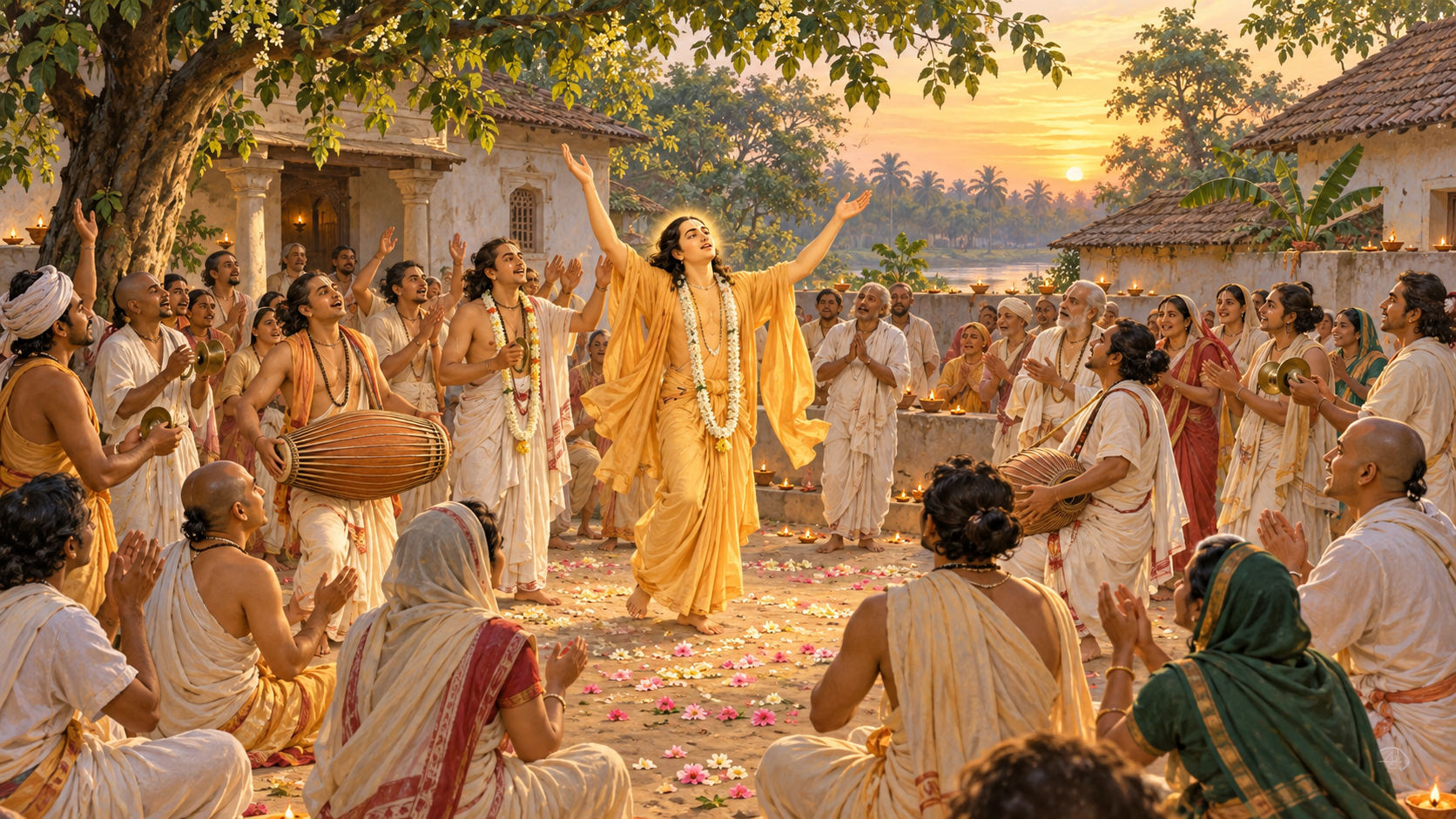
You may already join kirtana, sing the Divine Name, and feel drawn to Sri Chaitanya, yet still wonder what turns the gathering into worship of him. Is musical participation enough, or must something more deliberate happen?
The practical answer is that sankirtana becomes worship when you consciously receive it as Chaitanya’s path, offer your voice and attention in service, and help everyone present remember the Divine rather than admire the performers. That shift changes how you lead, listen, choose music, welcome people, and carry the practice into daily conduct.
What worship through sankirtana actually means
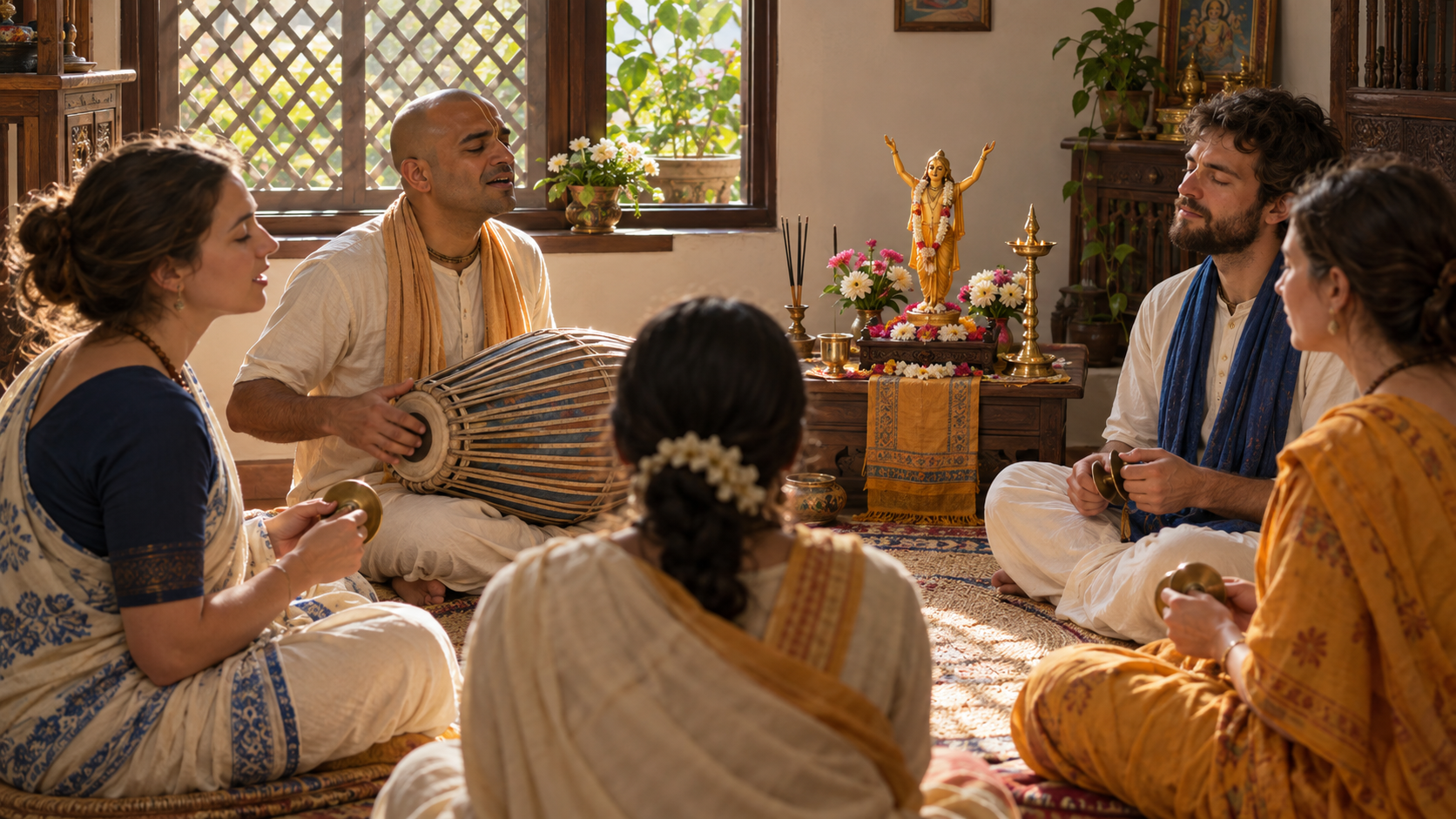
Within Gaudiya Vaishnavism, Srimad Bhagavatam 11.5.32 is commonly understood as describing the divine manifestation worshipped through sankirtana-yajna. This is a particular Vaishnava interpretation, not a rule imposed upon every Hindu or Dharmic sampradaya. Its importance lies in the relationship it establishes: congregational glorification is not merely preparation for Chaitanya’s worship; it is itself a principal way of worshipping him.
This resolves a common uncertainty. You do not have to choose between honouring Chaitanya and chanting the Divine Name. To honour the path he taught, embodied, and shared is to honour him. Direct prayers to Chaitanya can accompany sankirtana, but the practice does not become less centred on him when the assembly chants divine names rather than repeatedly naming him.
The word worship matters here. A concert asks whether the music moved the audience. Sankirtana asks whether the gathering turned attention toward the Divine. A concert naturally distinguishes performer from spectator. Sankirtana calls everyone into participation, even if one person leads and others respond. Musical skill can serve that purpose, but it cannot replace it.
Sankirtana also does not cancel other forms of bhakti. Murti-puja, personal chanting, scriptural hearing, remembrance, hospitality, and seva can support the same devotional life. The claim is not that every other practice is unnecessary. It is that collective glorification has its own integrity and should not be treated as devotional background music.
Build the gathering around offering, not performance
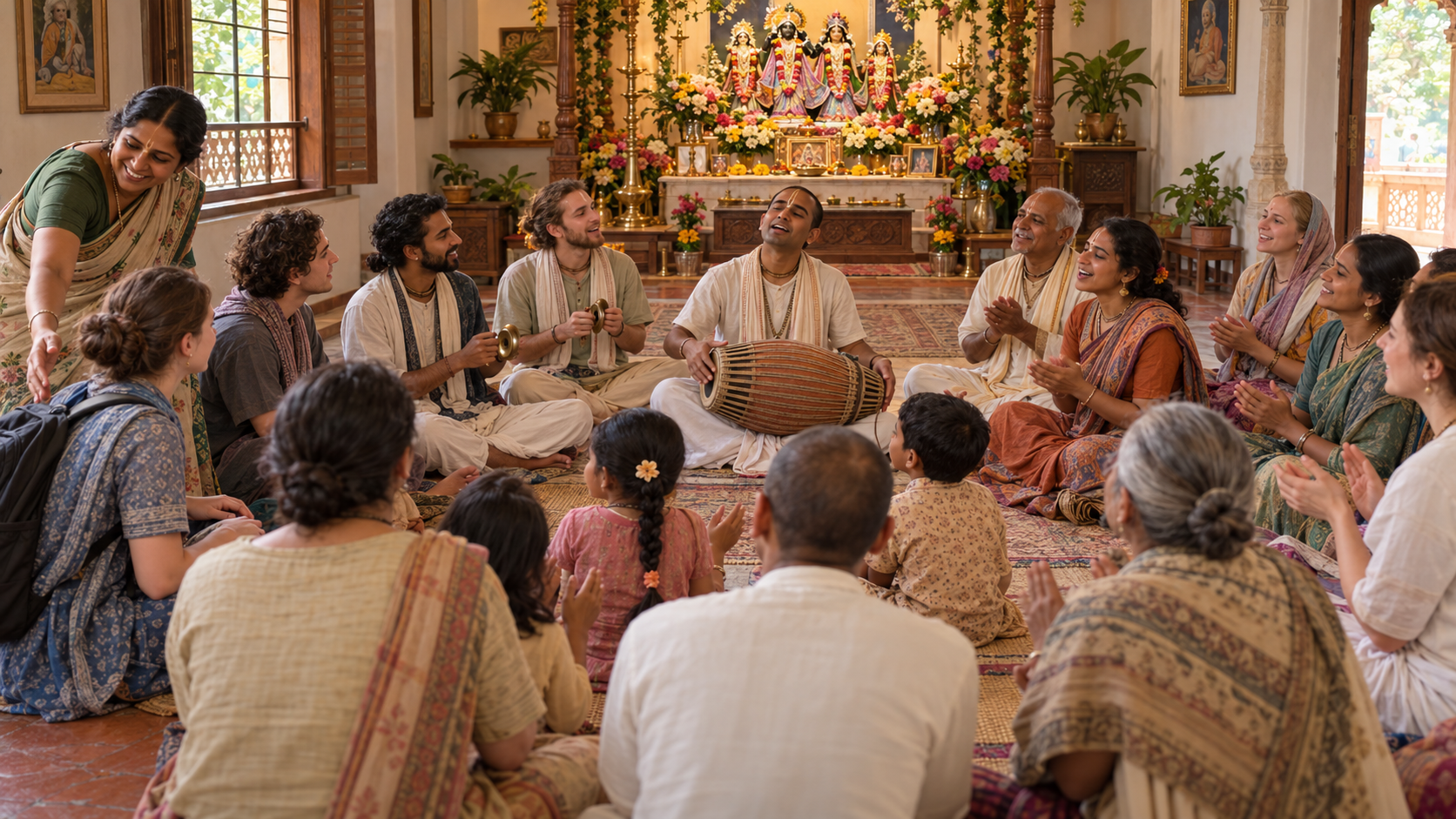
The most reliable test is simple: who or what becomes the centre of attention? If participants leave mainly discussing the lead singer’s range, the instrumental solos, or the excitement of the final tempo, the musical form may have eclipsed the devotional purpose. This does not mean beauty, rhythm, or strong musicianship is suspect. It means every musical choice must help the assembly chant, hear, and remember.
- State the intention. Before beginning, briefly acknowledge that the gathering is an offering to Sri Chaitanya through collective glorification. A clear sentence is more useful than a long speech.
- Choose a melody people can answer. If newcomers cannot find the response before the melody changes, simplify it. The assembly’s participation matters more than displaying the leader’s repertoire.
- Keep the sacred words audible. Instruments should carry the chanting, not bury it. Reduce volume or rhythmic density when people can hear percussion more clearly than the words they are trying to repeat.
- Lead by listening. A leader should hear the response and adjust pace, pitch, and complexity to the actual group. Continuing with a plan that the assembly cannot follow turns shared worship into a solo performance.
- Make room without making a spectacle of inclusion. Show an unfamiliar participant where the response begins, provide the words when needed, and let the person enter without being publicly tested.
- Close as an offering. Allow the energy to settle. End with gratitude, reverence, and a clear transition into prayer, prasada, study, or service rather than treating the final note as applause time.
You can also notice the difference within yourself. Devotional absorption may include joy and powerful emotion, but emotional intensity is not the only evidence of sincerity. A quiet participant who listens carefully and chants steadily may be more engaged than someone displaying visible excitement. Do not manufacture a mood or judge another person’s devotion by outward expression.
A practical order for home or temple sankirtana
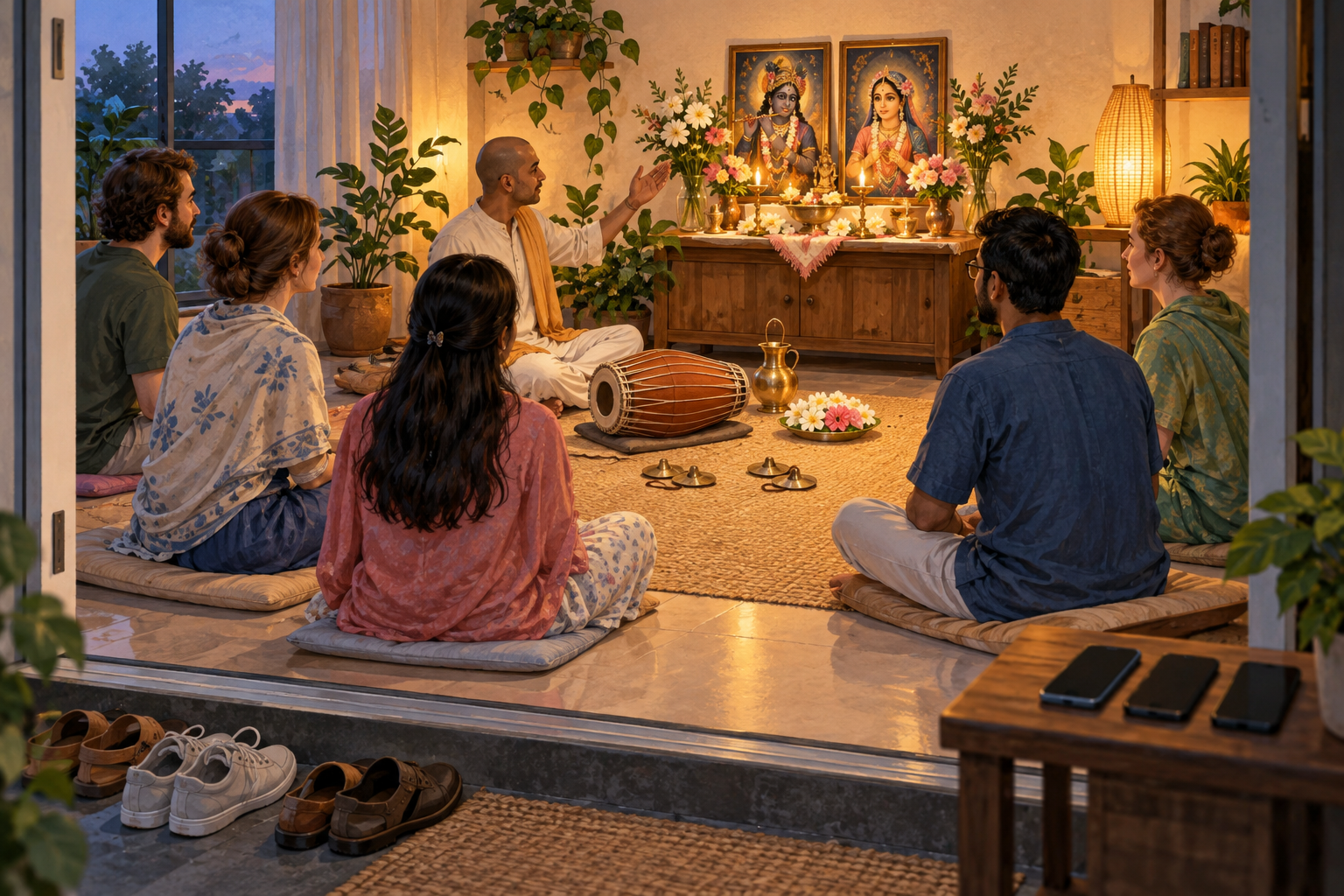
A household gathering does not need to imitate a large temple programme. It does need a recognisable devotional order. If your guru, temple, or sampradaya has an established procedure, follow that procedure rather than assembling incompatible elements from different traditions. Where no detailed local format has been given, the following sequence keeps the purpose clear.
- Prepare a clean, settled place. Arrange seating and instruments before people gather. Avoid making the sacred image or altar compete with phones, bags, cables, and unrelated conversation.
- Name the offering. Invite everyone to direct the chanting toward Sri Chaitanya and the Divine, not toward musical display or personal recognition.
- Begin with a familiar invocation from your lineage. Do not improvise sacred formulas merely to sound traditional. If participants come from different backgrounds, explain briefly what is being sung and allow respectful participation without coercion.
- Establish an easy call and response. Give the assembly enough space to complete its response. The leader should not begin the next call while the group is still chanting.
- Deepen through steadiness. Let repetition gather attention. Constant changes of melody, key, rhythm, or speed can keep the mind occupied with novelty while preventing it from resting in the Divine Name.
- End before attention collapses. A shorter gathering with attentive participation is better than prolonging the music until people are merely waiting for it to stop. Close while the offering can still be made consciously.
- Carry it into conduct. Follow the chanting with one concrete act of seva: serve prasada, clean the space, help someone return home, study a passage, or undertake a duty you have been avoiding. The voice that glorifies the Divine should train the hands and habits as well.
If you are alone, personal chanting and kirtana can still be genuine worship of Chaitanya. It is simply helpful to preserve the ordinary distinction between individual practice and congregational sankirtana. Do not wait for a large event, however. A small household or community gathering can retain the essential shared movement of leading, responding, hearing, and serving.
Correct a distracted sankirtana by simplifying it
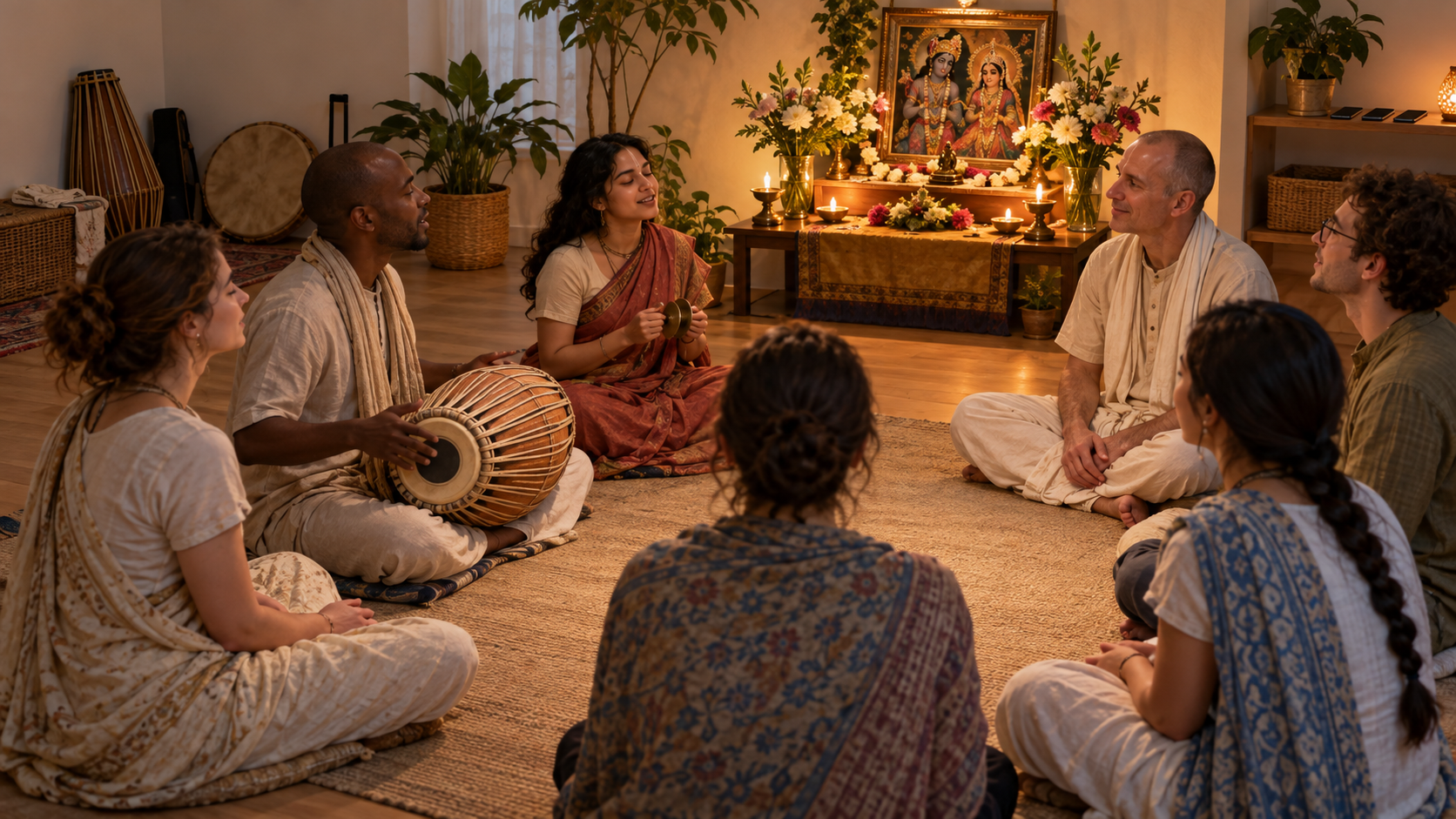
When a gathering loses focus, adding more stimulation is usually the wrong correction. Diagnose the obstruction and remove it. Sankirtana becomes stronger when participants have less musical clutter to manage and more room to hear.
- If the words are indistinct, slow the pace, lower the instruments, and repeat a short, clear phrase. Correct pronunciation gently and collectively; public embarrassment does not improve remembrance.
- If only the front of the room is chanting, use a more accessible pitch and response. Make the leader’s line shorter until the whole assembly can answer confidently.
- If the rhythm keeps breaking, simplify the beat. A basic pulse that supports everyone is more useful than an elaborate pattern that only trained musicians can follow.
- If the leader dominates, shorten solos, listen to the response, and allow another qualified person to lead. Shared worship should not become ownership of the microphone.
- If people are restless, resist the automatic urge to accelerate. A sudden increase in speed can create excitement without restoring attention. Return first to clarity and collective breathing.
- If the gathering feels emotionally flat, do not force enthusiasm. Chant attentively, hear the response, and let devotion mature without theatrical pressure.
- If disagreements arise over style, ask which option best supports the sacred words, the recognised practice of the community, and the participation of the assembly. Personal taste should not be disguised as a theological absolute.
Humility is especially concrete in sankirtana. It means accepting a singable key instead of your preferred key, repeating a simple melody instead of showcasing a difficult one, and remaining attentive when someone else leads. It also means refusing to rank participants by musical ability. The person struggling to keep the tune may still be making a sincere offering.
The practice should make social conduct gentler, not harsher. If chanting produces contempt for beginners, rivalry among leaders, or indifference to practical service, correct those habits rather than protecting them with devotional vocabulary. Worship of Chaitanya through sankirtana is measured not only by what happens during the singing but also by the quality of association it creates.
Key takeaways
- In the Gaudiya Vaishnava understanding, congregational glorification is itself a way of worshipping Sri Chaitanya, not merely music performed before worship begins.
- The leader’s first duty is to help the assembly chant and hear. Musical complexity is useful only when it serves that duty.
- Clear intention, audible sacred words, attentive response, and an orderly close matter more than volume, speed, novelty, or visible emotion.
- Solo chanting can honour Chaitanya, while sankirtana ordinarily names the shared practice of collective glorification.
- A sound gathering should continue as seva, humility, hospitality, and responsible conduct after the music ends.
At your next sankirtana, change one thing: make the response easier to hear, state the offering clearly, or connect the close to a specific act of seva. Then judge the change by whether more people could participate attentively. That is a practical way to place Chaitanya, rather than the performance, at the centre.
References

Leave a Reply
You must be logged in to post a comment.