
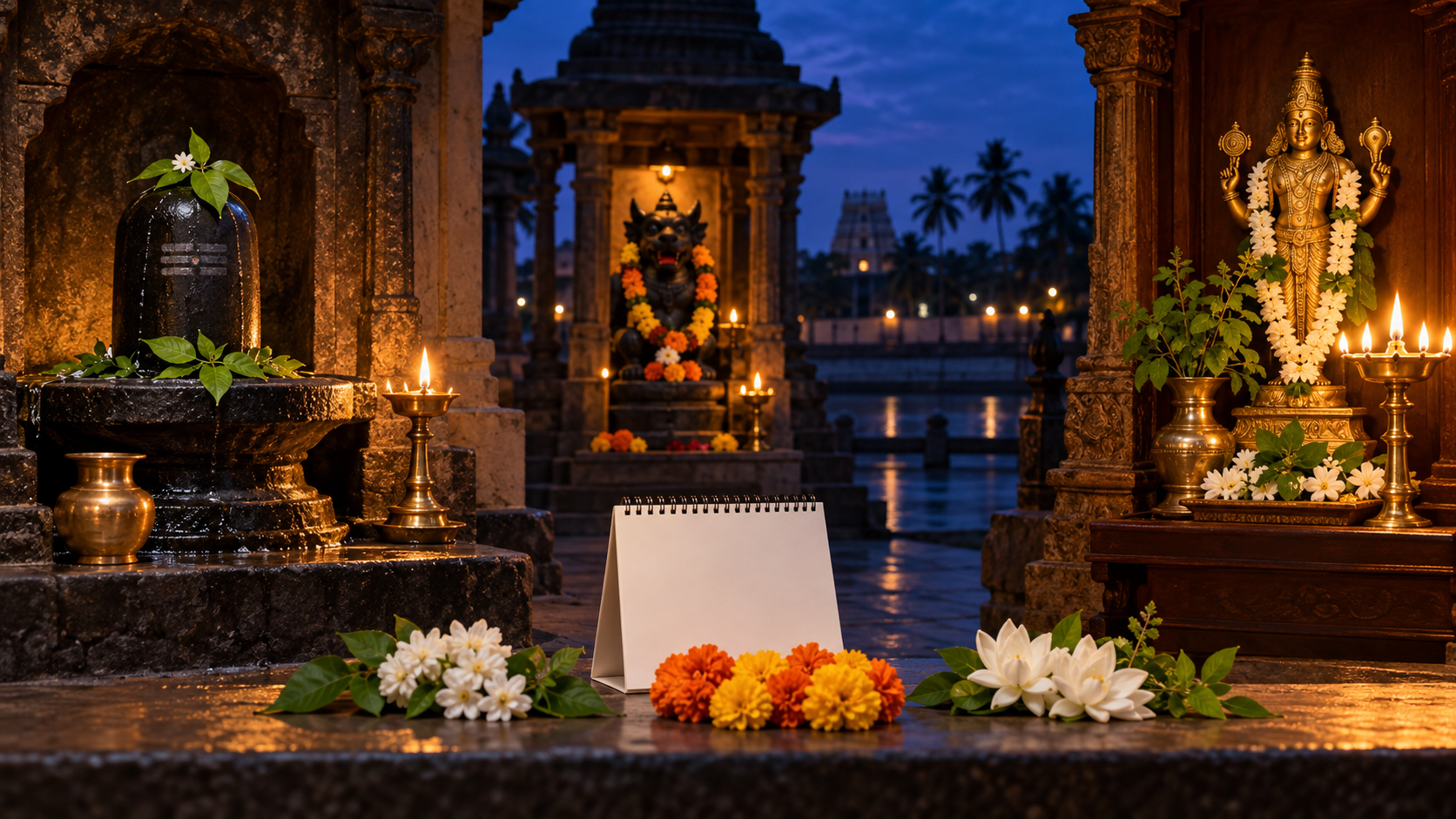
You want to observe Kartika faithfully, but the calendar presents a practical difficulty: a Shiva temple festival, a five-day Vishnu vrata, and Kaal Bhairav Jayanti fall close together. The month names can also appear to conflict, even when the civil dates do not.
The cleanest solution is to fix the dates first, follow one regional or family calendar consistently, and give each observance its proper form. You do not need to compress Shiva, Bhairava, and Vishnu worship into one improvised ceremony.
Put these three observances on your 2026 calendar

Start with the civil dates below. Then confirm the local tithi and temple schedule before making travel, fasting, or leave arrangements.
| Civil date in 2026 | Observance | What distinguishes it | Practical commitment |
|---|---|---|---|
| November 24 | Kartika Purnima and Jwalathoranam | Jwalathoranam is observed on Kartika Purnima, mainly at Shiva temples in Andhra Pradesh, Telangana, and parts of Karnataka. Its physical arrangement uses two upright wooden logs and a horizontal crosspiece forming a thoranam. | Confirm whether a nearby temple conducts it and when devotees should arrive. |
| November 30 to December 4 | Paitha Mahakruchcha Vratam | This is a five-day Vishnu puja observed in parts of Andhra Pradesh, Telangana, and Karnataka. It runs from Kartika Krishna Saptami through Krishna Ekadashi, also called Utpanna or Utpatti Ekadashi. | Protect time for a consistent daily practice across all five days. |
| December 1 | Kaal Bhairav Jayanti | The day commemorates the appearance of Kaal Bhairav, the fierce form of Shiva. It is also called Maha Kala Bhairava Jayanthi or Kala Bhairava Ashtami and is placed on December 1 in 2026. | Plan Bhairava worship without abandoning the Vishnu vrata already under way. |
These are not three interchangeable pujas. Jwalathoranam is primarily a temple observance, Paitha Mahakruchcha is a sustained Vishnu commitment, and Kaal Bhairav Jayanti is a particular Shiva-related appearance day.
The important scheduling detail is the overlap. December 1 is the second civil day of the November 30–December 4 Vishnu vrata. If you intend to keep both observances, make December 1 a two-part day: retain the established Vishnu practice at its normal time and arrange a separate period for Bhairava worship or temple darshan.
Why Kartika and Margashirsha labels can both appear

A civil date is not the same thing as a lunar date. A tithi can begin or end during a civil day rather than at midnight, and regional calendars do not always apply lunar month names in the same way.
You can see the practical consequence in this sequence. The five-day Vishnu vrata beginning on November 30 is described as occurring in Kartika Krishna Paksha, while Kaal Bhairav Jayanti on December 1 is described as falling in Margashirsha. That difference is a reason to identify the calendar tradition being followed, not a reason to accuse one community of observing the wrong month.
Use this verification process before committing yourself:
- Name the tradition you are following. Start with your family practice, guru-parampara, sampradaya, or the temple where you will worship. If none applies, the local temple actually conducting the observance is the most practical reference.
- Ask for the civil date and local time. Do not ask only, “When is Ashtami?” Ask when the relevant tithi is observed at that temple and when devotees should attend.
- Record the calendar or panchanga used. If two calendars disagree, switching between them for different observances will create more confusion. Use one coherent system unless your inherited practice directs otherwise.
- Separate the tithi from the event schedule. A temple may hold a public ceremony at a practical hour within its accepted observance window. Write down both the religious date and the announced programme time.
- Confirm vrata instructions independently. The dates tell you when Paitha Mahakruchcha begins and ends; they do not, by themselves, specify your household’s food rules, offerings, recitations, or conclusion procedure.
This approach matters especially outside Bharat. Your local time zone, temple timetable, and community tradition may not match a date graphic circulated from another region. A forwarded image is useful as a reminder, but it should not overrule the temple or lineage whose practice you have chosen to keep.
Build a Kartika rhythm you can actually complete
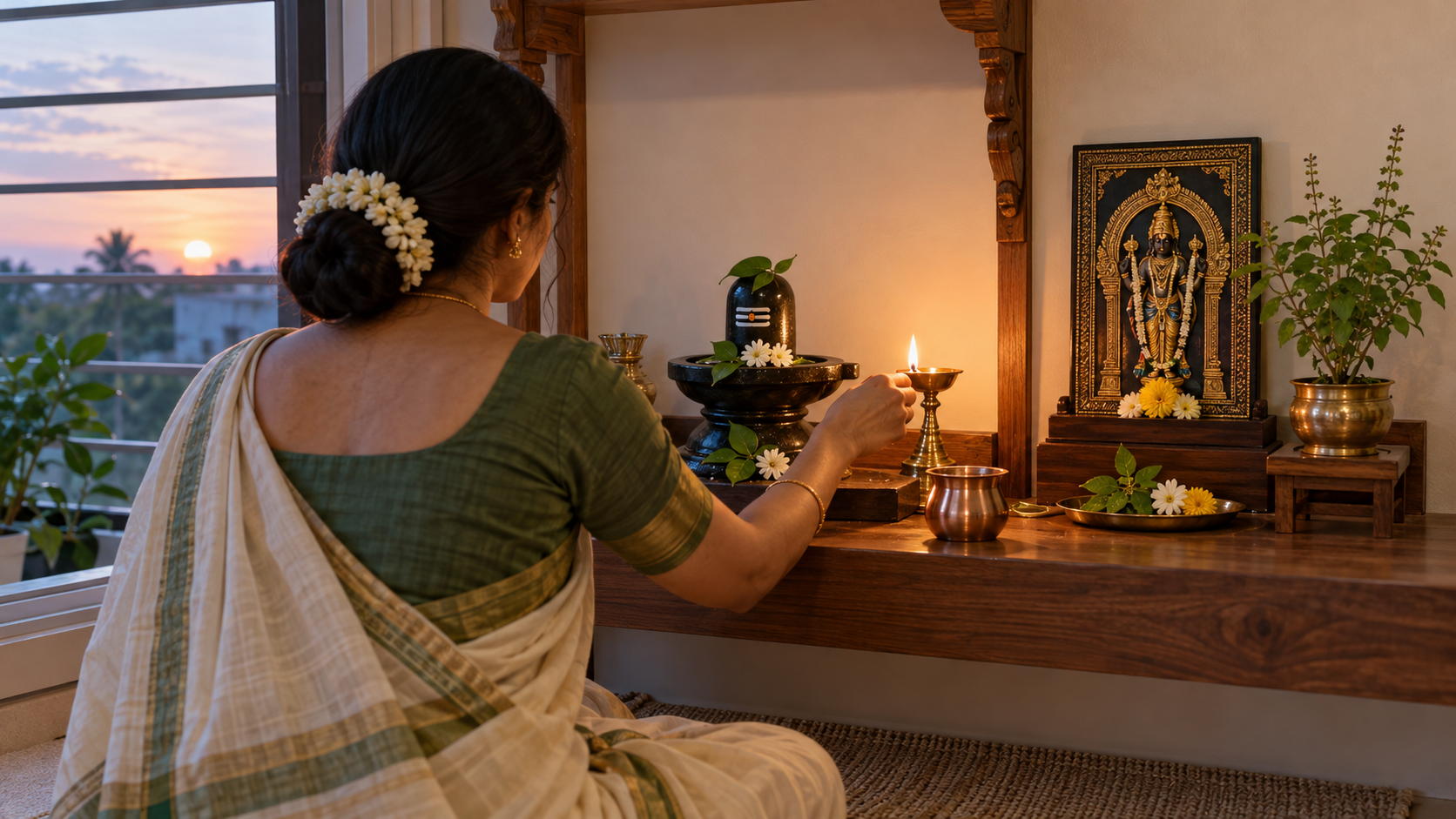
A vrata becomes fragile when its first day is ambitious and its remaining days depend on spare time. Decide in advance what you can repeat, particularly for the five-day Vishnu observance.
A workable 2026 sequence looks like this:
- Before November 24: contact the Shiva temple, verify whether Jwalathoranam will be held, and note any entry, crowd, or safety instructions.
- November 24: attend the temple observance if it is available. If it is not part of your local temple tradition, keep Kartika Purnima through your customary Shiva worship without presenting a home-made substitute as Jwalathoranam.
- Before November 30: obtain the actual Paitha Mahakruchcha procedure from the family, teacher, or temple whose vrata you are following. Set aside the same manageable period for Vishnu puja on each of the five days.
- November 30: begin the Vishnu commitment. Keep the opening practice simple enough that you can preserve it through December 4.
- December 1: continue the Vishnu vrata and add a separate Bhairava observance. Do not silently replace the second day of a five-day commitment with the Jayanti.
- December 2–4: return to the planned Vishnu rhythm and complete it according to the instructions you received, including its concluding observance where applicable.
The name “Paitha Mahakruchcha Vratam” does not, on its own, tell you how much to eat, whether to fast completely, or which mantras and offerings your lineage requires. Do not invent severe dietary rules from the name of the vrata. Follow the procedure you have actually received; if fasting could be unsafe for you, choose an appropriate non-dietary discipline and seek qualified medical guidance where needed.
If you have no detailed procedure, honesty is better than imitation. You may maintain a simple, consistent Vishnu puja during the stated period without claiming to have performed every requirement of a regional vrata. The same principle applies to Bhairava worship: use the prayer and puja form already accepted in your household or temple instead of assembling unfamiliar fragments from unrelated traditions.
Shiva and Vishnu devotion can share the season without losing their distinctness. Keep separate intentions, preserve each observance’s timing, and avoid blending mantras or ritual steps merely to save time. Continuity does not require homogenisation.
Keep Jwalathoranam temple-led and fire-safe
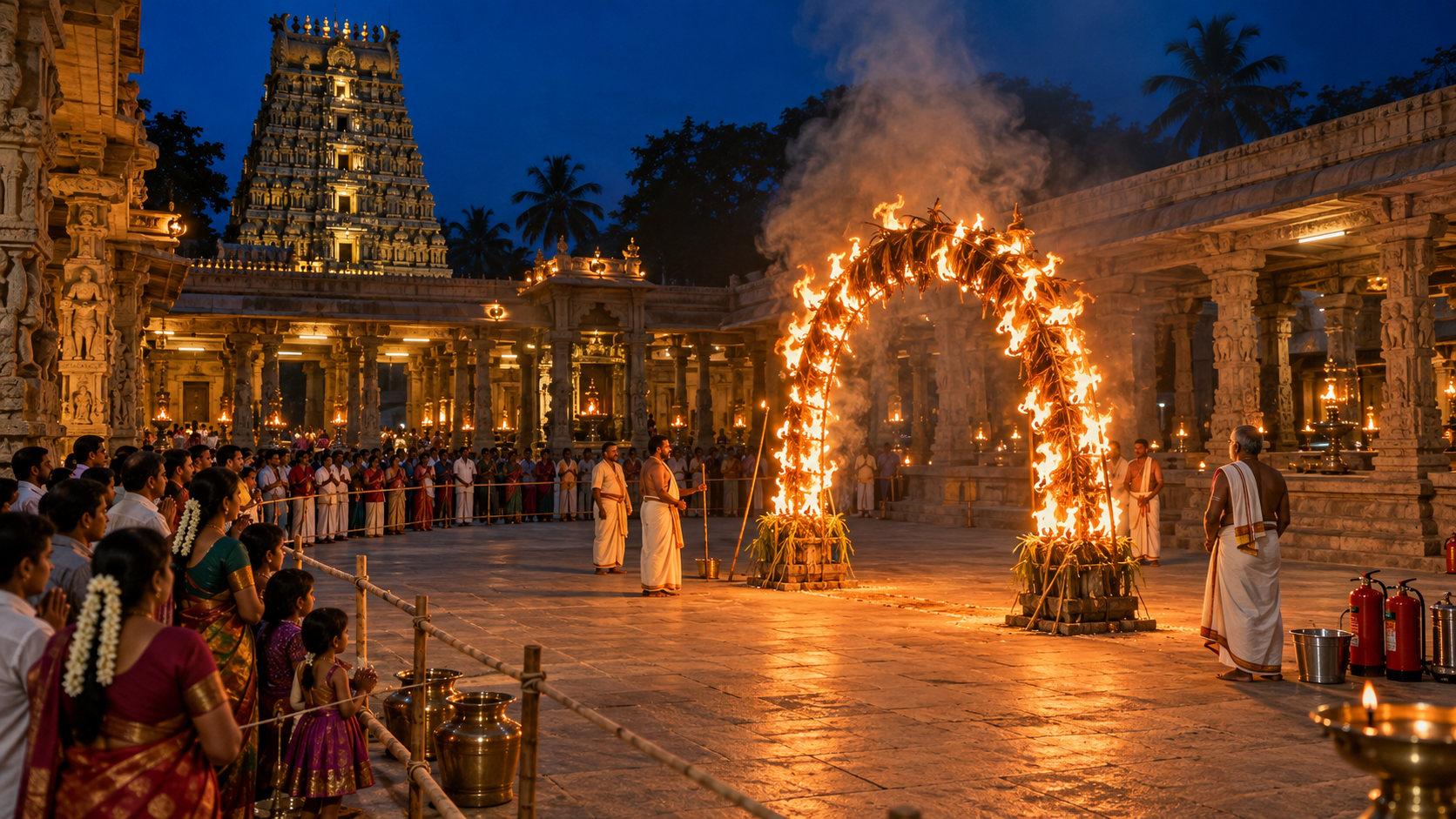
Jwalathoranam is not simply a decorative doorway that a household should copy. The substantial timber arrangement and its association with a public Shiva-temple ritual make organisation, space, and safety part of the observance.
If your temple conducts it, follow the designated viewing route and the instructions of the organisers. Keep children with you, remain behind barriers, and do not approach the wooden structure or any flame outside the permitted area. Crowding around a fire ceremony is not an expression of greater devotion.
If no qualified local institution conducts Jwalathoranam, do not recreate a large timber or fire structure in a home, balcony, yard, or informal community room. Mark Kartika Purnima through customary Shiva worship instead. This preserves the devotional purpose without pretending that a private approximation is the same as a regional temple observance.
Key takeaways for your 2026 observance
- Reserve November 24 for Kartika Purnima and any locally conducted Jwalathoranam.
- Reserve November 30 through December 4 for the five-day Paitha Mahakruchcha Vishnu puja.
- On December 1, continue the Vishnu vrata and observe Kaal Bhairav Jayanti separately.
- Use one family, lineage, or temple calendar consistently when Kartika and Margashirsha labels differ.
- Do not infer fasting, mantra, or offering rules from an observance’s name; obtain the actual procedure.
- Treat Jwalathoranam as a temple-led observance rather than a do-it-yourself fire ritual.
Your next step is small and concrete: save the three date entries, contact the temple or teacher whose calendar you will follow, and decide whether your five-day commitment is genuinely sustainable. Once those choices are made, the apparent clash between Shiva and Vishnu observances becomes an orderly sequence of worship.
References
- Hindu Pad — Kaal Bhairav Jayanti 2026 | Maha Kala Bhairava Jayanthi
- Hindu Pad — Jwalathoranam 2026 | Jwala Thoranotsavam
- Hindu Pad — Paitha Mahakruchcha Vratam | Five day Vishnu Puja in Karthika Month

Leave a Reply
You must be logged in to post a comment.