
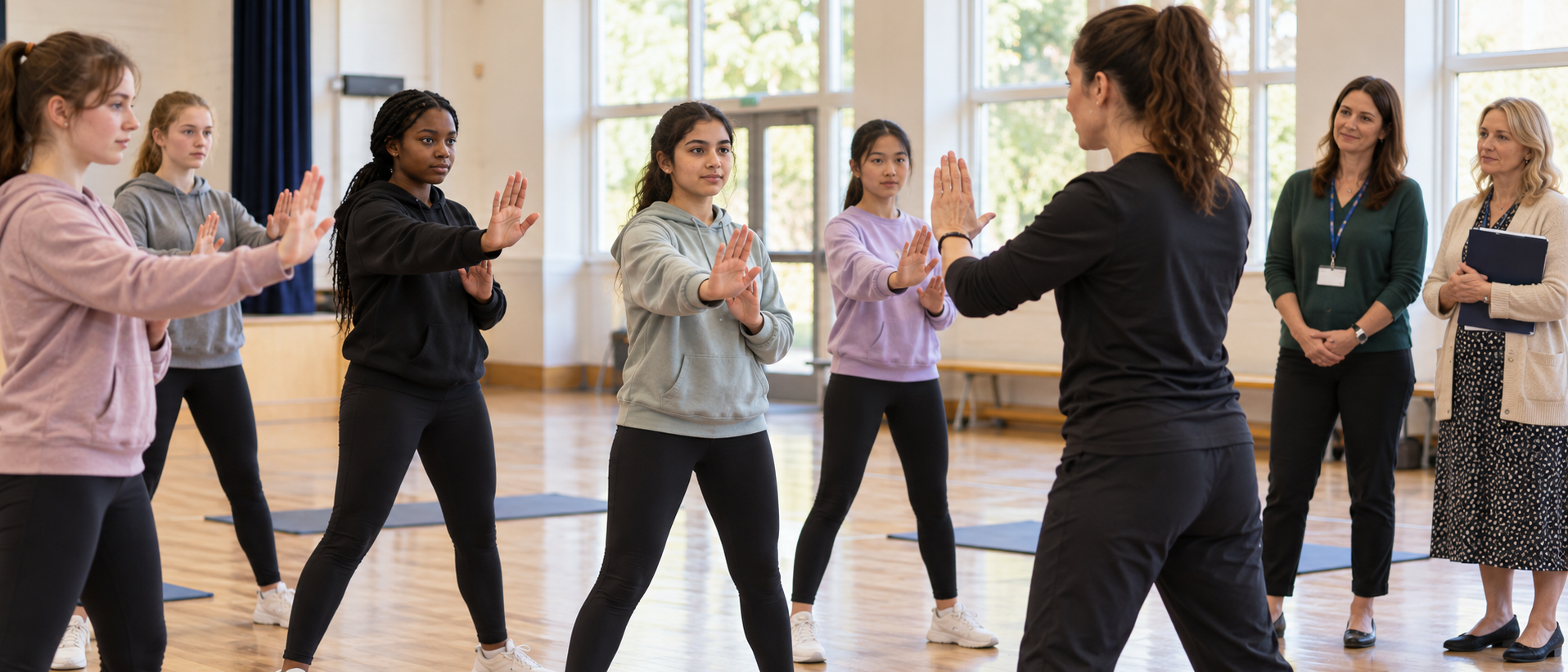
If you’re planning a school or community campaign for girls, the first question is not which self-defence moves to demonstrate. It is whether every participant will leave with a safer response, a known route to help, and adults who are ready to act.
That requires three things working together: practised responses, spiritual steadiness, and institutional responsibility. Leave out physical practice and the message stays abstract. Leave out spiritual formation and courage can shrink into aggression or performance. Leave out adult accountability and the burden of safety falls unfairly on the girl.
Define safety before you design the event

A useful campaign does not promise to make girls invulnerable. It helps them notice a boundary violation, respond without waiting for social permission, move towards safety, seek help, and persist if the first person approached does not respond properly. It also tells adults exactly what they must do when a concern reaches them.
The logic behind Kanya Surakshit, Rashtra Surakshit is strongest when it does not make girls responsible for protecting the nation through flawless behaviour. A secure society is one in which girls develop practical agency while families, schools, community organisations, and public institutions fulfil their own duties.
Dharmic language can give this work depth. Abhaya, or fearlessness, should not be presented as an order never to feel fear. It is the cultivation of enough courage and clarity to take the next safe action. Abhyasa, sustained practice, keeps that courage from remaining a slogan. Neither concept should be used to blame someone who could not respond as rehearsed.
A culturally rooted model is already visible in the school setting. During Navratri in Mathura, a lecture for students from Classes 9 to 12 connected spiritual strength with self-defence training. That combination is promising because adolescence is not served by either moral instruction without usable skills or physical drills without a moral framework.
Before announcing your campaign, write its outcome in one sentence. A workable version is: participants will practise setting a boundary, creating an opportunity to leave, reaching a trusted person, and using the local reporting route. If the proposed programme cannot deliver that, narrow its claims or redesign it.
Turn a lecture into repeatable practice
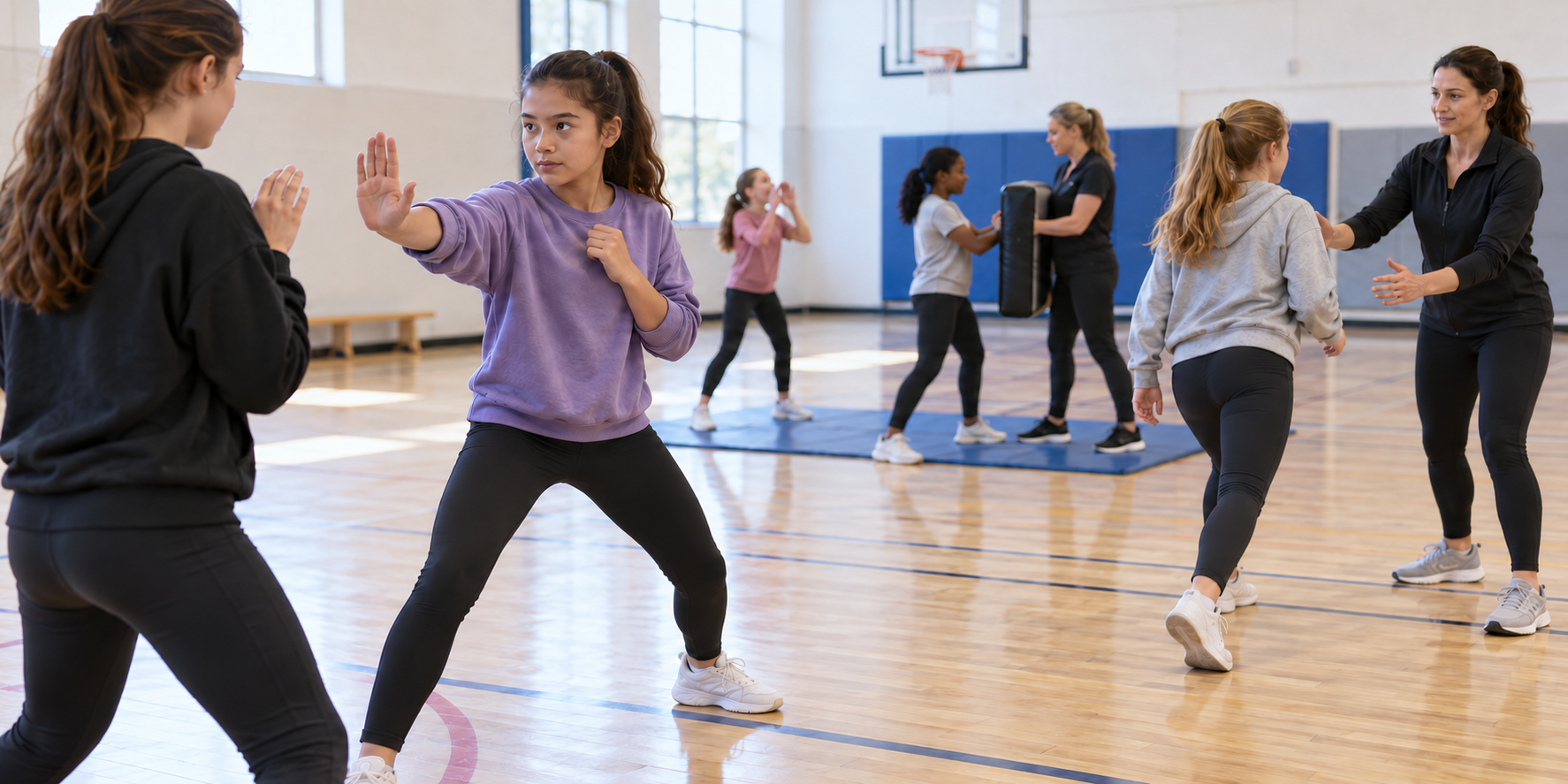
A lecture can name the problem, introduce Dharmic values, and give girls permission to take their safety seriously. It cannot by itself create a response that remains available under pressure. Build the campaign as a sequence in which participants hear, observe, practise, ask questions, and return for reinforcement.
Use a sequence that connects skill, judgement, and help
- Establish the ground rules. Explain consent, respectful conduct, the right to decline physical contact, and the confidential route for raising a concern. No participant should be surprised, grabbed without permission, mocked, or pressured to describe a personal experience.
- Practise a clear boundary response. Use ordinary scenarios and simple language. Participants can rehearse speaking firmly, stepping towards an exit or other people, and calling for help. The aim is not to reward the loudest performance; it is to give each girl more than one usable response.
- Teach physical skills under qualified supervision. Physical self-defence should be presented as a way to create an opportunity to escape, not as a promise to defeat an attacker. The instructor should adapt practice to age, ability, clothing, mobility, and comfort. Dramatic demonstrations must never replace supervised practice.
- Rehearse the help pathway. Every participant should know whom she can approach within the institution, whom she can approach outside it, and what she can do if the first adult dismisses the concern. Put the actual local contacts and reporting steps on a card or handout she can keep.
- Close with a spiritual discipline. A brief voluntary practice such as prayer, mantra japa, quiet breath awareness, or reflection on courage can help participants gather attention and connect the training to dharma. It should reinforce dignity and discernment, not claim to prevent danger.
Check capability rather than applause
Attendance, enthusiasm, and photographs tell you whether an event attracted attention. They do not tell you whether anyone is safer. Use short scenarios and observable tasks instead. Can the participant state a boundary and move towards a safer position? Can she identify a reporting route inside and outside the institution? Does she know what to do if a trusted person is unavailable? Can the responsible staff member explain what happens after a report?
Invite anonymous questions, including criticism of the session. Ask what felt unclear, inaccessible, or uncomfortable without asking anyone to disclose abuse. Then set the next practice date before the gathering ends. Without reinforcement, you have held an event; with reinforcement and a functioning help pathway, you are building a campaign.
Put adult accountability before physical drills
Girls cannot self-defend their way out of an institution that ignores reports, tolerates harassment, or protects reputations at their expense. Training should therefore begin with adult preparation, even if the public-facing programme begins with the students.
- Name a safeguarding lead. Participants, parents, teachers, volunteers, and instructors should know who holds responsibility during and after the programme.
- Provide more than one reporting route. A girl may be unable or unwilling to approach a particular teacher, relative, organiser, or spiritual leader. Give her an alternative inside the institution and another outside it.
- Set consent rules in advance. Obtain the permissions required by the institution and local law while also respecting the participant’s own assent. Permission from an adult should never be treated as permission to ignore a girl’s discomfort.
- Control photography and recording. Do not publish names, images, personal accounts, or training footage without the necessary permission. A safety campaign should not create a new privacy risk.
- Verify the instructor. Check identity, relevant credentials, experience with the age group, references where appropriate, and any screening required by the school or local law. Ask how the instructor handles touch, opt-outs, disability, distress, and disclosures before confirming the appointment.
- Write the escalation process. Staff should have the correct local emergency contacts and know when child-protection, medical, mental-health, or law-enforcement professionals must be involved.
If a participant reports an immediate danger, move first towards present safety and the appropriate emergency or safeguarding response. For other disclosures, listen without blame, avoid forcing repeated retellings, do not conduct a public or amateur investigation, and do not promise absolute confidentiality that you may be unable to keep. Explain the next step plainly and follow the institution’s safeguarding process and applicable law.
A self-defence instructor or spiritual mentor cannot substitute for trained child-protection, medical, mental-health, or legal support when those services are needed. State that limit during the campaign, not after a crisis.
Make spiritual strength practical rather than decorative
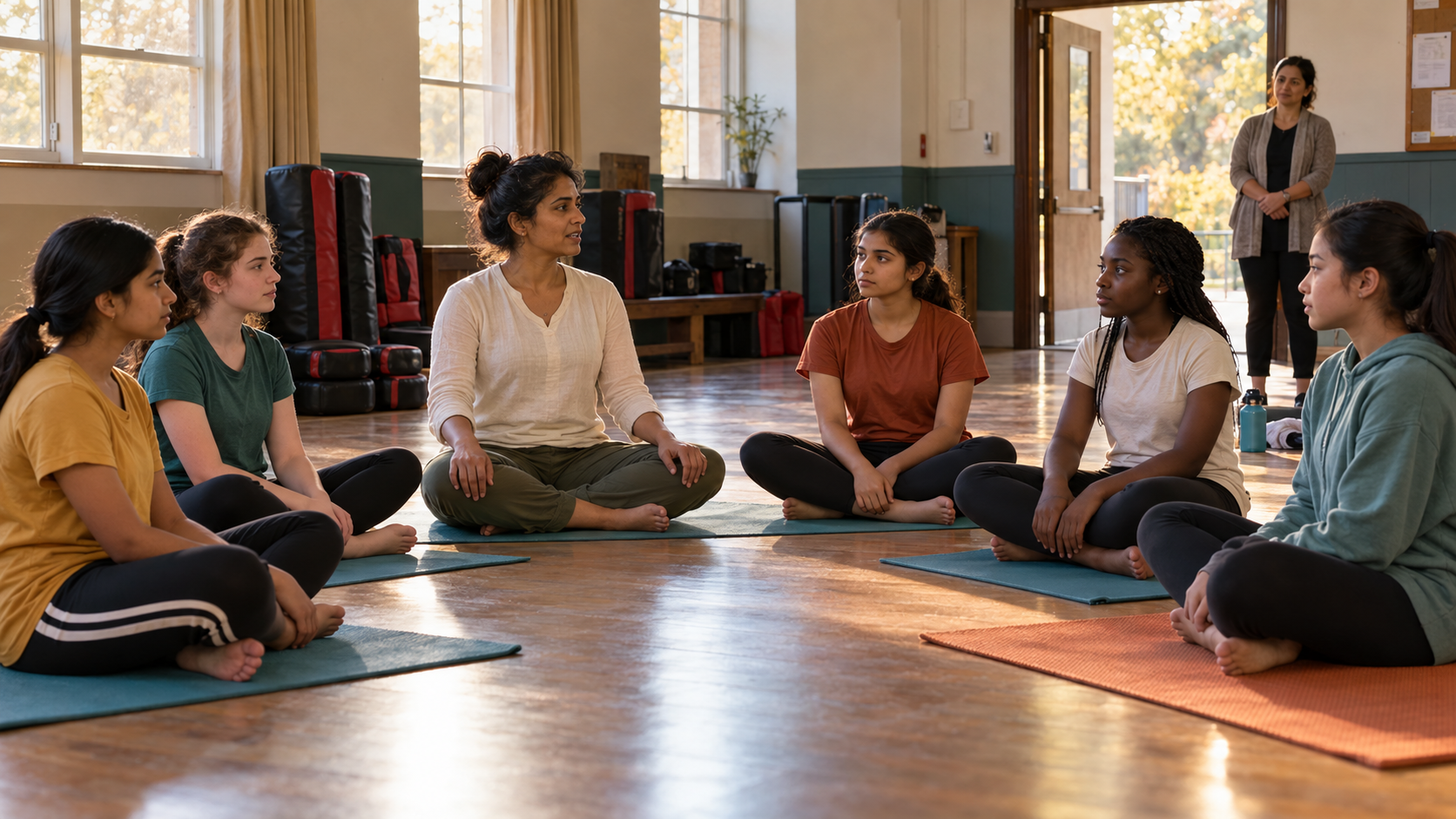
Spiritual strength becomes useful when it shapes a girl’s decisions. It can help her treat unease as information, hold a boundary even when someone invokes status or familiarity, ask for help without shame, and recover her sense of dignity after a frightening experience. It should never become a demand for silence, purity, obedience, or perfect composure.
- Teach attention. Use a short contemplative practice to notice the body, surroundings, exits, and emotional signals without panic. Keep the practice voluntary and do not present it as a protective shield.
- Teach discernment. Respect for elders, teachers, relatives, or religious figures does not require compliance with an unsafe request. Dharma is not served by suppressing a legitimate boundary.
- Teach a concrete sankalpa. Let each participant form a simple commitment about what she will do when something feels unsafe: move away, call out, contact a trusted person, or continue seeking help.
- Teach collective duty. Asking for help is not a failure of courage. Friends should know how to accompany one another, while adults should know that receiving a concern creates an obligation to respond.
- Protect dignity after harm. A girl who freezes, cannot escape, or does not report immediately has not failed spiritually. Responsibility for wrongdoing remains with the person who chose it.
Navratri offers a natural cultural setting for this work because reverence for Shakti can be joined to concrete responsibility towards girls. Do not let the symbolism stand alone. The meaningful offering is a safe training environment, trustworthy adults, a usable reporting system, and practice that continues after the celebration.
Key takeaways
- Define success as safer choices, escape opportunities, access to help, and responsible adult action – not victory in a fight.
- Combine verbal boundaries, movement, supervised physical practice, spiritual discipline, and a rehearsed reporting route.
- Give participants control over touch and participation; surprise contact, humiliation, and forced disclosure have no place in the programme.
- Measure what participants and staff can do in a scenario, not how many people attended or applauded.
- Treat the first gathering as the beginning. Schedule reinforcement and review the help pathway before calling the work a campaign.
Your next step is concrete: before choosing the poster, slogan, or date, put four decisions on one page – the safeguarding lead, the qualified instructor, the reporting path, and the next practice date. If any space is blank, the campaign is not ready to be announced.
Once those foundations are in place, begin at a scale where girls can question, practise, and influence the programme. A campaign rooted in dharma should leave them with more agency and leave the adults around them with less room to evade responsibility.
References

Leave a Reply
You must be logged in to post a comment.