

You may want to approach Krishna yet feel embarrassed by what you have to offer. Your japa is distracted. Your seva looks modest beside someone else’s. Your mind is carrying needs that make prayer feel uncomfortably close to asking for a transaction.
Sudama comes to Dvaraka with that same vulnerability. His meeting with Krishna shows you how to bring a real need without turning devotion into a bargain, how to offer something small without treating it as worthless, and how to honour another person before trying to improve that person’s circumstances.
The real poverty Sudama carries is the fear of having too little

Krishna and Sudama had studied together in the gurukula of Sandipani Muni. By the time Sudama visits Dvaraka, their external lives appear radically unequal. Krishna lives amid royal splendour; Sudama has scarcely enough for his household. Yet Sudama sets out chiefly because he longs to see his old friend, not because he intends to present a demand for wealth.
That does not make his material need imaginary. His wife sees the hardship clearly and encourages the visit. She obtains four handfuls of chipped rice from neighbouring brahmanas, ties them in a worn cloth, and gives the bundle to her husband. The gift is materially meagre, but it comes from a household for which even that much matters.
Sudama therefore carries two kinds of poverty. One is the visible lack of possessions. The other is the inward suspicion that what he brings is too poor to place before Krishna. The second kind can survive even in comfortable lives. You feel it whenever you postpone devotion until you are more disciplined, more peaceful, more learned, or more spiritually impressive.
The meeting corrects that instinct. Readiness for bhakti does not mean arriving without weakness. It means arriving truthfully. Sudama does not manufacture a grand offering, disguise his condition, or turn friendship into leverage. He goes as he is.
You can apply that distinction directly in prayer. State the need plainly: “This is what my family is facing,” or, “This is where my mind keeps failing.” Then refuse to make devotion the price of a desired result. Your worship is not a fee paid to secure an outcome. The need may be urgent, but the relationship is larger than the request.
Krishna honours Sudama before changing his circumstances
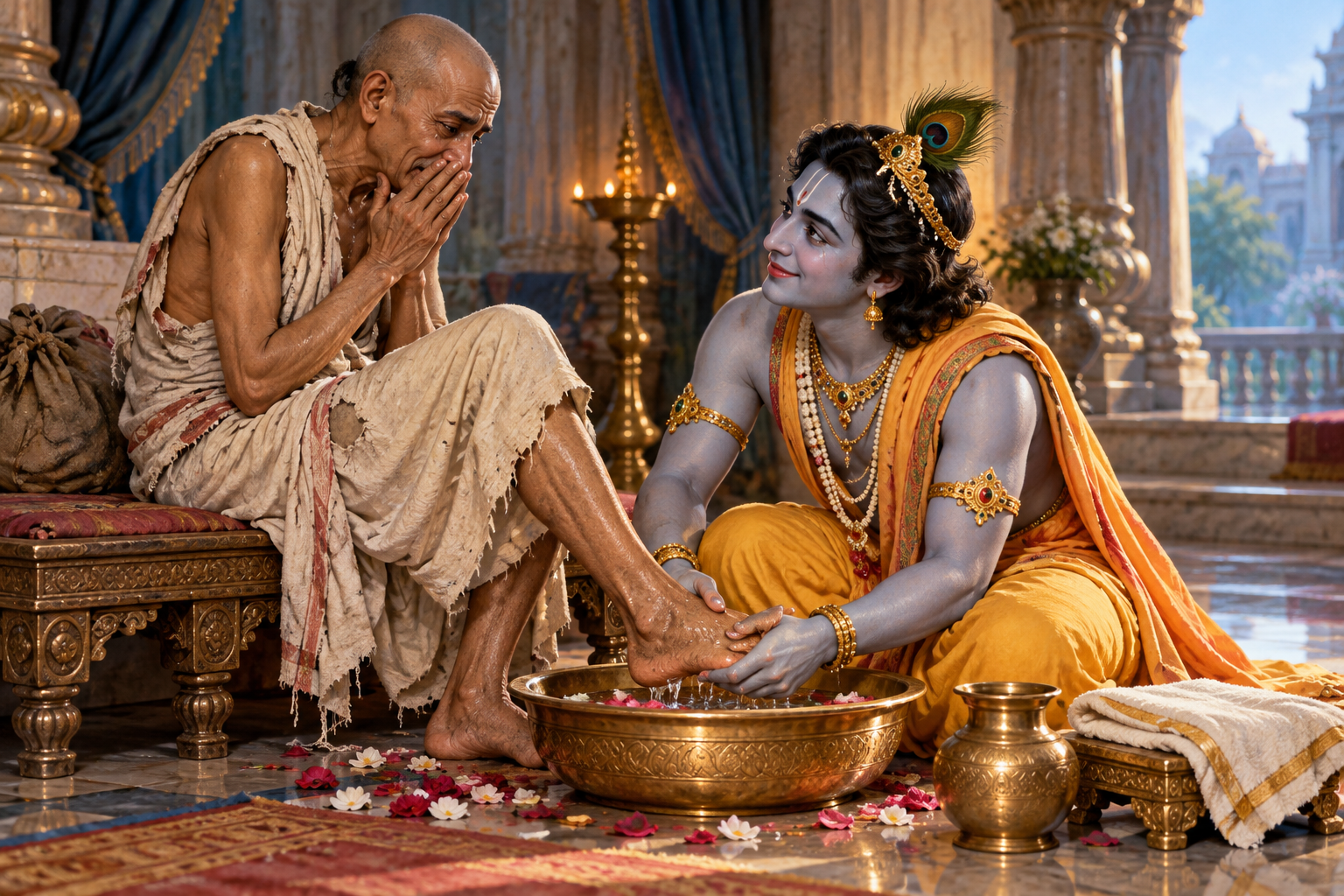
Krishna’s first response is not an assessment of Sudama’s usefulness, clothing, success, or social standing. He welcomes him personally, embraces him, gives him an honoured place, serves him, and remembers their student days together. Royal status has not erased recognition. Krishna receives the person before receiving the gift.
This is one of the sharpest lessons in devotional friendship. Love does not pretend that differences in wealth and power are absent. It refuses to let those differences determine whose presence has value. Sudama enters the setting as a poor brahmana, but Krishna does not reduce him to a problem requiring royal assistance. He is a friend to be welcomed.
That order matters in a temple, family, or community. When someone is struggling, it is possible to offer help while quietly making the person feel inferior. Advice arrives before listening. Assistance is made public. The giver controls the conversation, and the recipient becomes known only by the need.
Krishna’s welcome gives you a better sequence. Acknowledge the person. Make room. Remember the relationship you already share. Listen without demanding a performance of gratitude. Only then consider what practical help is appropriate. Assistance given after honour strengthens friendship; assistance offered without honour can turn friendship into hierarchy.
Nor should Sudama’s poverty be romanticised. Material deprivation is not made holy merely by calling it simple living. His wife’s concern is real, and his circumstances are transformed after the meeting. The lesson is not that a devotee should neglect a household or leave another person’s hardship untouched. It is that compassionate action should preserve dignity from the first moment.
Four handfuls reveal what makes an offering valuable
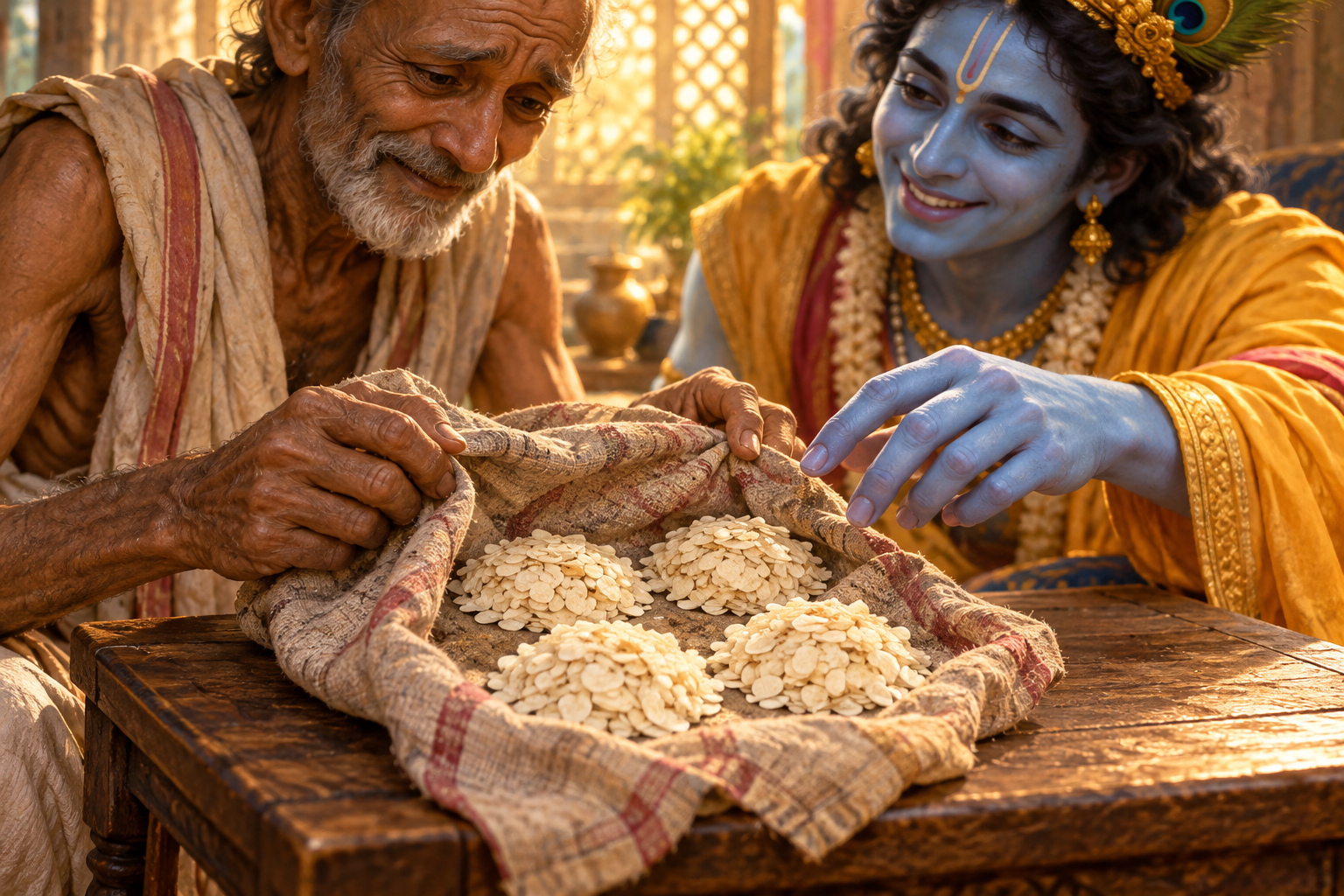
Sudama hesitates when Krishna asks what he has brought. The bundle that cost his household something now looks painfully small amid the abundance of Dvaraka. Krishna does not share that valuation. He takes delight in the chipped rice because he receives the devotion carried within it.
The same principle appears in Krishna’s teaching that a leaf, a flower, a fruit, or water can be accepted when offered with devotion. The object is not valuable because Bhagavan lacks food or possessions. It becomes an offering because a person consciously places love, gratitude, and surrender within an ordinary act.
This does not mean that effort is irrelevant. Sudama’s gift is small by the standards of a royal household, but it is not careless. His wife has gone to others to obtain it. The family gives from scarcity. The worn cloth and simple rice express their actual condition rather than a staged appearance of generosity.
That distinction protects the teaching from two opposite mistakes. The first is shame: “My offering is not grand, so I should offer nothing.” The second is complacency: “Krishna accepts anything, so attention and sacrifice do not matter.” Sudama supports neither conclusion. You need not imitate another devotee’s scale, but you should bring real attention to what is yours to offer.
When you are unsure whether a modest act is a sincere offering, examine it with three questions. Is it actually mine to give, rather than something chosen for appearance? Have I prepared or performed it with attention? Does it express some real movement of time, comfort, pride, or affection toward Krishna? A small act that survives those questions is not spiritually trivial.
This can take an ordinary form: a meal consciously offered before you eat; japa in which you return your attention each time it wanders; a difficult household duty performed without resentment; a few moments of attentive scriptural reading; or the first honest attempt to forgive a fellow devotee. The size of the act does not prove its devotion. Neither does its visibility. What matters is whether you are genuinely giving yourself through it.
Practise devotional friendship without making it a bargain
The story becomes practical when you stop using Sudama merely as an example of rewarded poverty. If the central lesson becomes “give Krishna something and prosperity will follow,” bhakti has quietly become a commercial exchange. Sudama’s defining desire is to see Krishna. The later change in his condition is Krishna’s reciprocation, not a payment Sudama negotiates in advance.
Use the following practice when inadequacy or anxiety is keeping you away from prayer:
- Name what feels insufficient. Be precise. It may be inconsistent japa, little time for seva, limited money for an offering, or a strained relationship you do not yet know how to repair.
- Choose something that belongs to your real life. Do not design a gesture for admiration. Offer the food you are preparing, the duty already before you, the attention required for your next mantra, or the apology you genuinely owe.
- Bring it without disguise. You do not have to pretend that the act is larger, purer, or easier than it is. A simple inward prayer can acknowledge both the limitation and the intention.
- Release the invoice. Ask for help if help is needed, but do not tell yourself that the offering obliges Krishna to deliver a particular result. Devotion can contain petition without becoming a contract.
- Carry Krishna’s way of receiving into your friendships. When another person comes with little, attend first to the person rather than the deficiency. Protect privacy, listen before advising, and do not use generosity to advertise your own importance.
This approach also changes how you interpret divine reciprocation. Do not force every favourable event into a claim that you have decoded Krishna’s plan, and do not treat a delayed outcome as proof that your devotion was rejected. Sudama teaches trust in Krishna’s freedom to reciprocate; he does not give you a formula for controlling when or how that reciprocation must appear.
The deepest shift is from asking, “Is this enough to earn something?” to asking, “Does this honestly carry me toward Krishna?” The first question measures a transaction. The second cultivates a relationship.
Key takeaways
- Sudama approaches Krishna with a genuine need, but his primary desire is the friendship itself rather than a negotiated reward.
- Krishna honours Sudama before altering his material condition, showing that compassionate help should begin by protecting dignity.
- The chipped rice is precious because it carries attention, sacrifice, and affection, not because smallness is automatically virtuous.
- You do not need to become materially or spiritually impressive before approaching Krishna honestly.
- A sincere offering can be modest without being careless, public, or transactional.
- Devotional friendship becomes visible in the way you receive people who cannot increase your status or repay your kindness.
Choose the offering you have been withholding because it seems too small. Prepare it attentively, place it before Krishna without bargaining, and then welcome the next person you meet with the same refusal to measure worth by outward abundance. That is where Sudama’s journey can begin to reshape your own.
References

Leave a Reply
You must be logged in to post a comment.