
If you have encountered Srila Prabhupada only through an altar portrait, a quotation card, or a dispute about ISKCON, you have encountered fragments. The more useful question is personal: what did his life make possible, and what would it mean for you to receive that legacy rather than merely admire it?
His enduring contribution was not simply to speak about devotion. He helped turn bhakti into a life that ordinary people could enter through hearing, chanting, study, association, food offered and shared as prasada, and practical service. That distinction matters. A teacher’s fame can survive as memory; a devotional legacy survives only when people continue the practice.
The 1965 voyage reveals the shape of his life

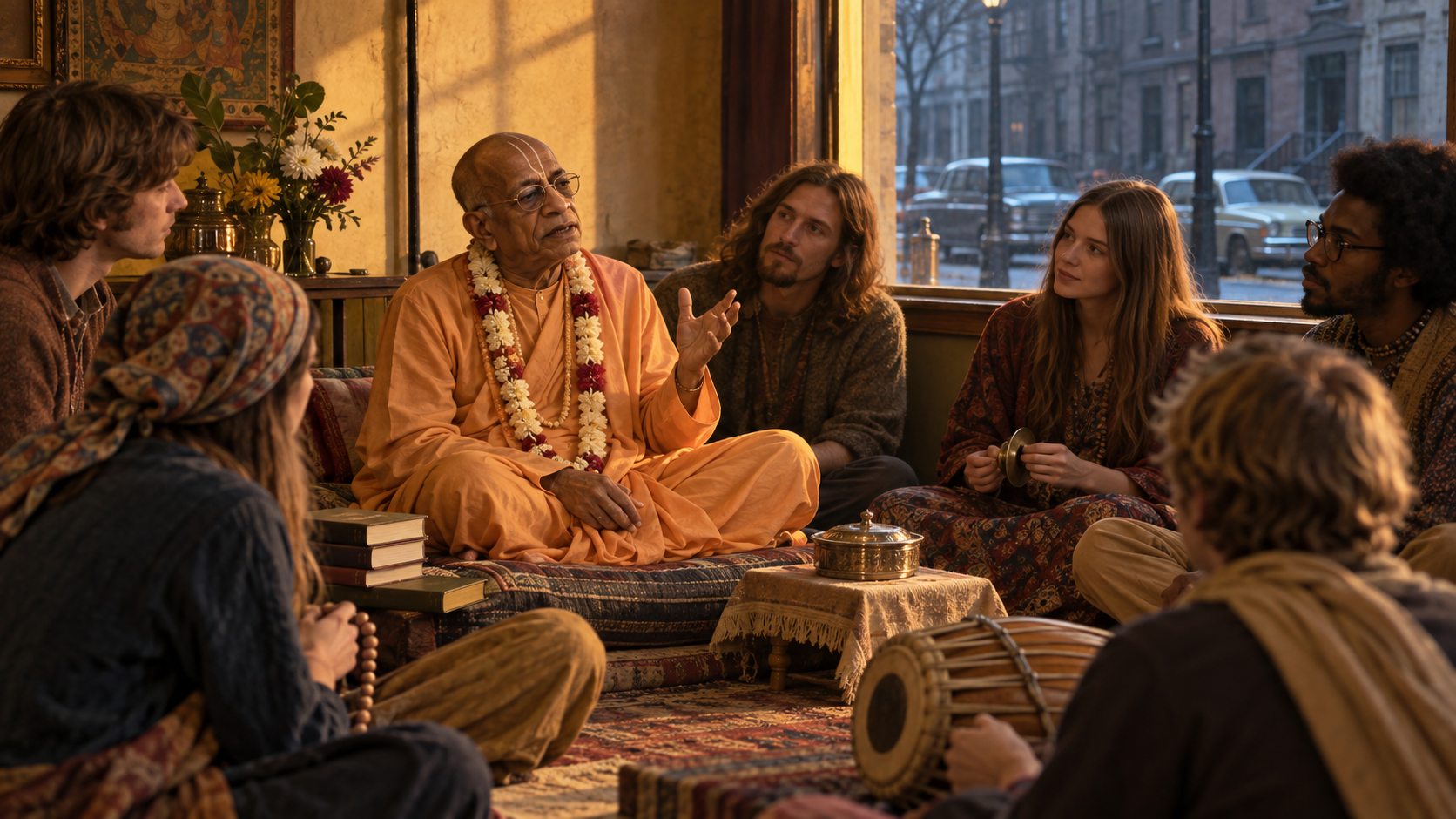
Srila Prabhupada’s 1965 voyage to America is the clearest hinge in his public life. It was more than a journey from Bharat to another country. It expressed a conviction: a tradition rooted in guru, shastra, and disciplined sadhana could cross an ocean and speak to people formed by a very different culture.
The important point is not that he made devotion easy by removing its demands. He made its demands intelligible. Congregational chanting did not require prior mastery of Sanskrit philosophy. Hearing could begin before a newcomer understood every theological distinction. Seva gave belief a practical form. Association placed the individual beside others attempting the same discipline.
Addresses such as 26 Second Avenue and 7 Bury Place consequently matter as more than entries in an institutional timeline. They represent the moment when an inherited teaching acquired a local rhythm: people could gather, ask questions, chant, receive prasada, and return. A global mission became durable by becoming regular and local.
This gives you a better way to read his biography. Do not look only for extraordinary episodes. Notice the repeated movement from receiving to transmitting, from conviction to routine, and from solitary resolve to shared practice. The lesson is not that everyone must reproduce his external journey. It is that whatever dharma you have received remains unfinished until it shapes how you live and what you help others access.
His devotional legacy is a repeatable discipline
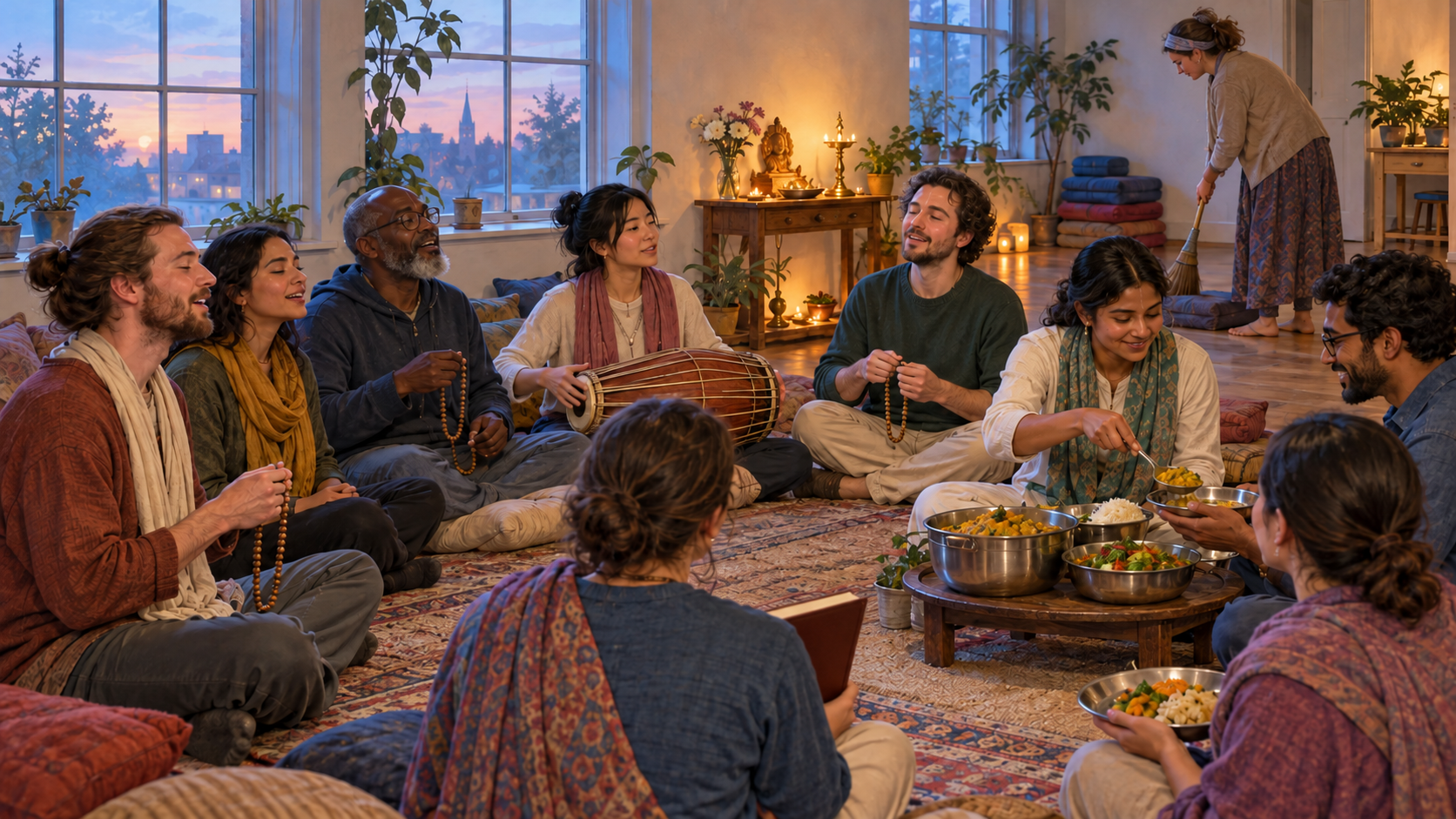
Srila Prabhupada is sometimes remembered chiefly as a powerful speaker, an institution builder, or the central personality in ISKCON’s formative history. Those descriptions identify parts of his work, but they can obscure its devotional centre. His method joined practices that support and correct one another.
- Hearing gives devotion content. It keeps spiritual life from becoming a projection of whatever you already prefer to believe. Listen for the teaching’s central claim, the scriptural reasoning behind it, and the change it asks you to make.
- Chanting turns remembrance into an embodied act. The voice, attention, and community are engaged together. The practical test is not how moving a session appears from outside, but whether you actually return your attention when it wanders.
- Study protects practice from vagueness. Read a complete passage or follow a complete discourse instead of building an impression from isolated quotations. Context reveals the question being answered and the limits of the answer.
- Seva exposes self-centred spirituality. Service asks whether devotion changes what you are willing to do, including necessary work that attracts no recognition.
- Association makes correction possible. A community can encourage regularity, preserve forms of practice, and challenge private interpretations. It should help you become more truthful and responsible, not merely more certain of your group identity.
These elements form a practical diagnostic. If remembrance of Srila Prabhupada produces emotion but no hearing, chanting, study, service, or better conduct, the remembrance has not yet matured into inheritance. Begin with one practice, give it a fixed place in your routine, and let it lead naturally to the others.
Judge the teacher, teaching, institution, and followers separately
Anyone seriously examining Srila Prabhupada will eventually encounter both reverence and criticism. You do not need to choose between unquestioning idealisation and reflexive dismissal. You need a sound method of judgment.
- Examine the person. Ask what commitments governed his choices, what sacrifices his mission required, and whether his conduct illuminates the principles he taught. The honorific “Srila” expresses devotional reverence; it should not be mistaken for a demand that every reader suspend inquiry.
- Examine the teaching. Identify its claims about the self, Bhagavan, duty, devotion, and liberation. Ask how those claims are grounded and how they fit together. Agreement or disagreement should follow understanding.
- Examine the institution. An institution gives teaching continuity through communities, roles, places, and routines. It also consists of fallible human beings. Respect for a guru does not require pretending that every later administrative choice is sacred.
- Examine later followers. A disciple may embody a teaching well, poorly, or selectively. Neither virtue nor failure can automatically be projected backward onto every principle the teacher articulated.
This four-part distinction prevents two common mistakes. The first is to defend every institutional act because the founder is revered. The second is to dismiss a body of teaching because a follower failed to live by it. Both shortcuts replace discernment with association.
Devotional biography has its own purpose within a living tradition. It remembers a sacred life in a way meant to awaken faith and practice; it is not the same genre as a detached modern biography. Read it with sympathy for that purpose, while still distinguishing documented events, devotional interpretation, and the lessons drawn from them.
A global mission can remain rooted in Bharat
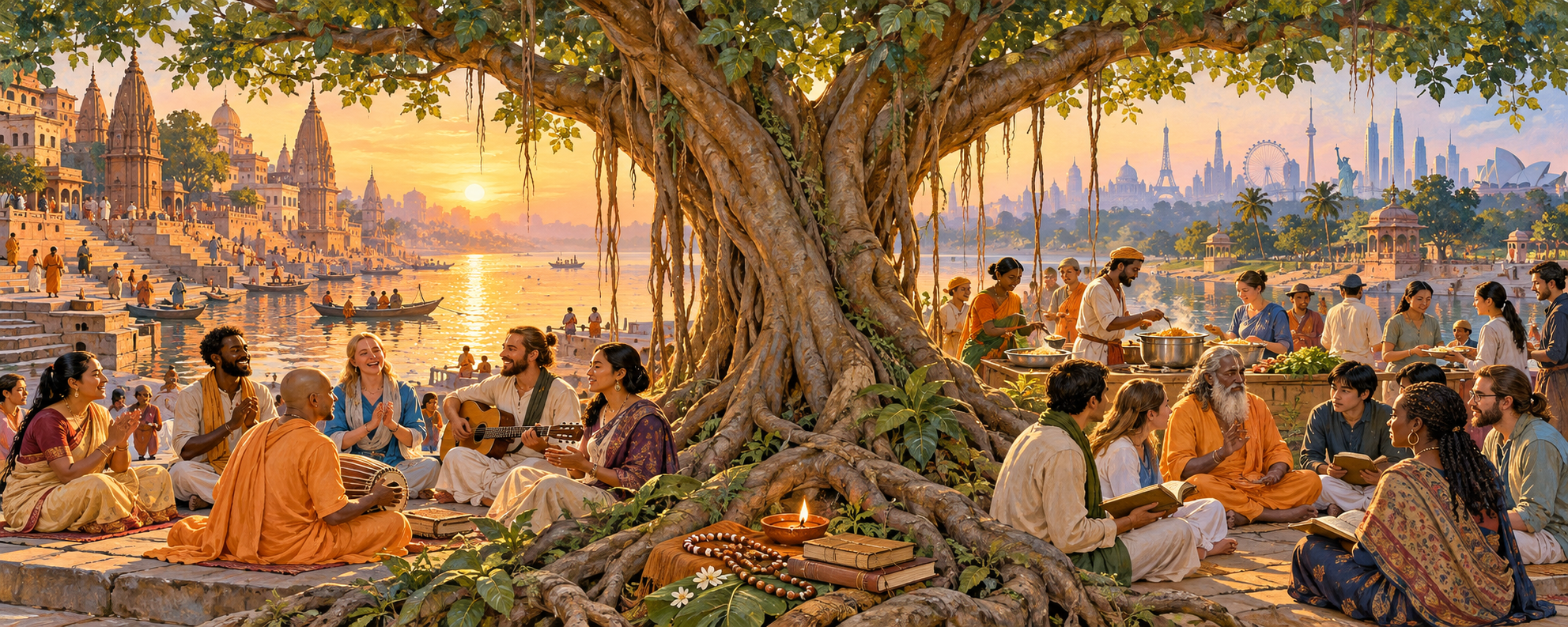
Srila Prabhupada’s international mission carries a lesson for anyone concerned with Bharat’s civilisational influence. A Dharmic tradition does not become universal by concealing where it came from. Nor does fidelity require leaving every explanation locked inside the language and social assumptions of its place of origin.
The real work is translation without severance. Essential practices and philosophical claims remain recognisable, while explanations, schedules, community forms, and points of entry become accessible to new people. When adaptation removes the centre, the tradition becomes a cultural mood. When preservation refuses all explanation, the tradition may remain intact yet inaccessible. Srila Prabhupada’s mission occupied the demanding ground between those failures.
This is why the legacy cannot be reduced to a one-way story in which Bharat gave something and the world merely received it. Once communities took root elsewhere, practitioners had to learn how to preserve discipline across languages, generations, and local circumstances. The continuing work is reciprocal: inherited wisdom guides new communities, and the questions of those communities force teachers to explain what is essential, what is customary, and what may adapt.
Devotional memory also returns to its sacred geography. In October 2026, devotees at ISKCON Vrindavan continued hearing accounts of Srila Prabhupada’s life. Within such a setting, biography is not celebrity recollection. It functions as sadhana when hearing about the teacher renews attention to the discipline he transmitted.
Turn admiration into a lived encounter

You do not need to settle every historical or institutional question before beginning an honest encounter with Srila Prabhupada’s legacy. You do need to move beyond fragments. Use the following sequence.
- Choose a complete unit of his teaching. Read one coherent chapter or hear one complete discourse published under his name. Do not substitute quotation images or short argumentative clips for context.
- Write down the central question. Note what problem is being addressed, which principle answers it, and what practice follows. This keeps reverence from becoming passive consumption.
- Test one devotional discipline. Set aside a regular time for attentive chanting, hearing, or study. Alternatively, undertake a specific act of seva that you can complete without public recognition.
- Enter a community as a learner. Observe whether its worship, teaching, hospitality, and treatment of people reinforce one another. Ask how newcomers are taught, how questions are handled, and how responsibility is exercised.
- Examine the fruit. Look for greater steadiness, honesty, humility, and willingness to serve. Emotional intensity may accompany devotion, but it cannot replace character.
- Return to the life with a practitioner’s question. Instead of asking only, “What remarkable thing happened?”, ask, “What commitment made this action possible, and where does my own commitment remain theoretical?”
Key takeaways
- The 1965 voyage matters because it demonstrates that a rooted Dharmic practice can cross cultures without abandoning its centre.
- Srila Prabhupada’s most durable legacy is a connected discipline of hearing, chanting, study, association, prasada, and seva.
- A fair assessment distinguishes the guru, his teachings, the institution, and the conduct of later followers.
- Devotional biography should awaken practice, not merely enlarge a personality’s fame.
- You can test the legacy by engaging a complete teaching, practising consistently, and judging the resulting character rather than the surrounding image.
Begin with one complete teaching and one repeatable act of devotion. Keep both small enough to sustain and serious enough to test you. Srila Prabhupada’s life becomes most intelligible at that point: not when you have collected every story about him, but when receiving dharma begins to create responsibility in your own life.
References

Leave a Reply
You must be logged in to post a comment.