

If you help run a mandir, volunteer at festivals or simply bring your family to worship, the alleged attack in Aurora leaves you with a difficult question: what should change now? The answer cannot be panic, but it cannot be business as usual either.
A coworker’s warning and a weapon malfunction may have prevented mass casualties. Neither is a security system. Hindu communities need a disciplined way to recognize threats, preserve evidence, reach law enforcement and protect crowded observances without turning sacred spaces into fortresses.
What allegedly happened at the Aurora temple
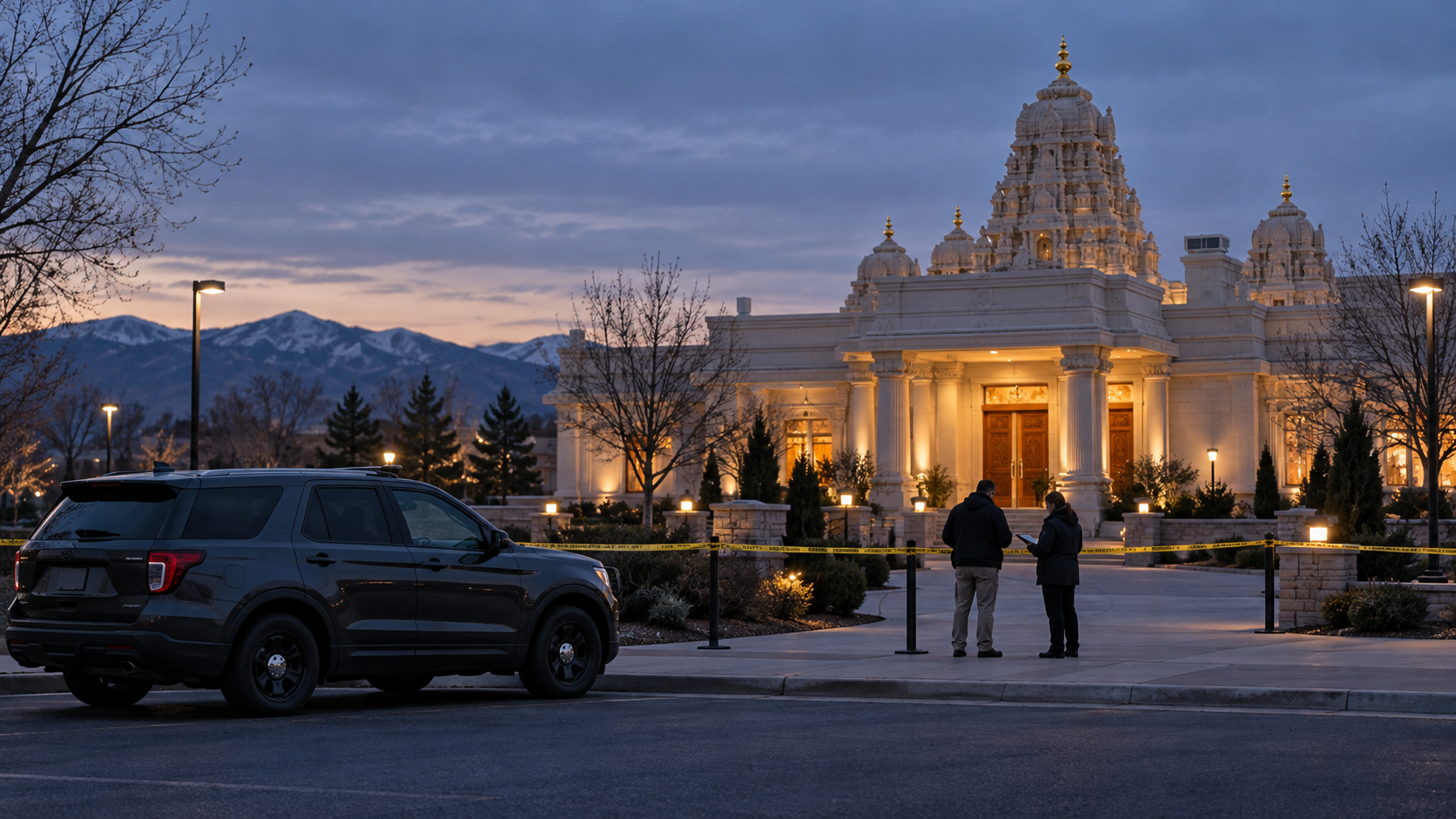
On October 11, 2026, devotees were celebrating Navratri at the Sri Venkateswara Swami, or Balaji, Temple in Aurora, Illinois. Prosecutors allege that 19-year-old Alexandros Paporakis of Palatine drove there with an AR-style rifle, tactical equipment and approximately 300 rounds of ammunition. He allegedly tried to fire the rifle, but it jammed.
The investigation began after a coworker alerted law enforcement to disturbing electronic communications containing details of the alleged plan. Police later searched Paporakis’s residence and reportedly recovered a rifle, loaded magazines, hundreds of rounds, body armor and material associated with white-supremacist ideology. An alleged manifesto contained racist hostility toward people of Indian descent as well as Black and Jewish people. Prosecutors say the planning had lasted about two years and the temple had been the focus for roughly two months.
Paporakis was arrested later that evening and charged with making a terrorist threat and unlawfully possessing a rifle with a barrel shorter than 16 inches. A judge ordered him detained on October 14, and his next court appearance was scheduled for October 30. These are allegations in a pending criminal case, not findings of guilt.
That distinction matters. Responsible advocacy can describe the target, the alleged preparation, the reported racist material and the charges without declaring a verdict before the court does. You do not strengthen the case against Hinduphobia by overstating what has been legally established.
The federal dimension is also unresolved. Congressman Raja Krishnamoorthi, who was inside the temple with family members, led 105 members of Congress in asking the FBI to examine the incident as a potential federal hate crime. Their October 20 request also asked how the bureau identifies and addresses credible online threats against Hindus, Americans of Indian origin and other communities. A request for investigation is important, but it is not itself a federal hate-crime determination.
Why an online threat cannot be dismissed as mere speech

The most consequential warning in Aurora did not come from a checkpoint at the temple. It came from a person who saw alarming communications and reported them. That sequence should change how you think about online hatred: the relevant question is not only whether a message is offensive, but whether it contains signs of preparation, target selection, access to weapons or an approaching time and place.
A 2022 Rutgers University and Network Contagion Research Institute study examined dehumanizing anti-Hindu rhetoric on social media, including its circulation in white-supremacist networks and its potential to move toward physical violence. Aurora gives that concern a concrete form: prosecutors allege an identified temple, a period of focused planning, equipment, ammunition and an attempted discharge during a major Hindu observance.
Not every ugly post is an imminent attack, and treating every insult as an emergency will bury the signals that require urgent attention. Use a simple distinction:
- Hostile opinion or religious abuse: document it when it forms part of a pattern, use platform reporting tools where appropriate and do not reward it with indiscriminate amplification.
- A targeted threat: preserve the exact words, account name, link, date, time and surrounding conversation; notify the person or institution being targeted and report it to law enforcement.
- An immediate or developing danger: move away from the danger, call 911 in the United States and give the dispatcher concrete observations rather than conclusions.
Do not crop away context or repeatedly forward threatening material through community groups. Save the original link and complete thread, take screenshots, note when you saw it and record any changes made afterward. Avoid contacting the person who posted it. Confrontation can increase danger, alert a suspect that evidence is being preserved or complicate an investigation.
Temple leaders should establish one reporting address or phone number that responsible volunteers actually monitor. If devotees do not know where to send a concern, useful information will remain scattered across private chats. The receiving person should acknowledge the report, preserve it and escalate it according to urgency. They should not conduct their own undercover investigation.
A broader pattern deserves attention without careless generalization. Since 2022, CoHNA has catalogued more than a dozen incidents involving Hindu places of worship. The reported incidents include gunfire at the Sri Sri Radha Krishna Temple near Spanish Fork, Utah, in June 2025; bricks thrown through a temple’s windows in Richmond Heights, Ohio, in October 2026; and vandalism at temples in California and New York. The events differ in conduct, evidence and legal status. They should not be flattened into one adjudicated conspiracy, but neither should each event be isolated so completely that a recurring risk becomes invisible.
A temple security plan that preserves the character of worship

Security works best when responsibility is assigned before a festival begins. A large gathering is the wrong moment to discover that everyone assumed someone else would call the police, guide families or meet emergency responders.
- Name a security lead and a backup. Put their contact details on the volunteer sheet. Define who calls emergency services, who communicates with priests and organizers, who meets responders and who issues verified updates to families.
- Walk through the building before a major observance. Identify entrances, lawful emergency exits, gathering areas, rooms used by children and places where older or mobility-impaired devotees may need assistance. Never block a required exit in the name of security.
- Use layered access, not ethnic or racial profiling. Keep the main public entrance clearly identifiable and attended during crowded events. Secure doors that should not be used for entry while maintaining safe egress. Give volunteers a way to report suspicious behavior based on conduct, threats or prohibited objects, not a person’s race, clothing, accent or faith.
- Coordinate with local law enforcement in advance. Provide the temple’s address, event calendar, estimated areas of crowding and a reliable contact. Ask how the department wants non-immediate threats reported and whether officers can conduct a site walk-through. Keep sensitive security details off public social-media pages.
- Create an evidence protocol. Preserve threatening emails, direct messages, voicemails and letters in their original form. Record when and how each item was received, who handled it and when it was provided to authorities. If disclosure or evidence preservation raises legal questions, consult law enforcement or qualified counsel.
- Brief volunteers on a few clear decisions. They should know how to summon help, where to direct emergency responders, how leaders will communicate an evacuation or shelter instruction and how to assist children and vulnerable devotees. Medical aid should be given only within the volunteer’s training.
- Control information after an incident. Designate one person to communicate confirmed facts. Do not circulate an unverified suspect’s identity, alleged motive, private information or graphic material. Ask witnesses to give their evidence directly to investigators rather than harmonizing stories in a group chat.
- Review what failed and what worked. After the event, update contacts, access procedures and volunteer roles. A plan that exists only in a binder will not help when the people named in it are absent.
No checklist can guarantee safety, and every building has different fire, occupancy and accessibility requirements. A local law-enforcement liaison or qualified security professional should review measures that affect entry, surveillance or emergency movement. The purpose is not to make a mandir feel militarized. It is to remove predictable confusion while worship continues.
Devotees have a smaller but important role. When you arrive at a crowded celebration, notice the ordinary exits and follow instructions from designated volunteers. If you see a weapon or immediate threat, prioritize distance and emergency reporting over recording video. Tell the dispatcher what you directly observed: the location, appearance, direction of movement and presence of a weapon. Separate observation from inference. A precise report is more useful than an emphatic but speculative one.
How to name Hinduphobia without weakening the case

Anti-Hindu hatred should be identified from evidence: selection of a Hindu institution, hostility toward Hindus or people of Indian descent, desecration of Hindu symbols, threats tied to Hindu observance or conduct intended to intimidate devotees. In Aurora, the alleged choice of a Hindu temple during Navratri and the reported hostility toward people of Indian descent provide concrete reasons to investigate anti-Hindu and anti-Indian bias.
The alleged hostility toward Black and Jewish people does not cancel the Hindu dimension. It indicates a wider dehumanizing worldview in which several communities can be targeted. Solidarity with those communities is not a distraction from Hindu safety; it is a practical rejection of the same ideology.
Precision also means resisting two common errors. The first is erasure: calling an attack on a mandir merely “generic extremism” when evidence points to the Hindu identity of the target. The second is inflation: assigning a hate-crime motive before investigators have established the relevant facts. Name what is known, label allegations as allegations and press authorities to answer specific questions.
Temple boards and community organizations can ask public officials for three practical commitments: a named law-enforcement contact for places of worship, a clear channel for escalating credible electronic threats and transparent follow-up after a report is submitted. Those requests are more useful than a general demand to “do something” because responsibility and response can be tracked.
Key takeaways
- The Aurora defendant has been charged, not convicted; describe the alleged conduct precisely and do not prejudge the case.
- Threats become more urgent when they include a named target, operational preparation, weapons access or timing connected to an event.
- Preserve original electronic evidence, report immediate danger to 911 and do not confront or publicly investigate a suspected attacker.
- A temple needs named decision-makers, a law-enforcement contact, safe access procedures and trained volunteers before a major gathering begins.
- Hinduphobia should be neither erased nor exaggerated. Tie the term to the target, words and conduct supported by evidence.
Before your temple’s next major gathering, put three things in writing: who receives threat reports, who makes the emergency call and who communicates instructions to devotees. Then walk through the plan with the people who will actually be present. Aurora’s narrow escape should become a reason for competent preparation, not permanent fear.
References

Leave a Reply
You must be logged in to post a comment.