
If you are planning November worship, temple visits, fasting, or family gatherings, four dates deserve an early place in your calendar: November 14, 17, 19, and 26. November 17 needs particular attention because two observances fall on the same Kartik Shukla Ashtami.
Do not treat a Hindu calendar as a list of civil dates alone. Tithi, lunar month, region, sampradaya, and family custom all matter. Use the dates below to plan, then confirm the applicable timing with the panchang followed by your household or local temple.
November 2026 dates at a glance
| Date | Observance or calendar point | Who should note it | Lunar basis or practical note |
|---|---|---|---|
| November 2 | Krishna Paksha Ashtami changes to Navami at 4:55 PM | Anyone using the daily panchang for a vrata, sankalpa, or ritual decision | A useful reminder that a tithi can change during a civil day; verify the time for your location |
| November 14 | Kartik Nagula Panchami | Especially Telugu and Andhra traditions that observe Nagula Panchami in Karthika Masam | Karthika Shukla Panchami; this is a regional observance distinct from the more widely observed Shravana occasion |
| November 17 | Gopashtami | Krishna devotees, cow-protection communities, temples, and families whose tradition keeps the vrata | Kartik Shukla Ashtami |
| November 17 | Karthaveerya Arjuna Jayanti | Communities and families that worship Karthaveerya Arjuna | Kartik Shukla Ashtami; it shares the date with Gopashtami but remains a distinct observance |
| November 19 | Yagnavalkya Jayanti | Communities that commemorate Maharshi Yagnavalkya in Kartik | Kartik Shukla Dashami; some other communities observe the jayanti on Phalgun Shukla Panchami instead |
| November 26 | First Manabasa Gurubar | Odia households and communities following the Margasira observance | The Pratham Pali begins a sequence of five consecutive Thursdays |
This is a focused planning calendar rather than an exhaustive catalogue of every local vrata, temple utsava, or sampradaya-specific occasion. If your family follows a regional panjika, retain its entries even when they do not appear in a general calendar.
Read the date, tithi, and tradition together

The easiest mistake is to copy a date into a phone and discard the information that made the date meaningful. A civil date answers when you should look. The tithi and customary observance rule determine whether that date applies to your practice.
November 2 shows why this distinction matters. Krishna Paksha Ashtami lasts only until 4:55 PM before Navami begins. That does not mean every reader should automatically use the displayed time. Panchang timings are location-sensitive, and different vratas can apply different rules when a tithi crosses part of a day.
- Choose the city where you will actually perform the observance. Do not use the timing for relatives in Bharat if you will be observing in another country.
- Check whether your family follows an amanta or purnimanta month reckoning and which regional panchang or panjika it trusts.
- Confirm the tithi applicable to the ritual, not merely the tithi visible at midnight on the civil calendar.
- Ask your family priest or temple whether its observance follows a particular tithi-presence rule. That question is more useful than asking only, “What is the date?”
- Record both the civil date and the lunar basis in your calendar entry. For example: “Gopashtami — November 17 — Kartik Shukla Ashtami.”
This method also prevents a regional custom from being mistaken for a universal obligation. Nagula Panchami in Karthika Masam and Manabasa Gurubar in Margasira belong to living regional calendars. Their regional character does not make them secondary; it tells you whose inherited practice should guide the preparation.
What to prepare for each observance
November 14: Kartik Nagula Panchami
Nagula Panchami falls on Karthika Shukla Panchami in the Andhra observance. Many people know Naga Panchami primarily as a Shravana festival, so a generic calendar can lead them to overlook this Karthika date.
If your household follows the Telugu or Andhra custom, contact the elder or temple that transmits your family procedure before buying puja materials. Keep the regional vrata intact rather than assembling a ritual from instructions meant for the Shravana observance. If your family does not keep Kartik Nagula Panchami, the date need not be turned into a new obligation merely because it appears on a wider Hindu calendar.
November 17: Gopashtami and Karthaveerya Arjuna Jayanti
Gopashtami commemorates the moment when Nanda Maharaj entrusted Krishna and Balarama with herding cows, marking their entry into the life of cowherds. The observance therefore directs attention toward Sri Krishna’s pastoral lila and the Dharmic duty of regard for cows. In 2026 it falls on November 17, Kartik Shukla Ashtami.
The same tithi carries Karthaveerya Arjuna Jayanti. Karthaveerya Arjuna is remembered as the king of Hehaya and a devotee associated in devotional practice with prayers concerning obstacles and lost property. Such worship expresses faith and sankalpa; it should not be presented as a guaranteed way to recover an object or resolve a dispute.
Because the two observances share a date, label them separately in a community programme. A temple may keep one, both, or neither according to its lineage. If your household follows both, ask whether the pujas should be performed independently rather than merging their names, narratives, and intentions into one ceremony.
November 19: Yagnavalkya Jayanti
Maharshi Yagnavalkya is commemorated by some communities on Kartik Shukla Dashami, which falls on November 19 in 2026. Other communities place his jayanti on Phalgun Shukla Panchami. That variation is not a clerical error that a universal calendar can settle.
If this jayanti belongs to your lineage, verify which of the two traditions it follows before inviting others or announcing a temple programme. Put “Kartik observance” in the November entry so that it is not confused with the Phalgun date followed elsewhere.
November 26: Manabasa Gurubar begins
For Odia families, November 26 is not an isolated festival date. It is the Pratham Pali, or first Manabasa Gurubar, of Margasira. The observance continues across five consecutive Thursdays, so preparation should cover a sequence rather than a single day.
Create the recurring calendar commitment when you add the first Thursday. Before the sequence begins, settle who will be present, which household tradition you will follow, and where the required items will come from. Families living outside Odisha should ask an elder for the customary form instead of assuming that a general Lakshmi-puja checklist captures an Odia Margasira practice.
Key takeaways for your November calendar
- Mark November 14 for Kartik Nagula Panchami if your Telugu or Andhra tradition observes it.
- Reserve November 17 carefully: Gopashtami and Karthaveerya Arjuna Jayanti share Kartik Shukla Ashtami but remain distinct observances.
- Use November 19 for Yagnavalkya Jayanti only if your community follows the Kartik Shukla Dashami tradition; others keep a Phalgun date.
- Treat November 26 as the beginning of the five-Thursday Manabasa Gurubar sequence, not as a one-day commitment.
- Use November 2 as a practical reminder that a tithi can change within a civil day and that local timing must be checked.
Build a calendar you can actually follow
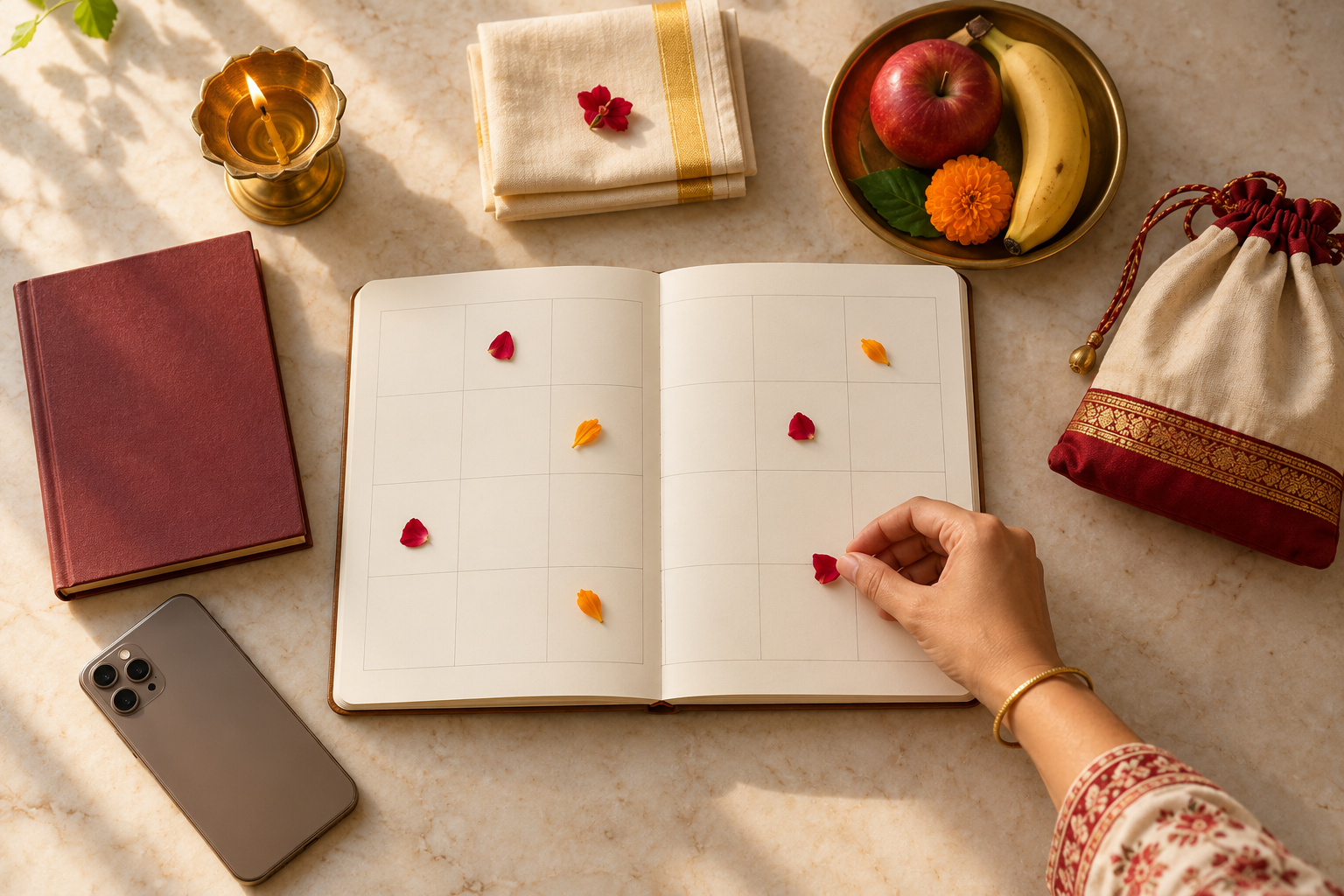
For each observance you intend to keep, create one calendar entry with four fields: civil date, tithi and lunar month, regional or lineage context, and the person or temple whose timing you will confirm. Add preparation reminders only after that entry is correct. This small discipline preserves both practical order and the diversity of Hindu calendrical traditions.
Start with November 17 if you need to coordinate a temple or community event, and with November 26 if your household keeps Manabasa Gurubar. Those dates involve either overlapping observances or a multiweek commitment, so they are the points where early planning will save the most confusion.
References
- Hindu Blog — November 2 2026 Tithi – Panchang – Hindu Calendar – Good Time – Nakshatra – Rashi
- Hindu Pad — Manabasa Gurubar 2026: Dates, Decoration, Puja Items, Ritual Significance
- Hindu Pad — Gopashtami 2026 | Gopashtami Vrata
- Hindu Pad — Karthaveerya Arjuna Jayanthi 2026 | Karthaveerya Uthpatthi
- Hindu Pad — Nagula Panchami during Karthika Masam in Andhra Pradesh
- Hindu Pad — Yagnavalkya Jayanthi 2026 | Yajnavalka Maharshi Jayanti

Leave a Reply
You must be logged in to post a comment.