

If you are considering a Kaveri pilgrimage during Tula month, the central question is not how many ritual details you can collect. It is how to make one sacred bath a truthful act of purification rather than a brief devotional event that leaves your daily conduct untouched.
The observance has a clear center: bathe in Kaveri while the Sun is in Tula, remember her sacred glory, and join the snana with charity and religious action. The tradition also makes extraordinary promises about the bath. To receive those promises responsibly, you need to hold grace and personal accountability together.
Why Tula is not just another month on Kaveri’s banks

Within the Agni Purana tradition, Tula is the season set apart for remembering Kaveri, bathing in her waters, and performing dana and other dharmic acts. Its sanctity is expressed through sacred geography: all holy tirthas are said to unite with Kaveri during this month. The traditional account gives the immense figure of 66,000 crore tirthas across the worlds.
This is not a claim about visible streams physically entering the river. It tells you how sacred time changes the meaning of sacred place. A bath during Tula is approached as contact with the gathered sanctity of the tirthas, not as ordinary contact with river water.
The praise extends beyond immersion. Even a breeze that has passed over Kaveri is described as liberating, while residence on her banks is treated as an exceptional blessing. The point is not to replace snana with a passing breeze. It is to notice that the river is revered as a living field of divine presence, not merely as the setting for a ritual.
A series of comparisons makes that status unmistakable. As Tulasi is exemplary among sacred plants, Ekadashi among vratas, Om among sounds, purity of mind among spiritual attainments, and food-giving among gifts, Kaveri is praised as foremost among flowing rivers. These comparisons give you a practical key: the outer bath belongs with disciplined observance, inner purification, and generosity.
Do not choose the pilgrimage date by guessing from a fixed civil-calendar date. The ritual window is tied to the Sun’s presence in Tula. Check the relevant dates in the panchanga followed by your family, temple, or intended Kaveri ghat, and confirm any locally observed principal bathing day before arranging travel.
The question behind the Mahatmyam is larger than sin
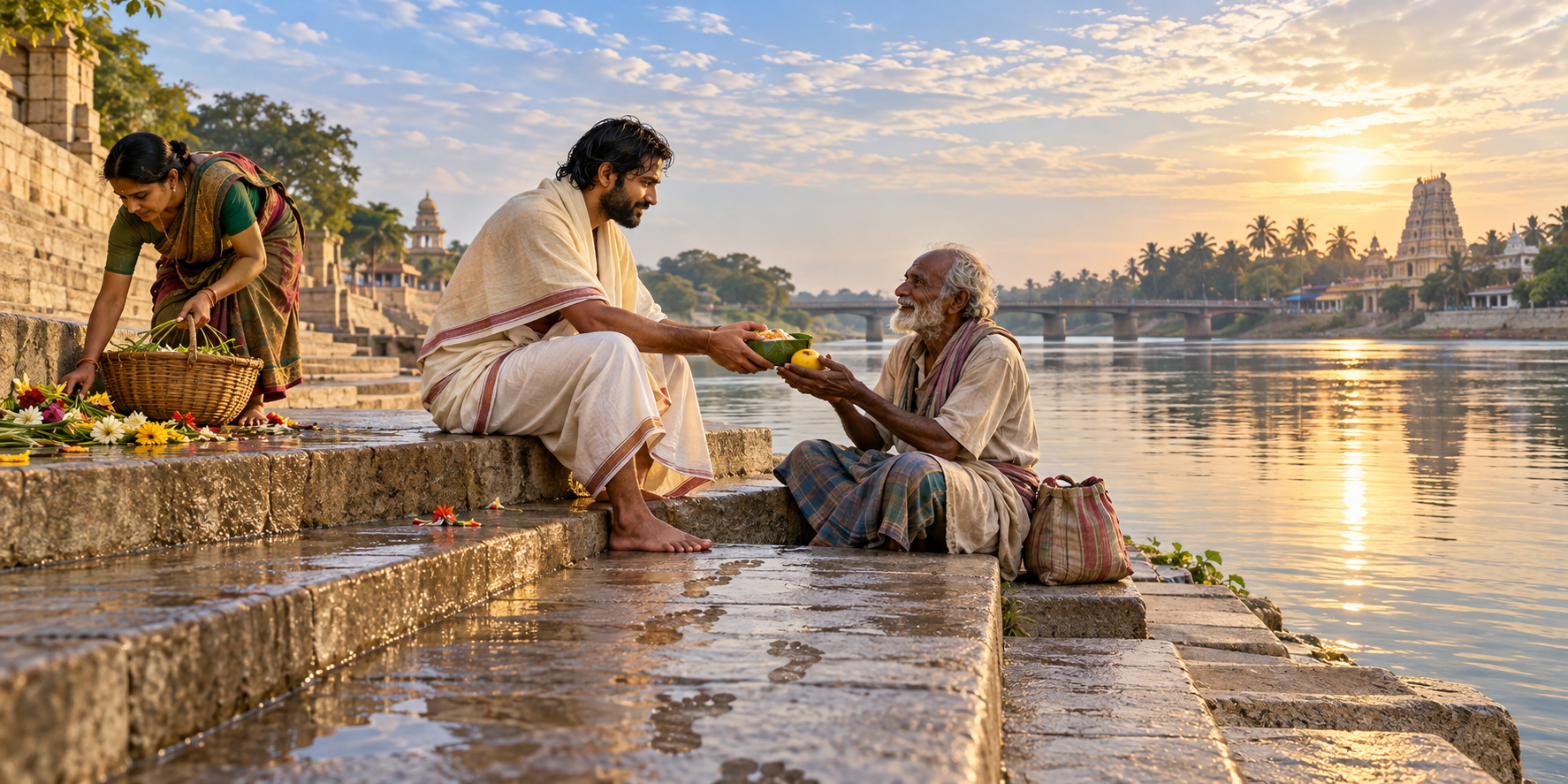
The teaching begins with Rajarishi Dharmavarma asking Sage Dalbhya how a person may gain rightful prosperity, reduce sin, accumulate punya, enjoy legitimate worldly life, and finally attain liberation. Dalbhya answers by repeating the instruction Sage Agastya had given King Harischandra. Harischandra is directed toward sacred bathing after his service in a cremation ground, and Kaveri snana during Tula is singled out for exceptional merit.
That narrative prevents a narrow reading of the observance. Thula Kaveri snana is not presented only as an emergency method for removing guilt. It is connected with all four purusharthas: Dharma, Artha, Kama, and Moksha. In other words, the pilgrim brings the whole shape of life to the river.
A useful preparation is to write one honest sentence for each purushartha before you travel:
- Dharma: Which neglected duty, harmful habit, or broken relationship needs correction?
- Artha: Is the way you earn, spend, save, or give wealth consistent with dharma?
- Kama: Which desire needs rightful boundaries rather than denial or indulgence?
- Moksha: What attachment, resentment, or false identity are you ready to loosen?
This reflection is not a substitute for the bath and is not presented as a mandatory historical ritual. It is a way to approach the traditional promise without reducing it to a transaction. You arrive knowing what purification must mean after you leave the water.
How to read the extraordinary promises without misusing them
The strongest declaration cannot be ignored: even a person burdened by grave transgressions is said to attain Brahma Loka after bathing once in Kaveri during Tula. The catalogue includes dishonouring one’s parents, harming cows, improper desire, intoxication, abandonment of right conduct, neglect of Vedic study, and failure to maintain sacred discipline. The glory of the snana is also associated with Vishnu Loka.
You do not need to weaken this promise in order to read it responsibly. Its first message is that return remains possible even for someone who has fallen very far. No person should decide that purification, repentance, or a renewed dharmic life is now beyond reach.
But the promise does not say that wrongdoing becomes acceptable, that injury requires no repair, or that a bath cancels every worldly consequence. Spiritual purification, restitution, legal responsibility, and the rebuilding of trust are different matters. If you have harmed someone, Kaveri snana should strengthen your resolve to stop the harm and make the repair that remains possible. It should never become an excuse to evade it.
Use the catalogue of transgressions as a mirror rather than a list with which to judge other pilgrims. If disregard for parents is relevant, choose one concrete act of honour or care. If intoxication has disordered your conduct, let the pilgrimage mark a genuine change rather than a ceremonial pause. If learning and worship have been neglected, resume a sustainable discipline. The river bath marks a return to dharma; your subsequent conduct shows whether you meant it.
A practical way to observe Thula Kaveri snana
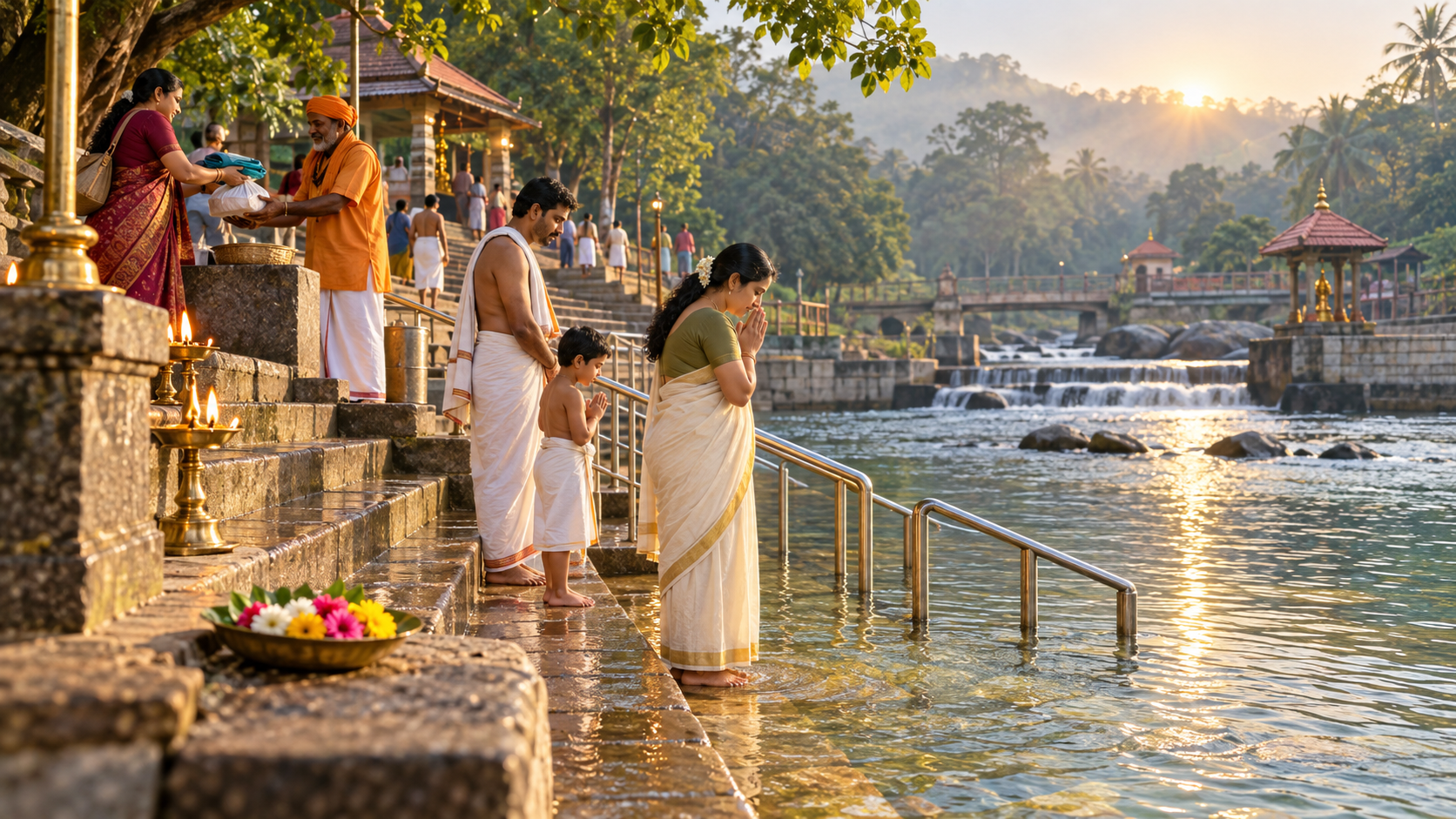
The central priorities are clear, but one universal script for every family and sampradaya is not. Preserve the mantras, sankalpa form, and temple customs you have actually received. If you do not have an inherited procedure, keep the observance simple instead of inventing elaborate requirements.
- Confirm the sacred window and the place. Use a trusted local panchanga or Kaveri temple announcement to identify the Tula period. Check ghat access and local instructions before leaving home.
- Name the purpose of the pilgrimage. Bring your four-purushartha reflection or choose one specific correction you intend to begin. A vague wish to become better is easy to forget; a named duty can be acted upon.
- Bathe reverently and safely. Kaveri snana is the central physical act. Use an accessible, managed bathing place and obey every local safety direction. Do not enter a dangerous current or force immersion when it is unsafe for you.
- Remember Kaveri without performing for an audience. Use the prayer or mantra belonging to your tradition, or offer quiet namaskara and sincere remembrance. The purpose is attention to the sacred river, not a display of ritual complexity.
- Join snana with dana. Charity and religious action belong to the observance, and food-giving receives particular praise among forms of dana. Decide beforehand whom you will serve and what you can give honestly. Give food to people; do not turn packaged offerings into litter at the river.
- Begin the corrective act promptly. Make the apology, fulfil the neglected obligation, resume study, change the harmful practice, or establish the regular act of worship you identified. Do not let the intention remain on the riverbank.
If travel or immersion is not possible, you can still honour the season through remembrance of Kaveri, worship, dana, food-giving, and renewed conduct. Do not casually claim that a home bath or remote observance is ritually identical to Kaveri snana when your tradition has not taught that equivalence. Call it what it is: a sincere devotional observance of Kaveri’s Tula glory.
Keep the river itself free of the waste generated by your visit. Cloth, plastic, food packaging, and abandoned ritual materials do not become sacred merely because they were carried to a tirtha. Reverence for Kaveri includes refusing to burden her waters.
Key takeaways
- Thula Kaveri snana belongs to the solar Tula period, so verify the dates through the panchanga or temple tradition relevant to your destination.
- The core observance joins bathing in Kaveri with remembrance, dana, religious action, and purity of intention.
- The gathering of all tirthas in Kaveri expresses a sacred convergence of time and place, not an ordinary physical event.
- The promised fruit embraces Dharma, Artha, Kama, and Moksha, so bring your whole life rather than one isolated request to the river.
- The promise of purification opens a path back to dharma even after grave wrongdoing; it does not authorize repeated harm or remove the duty to make amends.
Your next step is simple. Confirm the Tula dates and safe access with one local temple or trusted panchanga, decide your dana, and write down the one correction that must follow your bath. Go to Kaveri without chasing ritual spectacle, and let the snana become the beginning of conduct you are prepared to keep.
References

Leave a Reply
You must be logged in to post a comment.