
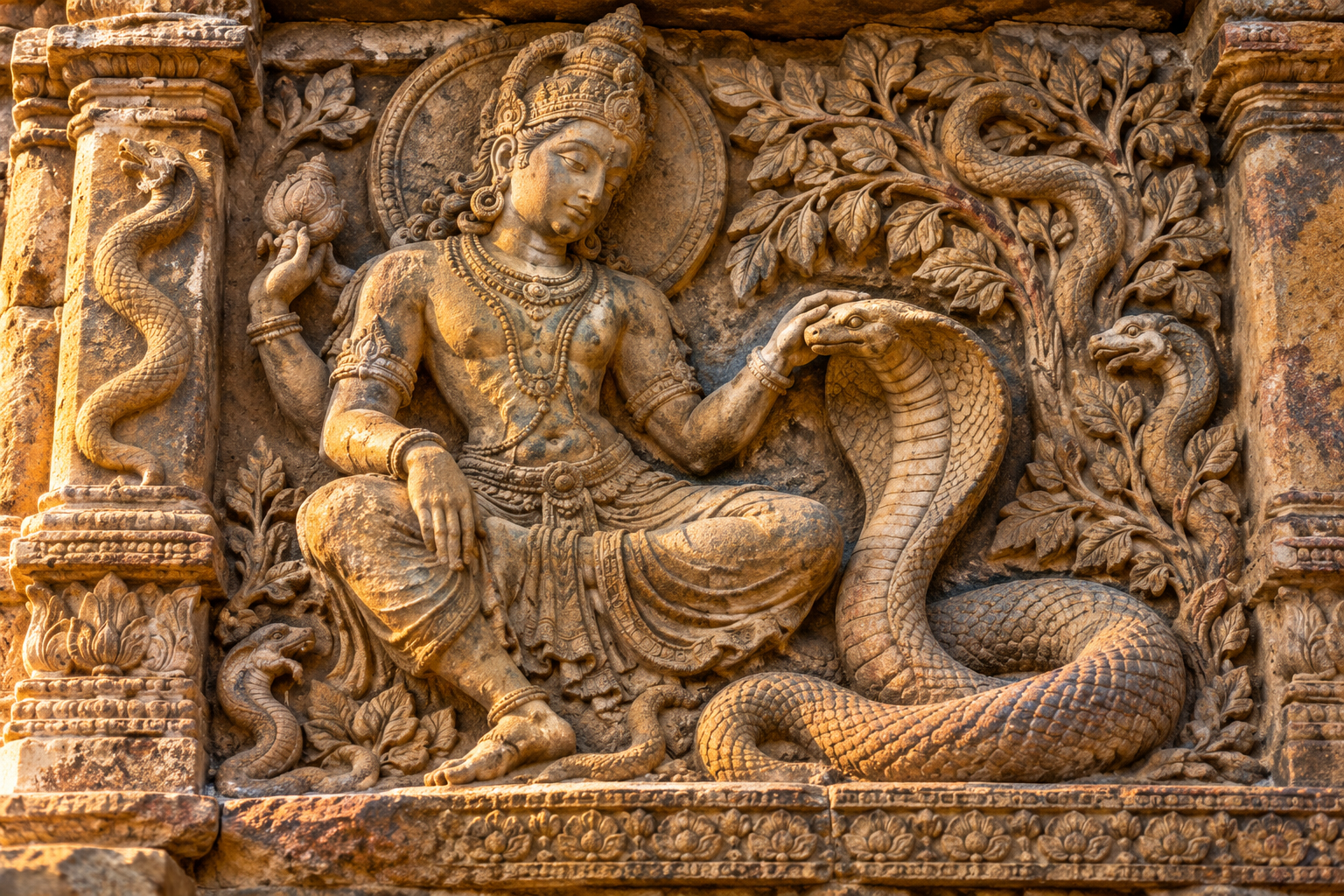
You are standing before a Hindu temple image and notice a serpent: coiled beside a figure, moving across the stone, or held in a divine hand. Is it dangerous, protective, desirable, spiritual, or something else? The honest answer is that you cannot determine its meaning from the animal alone.
The useful question is not simply, “What does the serpent mean?” Ask what this particular serpent is doing, where it appears, and how the surrounding figure relates to it. Those details let you distinguish three closely connected meanings: life, pleasure and renewal.
A serpent is not a one-word code
A sacred image works as a composition, not as a collection of symbols that can be translated one by one. A serpent may carry one meaning in motion and another when coiled. The same form may communicate living vitality, embodied pleasure or the capacity to renew. Several meanings may operate at once without becoming contradictory.
This is why treating every Hindu serpent as an emblem of evil produces a poor reading. It imports a fixed moral verdict before the image has been examined. Hindu sacred art repeatedly places the serpent on temple walls, in sculptures and in the hands of deities. Its presence within divine imagery requires you to consider sacred power and living movement, not only threat.
Keep three levels separate when you look:
- What you can see: posture, motion, placement and physical relationship.
- What the composition establishes: whether the serpent is approached, carried, contained, adorned, watched or allowed to move freely.
- What the image may teach: a meaning such as vitality, enjoyment, transformation or disciplined power.
Begin with the first level. If you jump straight to the third, you are likely to make the image confirm an interpretation you brought with you.
Life, pleasure and renewal are three connected meanings
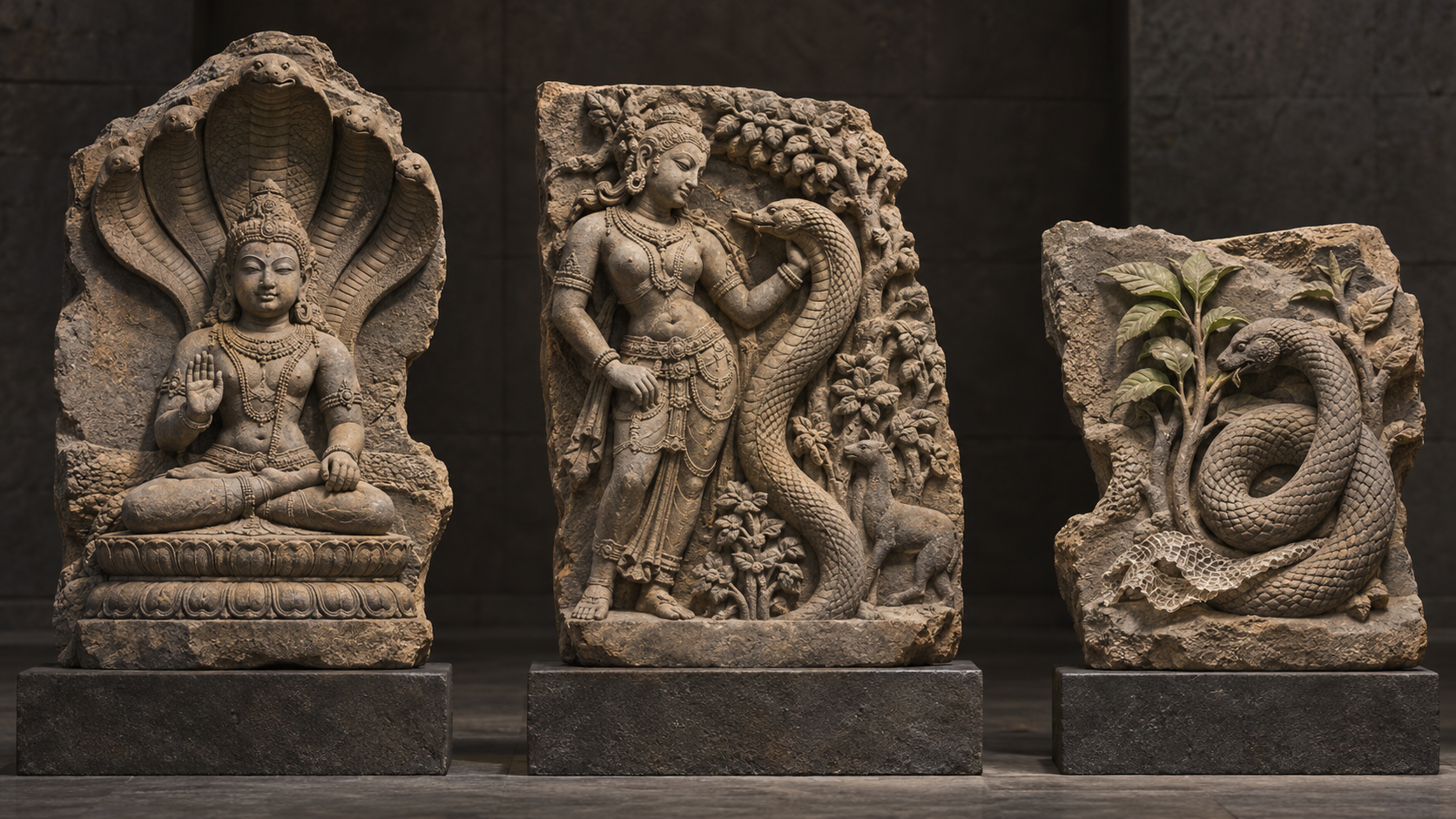
Life appears as movement
A slithering serpent makes life visible. Its body does not merely occupy space; the whole form becomes movement. It advances without limbs, keeps close contact with the ground and continuously reshapes itself as it travels. In a still sculpture, that winding line can make the stone appear animate.
When the artist clearly emphasizes motion, test vitality as your first interpretation. Follow the body with your eye. Does its curve lead toward the deity, circle a form, or carry your attention across the composition? The direction of movement may matter more than the species of snake.
Do not immediately turn every moving serpent into the name of a particular doctrine or practice. Begin with what the image securely gives you: living force in motion. Add a more specialized interpretation only when other features of the image support it.
Pleasure belongs to embodied life
Pleasure can sound surprising because many modern viewers expect a religious symbol to reject the body. The serpent complicates that expectation. Its supple movement, tactile presence and nearness to the earth can affirm life as something experienced through a body rather than contemplated only as an abstraction.
This does not make every serpent an erotic sign, nor does it turn sacred imagery into approval of uncontrolled appetite. Pleasure is the capacity to experience and enjoy embodied existence. Whether that capacity is harmonious, excessive, governed or transformed depends on the whole composition.
Look for the image’s treatment of proximity. Is the serpent worn comfortably, held without fear, or integrated into ornament? Such details make an affirmative reading of embodied power more plausible. If the relationship is tense or adversarial, pleasure may be a weaker interpretation than danger, restraint or transformation.
Renewal means change with continuity
A serpent sheds its old skin yet remains the same living being. That observable pattern makes it a fitting image of renewal. The symbolism is more exact than a vague promise to “start over”: an outer condition is left behind while life continues.
Read renewal carefully. It does not necessarily mean that the past is erased, that change is painless, or that the being has become immortal. It means that life can outgrow a former covering. That distinction is useful whenever a sacred image asks you to think about transformation without imagining total destruction.
If you are contemplating the image personally, ask a precise question: what has become a constricting skin rather than an essential part of who you are? That question stays close to the symbol. It is more fruitful than using “transformation” as an attractive but undefined word.
Posture and placement decide which meaning leads
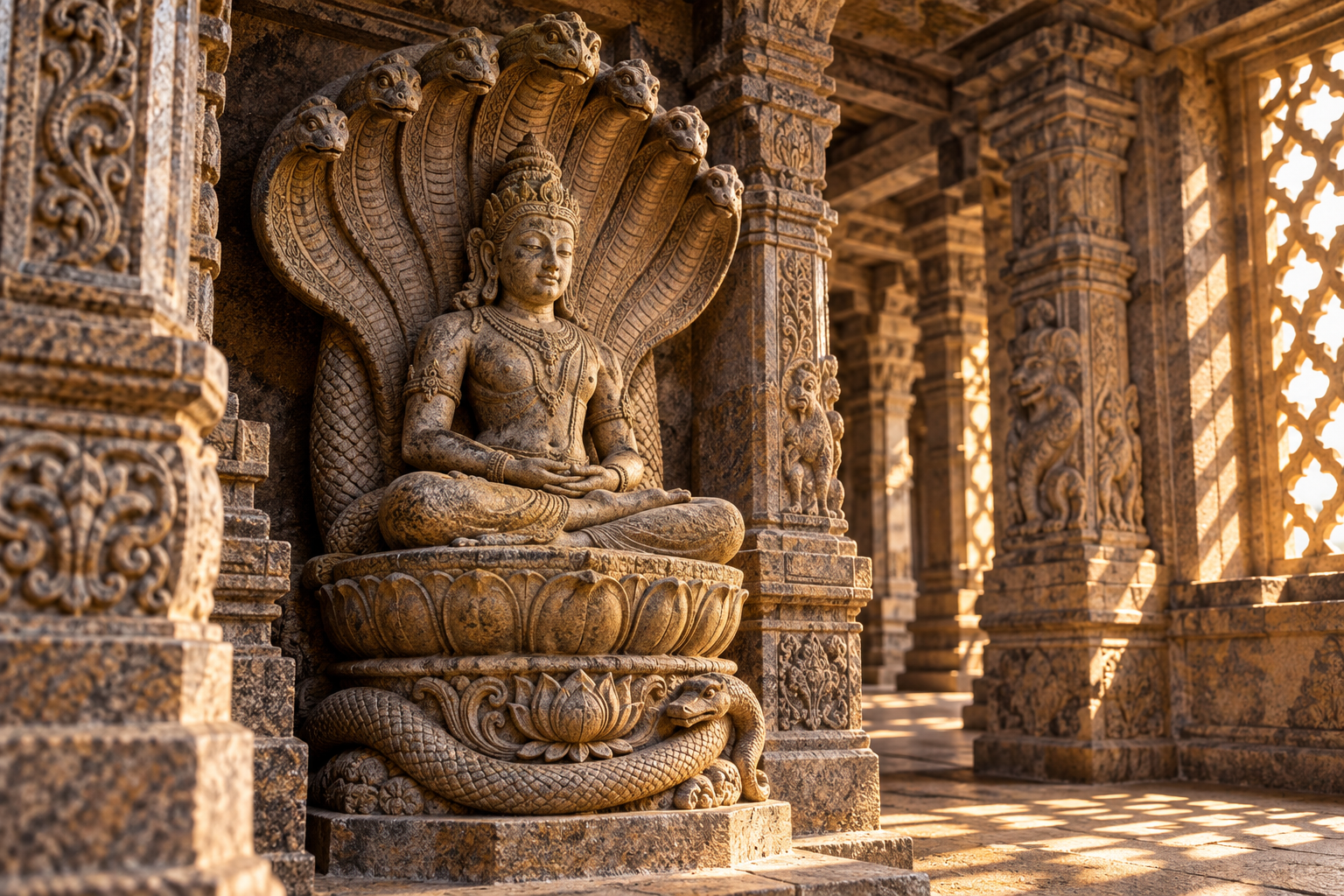
The serpent’s form gives you a practical interpretive grammar. These are starting points, not rigid equations:
- Slithering or extended: begin with active life, unfolding change and directed movement. Ask where that movement leads.
- Coiled: begin with gathered capacity, stillness or power held in reserve. A coil is not inactivity; it is movement contained within a concentrated form.
- Held by a deity: examine the relationship. A deliberate grip may suggest governance, intimacy, possession or the integration of a potent force. It does not resemble an accidental encounter with a wild animal.
- Worn or kept close to the body: consider whether the serpent has become an attribute of the sacred figure rather than an external enemy. Nearness changes the interpretive field.
- Carved as part of a larger pattern: read its curves in relation to the architecture and adjacent figures. Repetition may emphasize a pervasive principle rather than a single narrative event.
- Shown in visible conflict: do not erase the conflict merely because serpents can represent life or renewal. The action of the scene may foreground danger, disorder, discipline or a power being redirected.
The contrast between a coil and a slither is especially important. A coiled serpent concentrates the eye; a moving serpent carries it onward. One suggests potential gathered inward, while the other makes vitality legible through change. Before assigning a theological label, notice what your eye is being made to do.
The divine hand is equally significant. An object deliberately held in sacred iconography is being presented for attention. First determine whether the hand restrains, supports, displays or simply accompanies the serpent. Each verb produces a different reading, and the carving itself should decide which verb fits.
Use a five-step method when viewing temple imagery
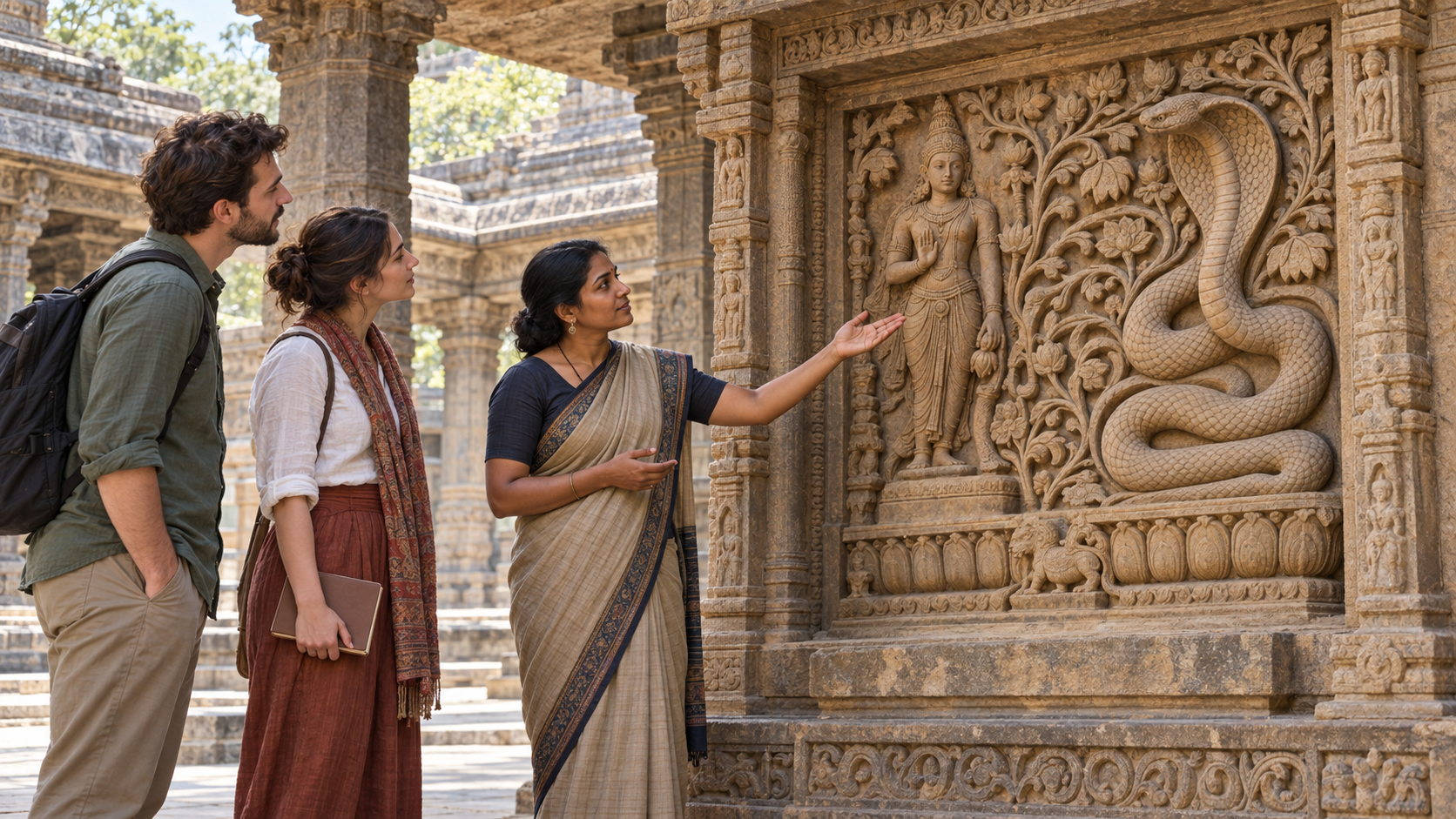
You do not need to be an iconography specialist to avoid the most common mistakes. Use this sequence before consulting a label, tour commentary or symbolic dictionary:
- Describe before interpreting. Write one literal sentence: “A serpent curves upward and is held in the figure’s left hand.” Avoid symbolic words at this stage.
- Locate the serpent. Note whether it appears on the body, in a hand, underfoot, beside the figure or in the surrounding architecture. Placement establishes relationship.
- Name its state. Is it slithering, coiled, resting, raised or involved in conflict? If the stone is worn, admit that the posture may be uncertain.
- Test the three main meanings. Ask how life, pleasure and renewal each fit the visible details. Reject any reading that requires you to ignore the action of the scene.
- Keep the result provisional. Compare the serpent with the deity’s posture, expression and other attributes. The strongest interpretation explains several features at once, not just the snake.
Suppose the serpent is moving freely and the surrounding figure shows no conflict. Life in motion is then a firmer first reading than conquered danger. If it is held close and incorporated into the deity’s appearance, integration or mastery becomes worth considering. If its body is tightly coiled, concentrated potential may lead. You are not choosing a universal definition; you are determining which meaning the composition places in the foreground.
This method also protects you from two opposite errors. The first is reducing every serpent to danger. The second is declaring every serpent benevolent because it appears in sacred art. Hindu imagery can accommodate the serpent’s potency without making its meaning flat or sentimental. Context tells you how that potency is being encountered.
Key takeaways
- A Hindu serpent does not carry one fixed meaning in every image.
- Life, pleasure and renewal form a connected interpretive cluster: animation, embodied experience and the continuation of life through change.
- A slithering form usually foregrounds movement; a coil foregrounds gathered potential.
- A serpent in a divine hand should be read through the deity’s relationship to it, not through the animal in isolation.
- Describe posture and placement before applying a theological label.
- The best reading explains the wider composition and remains open to correction when more context becomes available.
The next time you encounter a serpent in Hindu art, pause before naming its meaning. Record three things: its posture, its placement and its relationship to the sacred figure. Then test life, pleasure and renewal against what you can actually see. That small discipline turns a generic symbol into a precise encounter with Hindu visual thought.
References

Leave a Reply
You must be logged in to post a comment.