
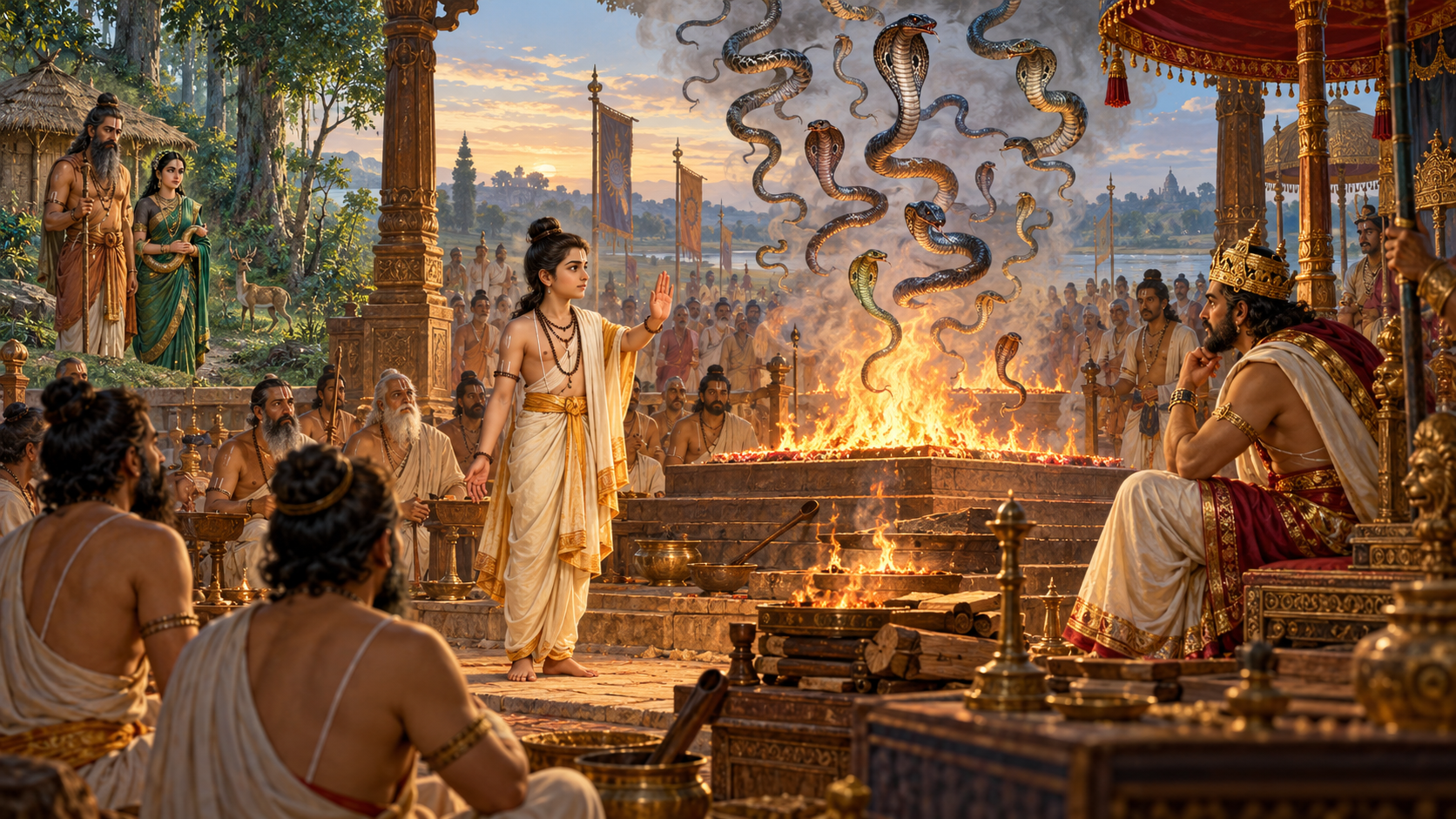
If you came to this episode wondering why an austere rishi belongs in the story of a violent royal sacrifice, keep three names in one chain: Jaratkaru, Astika, and Janamejaya. The connection between them is the key to the episode.
Read that chain carefully and the story becomes more than an account of snakes rescued from a fire. It shows you how tapas must remain answerable to duty, how a child can carry the consequence of an elder’s choice, and how dharma may require someone to stop an action that has acquired the authority of ritual.
Follow the relationship before the spectacle
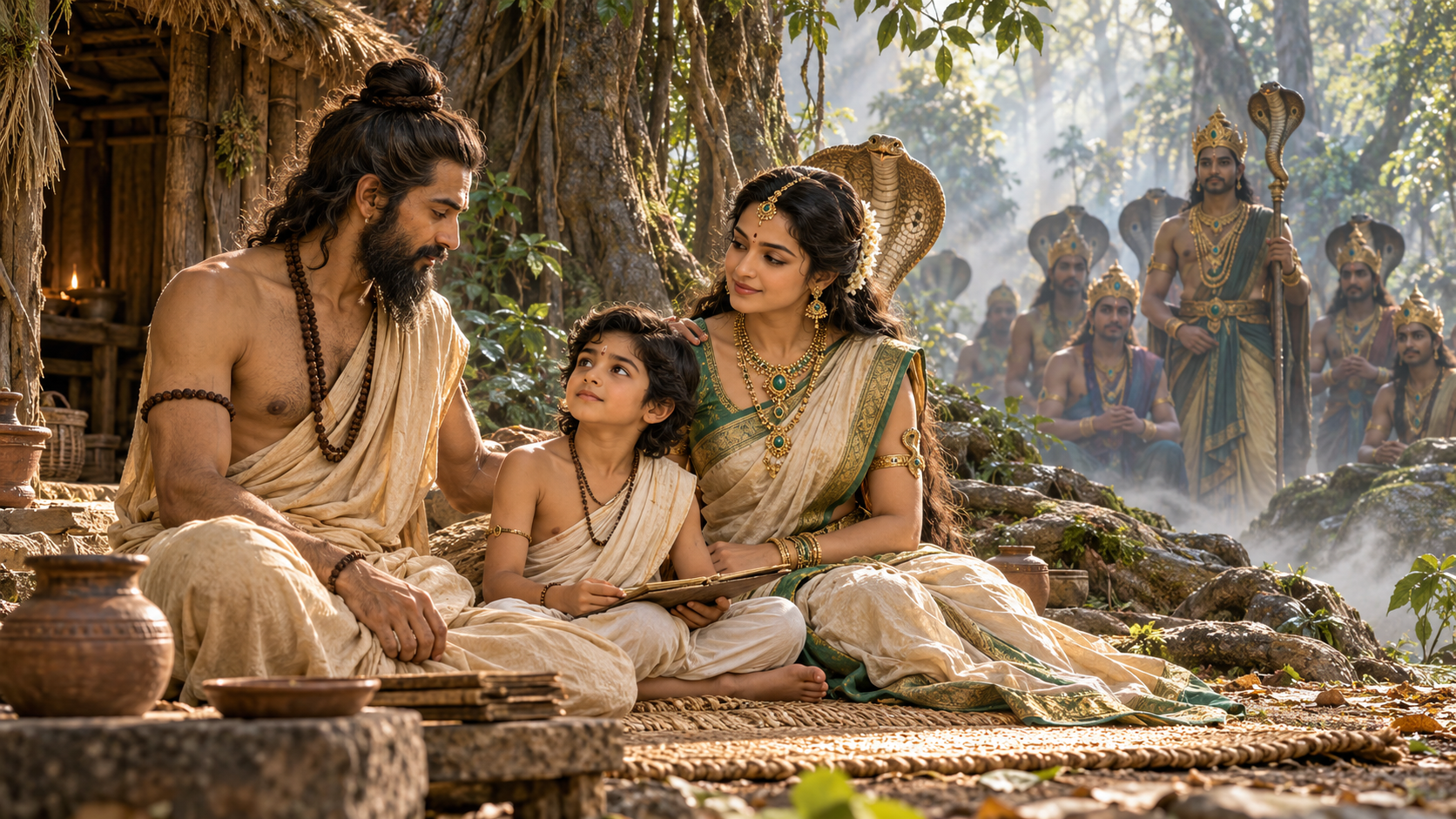
The simplest reliable map of the episode is also the most revealing. Jaratkaru is a great rishi. He becomes the father of Astika. Astika then stops King Janamejaya’s Sarpa Satra, or snake sacrifice, and prevents the snakes from being burned alive. This narrative belongs to the Astika Parva of the Adi Parva.
That sequence tells you where to place your attention. The dramatic centre may appear to be the sacrificial fire, but the moral structure begins earlier, with Jaratkaru. His fatherhood is not a detachable biographical detail. It makes Astika’s later intervention possible.
This is a useful safeguard when you encounter a shortened retelling. If Jaratkaru is reduced to a name in Astika’s ancestry, the first movement of the story disappears. If Astika is remembered only as a miraculous rescuer, his place in a chain of obligation disappears. And if Janamejaya’s sacrifice becomes nothing more than colourful mythology, the question of when power must accept a limit disappears.
Jaratkaru makes austerity answerable to duty

Jaratkaru represents tapas, the disciplined austerity associated with a rishi. Yet the episode does not leave him sealed inside private spiritual attainment. His importance lies in becoming Astika’s father. A life defined by restraint therefore becomes the condition for an act that protects other lives.
You do not need to read this as a rejection of renunciation. The sharper lesson is that no spiritual role should be interpreted in isolation from dharma. Austerity can be genuine and still exist beside an obligation whose fruit will appear later. The action required in one moment may be contemplation; in another, it may be participation in the continuity of life.
This distinction matters because tapas is sometimes romanticised as withdrawal from every claim made by the world. Jaratkaru’s place in the narrative resists that easy reading. His discipline matters, but so does the consequence that becomes possible when his life produces Astika. The rishi’s legacy is not only what he renounces. It is also whom he enables.
When you read Jaratkaru, therefore, ask a precise question: what future act of dharma depends upon a responsibility being accepted now? That question is more productive than treating asceticism and duty as permanent opposites.
Astika shows how dharma interrupts destruction
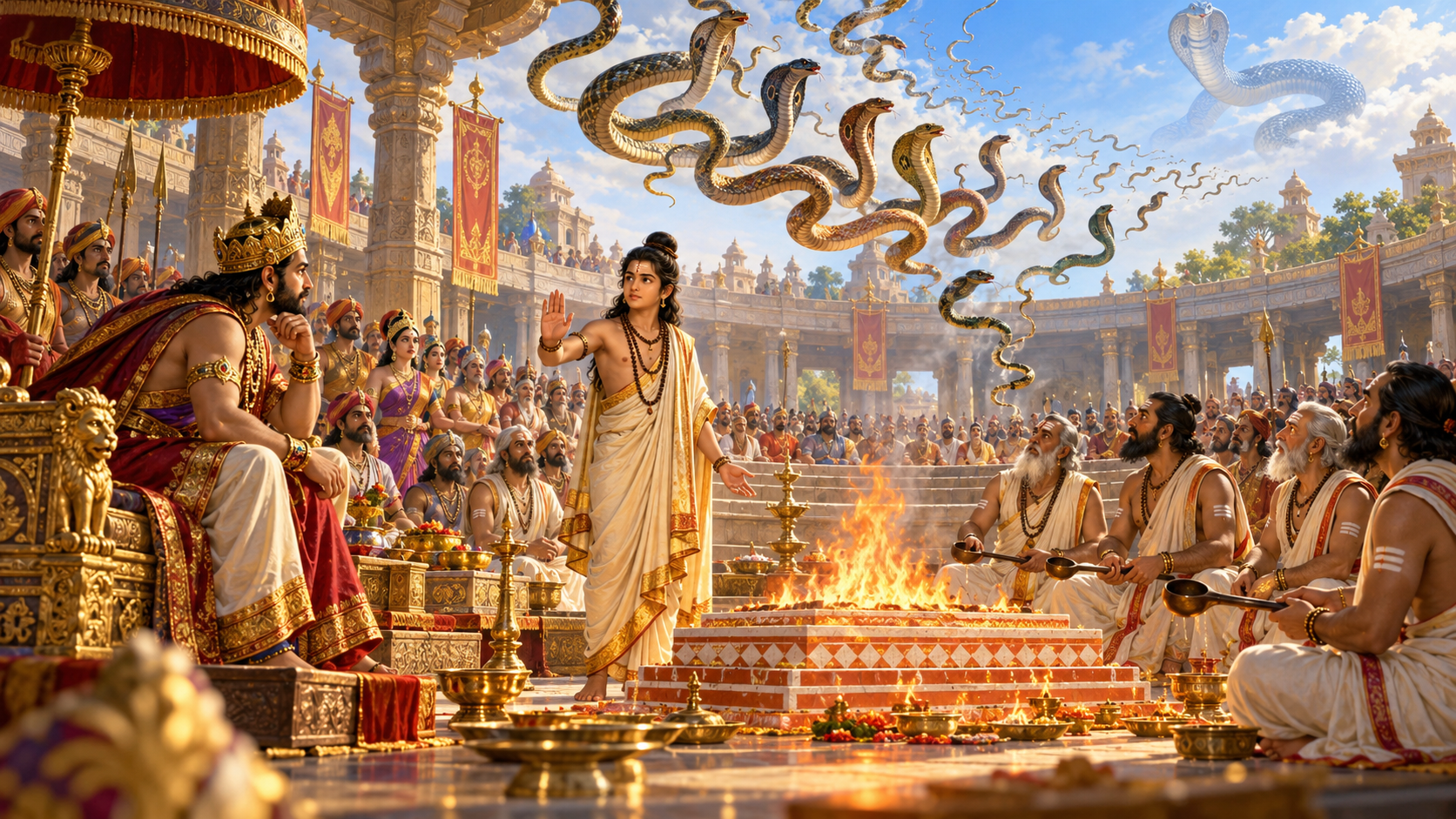
Astika is remembered for a decisive act: he stops the Sarpa Satra of King Janamejaya. The boy does not merely escape the danger himself. His intervention prevents the continuing destruction of the snakes being consumed by the sacrifice.
The ethical distinction is important. Astika stops a particular sacrifice whose ongoing effect is the burning of living beings. That is not the same as condemning every yajna or dismissing ritual as such. The episode asks whether an action remains dharmic simply because it has taken ritual form. Its answer is delivered through interruption: sacred form does not make restraint unnecessary.
Nor should Astika’s success be read as passivity. Restraint is an action here. Stopping the sacrifice changes what will happen next, saves lives, and places a boundary before royal power. Dharma is not confined to beginning worthy acts. It also includes recognising when an act must end.
This gives you a practical test for reading other Dharmic narratives. Do not judge a character only by whether he obeys, fights, renounces, performs a ritual, or prevents one. First identify what the action is doing at that moment. Then ask whether continuing it preserves order or turns authority into destruction. Astika’s greatness lies in seeing that the decisive duty is to stop.
The sacrifice is a warning against moral momentum
Large actions develop momentum. Once a king has commenced a sacrifice and its machinery is operating, continuation can appear to be the natural course. The Sarpa Satra exposes the danger in that appearance. What is already underway is not therefore beyond moral examination.
Notice the difference between procedure and purpose. A procedure asks whether an undertaking is being completed. Dharma asks what that completion will do. In Janamejaya’s sacrifice, the consequence is not incidental: snakes are being burned alive. Astika redirects attention from the momentum of the rite to the lives at stake.
You can carry that distinction into ordinary decisions without pretending that every disagreement resembles an epic sacrifice. When a family custom, institutional process, public campaign, or personal vow begins causing the very harm that conscience should restrain, its age, status, or momentum is not a complete defence. Pause and examine the consequence. Astika’s example is not reckless disruption; it is timely limitation.
The same discipline should govern interpretation of the story itself. Do not turn the snakes into a decorative detail or rush past their suffering in search of symbolism. Within the narrative, Astika saves beings from being burned. Any philosophical reading that forgets that concrete rescue has lost the event that gives the episode its moral force.
A practical way to read the episode
Begin with causation. Write the sequence in a single line: Jaratkaru becomes Astika’s father; Astika reaches the point of intervention; Janamejaya’s snake sacrifice ends; the snakes are saved. This prevents the spectacular conclusion from swallowing the quieter duty that made it possible.
Next, distinguish role from righteousness. Jaratkaru is a rishi, Janamejaya is a king, and Astika is a boy. None of those labels, by itself, settles what dharma requires. The rishi’s significance includes fatherhood. The king’s authority does not make an ongoing destructive act immune to restraint. The boy’s youth does not make his intervention morally negligible.
Then locate the turning point. The story does not become ethically important only after the rescue is complete. Its crucial moment is the decision that the sacrifice must not continue. That is where knowledge becomes courage and concern becomes effective action.
Finally, resist two opposite simplifications. Do not reduce the episode to a general attack on sacrifice; Astika stops the Sarpa Satra in front of him. But do not reduce it to an adventure in which the rescue needs no ethical explanation. The point is precisely that a formally authorised undertaking can reach a limit, and someone must recognise that limit in time.
Key takeaways
- Jaratkaru matters to the episode because he becomes the father of Astika, whose later intervention saves the snakes.
- The movement from Jaratkaru’s austerity to fatherhood shows that tapas and duty need not be treated as permanent opposites.
- Astika stops a specific destructive sacrifice; the episode should not be flattened into a rejection of every yajna.
- The Sarpa Satra tests whether ritual form and royal authority are sufficient when an action is destroying life.
- The practical lesson is to examine consequences before momentum turns continuation into an unquestioned duty.
When you next read or hear this episode, listen for the moment responsibility changes hands: from Jaratkaru’s duty, to Astika’s birth, to Astika’s intervention, and finally to Janamejaya’s acceptance of an ending. That movement is the heart of the story. It teaches you to honour disciplined action, but also to recognise the higher discipline of stopping destruction before it becomes irreversible.
References

Leave a Reply
You must be logged in to post a comment.