
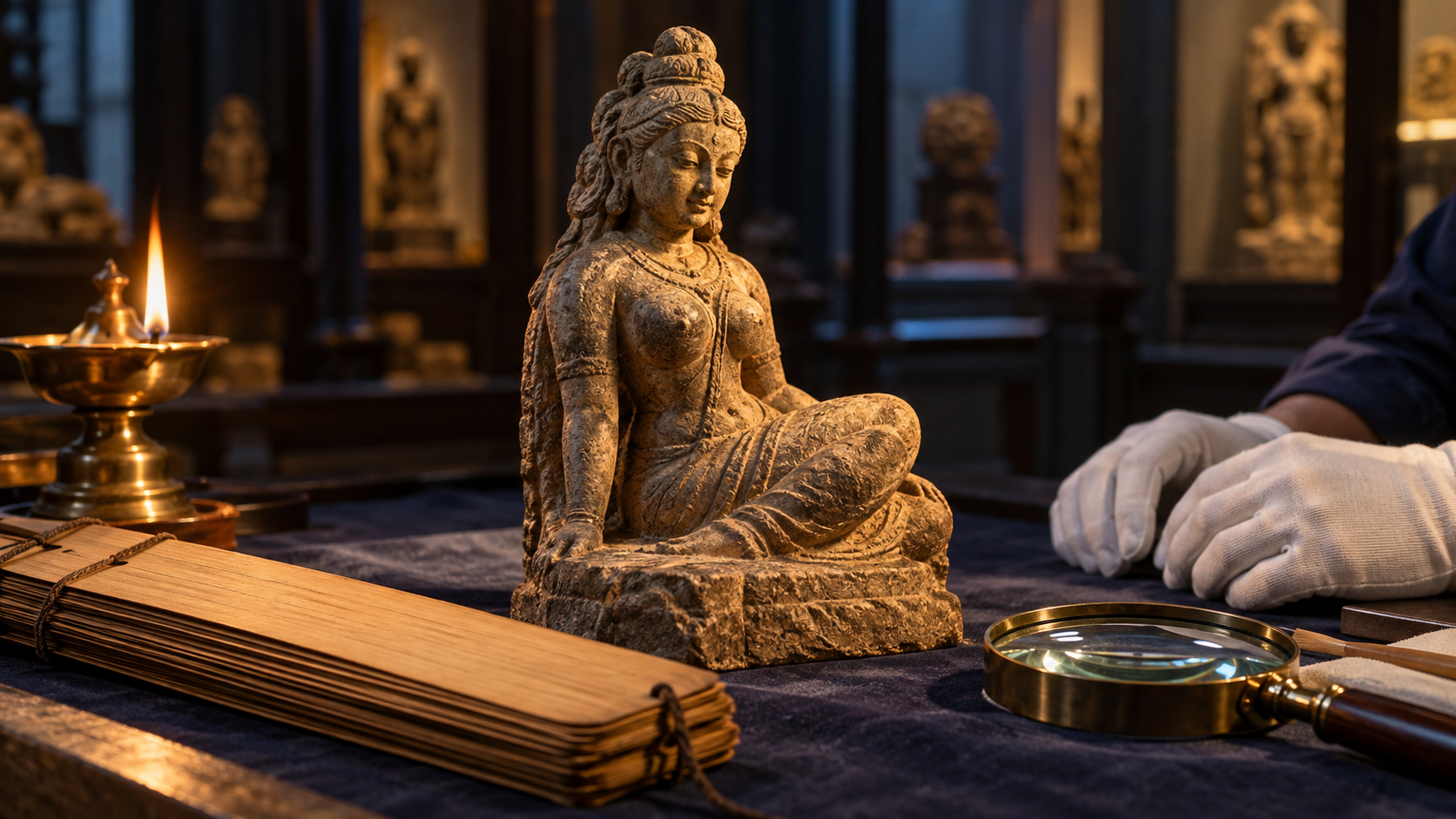
If you found the name Shuddhavidya beneath a temple image, manuscript painting, or modern devotional print, you probably want a firmer answer than “a form of the Goddess of knowledge.” You want to know which visual details establish the identity, which meanings are defensible, and where an attractive caption may be claiming too much.
The honest answer begins with a distinction: the name gives you a strong interpretive centre, but it does not by itself supply a complete iconographic formula. Because Shuddhavidya is a rare form preserved within particular traditions, identification must join the image to its inscription, provenance, and ritual or textual setting.
Start with what the name actually establishes

Shuddhavidya means “pure knowledge”: shuddha conveys purity, while vidya means knowledge, wisdom, or a liberating mode of knowing. The name therefore directs your attention toward knowledge purified of confusion and distortion. That is more spiritually demanding than mere possession of information.
The historical setting matters just as much. Shuddhavidya Devi is a rare form associated with regional Agamic and Tantric material rather than the widely circulated Puranic canon. You should therefore expect the decisive evidence to be local and tradition-specific: a ritual manual, an inherited temple identification, a manuscript caption, or an established regional convention may carry more weight than a generic catalogue of Hindu deities.
Do not jump from “knowledge” to Saraswati. Deities can share theological themes and even visual attributes without being interchangeable. A book, blossom, vessel, rosary, hand gesture, or luminous appearance may contribute to an identification, but no familiar symbol should be allowed to settle the name on its own.
This is the first practical rule: use the name to frame the symbolism, but use provenance and tradition to establish the form.
Rank the evidence before interpreting the symbols
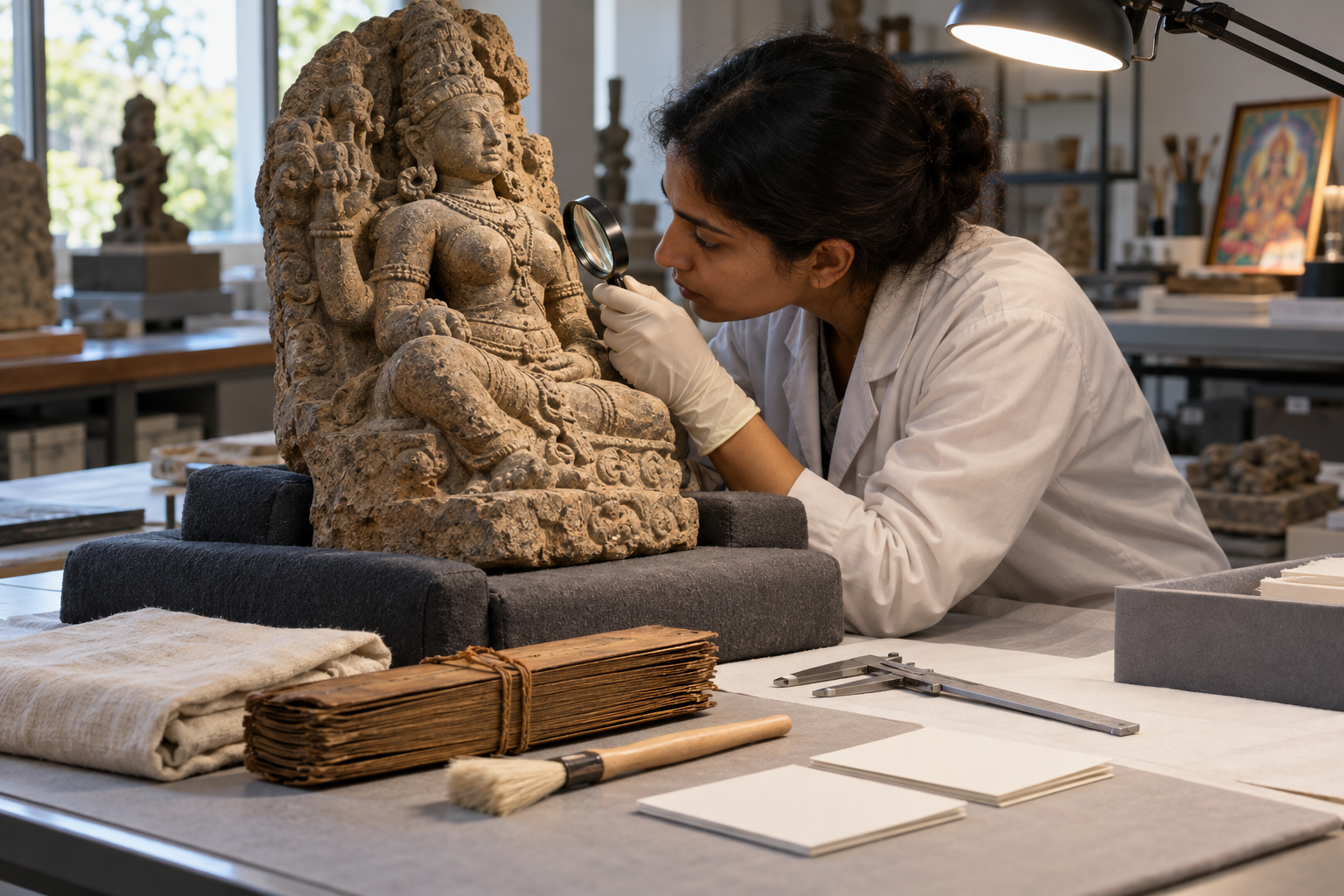
Rare iconography attracts false precision. A modern caption gets repeated, an uncertain object becomes a named attribute, and the repetition begins to look like a canonical description. You can avoid that trap by ranking each kind of evidence according to what it can actually prove.
| Evidence | What it can support | What you still need to check |
|---|---|---|
| An original inscription or manuscript caption attached to the image | The intended name and, sometimes, the image’s setting | Whether the reading, translation, and attachment to the object are secure |
| An iconographic or ritual text used by the relevant community | A prescribed form within that textual tradition | The recension, region, date, and whether the surviving image follows that prescription |
| An inherited temple or lineage identification | How a living tradition understands and worships the form | Whether the identification is local rather than universal |
| A close visual parallel with known provenance | A plausible comparison and a direction for further inquiry | Whether shared features belong to many deities or to this form specifically |
| A dealer’s label, reposted image, or unattributed online caption | A lead worth investigating | Everything: the name, origin, date, and even whether the caption belongs to that image |
The distinction between prescription and depiction is especially important. A text may prescribe a particular form, while a regional artist simplifies, combines, or adapts it. Conversely, a modern artist may assemble traditional-looking symbols without following any single textual prescription. Do not force either object into a uniform scheme merely because the name appears familiar.
Make a visual inventory before naming the image
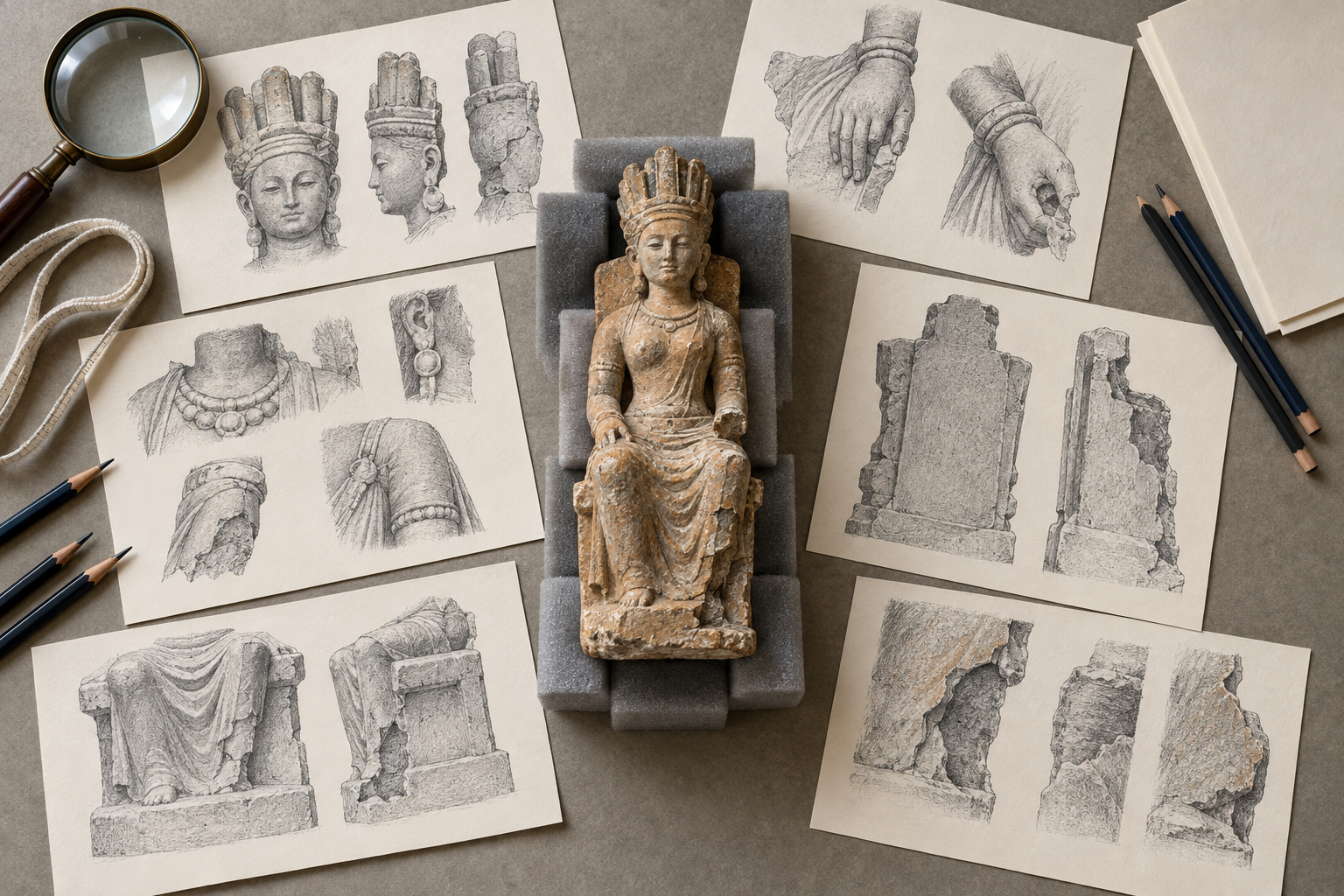
Interpretation becomes more reliable when observation and conclusion are kept separate. Before you search for correspondences, write down what is physically present. This prevents a suggested identity from changing what you think you see.
- Preserve the exact label. Copy the original script if possible, not only its English spelling. Keep variants such as Shuddhavidya and Shuddha Vidya in your search notes instead of assuming that spacing or transliteration marks a different deity.
- Record the object’s context. Note whether you are looking at a temple murti, architectural carving, manuscript image, ritual diagram, calendar print, or recent digital artwork. Record the stated place, community, date, artist, and collection without silently treating any uncertain claim as fact.
- Describe the whole figure. Count visible faces and arms. Note whether the Devi stands or sits, the direction she faces, the form of her seat, and the arrangement of any attendants. Write “not visible” when the image is cropped; do not turn missing information into absence.
- Map every hand separately. Record right and left, upper and lower, the gesture, and the physical shape of each object. Begin with descriptions such as “blossom-shaped object” or “small round vessel.” Apply a traditional name only when the image is clear or a reliable identification supports it.
- Inspect the surrounding field. Look for a vehicle, pedestal, halo, arch, subsidiary figures, directional placement, and repeated motifs. These relationships can be more diagnostic than an isolated object in one hand.
- Mark damage and restoration. A broken hand, replacement attribute, repainting, or recent ornament can change the apparent iconography. Distinguish the original carved or painted form from removable decoration and later repair.
- Compare within the right tradition. Start with material from the same region, temple network, lineage, or manuscript family. A distant image that looks similar is weaker evidence than a locally transmitted identification supported by text or practice.
A useful working note has three columns: “observed,” “identified by tradition,” and “interpretation.” For example, the shape visible in a hand belongs under observation; its ritual name belongs under traditional identification; the spiritual quality it represents belongs under interpretation. Keeping those columns separate makes your eventual caption both clearer and more honest.
Avoid the five shortcuts that create false certainty
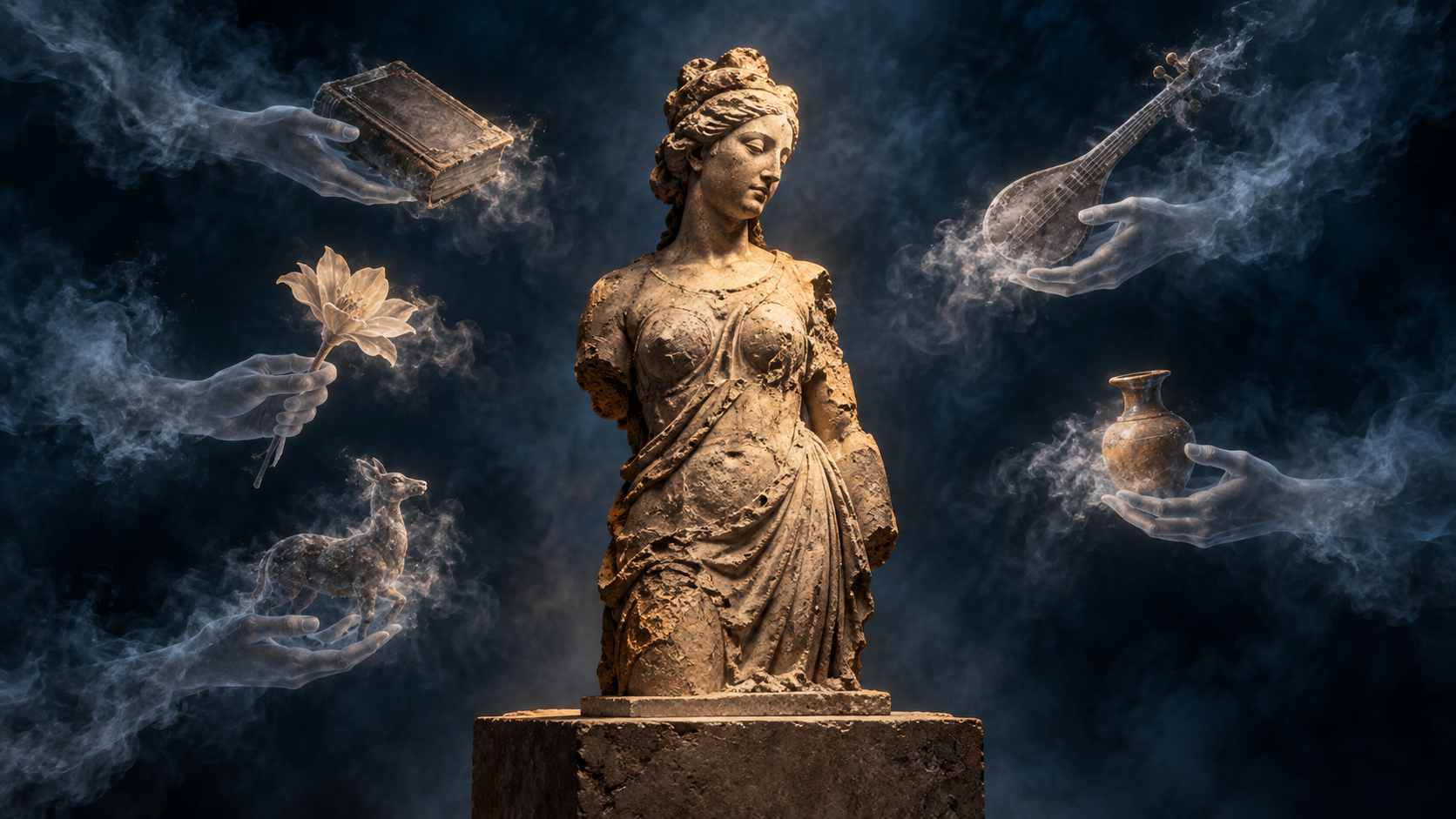
The greatest difficulty with Shuddhavidya iconography is not a lack of imaginative meanings. It is the temptation to make fragmentary evidence look complete. Watch for these recurring errors:
- Equating a shared theme with a shared identity. Association with wisdom does not make every image Saraswati, just as the presence of a broadly used sacred object does not identify one exclusive deity.
- Combining features from different depictions. If one regional description and one modern painting disagree, do not merge them into a supposedly universal form. Present each as a bounded variant when its provenance is known.
- Turning theology into anatomy. The meaning “pure knowledge” gives an interpretive orientation. It does not, without further evidence, determine a fixed colour, posture, number of arms, vehicle, or set of implements.
- Treating modern polish as antiquity. A digitally rendered or recently printed image may express sincere devotion, yet it cannot automatically prove an old iconographic convention. Date and medium belong in the caption.
- Reading every detail as a secret code. Some features may be compositional, regional, or decorative. Assign a symbolic meaning only when the relevant tradition supports it or when you clearly label the reading as an interpretation.
Use calibrated language when the evidence remains incomplete. “Identified locally as Shuddhavidya Devi” tells the reader where the name comes from. “Possibly Shuddhavidya Devi” signals a visual attribution. “Shuddhavidya Devi, as prescribed in a named tradition” makes a stronger claim and therefore requires the corresponding textual or lineage evidence. Confidence should rise with the evidence, not with the fluency of the description.
Choose the right standard for what you plan to do
Your next step depends on whether you are identifying, publishing, commissioning, or worshipping the form. Each activity needs a different level of certainty.
When identifying an unfamiliar image
Do not begin by asking, “What does this symbol mean?” Begin with, “Who named this image, where, and within which tradition?” Then complete the visual inventory and look for corroboration from the same regional or ritual setting. If the name rests on resemblance alone, preserve the uncertainty in your notes.
When publishing or teaching
Caption the evidence, not your confidence. Include the object type, location or provenance when known, approximate period only when supplied, and the basis of identification. Separate a tradition’s explanation from your interpretive commentary. If you cannot verify a precise list of attributes, omit it rather than filling the gap with features borrowed from another goddess.
When commissioning an image or preparing for worship
A general internet description is not a sufficient design brief or ritual authority. Ask the relevant acharya, temple authority, or lineage holder for the form recognised in that tradition, including the textual basis and any regional convention the artist must follow. The same caution applies to mantra, nyasa, initiation, and ritual procedure: do not manufacture a practice from visual symbolism.
Key takeaways
- Shuddhavidya means pure knowledge, but the name alone does not establish a complete visual formula.
- The form’s regional Agamic and Tantric setting makes provenance, lineage, and textual context central to identification.
- Record visible features before interpreting them, and distinguish damage, restoration, and removable ornament from the original image.
- A shared wisdom symbol is supporting evidence, not proof of identity.
- Use labels such as “local identification,” “probable attribution,” and “textually prescribed form” to match your wording to the strength of the evidence.
If an image is in front of you now, save the uncropped version, transcribe its label exactly, and complete the inventory before searching by resemblance. Then ask one narrow question: which regional Agamic or Tantric tradition identifies this form as Shuddhavidya, and what authority does that tradition use? That question can turn a vague visual match into a responsible act of Dharmic preservation.
References

Leave a Reply
You must be logged in to post a comment.