
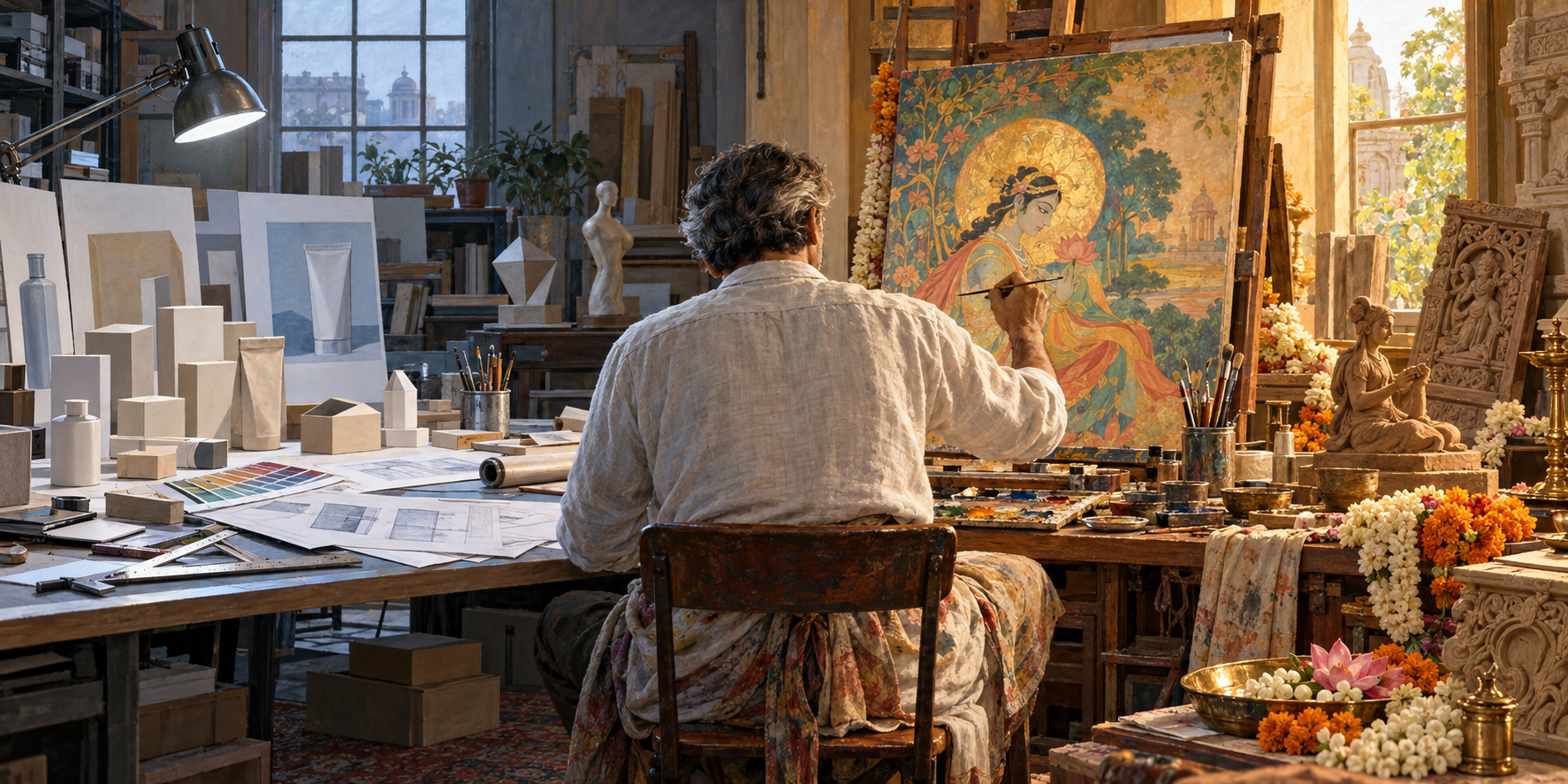
If your portfolio is improving while the work itself feels less worth doing, Alfred Valerio’s life offers a precise lesson: a vocation can change at the level of purpose before it changes at the level of technique. He did not answer artistic dissatisfaction by becoming less rigorous. He found a religious vision that demanded everything he had learned.
His transformation matters because it is easy to mistake renunciation for rejection. Valerio did not cease to be a trained painter, designer, modeller, or project leader when he became Bhaktisiddhanta dasa. He redirected those capacities from commercial persuasion toward devotional service. If you are wondering whether meaningful work requires abandoning professional skill, his example points to a harder and more useful question: what is your skill serving?
A successful career had not solved the real problem

Valerio was not looking for spiritual meaning because he had failed in the marketplace. In 1969, the Today Show featured his paintings while he was rising in Madison Avenue commercial art. He was selling paintings for $1,000 apiece and accepting work that ranged from corporate logos to city hall murals. His advertising assignments included Jeeps, Tide, Ivory Soap, and Duncan Hines cakes.
Nor was he an untrained enthusiast hoping that religion would compensate for weak technique. He studied at the Los Angeles College of Art and Design, became a friend and protege of Brooklyn Museum director Thomas Buechner, and received a John F. and Analee Stacy fellowship for classical painting. During two years of study in Italy, he produced more than seven hundred paintings.
The unsettled part of his life was philosophical. He wanted beauty and truth to inhabit the same work. Birth, ageing, disease, and death appeared true but not beautiful to him; the beauty he encountered seemed temporary and therefore unable to express lasting truth. That was Valerio’s diagnosis, not a rule every artist must accept. It nevertheless identifies a real form of vocational conflict: technical achievement can answer whether you are good at your work without answering why the work deserves your life.
His spiritual search also began before his encounter with Krishna consciousness. As an Italian Catholic, he looked to the Bible for direction and imagery, painted church murals in Florence, and seriously considered joining the Capuchin order. Returning to commercial work did not erase that search. The later transformation was dramatic, but it was not an inexplicable overnight change.
If your own work feels misaligned, name the problem before changing careers. Separate four questions that are often confused:
- Subject: Are you tired of what you are being asked to depict?
- Purpose: Do you object to the use being made of your skill?
- Practice: Is the daily process itself damaging your attention or character?
- Worldview: Does your work assume that beauty, truth, and value mean something you no longer believe?
A change of client may solve the first problem. A new working routine may solve the third. Valerio’s conflict reached the fourth, so only a deeper reorientation could answer it.
The Miami encounter gave his imagination a centre
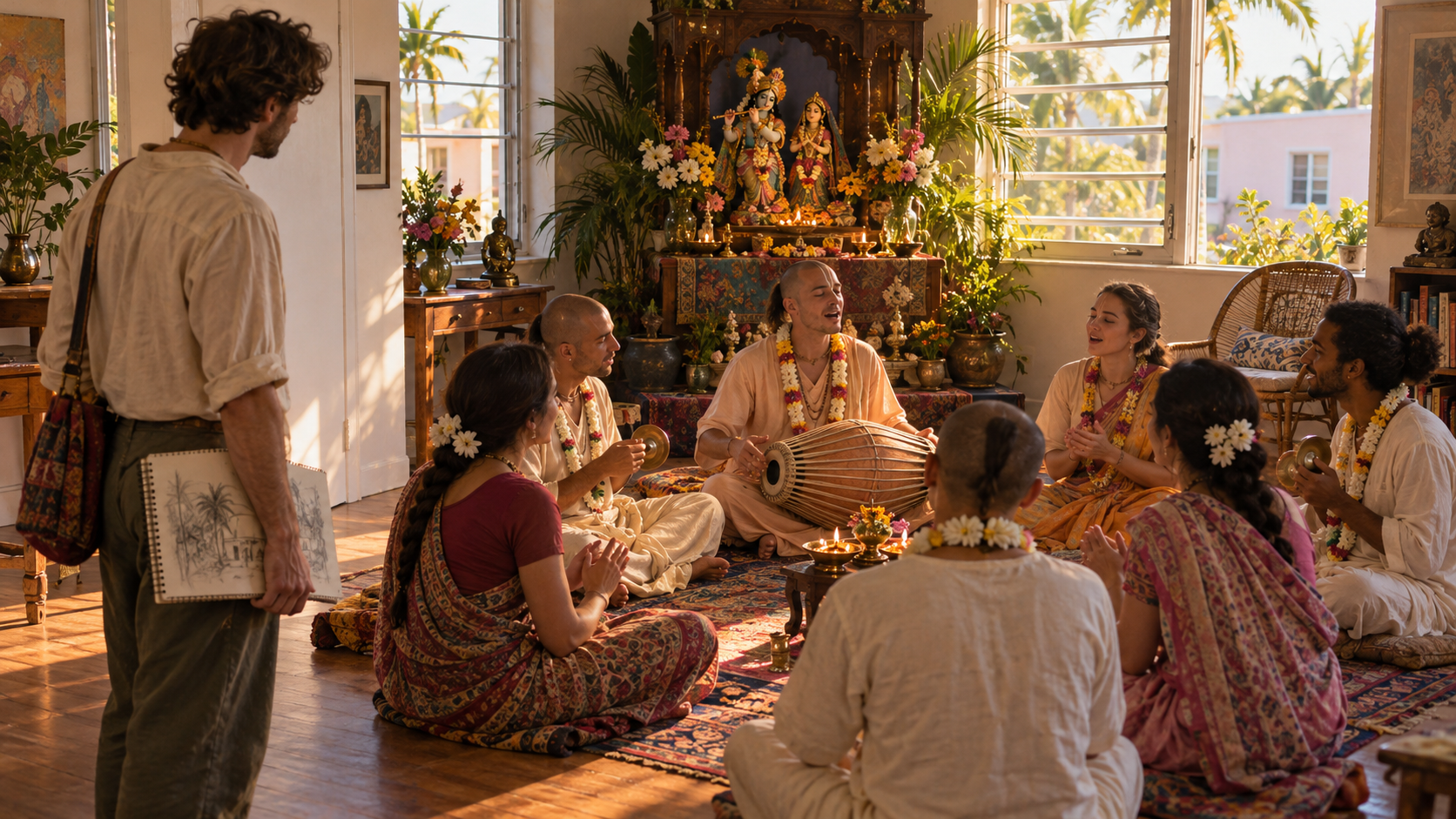
Valerio and his wife first visited a Hare Krishna temple in Miami. There he encountered Krishna not merely as an inspiring theme but, within Gaudiya Vaishnava theology, as the personal Absolute: truth and beauty united in one divine person. That claim met the precise difficulty he had been unable to resolve through professional success or his earlier religious exploration.
The content of the teaching mattered as much as the atmosphere of the temple. In the first lecture he attended, he heard how Maha-Visnu lies in the Causal Ocean and brings forth universes through His breathing. Valerio’s response was immediately visual: he anticipated illustrating that account of cosmic creation in detail. Theology had given his imagination a world to render, not simply a religious label to place on familiar work.
The Bhagavad-gita and Srimad-Bhagavatam, as he encountered them in Krishna consciousness, disclosed a personal God with form, activity, relationships, and an enchanting realm populated by friends, relatives, animals, birds, trees, and flowers. For a visual artist, this was decisive. The sacred was not presented only as an abstraction beyond depiction. It offered personalities, environments, gestures, relationships, and narratives that could call painting, sculpture, and architecture into service.
This distinction can help you evaluate a proposed devotional direction. A sacred-looking style is not yet a devotional vocation. Before choosing motifs, ask:
- What understanding of reality will the work embody?
- What should a viewer remember, contemplate, or do after encountering it?
- Which tradition will govern the meaning of its forms?
- Who is qualified to correct your understanding when visual invention distorts the teaching?
Valerio did not begin with a decorative preference for Indian imagery. He first accepted a theological centre; the imagery followed. That order matters. When style comes first, the sacred can become an aesthetic costume. When conviction comes first, formal choices can be judged by whether they clarify or obstruct the devotional purpose.
Conversion changed the commission, not the competence
After entering Krishna consciousness and becoming known as Bhaktisiddhanta dasa, he did not stop producing art. The new spiritual commitment gave his painting, sculpture, and architectural work a subject and direction he regarded as worthy. The continuity is as important as the rupture: the hand was trained before the purpose changed, and the training remained useful afterward.
He also understood spiritual guidance through a relationship already familiar to a serious artist. A professional artist seeks a master, submits work to correction, and gradually acquires standards that cannot be learned from preference alone. Bhaktisiddhanta saw his relationship with A.C. Bhaktivedanta Swami Prabhupada in a comparable but deeper way. His previous teachers had refined style and technique; Prabhupada gave the art a spiritual foundation.
That does not mean technique became secondary or that sincerity excused poor work. Devotional service gave technique a demanding function. A figure had to communicate a recognisable devotional practice. An architectural programme had to organise many images into a coherent whole. A traditional narrative had to remain legible while moving through the judgement and hand of a contemporary artist.
The useful pattern is not to discard whatever came from professional life. Sort it:
- Keep the craft: drawing, composition, modelling, colour, spatial judgement, planning, and the patience to revise.
- Examine the habits: urgency, vanity, self-promotion, and the tendency to treat attention as the final measure of value.
- Change the governing standard: ask whether the work serves the teaching and devotional use, not merely whether it displays the artist.
- Accept correction: combine artistic expertise with guidance from people who understand the tradition being represented.
- Let life changes follow conviction: do not imitate an outward renunciation before you know what inward commitment it is meant to protect.
Valerio eventually regarded the commercialised Western art he had left as meaningless. That was his mature judgement about his own vocation; it is not proof that every paid commission is spiritually empty. Commercial work can be honest and useful, while sacred-looking work can still be driven by vanity. The sharper test is what the work directs attention toward, which authority shapes it, and what kind of person its repeated practice is making you.
Mayapur made devotion a collaborative discipline
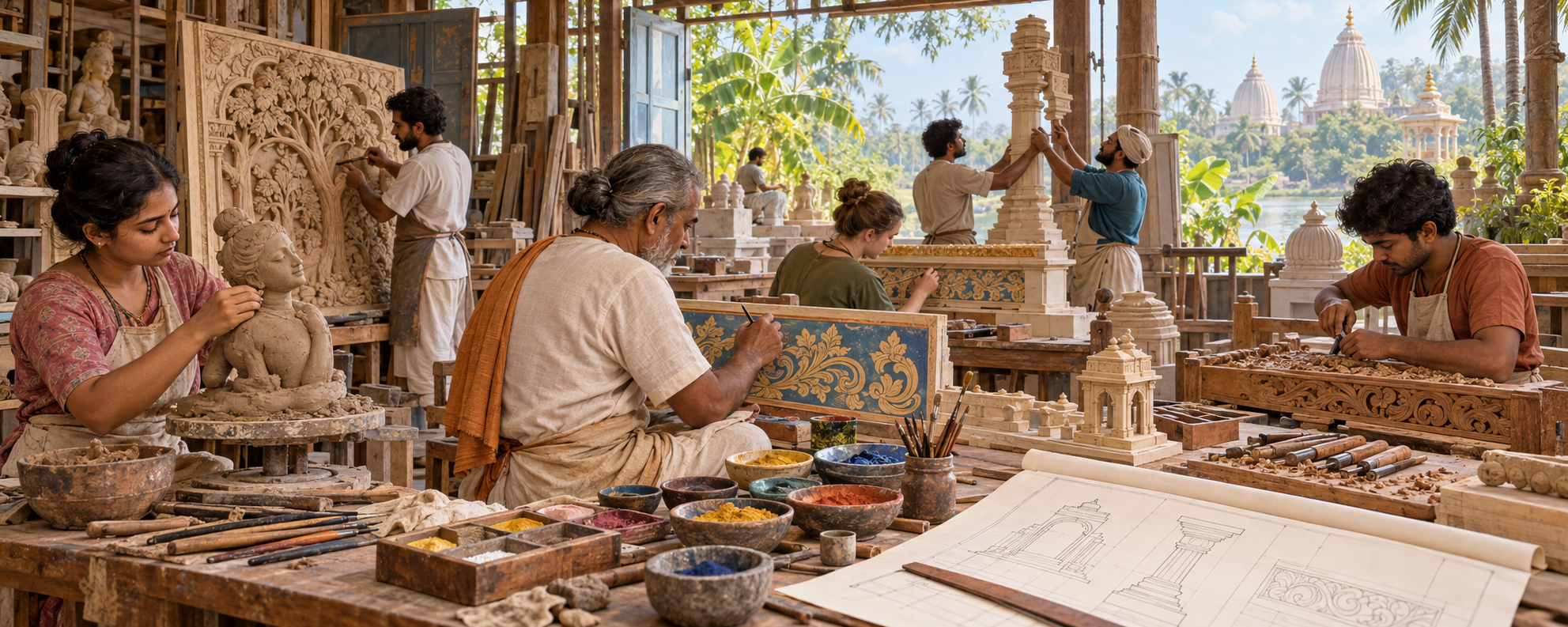
The scale of Bhaktisiddhanta’s later responsibility dispels any notion that devotional art meant retreating into a private hobby. Thirteen years after the 1969 television feature, he was living simply in Mayapur, West Bengal, and overseeing sculptors, painters, and craftsmen working on a 160-foot memorial to Prabhupada. He served under chief architect Surabhir-abhipalayantam Goswami and designed the figures embellishing the puspa-samadhi, or memorial tomb.
The visual programme was not ornamental filler. Sixteen twelve-foot figures around the dome were planned to represent practices taught by Prabhupada, including Deity worship, cow protection, Vedic education, and the distribution of Krishna literature. Nine eight-foot figures were to show modes of devotion such as hearing, chanting, and remembering. Another 1,600 feet of bas-relief panels would depict devotees chanting as demigods offered flowers and blessings.
Every dimension served a programme of remembrance and instruction. The commission required theology to become spatial sequence, bodily posture, scale, and material. It also required leadership. Bhaktisiddhanta’s role joined individual design with the coordinated labour of specialised teams.
He could work across traditions of making as well. In Los Angeles in 1976, he used the Indian puttala method, building a straw base before modelling the final figure in clay. The important point is not that one inherited method is mandatory. It is that devotional intention does not free an artist from the material intelligence of a medium. The straw armature, clay surface, architectural setting, and iconographic meaning all have to cooperate.
If you want to begin a devotional project of your own, use a sequence that keeps inspiration accountable:
- Define the devotional function in one sentence. Name what the finished work should help a real viewer remember, understand, worship, or practise.
- Ground it in a specific teaching or narrative. Do not combine symbols merely because they look harmonious. Know what each form means within its tradition.
- Find two kinds of correction. Seek one person who can test the theological content and another, where necessary, who can test the craft. They may be the same person, but do not assume that spiritual knowledge automatically supplies technical mastery or vice versa.
- Make a bounded study before the full work. Resolve one figure, panel, scene, or material problem first. A study makes errors correctable before they spread across an ambitious programme.
- Evaluate service, not just appearance. Show the work in the setting for which it is intended. Ask whether its meaning is clear, whether it supports the surrounding practice, and whether anything in it draws attention away from the devotional centre.
This is where Valerio’s commercial experience remained valuable. Large sacred projects still need deadlines, division of labour, drawings that others can execute, and a coherent visual system. Devotion changes why those abilities are used; it does not make organisation unnecessary.
Key takeaways for artists at a crossroads
- Professional recognition and vocational meaning answer different questions. Valerio possessed the first before he found the second.
- His transformation did not erase his Western training. It placed trained capacities under a new purpose.
- Krishna consciousness answered his particular conflict by presenting divine truth and divine beauty as united in a personal Absolute.
- The guru-disciple relationship expanded a discipline he already understood from artistic apprenticeship: freedom grows through standards, practice, and correction.
- The Mayapur memorial shows that devotional art can be technically ambitious, collaborative, public, and instructional.
- The part worth imitating is not the outward drama of leaving Madison Avenue. It is the sequence: identify the deepest conflict, accept a coherent centre, submit skill to guidance, and make something that genuinely serves.
If beauty and truth feel divided in your own work, do not romanticise quitting. Take the strongest skill you already possess, root one bounded work in a teaching you are willing to be corrected by, and complete it for an actual devotional use. The next honest step is not a new artistic identity. It is an offering disciplined enough to serve someone besides the artist.
References

Leave a Reply
You must be logged in to post a comment.