
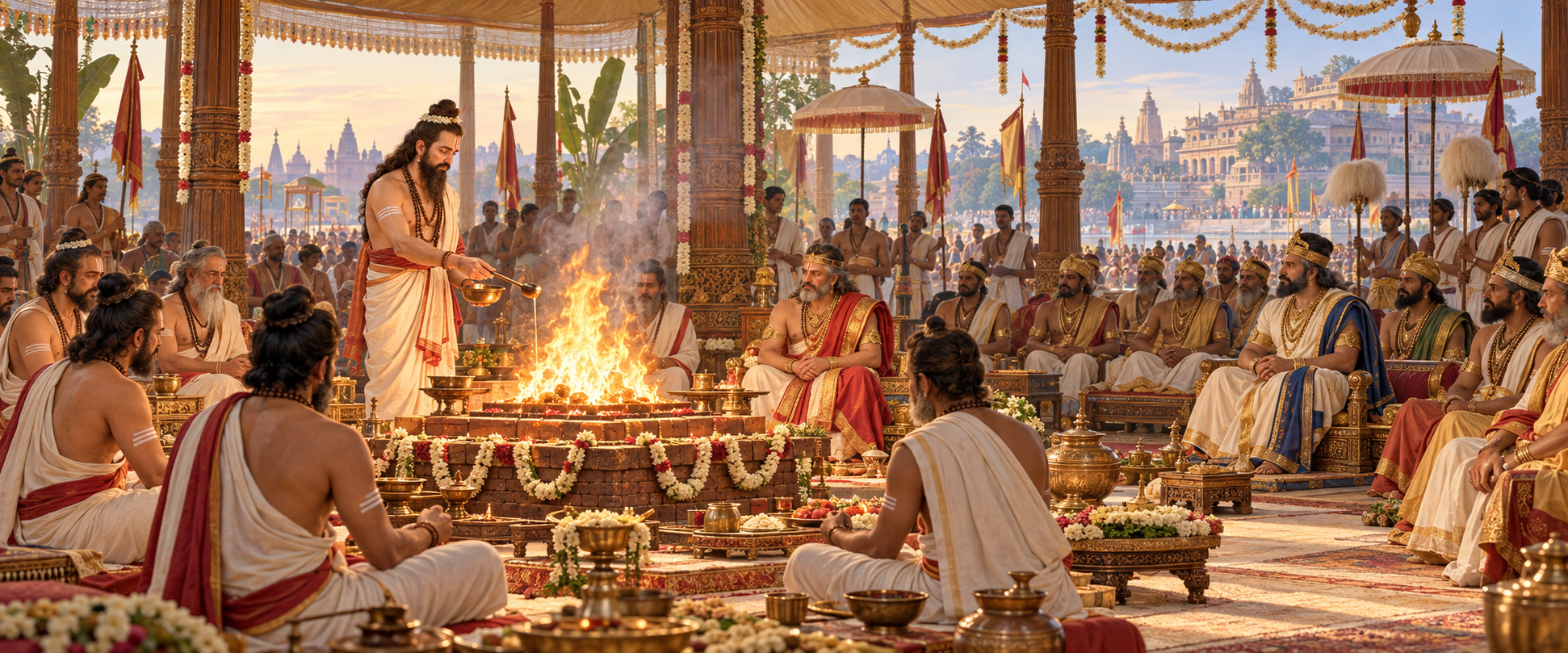
If you have heard that King Janaka attended Dasharatha’s Putrakameshti Yajna, you may be wondering whether this belongs to the Ramayana itself or to a later devotional embellishment. The detail is easy to miss because Rama and Sita have not yet entered the story as living participants.
The answer is clear, but its meaning needs care. Janaka is present at Dasharatha’s sacrifice. That establishes an early connection between Mithila and Dasharatha’s court. It does not establish that either king foresaw the marriage of Rama and Sita, or even that the narrative describes a private conversation between them.
What the Ramayana actually establishes
Bala Kanda, Chapter 12 places King Janaka of Mithila at King Dasharatha’s Putrakameshti Yajna. This occurs before the births of Rama and Sita. Dasharatha is the king undertaking the sacrifice, while Janaka is present at the event.
That distinction matters. Calling Janaka an attendee is supported. Calling him a participant in a secret plan for the future marriage is not. Even the word meeting should be used carefully: the two kings are placed at the same royal-sacred occasion, but the bare fact of shared presence does not by itself give us a recorded dialogue, agreement, or prophecy.
Key takeaways
- Janaka’s presence belongs to Bala Kanda, Chapter 12; it is not merely a detail invented after the marriage of Rama and Sita.
- The occasion is Dasharatha’s Putrakameshti Yajna, a rite undertaken in the hope of progeny.
- Rama and Sita are not yet born at this point in the narrative.
- The later marriage gives the scene retrospective meaning, but the attendance itself does not prove foreknowledge.
Why the timing makes Janaka’s presence significant
You already know what the kings in that moment do not: Dasharatha will become Rama’s father, Janaka will become Sita’s father, and Rama and Sita will later be joined in marriage. That difference between the reader’s knowledge and the characters’ knowledge is what gives this small detail its force.
In the immediate scene, Janaka is a king attending another king’s sacred occasion. In the larger movement of the Ramayana, the future fathers of Rama and Sita stand within the same ceremonial world before either child is born. Ayodhya and Mithila are not introduced to one another only when a marriage must be arranged. Their rulers have already occupied a shared field of royal duty, sacred practice, and social relationship.
This is best understood as foreshadowing. Foreshadowing does not require a character to know what is coming. Its effect belongs to the shape of the narrative. Once you know the later marriage, Janaka’s earlier presence becomes charged with a significance that nobody at the yajna needs to announce.
That makes the scene especially useful in a Ramayana reading or pravachan. Pause at the chronology: first comes the sacrifice and the gathering of kings; only later come the births and the marriage. The sequence lets listeners feel the future taking form without forcing an unrecorded prediction into the mouths of the characters.
What Janaka’s attendance does not prove
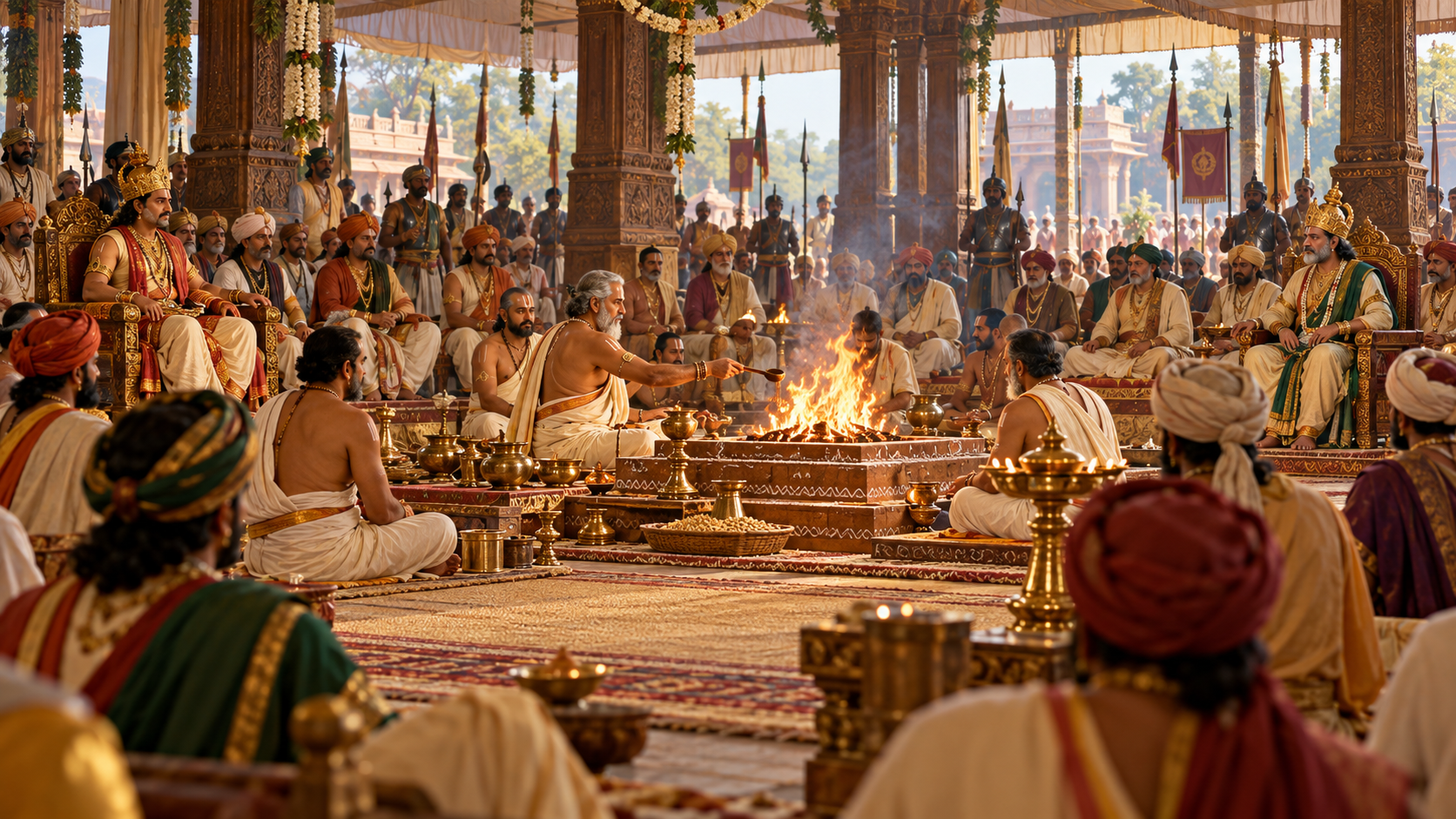
Devotional interpretation often sees destiny in an earlier encounter whose importance becomes visible only later. That is a legitimate way to contemplate the episode, provided interpretation is not confused with an explicit statement in the narrative.
Janaka’s presence does not, by itself, prove that he knew Rama would be born, that he anticipated Sita’s marriage, or that the two royal houses had already arranged a future alliance. It also does not prove that Janaka had a special role in conducting Dasharatha’s rite. The secure claim is narrower: he was present at the Putrakameshti Yajna before the births of the two children whose marriage would later unite the houses.
This boundary is not a reason to strip the scene of spiritual meaning. It protects that meaning from exaggeration. A detail can carry providential resonance without becoming a prediction. Two lives can be moving toward a future relationship even when the people around them have no knowledge of it. The reader perceives the pattern because the completed story illuminates the earlier moment.
A careful formulation is therefore stronger than a dramatic one: the Ramayana places Janaka at Dasharatha’s yajna before Rama and Sita are born, and their later union gives his presence retrospective significance. That says everything the episode can securely bear without turning suggestion into invented history.
A disciplined way to read this episode
This brief appearance offers a practical method for reading other easily overlooked details in an itihasa. Use the following sequence when a striking claim circulates in a discourse, video, or social-media post.
- Locate the claim. Here the relevant location is Bala Kanda, Chapter 12. An interpretation becomes easier to assess once it is tied to a definite place in the narrative.
- Fix the chronology. Janaka’s attendance occurs before Rama and Sita are born. Do not unconsciously import the knowledge of their later marriage into the minds of the people at the yajna.
- Separate presence from interaction. Being present at the same event supports an early association between the royal worlds of Dasharatha and Janaka. It does not automatically establish a private exchange or agreement.
- Distinguish statement from inference. Janaka’s attendance is the stated fact. Foreshadowing is a literary inference. Destiny is a devotional interpretation. All three can matter, but they are not the same kind of claim.
- Test every added detail. If a retelling supplies motives, dialogue, predictions, or promises, ask whether those elements are actually established in the passage or are being offered as reflection.
This method preserves both shraddha and precision. You do not have to choose between receiving the Ramayana as sacred narrative and reading its wording attentively. Careful limits prevent an attractive interpretation from being repeated as though it were a recorded event.
Carry the scene into your next Ramayana reading
For a devotional reader, Janaka’s presence can train the eye to notice how a larger order becomes visible only with time. Dasharatha acts for the immediate purpose of progeny. Janaka attends that sacred occasion. Later, Rama and Sita bring the two houses into a relationship whose importance neither king needs to foresee during the yajna.
The next time you hear this episode discussed, hold its three levels together: the textual fact of attendance, the narrative effect of foreshadowing, and the devotional sense of destiny. Name which level you mean. You will read the moment more deeply without claiming more than it gives.
References

Leave a Reply
You must be logged in to post a comment.