

If you have looked at a Yali on a Hindu temple and thought it resembled the stone lions guarding a Chinese building, your eye has caught a genuine visual connection. The mistake comes afterward, when resemblance is treated as proof that the figures are the same being, carry the same theology, or demonstrate that one civilisation copied the other.
You can make a sounder comparison by reading three things separately: where the figure stands, what kind of body it has, and what work it performs. That approach reveals an important shared idea without dissolving two distinct traditions into one.
Begin with the boundary, not the animal
A guardian image is partly defined by its location. The Yali appears on Hindu temple pillars, entrances and stairways, while the Chinese guardian lion watches over sacred and royal spaces. In both cases, the sculpture belongs to a place through which people approach, enter or move toward something set apart.
This is why identifying the creature from a cropped photograph can be misleading. A head, paw or open mouth shows appearance, but the wider architectural view shows purpose. A figure beside an entrance relates to everyone who crosses that entrance. One built into a pillar does more than occupy empty space: it makes protective force appear to belong to the structure itself.
Before deciding what a guardian means, ask four practical questions:
- What lies beyond the figure: a sanctum, ceremonial route, courtyard, palace or another important space?
- Is it framing an opening, supporting an architectural element or marking a change in level?
- Does it face the approaching visitor, the passage, or another figure?
- Is it an isolated ornament, a repeated motif or part of an organised entrance?
These observations will not answer every historical question, but they prevent the most common interpretive error: treating sacred architecture as a collection of disconnected statues.
The Yali embodies force disciplined by sacred order
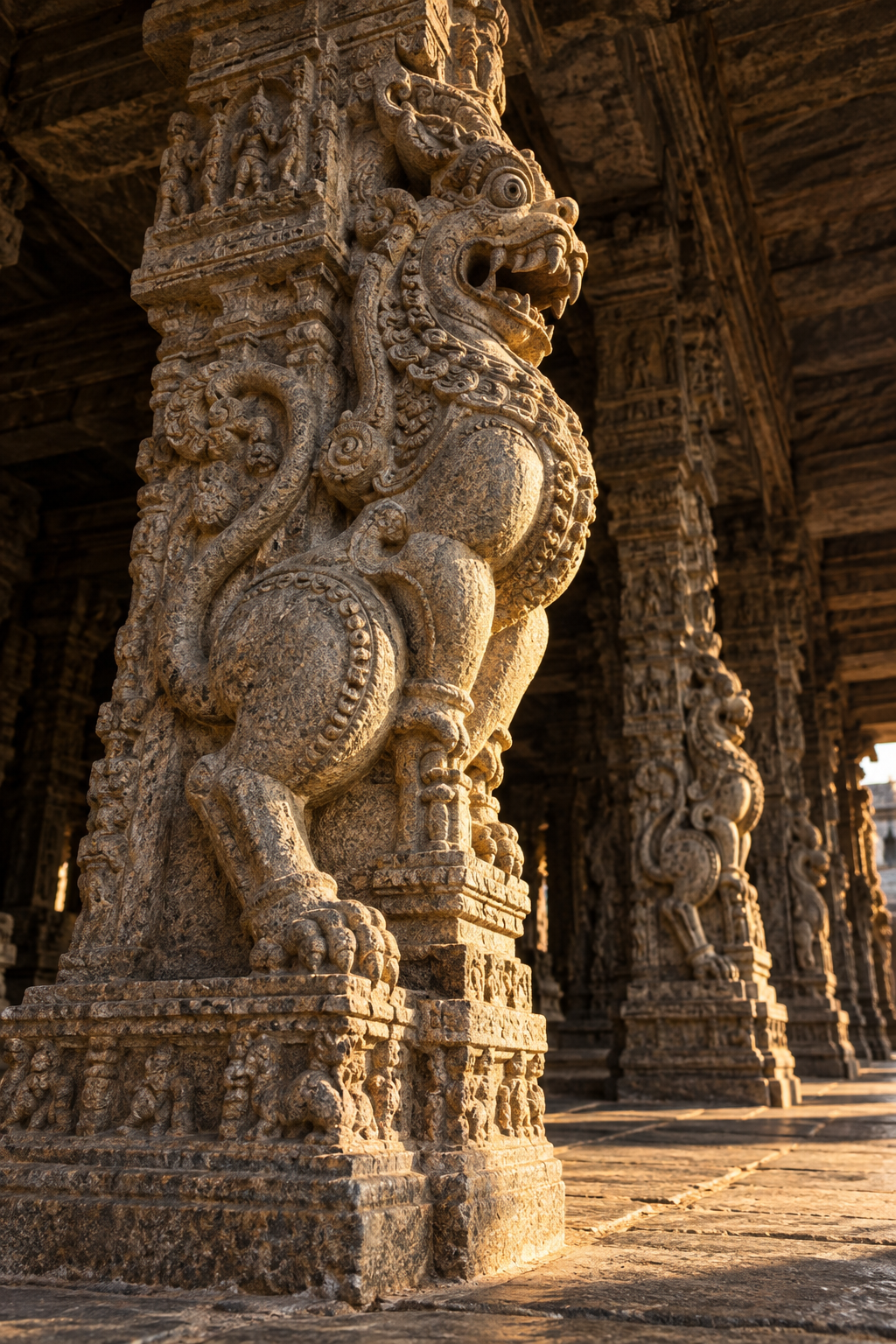
The Yali, also called Vyala, is a composite, lion-bodied figure associated with Hindu temple architecture. “Composite” is not a minor descriptive detail. It tells you not to read the image as if a sculptor were documenting an ordinary animal. Its form deliberately exceeds a single natural species.
A composite body allows several impressions of strength, alertness and danger to be concentrated in one presence. The resulting creature is suitable for a boundary because it looks capable of meeting threats that an ordinary being could not. Its visual impossibility is part of its symbolic usefulness.
You should also resist equating a fierce appearance with evil. Within Dharmic visual culture, an intimidating form can serve a protective purpose. Fangs, a forceful posture or an exaggerated body may communicate that destructive power has been placed in the service of sacred order. The useful question is therefore not, “Does this creature look frightening?” It is, “What does its fierceness protect?”
Placement supplies the answer. On a pillar, stairway or entrance, the Yali participates in the devotee’s movement through the temple. It can announce that entry into sacred space is not casual, while its incorporation into the building makes vigilance seem permanent rather than momentary.
Do not automatically identify every Yali as the temple’s presiding deity. A sacred building contains images with different functions, and guardianship is one of them. When cataloguing or explaining a carving, begin with the modest description “a Yali or Vyala guardian figure associated with the temple’s architecture.” Add a more exact identification only when the local tradition, inscription or reliable site information supports it.
The Chinese guardian lion makes authority watchful
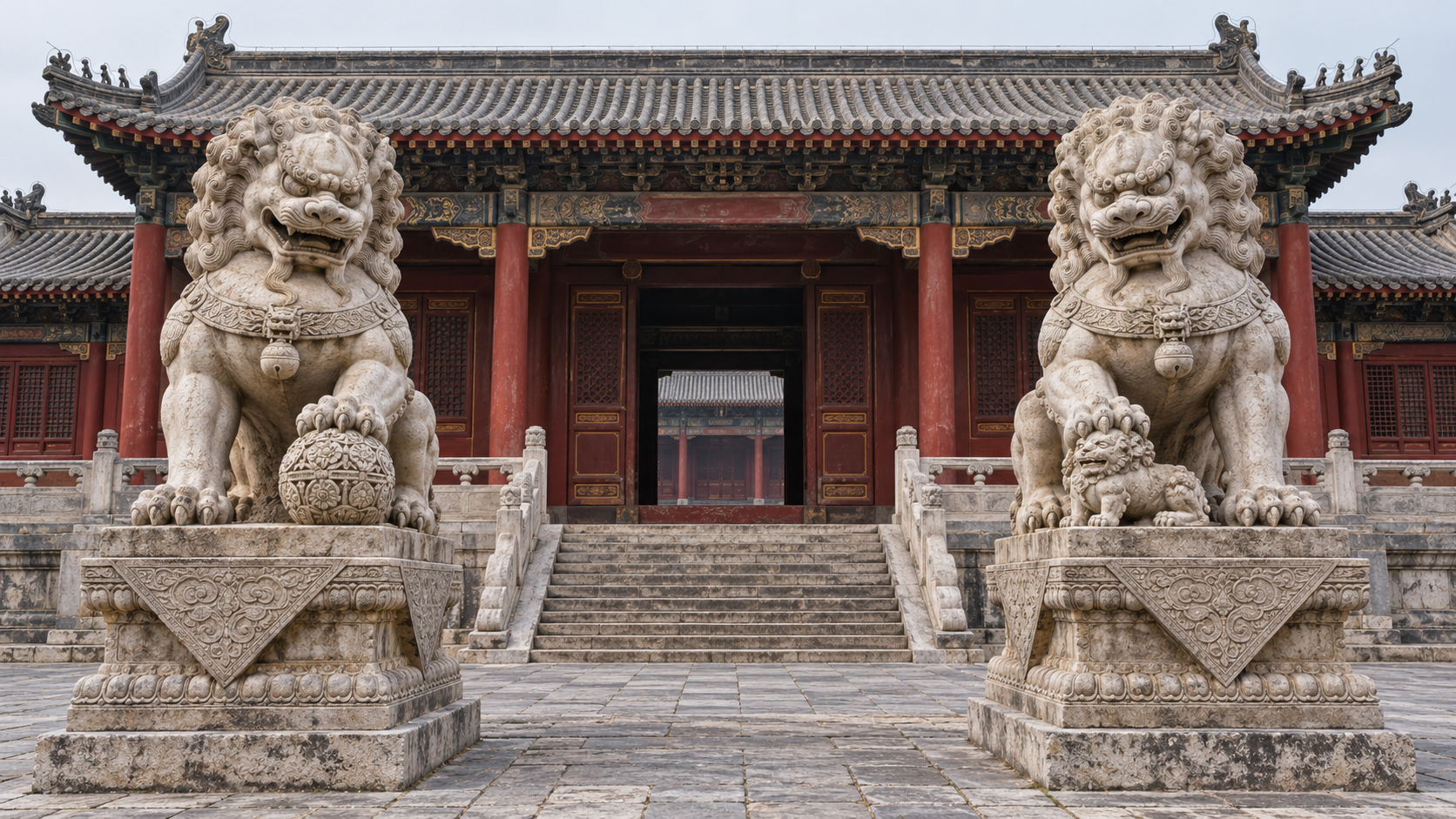
“Foo Dog” is a familiar alternate label, but “Chinese guardian lion” keeps the comparison clearer. The figure is leonine even when its features are highly stylised. Calling it a dog can cause you to begin with the wrong animal and miss the symbolism of controlled leonine power.
Its central architectural message is guardianship. At a sacred or royal space, animal strength is not presented as wandering or uncontrolled. It has been stationed, ordered and made watchful. The sculpture turns power into an enduring feature of the entrance and, by extension, of the institution behind it.
If you encounter two lions arranged around an approach, read the whole entrance before assigning detailed meanings to either member. Notice the axis they create, the route between them and the building they address. Pairing may structure the visitor’s experience, but a precise interpretation should come from the conventions of that particular setting rather than from a caption copied from an unrelated monument.
The Chinese guardian lion is therefore not simply a Yali under another name. Its identity comes from its own cultural setting, established terminology and relationship to Chinese sacred or royal space. The two figures can perform comparable work without belonging to one mythology.
Shared guardian symbolism does not prove a shared identity
The strongest comparison is functional. Both traditions use leonine force to protect significant places. Both make that force visible at points where a visitor’s relationship to the space changes. Both transform a potentially dangerous animal presence into a defender of an ordered realm.
That shared symbolic grammar matters. Across cultures, a guardian must be powerful enough to deter disorder yet controlled enough to serve what lies behind it. A lion-like form communicates both possibilities at once: formidable power and disciplined vigilance. The Yali intensifies this logic through its composite body; the Chinese guardian lion expresses it through its own recognisable sculptural tradition.
But visual similarity alone cannot establish direct borrowing. It does not tell you that the figures have the same name, arose from the same narrative, carry identical ritual status or developed in a single historical line. Similar architectural problems can produce comparable symbolic answers.
A serious claim of transmission would require evidence beyond appearance: securely dated objects, a plausible route of contact, changes that can be traced across places, relevant terminology, or textual and inscriptional support. Without that evidence, use calibrated language. Say that the figures “share a protective function,” “use leonine imagery” or “occupy comparable symbolic roles.” Do not promote resemblance into a migration story that the available facts cannot sustain.
This distinction protects both sides of the comparison. It lets you recognise a meaningful human pattern while preserving the particularity of Hindu and Chinese traditions. Connection does not require sameness, and difference does not make comparison pointless.
A practical method for reading either guardian
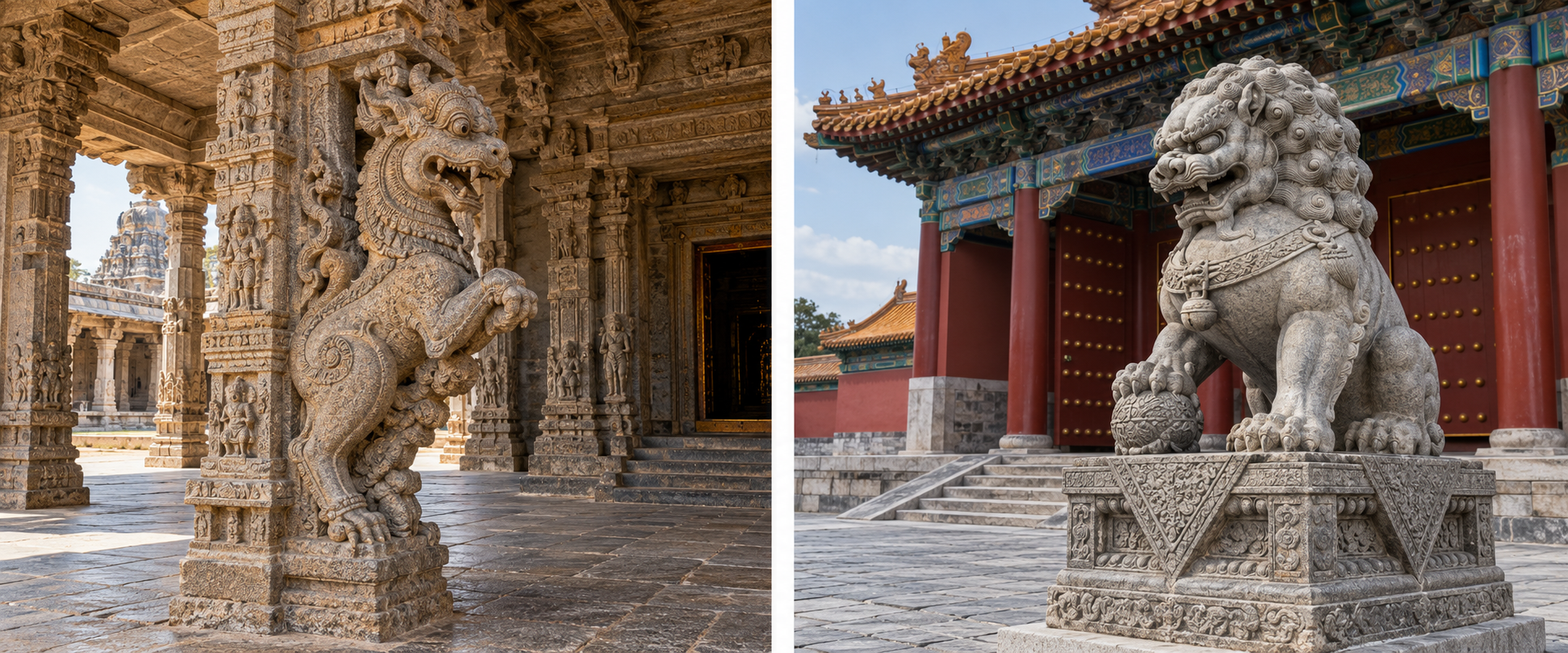
Whether you are visiting a temple, writing a caption or assessing a claim online, use the following sequence:
- Record what you can actually see. Note the body, posture, degree of stylisation and any composite features. Keep observation separate from interpretation.
- Restore the architectural context. Look for a wide view showing whether the figure belongs to a pillar, entrance, stairway or ceremonial approach.
- Identify its immediate job. Ask whether it guards, frames, supports, marks a transition or performs several of these functions together.
- Use the tradition’s own name. Prefer Yali or Vyala for the Hindu temple figure and Chinese guardian lion for the Chinese figure. A familiar nickname should not replace a more informative identification.
- Compare like with like. Compare function with function, placement with placement and visual strategy with visual strategy. Do not compare one figure’s anatomy with an unsupported claim about the other’s theology.
- State the limit of the comparison. A responsible conclusion can recognise common guardian symbolism while saying plainly that resemblance does not establish identical origins or meaning.
Key takeaways
- The Yali or Vyala is a composite, lion-bodied guardian associated with Hindu temple pillars, entrances and stairways.
- The Chinese guardian lion protects sacred and royal spaces within its own cultural and architectural tradition.
- Placement is evidence: the boundary being guarded often explains more than a close-up of the creature.
- A fierce appearance can express protection and controlled power rather than evil.
- The figures share a guardian logic, but that does not make them the same being or prove direct cultural borrowing.
The next time you encounter either figure, do not begin with “What animal is this?” Begin with “What boundary is it guarding?” Then let the building and the local tradition supply the name. That order of attention will help you recognise a civilisational parallel without erasing the identities that make it meaningful.
References

Leave a Reply
You must be logged in to post a comment.