
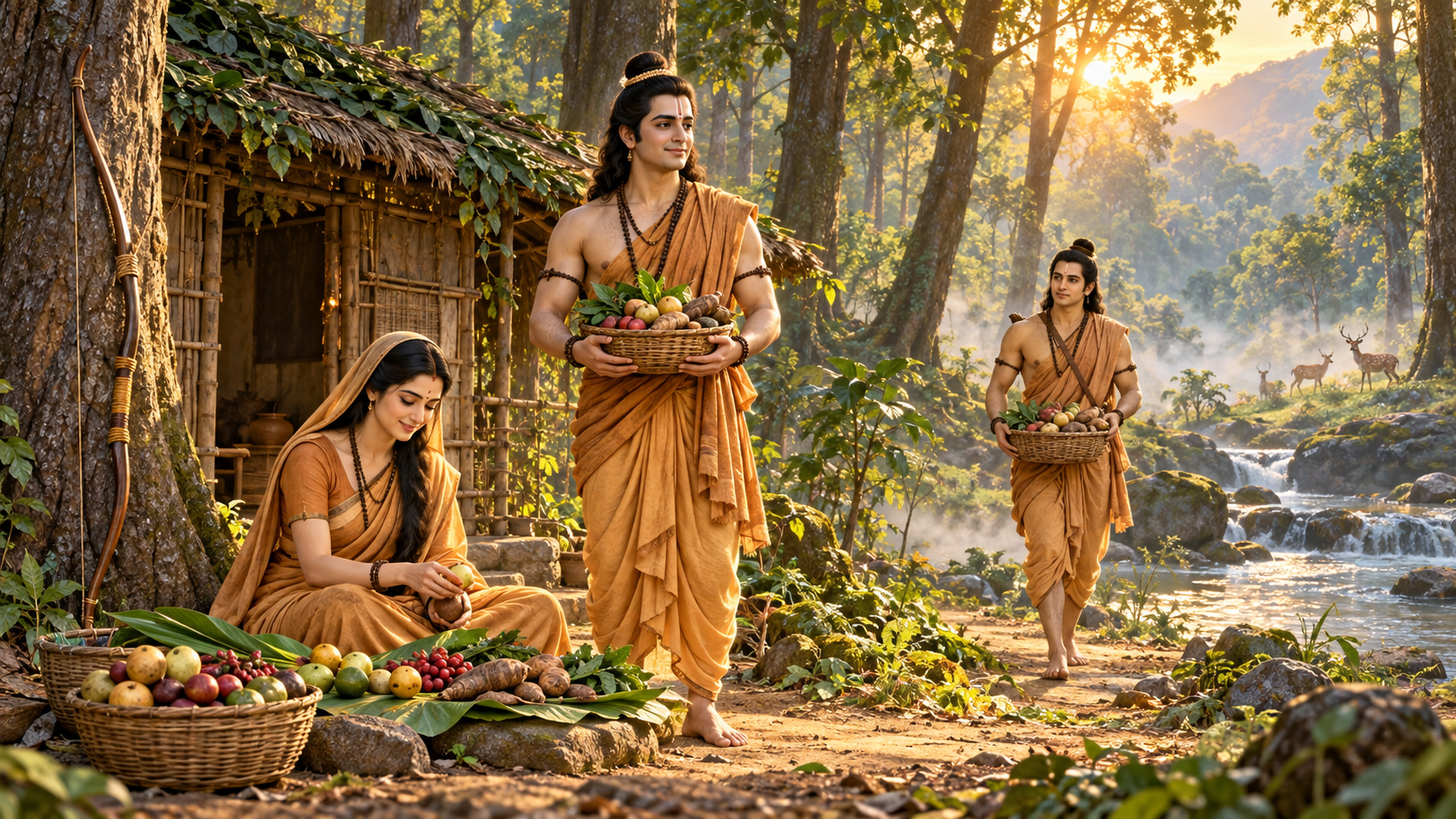
If you have encountered one confident claim that Shri Rama ate meat and another that a single line proves his lifelong diet, you need a more precise answer. The relevant passages support a strong conclusion about his fourteen-year forest exile: Rama undertook to live on roots, tubers, and fruit, to give up meat like a sage, and was later described as not eating meat.
A careful reading separates two questions: what Rama’s forest discipline required, and whether those statements amount to a complete dietary biography. That distinction lets you defend what the text actually establishes without turning devotion into overstatement.
The strongest answer concerns Rama’s years in exile
The most defensible conclusion is time-bound: Rama abstained from meat as part of his life in the forest. This conclusion does not rest on one vague reference to fruit. It rests on two complementary kinds of evidence: Rama’s stated commitment when entering exile and Hanuman’s later description of Rama’s conduct.
Rama says that he will spend fourteen years in the uninhabited forest, living on tubers, roots, and fruit and giving up meat like a sage. Another statement connects obedience to his father’s command with entering the forest hermitage, practising dharma, and eating roots and fruit.
Three details matter. The duration is specified. The foods are named. The manner of living is compared with that of a muni, or sage. Rama’s diet is therefore presented as part of a chosen discipline of renunciation and self-restraint, not merely as whatever food happened to be available.
The clearest statement says that Rama does not eat meat
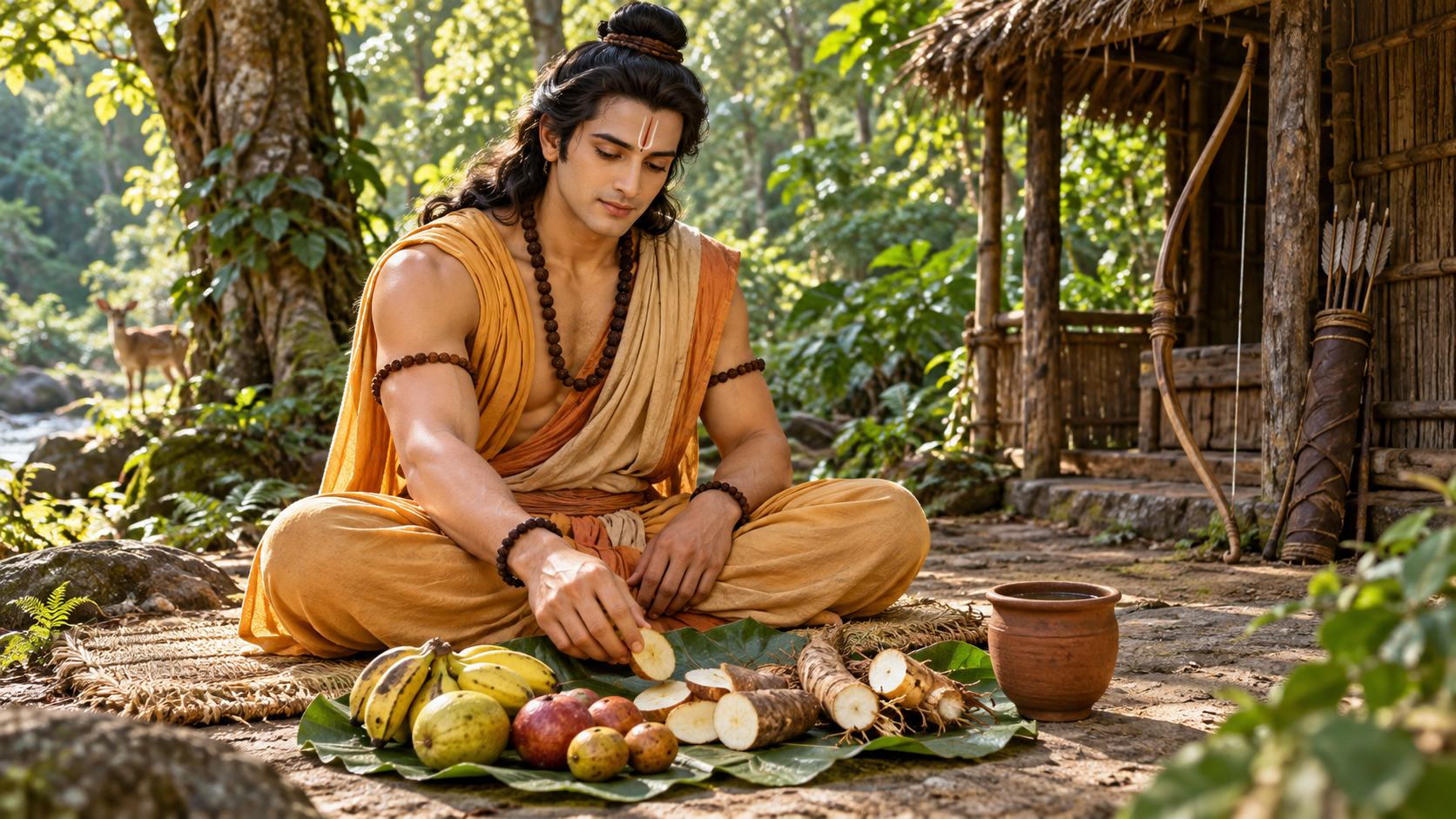
In a commonly circulated reading from the Sundara Kanda, Hanuman tells Sita about Rama’s condition and uses an unmistakably direct phrase:
“Na māṃsaṃ Rāghavo bhuṅkte…”
Valmiki Ramayana, Sundara Kanda
The phrase means that Raghava does not eat meat. This is the best place to begin when someone asks for direct textual evidence. You do not have to infer abstention from an incomplete menu: meat is named, and Rama is said not to eat it.
The same line adds that Rama does not partake of madhu, a word rendered in this discussion as honey or an intoxicating drink. That translation choice should be kept visible rather than forced into false certainty. It does not change the central dietary statement, because māṃsa, meat, appears separately and is explicitly negated.
The rest of the verse refers to properly prepared forest food. Its significance lies in continuity: the life Hanuman describes accords with the restrained forest life Rama had undertaken.
Roots, tubers, and fruit express a dharmic discipline
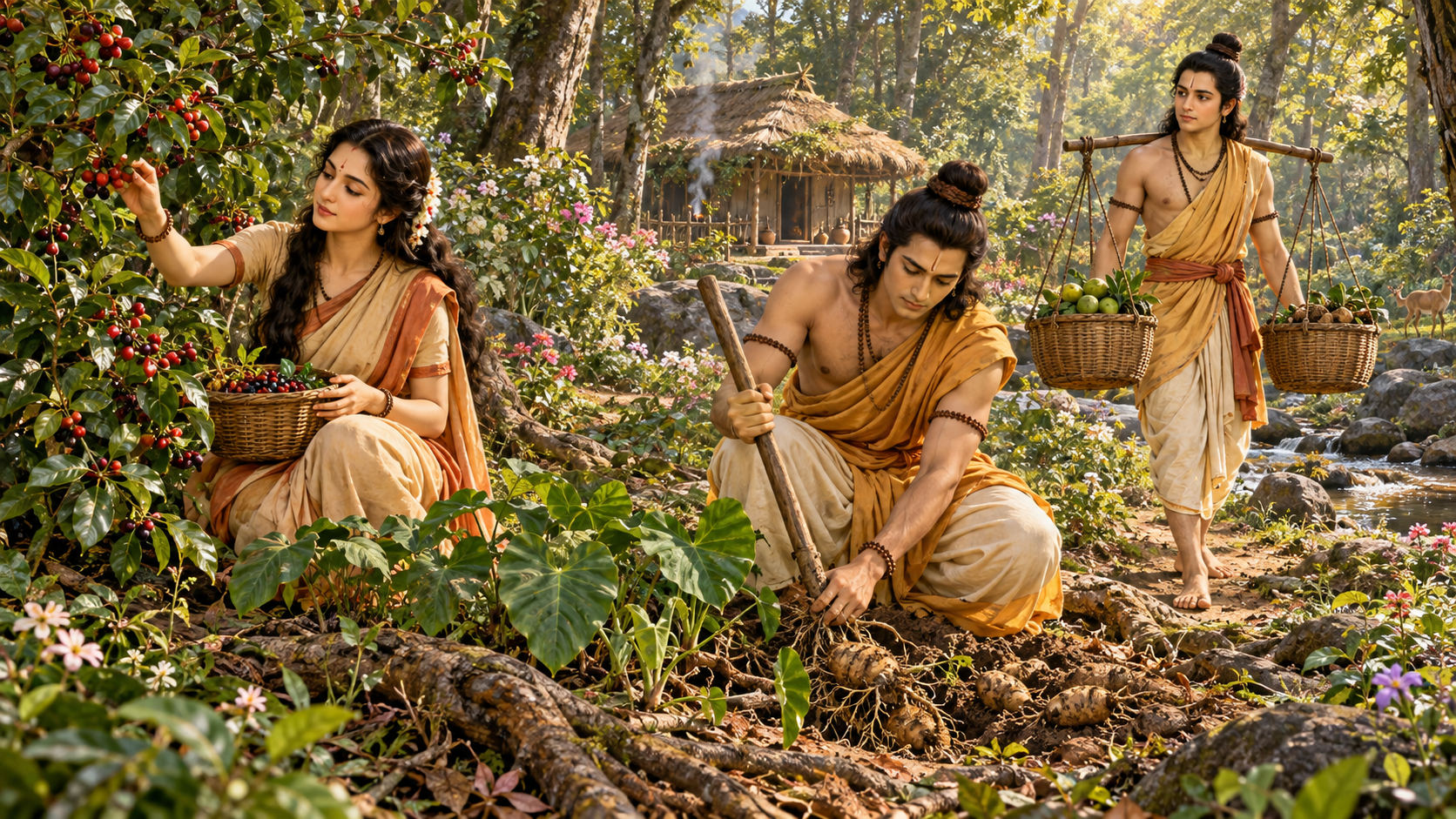
If you discuss these passages only as a debate over permitted ingredients, you miss their moral centre. Rama leaves royal comfort and accepts the conditions of exile because he will honour his father’s command. His food becomes one visible expression of that acceptance.
The comparison with a sage is especially important. “Like a sage” explains the character of the renunciation: simple food, reduced appetite for pleasure, and conduct governed by self-restraint. Roots, tubers, and fruit are not presented as an elaborate alternative cuisine. They belong to a deliberately austere way of living.
This also explains why the dietary statements should not be detached from dharma. Rama does not merely announce a menu. He links forest life, obedience, austerity, and righteous conduct. When you explain his diet, connect those elements instead of treating vegetarianism as an isolated modern identity label.
The English word “vegetarian” remains useful shorthand because the passages describe plant foods and explicit abstention from meat. The Sanskrit wording is nevertheless more concrete than the label: it tells you what Rama would eat, what he would give up, how long the forest life would last, and what kind of discipline it represented.
What the evidence establishes, and where it stops

The verses support a strong claim about Rama’s exile. They do not, by themselves, catalogue every meal from his birth through his reign. That boundary matters because a sound scriptural argument should be no broader than its evidence.
If someone asks, “Was Rama vegetarian?” you can answer plainly: during his fourteen-year forest exile, Shri Rama committed himself to roots, tubers, and fruit, gave up meat in the manner of a sage, and was later described by Hanuman as not eating meat.
If the question changes to “Do these passages prove what he ate at every stage of his life?” the answer must be narrower. These cited lines establish his declared and reported conduct in the forest. A claim about his complete lifelong diet would require evidence covering those other stages as well.
This qualification does not weaken the case. It makes the case harder to dismiss. You are distinguishing a direct statement from an inference, identifying its narrative setting, and refusing to claim more than the cited wording can carry.
Key takeaways for a careful dharmic reading
- Lead with the direct evidence: Hanuman says that Raghava does not eat meat.
- State the period clearly: Rama’s commitment covers the fourteen years of forest exile.
- Name the foods precisely: roots, tubers, and fruit.
- Keep the moral setting intact: the diet belongs to obedience, renunciation, dharma, and sage-like self-restraint.
- Do not turn evidence about exile into an unsupported account of every period of Rama’s life.
- Leave the translation of madhu open where necessary; the separate statement about meat remains clear.
The next time this question arises, ask three things before accepting a sweeping answer: which words are being cited, which period of Rama’s life is being discussed, and whether the conclusion stays within that scope. On those terms, the forest-exile evidence for Rama’s abstention from meat is direct, coherent, and rooted in the larger dharmic meaning of his renunciation.
References

Leave a Reply
You must be logged in to post a comment.